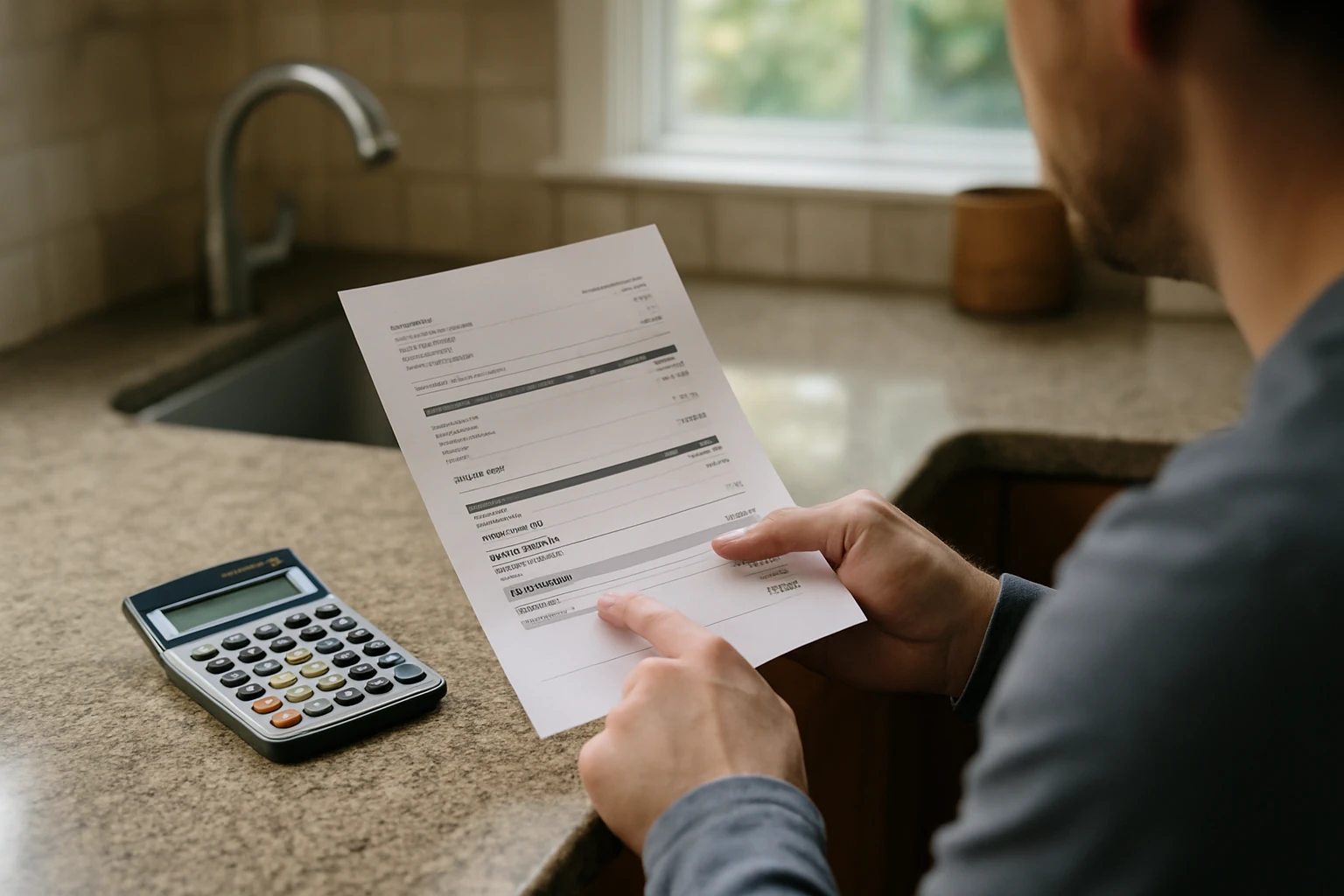
The problem: your bill has a charge even when you used almost no water
You did not water the lawn. You were out of town. The usage on your bill looks tiny. And yet there it is: a water "service charge," "base charge," "customer charge," or "meter charge."
That moment is frustrating because it feels like you are paying for nothing.
You are not paying for "nothing," but you also should not have to guess what the fee means. This guide explains it in plain English and shows you how to sanity-check what you are being charged.
If you want the big picture of how water bills are built (fixed fees + usage + sewer), start with our pillar: Water Service Explained.
Table of contents
The quick answer
A water service charge is a fixed monthly feethat helps pay for keeping your account and connection "ready to serve" even if you use very little water.
It is different from your usage charge (the part based on gallons, CCF, or kgal). It is also different from sewer, which is often calculated using your water usage as a proxy.
If you are trying to lower your bill, the important takeaway is simple: you can usually lower usage, but the fixed fee stays the sameunless your utility allows changes like a smaller meter size.
What a water service charge is (and what it is not)
The fixed fee goes by different names:
- Service charge
- Base charge
- Customer charge
- Meter charge
- Minimum charge (sometimes)
The key idea is not the label. The key idea is what it does: it is not a measurement of water you used.
Your usage is measured separately, usually in gallons or CCF. If you keep seeing "CCF" on your bill and want to translate it into something you can picture, see: what CCF means on a water bill.
What the fixed fee usually covers
Think of the fixed fee as the cost of having an active utility account and a working connection. Even if your usage is low, the system still exists for you.
What it can include varies by city, but these are common:
- Meter costs (the meter itself, testing, replacement)
- Billing and customer service (account setup, statements, payment processing)
- Operations and maintenance (keeping pipes, valves, and pumps working)
- Readiness costs (the system is sized and staffed so water is available when you need it)
Some utilities also include separate fixed fees for things like "fire line," "hydrant," or "infrastructure." Those are still fixed-fee ideas, just broken into multiple lines.
Where to find the service charge on your bill
The service charge usually shows up in the section that looks like a mini-itemized list. Look for a line that:
- Is the same amount each month, or
- Mentions "base," "service," "customer," or "meter," and
- Does not change when your gallons/CCF change
If your bill includes sewer on the same statement, do not be surprised if it looks bigger than the water service charge. Sewer is often a major part of the total. This is the clearest explanation on the site: how sewer charges work.
How to sanity-check the charge
You do not need to be a rates expert to do a basic check. Use this three-step approach:
1) Confirm it is fixed (not usage-based)
Compare two bills: one with higher usage and one with lower usage. If the line item stays the same, it is a fixed fee.
2) Check whether the charge scales with meter size
Many utilities tie the service charge to meter size (for example, 5/8", 3/4", 1"). A larger meter can mean a higher fixed charge.
3) Make sure you are not seeing "two fixed fees" that are actually different
It is common to have more than one fixed-fee-looking line item (water service + sewer base fee, or water base fee + infrastructure fee). If the labels are unclear, look for the section headings that separate "Water\" and \"Sewer."
If your total jumped unexpectedly and you are trying to figure out whether it is usage, a rate change, or something else, this guide is a good next stop: why your water bill suddenly increased.
What you can (and cannot) lower
This is the part most people care about, so let's be direct.
You can usually lower
- Usage charges by reducing gallons/CCF (fix leaks, adjust irrigation, shorten showers)
- Summer spikes by focusing on outdoor use (see our summer guide below)
You usually cannot lower
- The base/service charge without a specific program or account change
Two practical next reads, depending on what you are seeing:
- If you suspect a hidden leak, use your meter as a truth source: water meter leak indicator explained.
- If your bill climbs every summer, the pattern is usually outdoor use + tiered pricing: why water bills are higher in summer.
Common misconceptions
- "The service charge means they estimated my usage."No. Estimated usage is about meter reads. The service charge is a fixed fee.
- "If I used zero water, I should pay zero." It feels fair, but utilities are built around fixed system costs + variable usage costs.
- "The fixed fee is the same everywhere." It is not. Utilities set rates locally, and the names and breakdowns differ.
Next steps if it still feels wrong
If the charge is truly surprising, here are the calm, high-signal checks to make:
- Confirm the account status (active vs vacant vs seasonal). Some cities have special rates for vacant properties.
- Confirm meter size. If the fixed fee is tied to meter size, make sure your record matches what is actually installed.
- Separate water vs sewer. Many "water bills" are really two services on one statement.
You can also browse the rest of the Water pillar for related topics: Water Service Explained.
Frequently asked questions
A water service charge is a fixed fee that helps cover the cost of maintaining the water system and keeping your service connection and account active, even if you use very little water.