Start here: what CCF means on a water bill
If you opened your water bill and saw "CCF," you are not alone. It is one of those utility terms that feels obvious to the utility and totally unclear to everyone else.
Here is the simple definition: CCF means "hundred cubic feet."It is a unit of volume--how much water flowed through your meter during the billing period.
This article gives you a plain-English conversion you can trust, plus a quick way to connect the CCF number to what you actually pay.
If you want the big picture first, start with ourWater Service Explained pillar.
CCF vs cubic feet vs gallons (and why bills use different units)
Utilities measure water in volume. The most common units you'll see are gallons, cubic feet (ft3), and CCF.
- 1 cubic foot = 7.48 gallons
- 1 CCF = 100 cubic feet = 748 gallons
So if your bill says you used 6 CCF, that is about 4,488 gallons ($6 x 748$).
Some cities use kgal (thousand gallons) instead. The important thing is that the unit is just a way to count volume-- it does not change the actual amount of water you used.
Quick conversions you can memorize
If you want a quick mental shortcut, these are the most useful:
| Bill unit | Roughly equals |
|---|---|
| 1 cubic foot | 7.5 gallons |
| 1 CCF | 750 gallons |
| 2 CCF | ?1,500 gallons |
| 10 CCF | ?7,500 gallons |
The goal isn't perfect math. The goal is being able to look at your bill and think, "Is this number in the right ballpark?"
How CCF turns into charges
Once your utility has a usage number, it applies your local rates. That rate structure can be simple or complicated depending on where you live.
Flat-rate pricing
With a flat rate, each CCF costs the same. Your usage charge is basically: CCF x rate.
Tiered pricing
With tiers (block pricing), the first chunk of usage is cheaper and later chunks are more expensive. That can make it look like your "price per unit" changed month to month.
If your bill also includes sewer, your water usage may drive that charge too. Seehow sewer charges workfor the plain-English model.
How to sanity-check your CCF usage
The fastest way to build confidence is to connect three things: (1) your meter, (2) your bill, and (3) what your household is doing.
1) Compare the meter to the bill
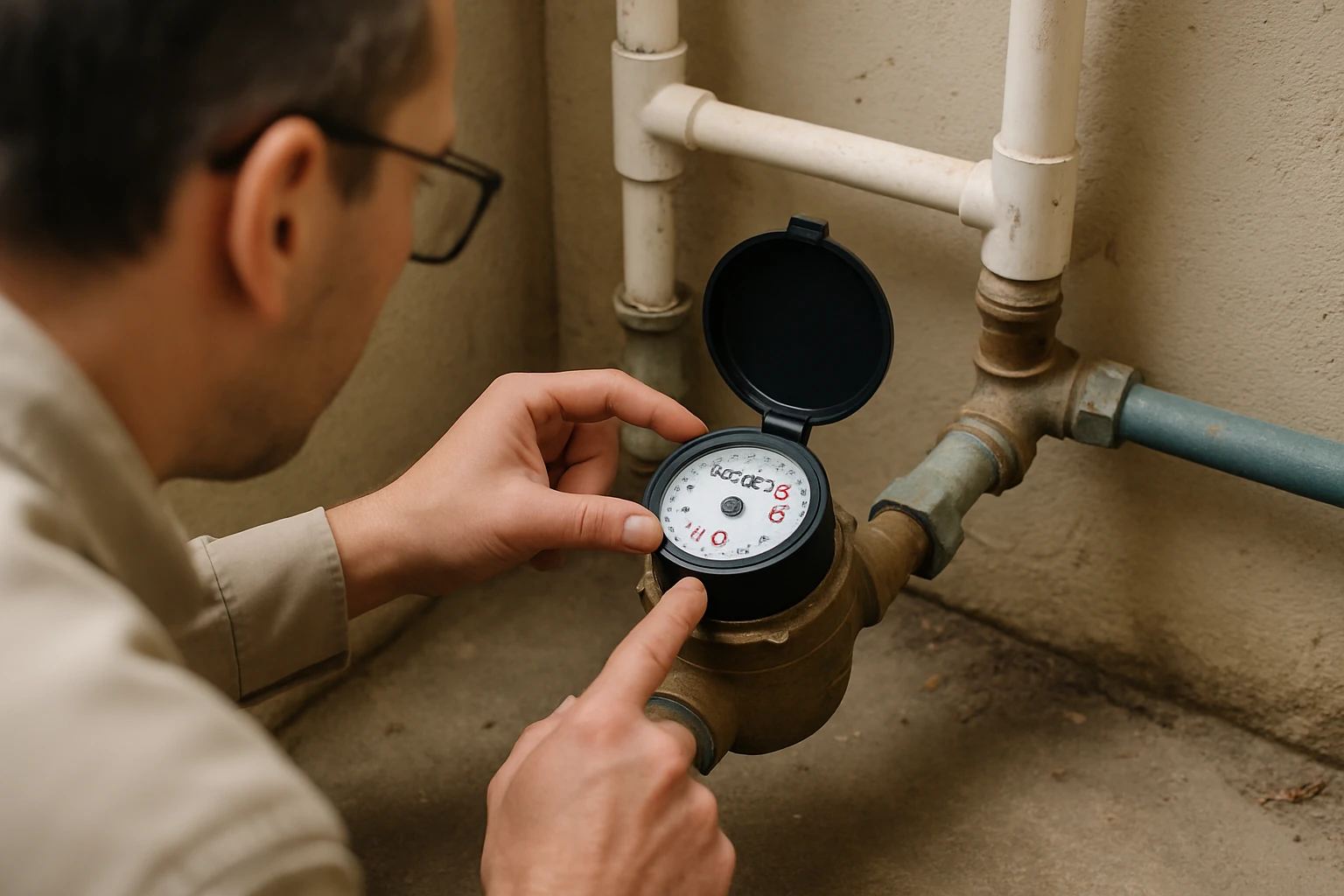
Your bill lists a previous and current meter reading. Subtract to get usage. If you want the step-by-step, seehow to read a water meter.
2) Check whether the jump makes sense
If your usage suddenly spiked, your next step is usually to rule out leaks--especially toilets. Our troubleshooting guide isa simple toilet leak test(it takes minutes).
3) Use "normal" as context (not as a rule)
Households vary, but having a rough benchmark helps. Seeaverage water usage per personfor a practical range.
Common misconceptions about CCF
- "CCF is water pressure." No--pressure is psi. CCF is strictly volume.
- "CCF is a fee." CCF is the measurement. The fee comes from the rate applied to that measurement.
- "The utility is hiding gallons." Usually it's just a standard unit that's convenient for billing.
If you want the broader "why did this jump?" diagnosis, seewhy water bills suddenly increase.
Frequently asked questions
1 CCF (hundred cubic feet) is 100 cubic feet, which is about 748 gallons.