Quick Answer
Sewer bills are almost always higher than water bills because the cost to collect, transport, and chemically treat wastewater to environmental standards is significantly higher than the cost to pump and filter clean water. In cities like Seattle, the 2026 sewer rate is $20.18 per CCF—often double or triple the corresponding water rate—reflecting the massive infrastructure and energy required for sewage processing. While water is a commodity you buy, sewer is a service you pay for, and that service includes maintaining thousands of miles of underground pipes and managing stormwater runoff.
The Fundamental Reason: Treatment vs. Extraction
It is a common shock for new homeowners: you look at your combined utility statement and realize the “Sewer” line item is twice as large as the “Water” line item. It feels counterintuitive—why would getting rid of the water cost more than buying it in the first place?
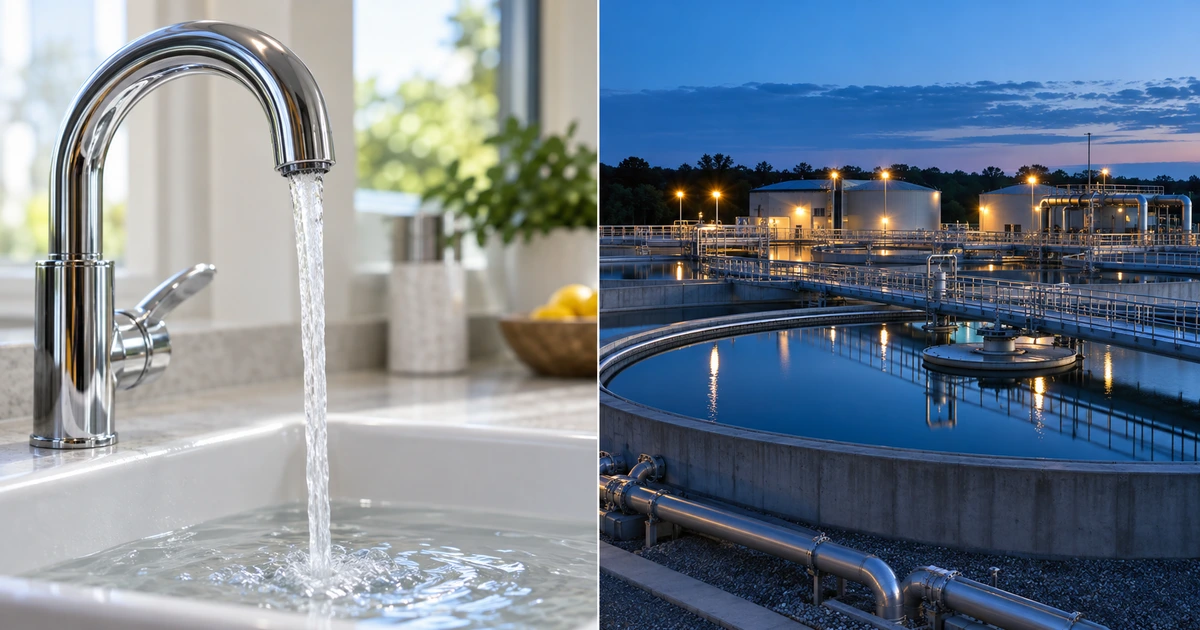
The answer lies in the complexity of the process. To provide you with water, a utility typically draws from a well or reservoir, performs basic filtration and disinfection, and pumps it to your home. To handle your sewage, the utility must maintain a separate, gravity-fed pipe network, operate lift stations to move waste uphill, and run a massive treatment plant that uses biological and chemical processes to remove pathogens and pollutants before the water can be safely returned to the environment.
In Seattle, for example, the verified 2026 sewer rate is $20.18 per CCF (one CCF is 748 gallons).[1] When you compare this to typical water rates, the gap is stark. You aren’t just paying for the volume of liquid; you are paying for the environmental protection required by law. For a deeper look at the specific line items on your statement, see how sewer charges work on your water bill.
How Sewer Bills Are Calculated (The Math)
Most utilities do not have a separate meter for your sewer line. Instead, they assume that most of the water you buy eventually goes down a drain. There are three main ways this is calculated:
1. The 1:1 Volumetric Model
In this simplest (and often most expensive) model, the city assumes 100% of the water that enters your home leaves through the sewer. If you use 10 CCF of water, you are billed for 10 CCF of sewer. Because the sewer unit rate is higher, the sewer portion of the bill will always be the larger number.
2. Winter Averaging
To account for the fact that you might use water for gardening or filling a pool in the summer (water that never enters the sewer), many cities use “winter averaging.” They look at your water usage during the months of December, January, and February—when outdoor watering is at a minimum—and use that average to set a “cap” for your sewer billing for the rest of the year. If you want to know how to optimize this, read our guide on sewer averaging explained.
3. Fixed vs. Volumetric Mix
Some bills include a large fixed “service charge” for sewer that applies regardless of how much water you use. This covers the debt service on the treatment plant and the cost of maintaining the pipes under your street. Even if you are extremely frugal with water, this fixed base rate can keep your sewer bill high.
Worked Example: The Seattle 2026 Scenario
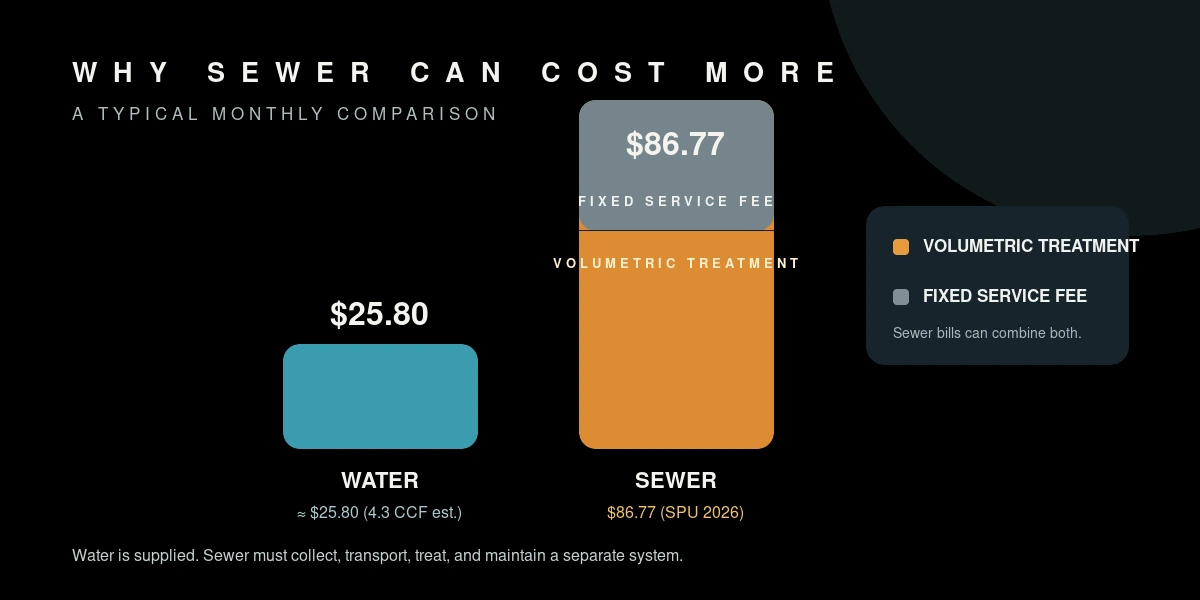
To see how this looks in the real world, we can use verified data from Seattle Public Utilities. The typical residential sewer bill in Seattle is $86.77 per month.[1]
If we use the 2026 rate of $20.18/CCF, we can derive the average billed volume: $86.77 ÷ $20.18 ≈ 4.3 CCF per month
Now, let’s look at the water side. If the water rate were, for example, $6.00/CCF (a common tier for many cities), the water portion of that same usage would be: 4.3 CCF × $6.00 = $25.80
In this scenario, the sewer bill ($86.77) is 3.3 times higher than the water bill ($25.80). This ratio is normal for many high-cost urban areas. If you are confused by the units, our CCF calculator can help you convert these numbers into gallons to better understand your daily usage.
Troubleshooting: Is Your Sewer Bill Too High?
While it is normal for sewer to cost more than water, it is not normal for the ratio to suddenly spike. If your sewer bill has jumped while your water bill stayed flat (or vice versa), you need to investigate.
The “Sewer Multiplier” Effect
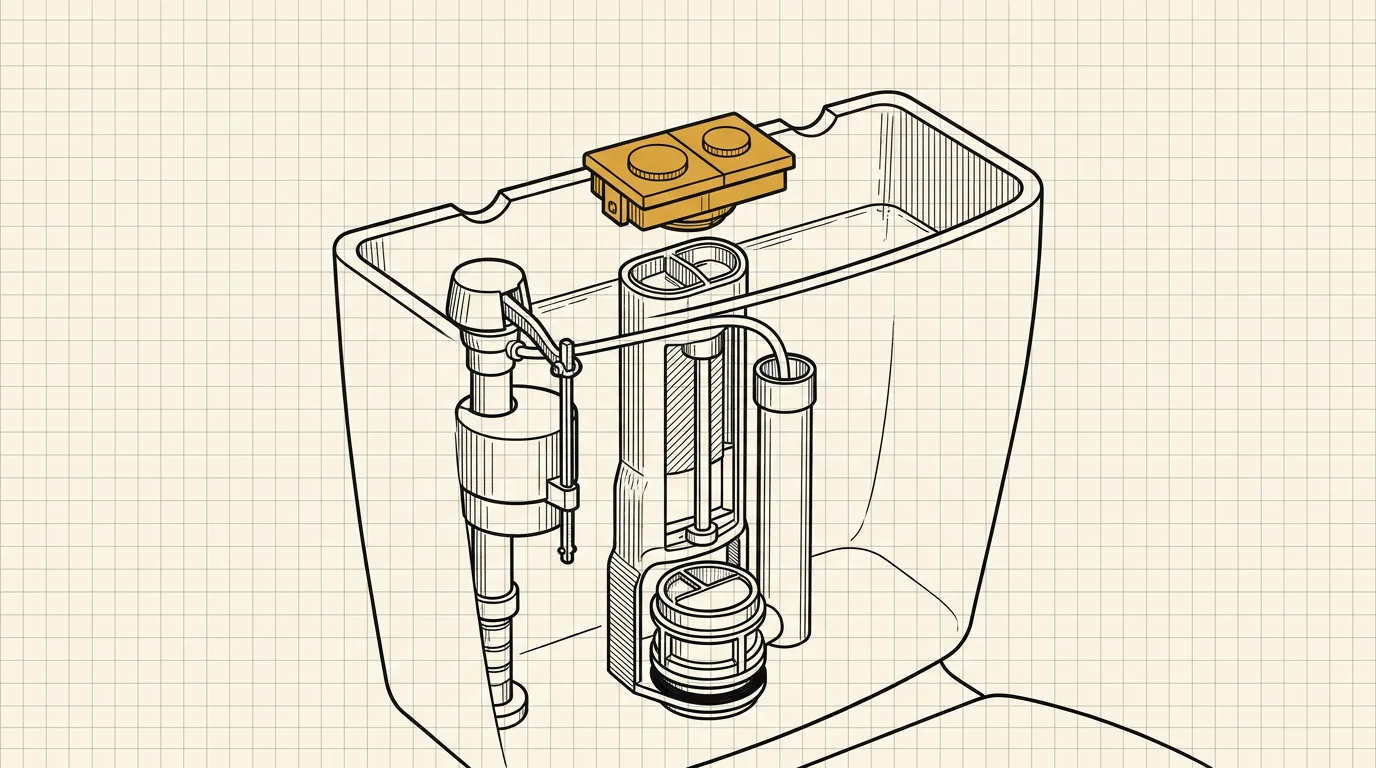
A leak in your home is a double financial hit. If a toilet runs constantly, you pay for the extra water, but you also pay for the extra sewer treatment. Because the sewer rate is so much higher (like the $20.18/CCF vs. a lower water rate), a small leak that adds $10 to your water bill might add $30 to your sewer bill.
The EPA notes that a family of four using more than 12,000 gallons in a winter month likely has a serious leak.[2] At 748 gallons per CCF, that is about 16 CCF. In Seattle, that leak would cost you $322.88 in sewer charges alone (16 CCF × $20.18).
To catch these spikes early, place sensors near the high-risk spots — under toilets, near the water heater, and behind washing machines.
Contact sensors that alarm loudly and phone-alert you the moment water appears — placed under toilets and near the water heater, they catch the leaks that inflate a sewer-based bill for months before anyone notices.
Check price on Amazon Price & availability shown on Amazon.com — we may earn a commission.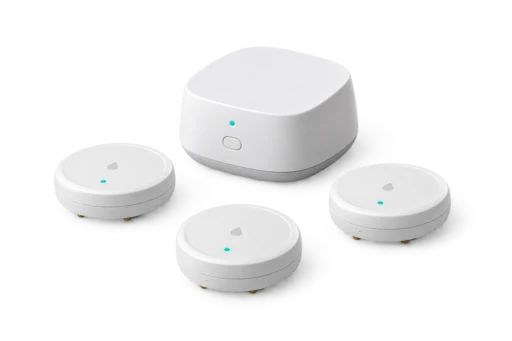
For placement tips, see where to place water leak sensors.
Common Causes for Abnormal Ratios:
- Irrigation without a second meter: If you water a large lawn but don’t have a dedicated “irrigation meter,” the city may be charging you sewer rates for water that is just soaking into the grass.
- Winter Averaging Errors: If you had a leak during the specific months the city used to set your “winter average,” your sewer bill will be artificially high for the entire next year.
- Stormwater Add-ons: Some cities bundle “Stormwater Management” or “Drainage” fees into the sewer line item. This is based on the square footage of “impervious surface” (roof, driveway) on your property, not your water usage.
How to Check and Dispute Your Bill
If the math doesn’t add up, follow these steps:
- Check the Meter: Ensure the “Current Reading” on your bill matches the number on your physical water meter. If water is moving with everything off, the water meter running guide walks through the two-hour all-off test.
- Perform a Dye Test: Put a few drops of food coloring in your toilet tank. If color appears in the bowl without flushing, you have a leak. This is the #1 cause of why a water bill suddenly increased.
- Verify the “Average”: If your city uses winter averaging, check which months they used. If you had a pipe burst in January, you can often dispute the utility bill to have your sewer cap adjusted.
Summary of Costs and Ratios
| Component | Typical Rate (Seattle 2026) | Impact of 1 CCF Leak |
|---|---|---|
| Water | ~$5.00 - $9.00 (Estimated) | ~$7.00 |
| Sewer | $20.18 [1] | $20.18 |
| Total | ~$25.18 - $29.18 | ~$27.18 |
Note: 1 CCF = 748 Gallons. Arithmetic: $20.18 (Sewer) + $7.00 (Est. Water) = $27.18 total per unit of leakage.
Frequently Asked Questions
Why is my sewer bill higher than my water bill in an apartment?
Can I get a separate meter for my garden to lower my sewer bill?
Does a running toilet affect the sewer bill?
For more help navigating your monthly statements, visit our Water Explained hub.
Sources
- [1] Seattle Public Utilities - 2026 Sewer Rates. Verified 2026 sewer rate $20.18/CCF; typical residential bill $86.77/mo.
- [2] EPA WaterSense - Statistics and Facts. Data on household leaks and winter usage thresholds.
- [3] Austin Water - Wastewater Rates and Winter Averaging. Context for volumetric vs. averaged billing.