The short answer most people need
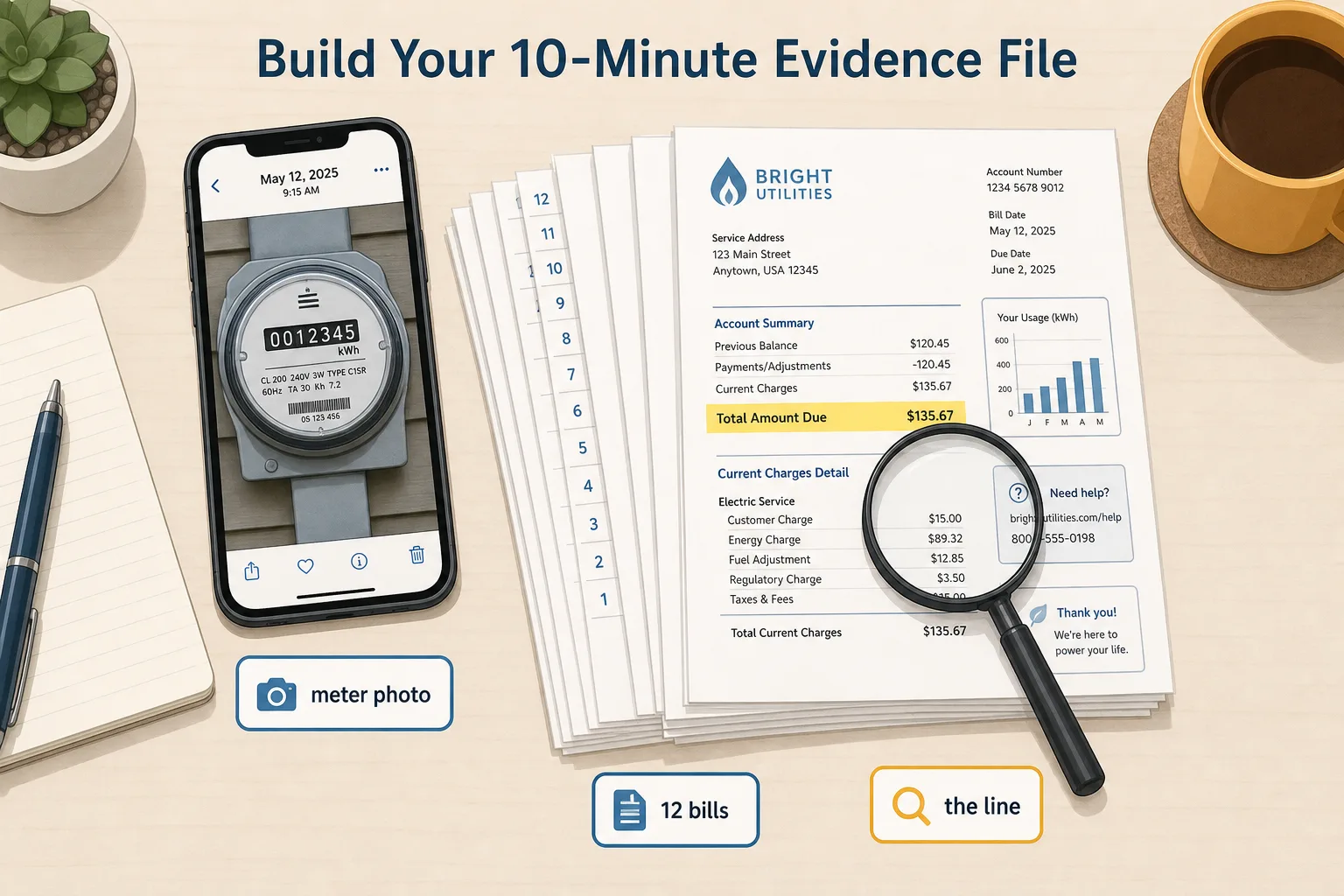
Pull this bill and last month’s, and compare five things in order: billing days, usage (kWh/therms/CCF), price per unit, fixed and one-time charges, and meter-read status (actual vs estimated). One of those five explains almost every “nothing changed” increase — the ranked shortlist below names the five concrete causes and the one-line bill check for each.
You open the bill, see a higher total, and think, "Nothing changed." Almost always, something did change — just not your habits.
If you want the broader map first, start with Utility Bills & Costs Explained. It shows how all the pieces fit together.
Five month-over-month causes, ranked — and how to confirm each from the bill
Check these in order. Four of the five leave your habits completely out of it.
- A longer billing cycle (27–35 days). More days of charges raise the total even when daily use is identical. How to confirm: read the bill-period dates — if the cycle ran long, kWh per day stays flat while the total climbs. Deep dive: Utility Billing Cycle Explained.
- A rate change that took effect mid-cycle. The effective date on the tariff — not your usage — moved the price per unit. How to confirm: compare price per unit between the two bills and scan the line items for a rate-change note.
- Seasonal heating or cooling. Weather shifts HVAC and water use before you feel it. How to confirm: compare kWh or therms per day against the same season last year, not last month. If electricity is the driver: why your electric bill is so high — the full diagnostic.
- An estimated read that just caught up. The estimate underbilled one month; the next actual read corrects for both. How to confirm: look for an "E" or the word "estimated" beside the meter read on either bill. Deep dive: Estimated Utility Bill Explained.
- A new occupant or appliance. New residents, a second refrigerator, or space heaters raise true usage. How to confirm: no rate changes, no estimated read, fixed charges flat — but kWh per day stepped up. The increase is real and belongs to the household, not the bill's math.
The three buckets that change your total
All five causes act through one of three buckets. Your bill is not just usage: it is usage times price, plus fixed charges.
1) Usage (how much you used)
The kWh, therms, or gallons on the bill — causes 1, 3, and 5 land here.
2) Price per unit (what each unit costs)
Rates change on effective dates, and tiered or time-based pricing makes small shifts feel big — cause 2 lands here. For a deeper model, see how rates, fees, and usage work together .
3) Fixed and pass-through charges
Service charges, taxes, and riders. They do not depend on usage and can move a total even in a low-use month.
The billing days trap (28 days vs 33 days)
Utility cycles run 27–35 days, not calendar months — "this month" can simply run longer than last. The total moves even when daily use is similar.
Look for the bill period dates. Then compare usage per day, not just the total. For a deeper explanation, see Utility Billing Cycle Explained.
Estimated reads and catch-up bills
If your meter read was estimated, the bill can swing when the next actual read lands. That correction is not random. It is just catching up.
Check the usage section for an E or the word "estimated." If you see it, the story usually continues in Estimated Utility Bill Explained.
A quick self-check you can do in 5 minutes
- Compare billing days, not just totals.
- Scan for rate or rider changes in the line items.
- Confirm whether the read was estimated.
- Look for fixed charges that stayed the same.
If you want a deeper breakdown of line items, this guide helps: Delivery vs supply charges on utility bills .
Common misconceptions
- "My total went up, so my usage must have doubled." Not always. A longer billing period or a rate change can do it.
- "Fixed charges are small, so they do not matter." They matter most when usage is low.
- "Estimates are mistakes." They are placeholders that often get corrected later.
Continue learning in the main hub: Utility Bills & Costs Explained.
Why did my utility bill go up when my usage looks the same?
How do billing days affect my bill?
What is an estimated read and why does it matter?
Do fixed charges change month to month?
What should I check first when my bill jumps?
Sources
- U.S. Energy Information Administration: Typical residential electricity bills could be slightly higher this summer — illustrates that residential bills can change with use, weather, and retail electricity prices.
Related Reading: