Quick Answer
The standard rule across most US utilities: the utility owns and repairs the pipe from the water main up to (and usually including) your meter; you own everything from the meter’s outlet to and inside your house. A leak before the meter is the utility’s problem and cost; a leak after it is yours — including the stretch of underground service line that runs under your own yard, which surprises most homeowners. If water is still moving through your meter with everything in the house shut off, the leak is almost certainly on your side. How to run that test.
But knowing the rule is the easy half. The hard half is the boundary case — a leak at the meter box itself, a utility that says “not ours” to a pipe you believe is theirs, a bill for water you never used. This page covers the rule, the boundary map, and the escalation path with the evidence to bring. For the diagnosis steps that get you here, start with the leak indicator guide; for what a mystery leak does to the bill, see why water bills suddenly increase.
The boundary map: where “yours” starts
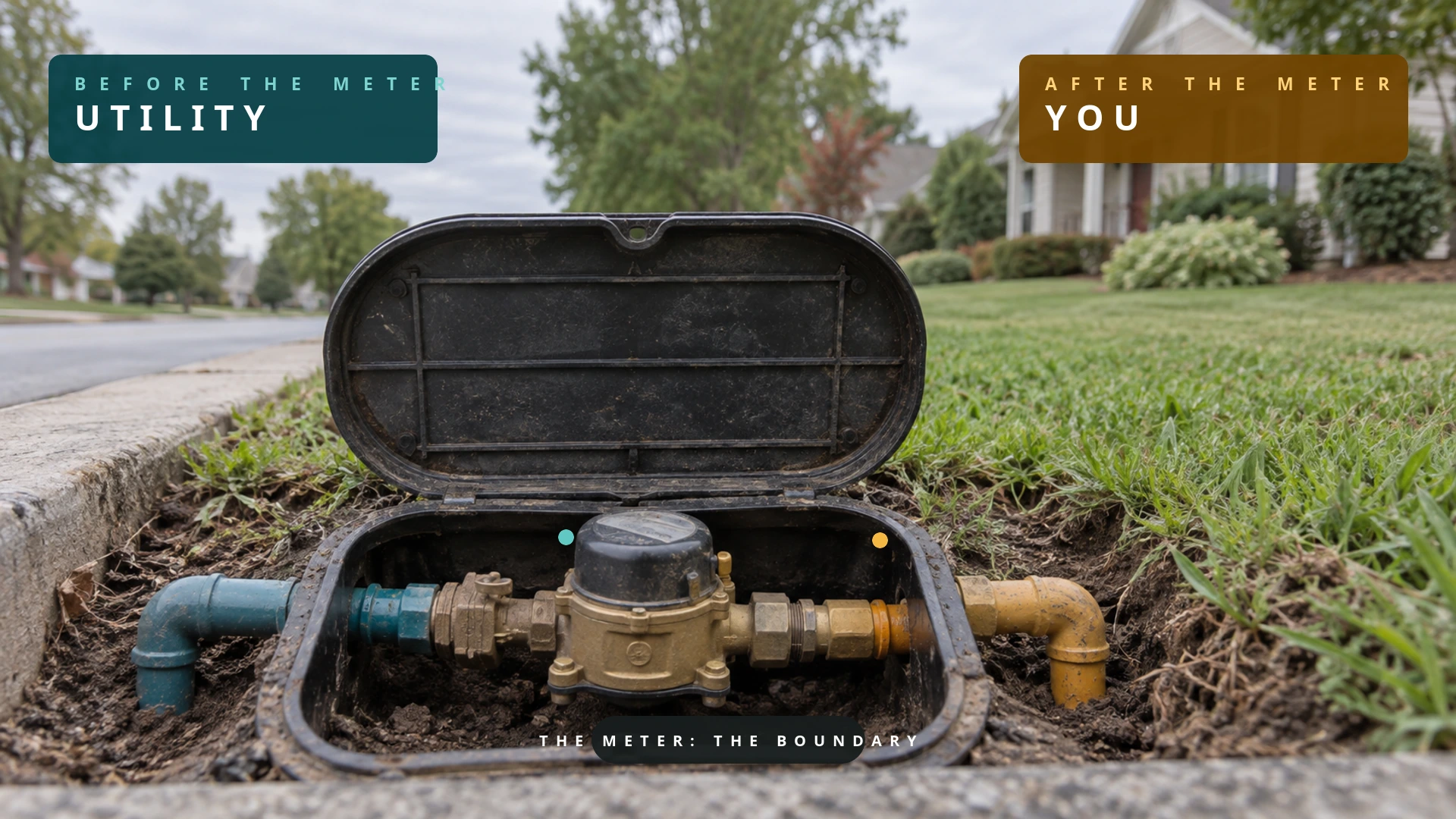
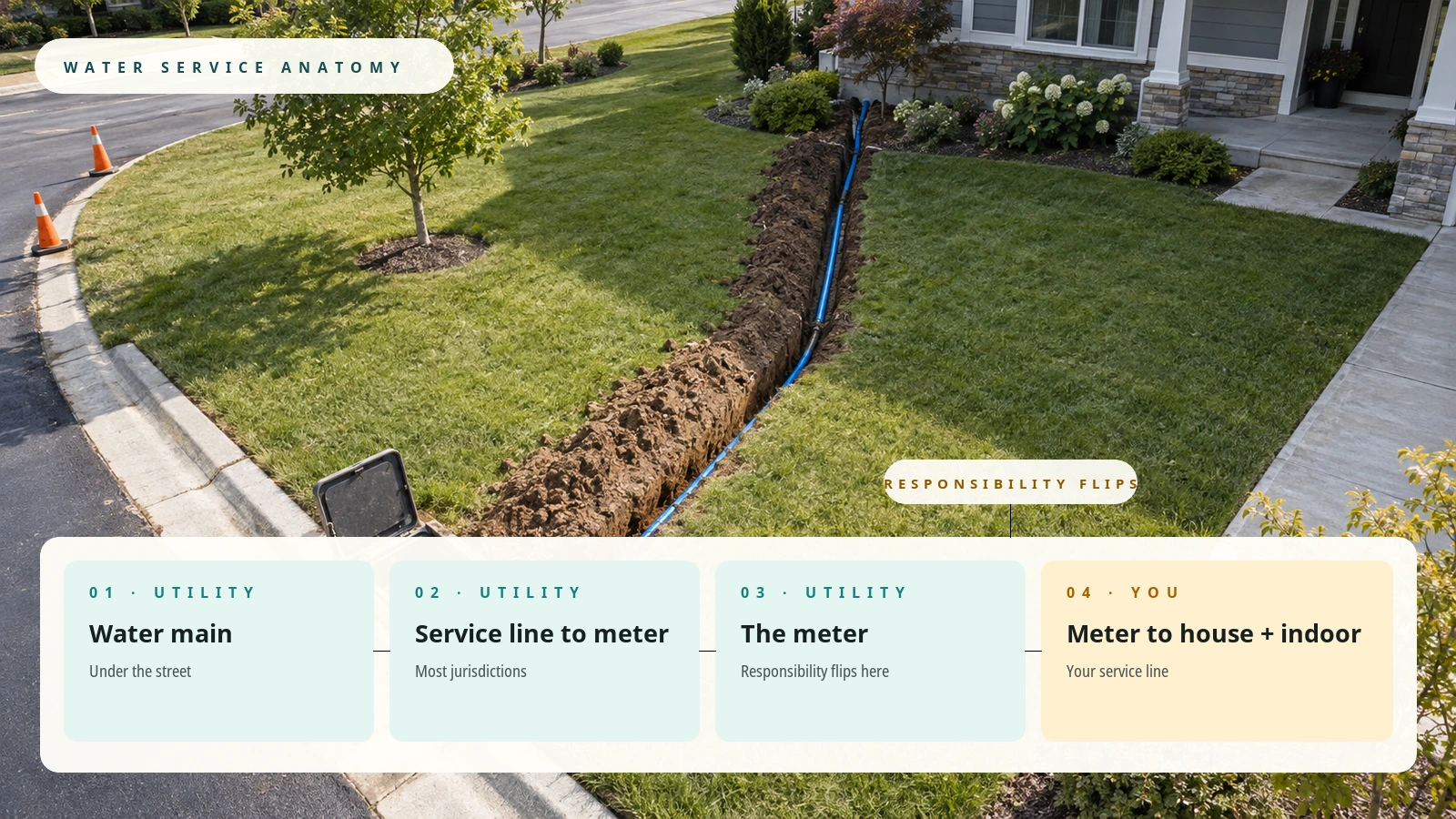
Every property with a municipal water connection has the same four-part anatomy. Responsibility flips exactly once, at the meter:
| Segment | What it is | Who owns/repairs it |
|---|---|---|
| Water main | The utility’s pipe under the street | Utility |
| Connection + service line to the meter | The pipe from the main to your meter box (often at the property line, curb, or easement) | Utility (in most jurisdictions) |
| The meter | The meter body itself and its fittings | Utility |
| Service line from meter to house + all indoor plumbing | The pipe under your yard, into and through your house | You |
Three wrinkles worth knowing before you point a finger:
- “Before the meter” is not the same as “before your property line.” In most jurisdictions the utility’s responsibility ends at the meter, even when the meter sits at the street — meaning the entire yard run is yours. But some utilities own further (to a curb stop valve), and some municipal codes push responsibility back to the property line even without a meter there. The only authoritative answer is your own utility’s service-line policy, usually a one-page document on its website.
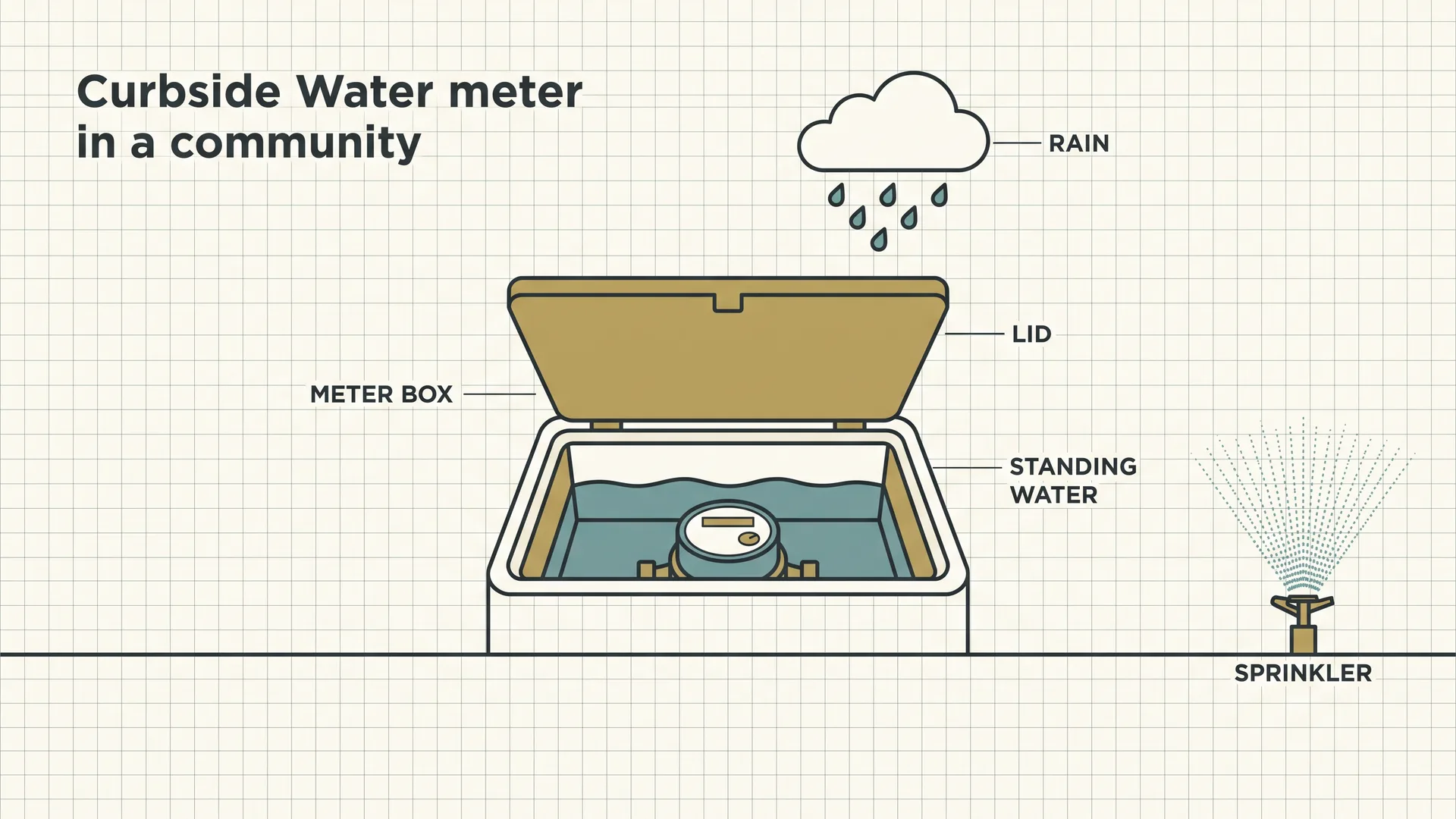
- The meter box itself is a gray zone. The lid, box, and fitting repairs are commonly utility territory even when the surrounding pipe is yours. A meter box standing full of water is often the utility’s maintenance issue, not a plumbing emergency — the full rain-vs-leak decision tree sorts which — but the pipe joints on either side of the meter follow the ownership rule above.
- Private wells and HOA/community systems rewrite everything. With a well, you own all of it. In an HOA or shared system, the bylaws decide. Ask for the service-territory map in writing.
The 10-minute test that settles “which side is it on?”
You rarely need to excavate to know which side of the meter a leak is on. The meter is the boundary and the instrument:
- Shut off your main shutoff valve (usually where the line enters the house, or at the meter box if there’s a customer-side valve).
- Watch the meter’s leak indicator or register dial. If it keeps moving with your side isolated, water is flowing between the main and your shutoff — the utility side of your isolation point. How to find the leak indicator.
- Reverse it: house valve open, all fixtures off, meter still moving — the flow is inside or under your house.
- Photo everything: the meter reading, the moving indicator, the valve position, the wet spot or box condition. Timestamped photos are your entire case file if the boundary is disputed later.
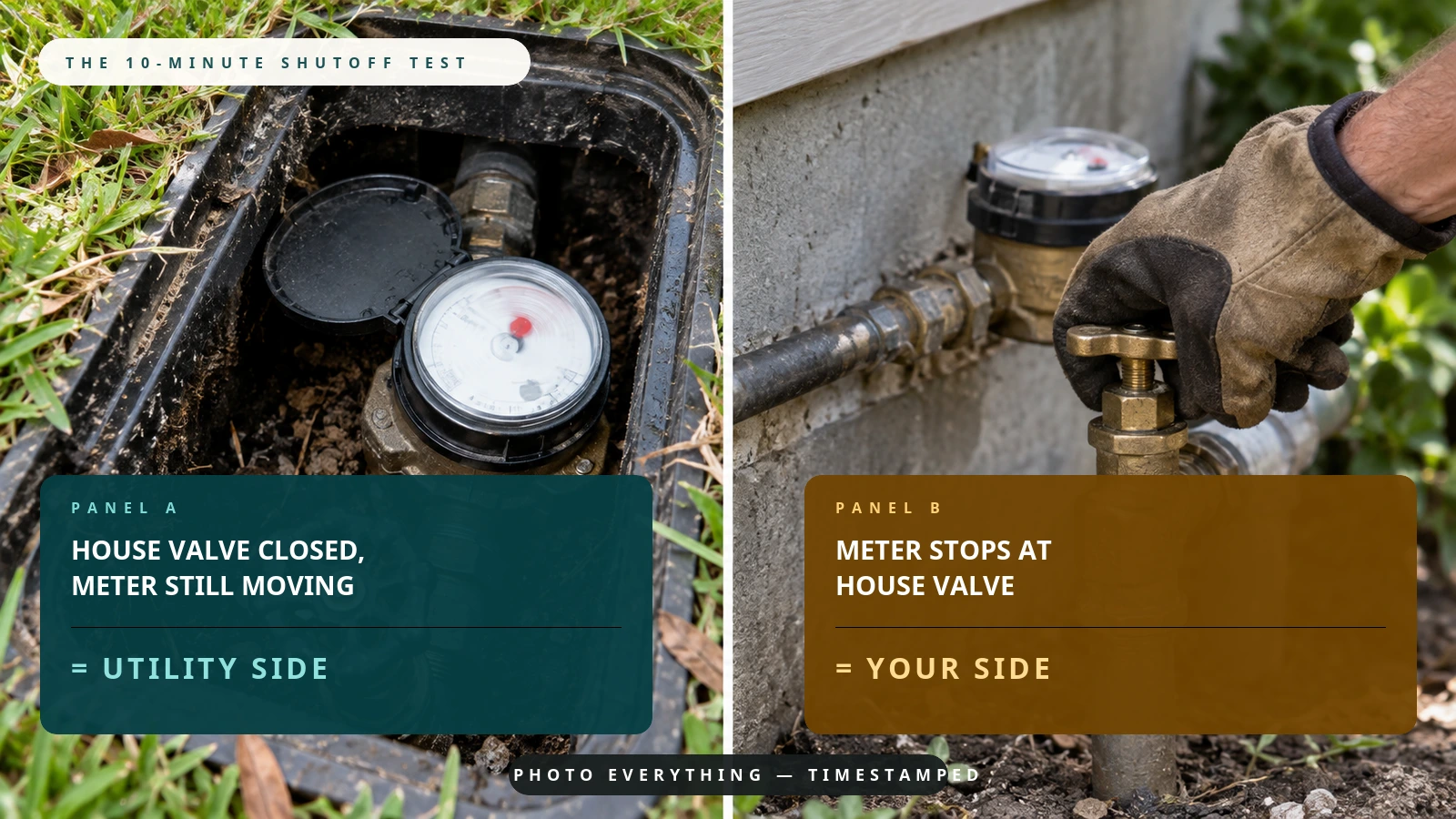
If the meter stops the moment you close your house valve, the mystery flow is on your side of that valve — under the yard or in the house. That’s when the meter-vs-main-valve isolation walkthrough narrows it further, and when you start collecting plumber quotes rather than utility claims.
What “yours” costs when it’s the underground service line
The bill homeowners don’t see coming: the yard run of pipe is your responsibility even though it’s buried under ground you might think of as the utility’s corridor. When it leaks or freezes:
- Typical repair cost: professional main-line repair averages around $990, with most projects between $350 and $1,665 depending on depth, length, and whether the line is copper, galvanized, or plastic; plumber labor runs $75–150/hour. [4][5]
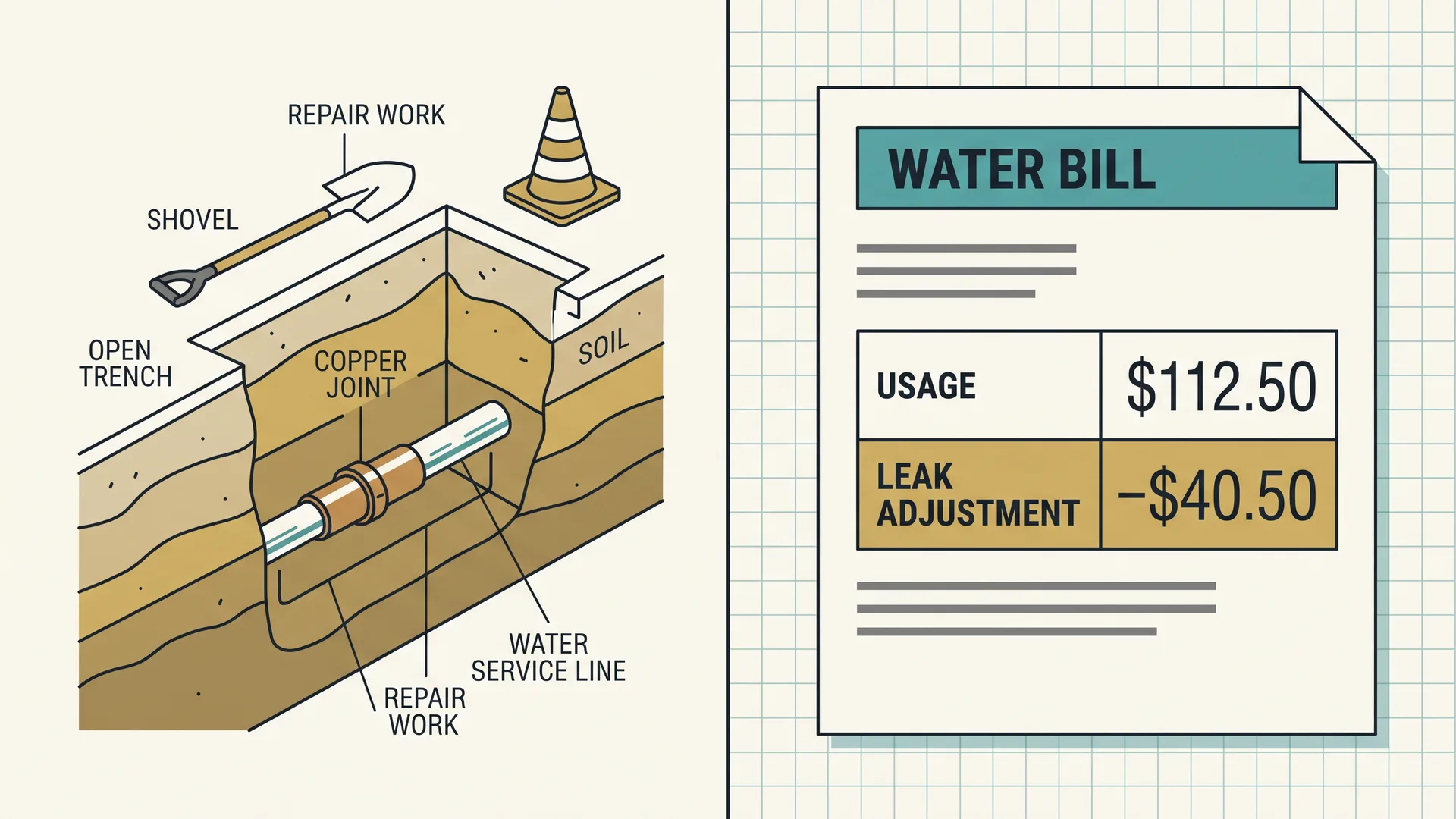
- Excavation is the cost driver. The pipe is cheap; the digging and restoration are not. Trenchless options exist in some cities but are not universal.
- Homeowners insurance usually does not cover the line itself. Standard policies typically exclude service-line repair; some insurers sell it as a cheap add-on rider. If you have a long yard run of aging pipe, that rider is worth a phone call — ideally before the leak, not after. [6]
- Sewer laterals are a separate but parallel trap. The same before/after logic applies to the sewer side, with the same insurance exclusion. How sewer charges work explains which side of that bill you can influence.

When the utility says “not ours” — the escalation path
Utilities state their own rule, and their frontline answer is not always the last word — especially when the leak sits in the boundary’s gray zones. The differentiation gap this page exists to fill:
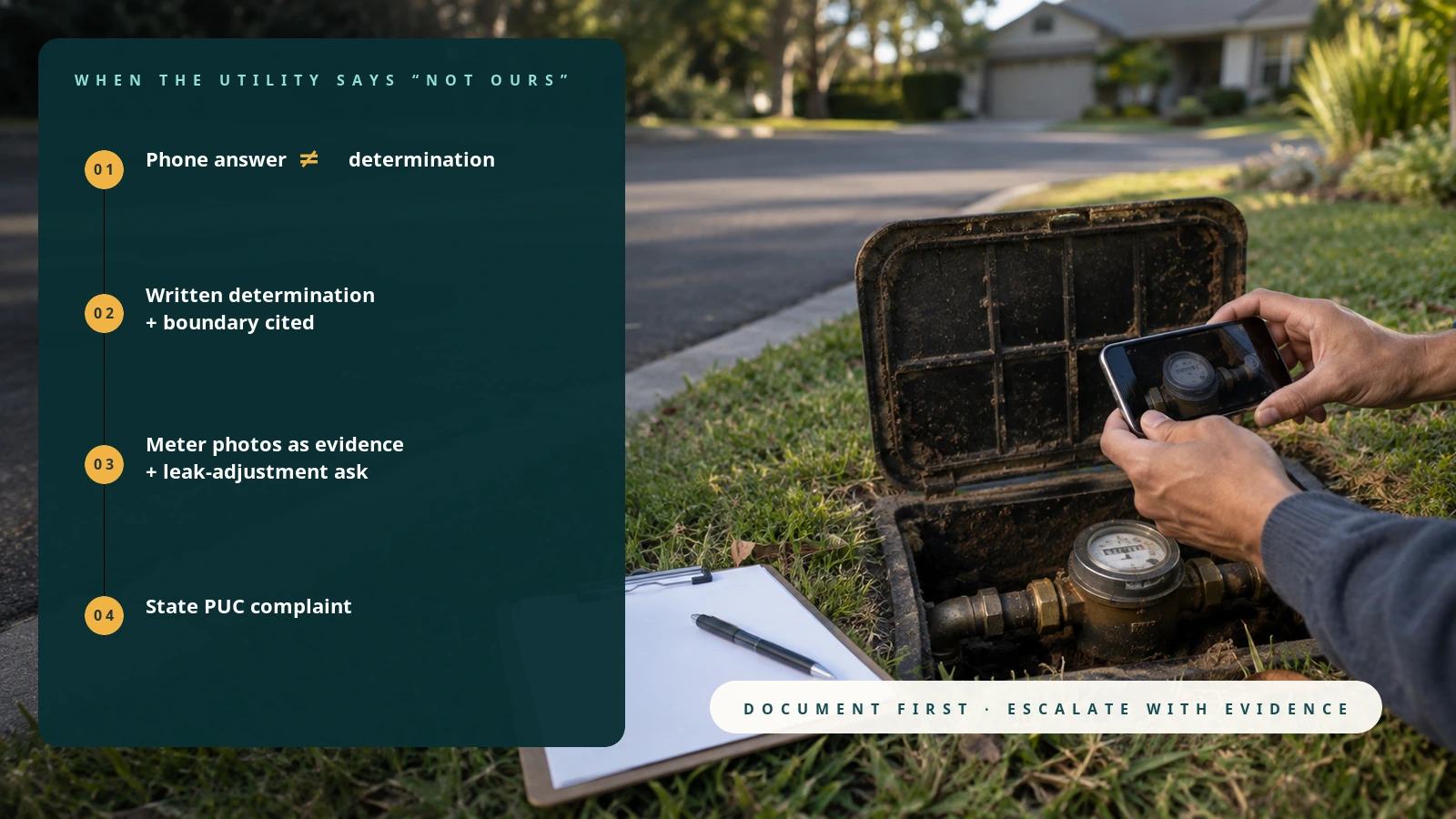
- Ask for the determination in writing, with the boundary cited. “Customer-side” on the phone is not a determination; a written reference to the tap or meter point is. Most utilities have a field supervisor who makes formal boundary calls.
- Present your meter evidence, not your opinion. The timestamped photos from the 10-minute test show exactly where flow was isolated. If the meter was replaced or re-read recently, note it — meter work is sometimes the cause of fitting leaks that appear days later.
- Ask about leak-adjustment policy. Many utilities will credit part of the bill for water lost through an underground leak you repaired — typically one billing period’s excess over your average, once, after proof of repair. This is the money conversation, and it’s separate from who fixes the pipe. (The full letter-template process.)
- State PUC/public-works complaint is the backstop if the utility refuses to engage: most states let you file without a lawyer, and the threat of a regulator reading the file often unblocks a stalled determination.
Season’s warning: the freeze months are when this page matters most
Service-line breaks cluster in the freeze months — deep-january cold snaps, thaw cycles, and the first hard freeze after a dry autumn. If you’re reading this in fall: the cheapest preparation is knowing where your meter, curb stop, and house shutoff are, that they turn, and where your boundary sits on the utility’s map. A meter-mounted flow monitor catches a slow underground leak weeks before the bill does — and weeks before the burst.
Related Reading
- Water meter running when no water is used — the isolation walkthrough that tells you which side you’re on.
- Water meter leak indicator explained — find and read the small dial that never lies.
- How to read a water meter — the register, the units, and the two-reading usage check.
- Why did my water bill suddenly increase? — the bill-side diagnosis this page’s boundary rule feeds into.
- Point sensor vs whole-home water monitor — what to buy if you want the leak found before the bill.
Is the water meter itself my responsibility?
What if the leak is exactly at the meter box?
Does homeowners insurance cover a leaking service line under my yard?
Can I get the water bill credited for a leak I repaired?
Who do I call first — utility or plumber?
The Boundary Is Documentable
The rule is simple; the disputes are not. The homeowners who win boundary calls are the ones who arrive with timestamped meter photos, a written determination request, and the utility’s own service-line policy printed out. Ten minutes of documentation beats an hour of phone tag — and the meter, which belongs to the utility, is the instrument that usually settles the case in your favor.
Where to go next: run the shutoff test today and photograph the meter state; if it’s your side, isolate the source and collect quotes; if it’s theirs or ambiguous, request the written boundary determination and ask about the leak-adjustment policy in the same call.
This page is part of the Water hub; terms are defined in the utility glossary.
Sources
- EPA WaterSense — Leak Detection and Flow Monitoring Devices — consumer guidance on detection devices, retrieved September 27, 2026.
- Home Water Works — Water Leaks: Checks and Repairs — the standard before/after-meter responsibility split, retrieved September 27, 2026.
- San Antonio Water System — Leak resources — utility-side example of a formalized leak/adjustment process, retrieved September 27, 2026.
- Angi — How Much Does It Cost to Repair a Main Water Line — repair cost averages ($990; $350–1,665 range), retrieved September 27, 2026.
- HomeGuide — Main Water Line Repair Cost — plumber labor rates $75–150/hour, retrieved September 27, 2026.
- SageSure — Who Pays to Repair a Water Service Line Break? — insurance exclusion for service lines, retrieved September 27, 2026.