Rate basis: U.S. EIA national averages through October 2026
Quick Answer
Set the thermostat to 68°F while you’re awake and at home, and 7-10°F lower — 58-61°F — for the eight hours you sleep and any stretch nobody’s home. That single pattern is worth roughly 10% off your heating bill under the Department of Energy’s long-standing rule of thumb (about 1% per degree of setback held for 8 hours). For vacations or an empty house in a hard-freeze climate, the floor is 55°F — low enough to save, high enough to keep pipes safe, per the American Red Cross’s frozen-pipe guidance. The one big exception: heat pumps should use milder 2-4°F setbacks or a smart thermostat’s staged recovery, because a deep recovery can trigger expensive auxiliary heat.
If you’re choosing hardware to automate this, that’s our smart thermostat comparison; this page is the free part — what the schedule should actually say.
The Two Numbers That Matter
Everything in winter thermostat strategy reduces to two settings and a discipline:
- 68°F occupied. Not a magic constant — it’s the balance point most households find comfortable in sweaters-and-slippers clothing. If 66°F works for you, you save a bit more; if the household genuinely needs 71°F, that costs a bit more. The bill difference between 68°F and 70°F held all winter is real but modest (rule of thumb: ~2-3% of heating per 2°F); the BIG money is in the setback hours, not the occupied setpoint.
- 7-10°F lower for 8 hours. Overnight while sleeping (blankets do the compensating) and during the workday in an empty house. This is where the ~10% lives, and it’s the setting most households never program.
Why the Setback Saves (It’s Not “Reheat Eats the Savings”)
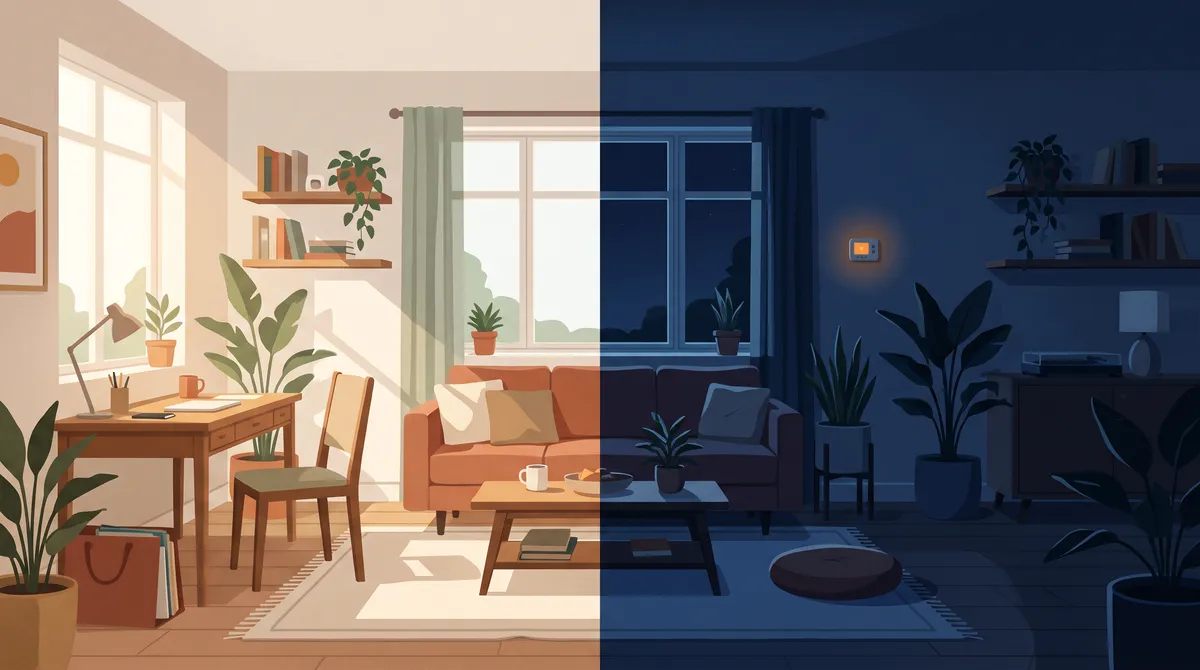
The persistent myth: “the furnace works so hard warming the house back up that you save nothing.” It’s false for a physical reason worth 30 seconds: heat loss from your house is proportional to the indoor-outdoor temperature difference. Drop the inside from 68°F to 58°F on a 28°F night and the rate of heat loss drops by a quarter for those hours. The house genuinely banking less lost heat IS the savings; the morning recovery burns extra fuel for 30-45 minutes, but it’s buying back a fraction of what the setback hours banked. Net: positive, reliably.
The DOE’s rule of thumb — roughly 1% of heating energy per degree of setback per 8 hours — has survived decades of field testing. Manufacturer studies land in the same neighborhood: Nest’s own published averages run around 10-12% on heating for homes that adopted schedules (manufacturer-reported; our smart thermostat comparison quotes the claim wording precisely).
The Exception That Pays for a Smart Thermostat: Heat Pumps
If you heat with a heat pump, deep setbacks can backfire, and this is the single most expensive thermostat mistake of the season. The physics: below a certain outdoor temperature the compressor alone can’t recover a 10°F drop quickly, so the system calls in auxiliary electric resistance strips — heat at one-half to one-third the compressor’s efficiency. A deep setback that pays back $2 overnight can trigger a $1.50 aux blast every morning recovering it. Marginal becomes losing.
ENERGY STAR certified with smart recovery — it finishes the morning warm-up (instead of starting it) at wake time, on the cheapest hours it can find. The mid-tier pick from our four-way comparison: enough automation to hold the 68°F-when-home, 58-61°F-asleep pattern without anyone remembering it.
Check price on Amazon As an Amazon Associate we earn from qualifying purchases. Price & availability shown on Amazon.com.The right pattern on a heat pump:
- Mild setbacks — 2-4°F — for sleep and away periods.
- Or let a smart thermostat stage the recovery: modern units start the warm-up early and slow, finishing on the compressor alone. This is the #1 heat-pump-specific reason to upgrade hardware; the thermostat tier comparison flags which models handle it well.
- Never use “Emergency Heat” for warming the house faster — that’s a maintenance mode, not a turbo button. The full explanation is in aux heat vs. emergency heat, and a heat pump that runs aux constantly all winter is usually a bill problem with a specific fix.
The Full Settings Table
| Situation | Setpoint | Why |
|---|---|---|
| Home, awake (day/evening) | 68°F | Comfort baseline in winter clothing |
| Home, asleep | 60-62°F | Blankets compensate; full 8-hour setback window |
| Away at work (empty house) | 58-61°F | Same math as overnight; nobody’s comfort to protect |
| Away for the weekend+ | 60°F | Recovery on return; pipes not a concern yet |
| Vacation / vacant in freeze climate | 55°F floor | Red Cross frozen-pipe guidance: don’t go lower than 55°F while away in winter — this protects plumbing, and it’s also why our frozen-pipes ladder says “same temperature day and night” during extreme events |
| Someone home all day (infants, night shifts, remote work) | 68°F held | A held comfortable temp beats griefing a schedule — program the setback into the hours that ARE empty |
| Heat pump (any of the above) | Setback only 2-4°F, or staged recovery | Avoid aux-strip recovery; see above |
Special populations: infants’ rooms are often recommended slightly warmer than the hallway (around 68-72°F for sleep safety), and elderly or medically sensitive households should treat 68°F as a floor, not a target. No energy saving is worth a hypothermia risk — the setback pattern presumes blankets and healthy adults.
Making It Automatic (So February Doesn’t Erase January)
The failure mode of every manual setback plan is the third week of January, when someone gets cold at 9pm, bumps it to 72°F, and the bump stays until March. Two fixes:
ENERGY STAR certified with smart recovery — it finishes the morning warm-up (instead of starting it) at wake time, on the cheapest hours it can find. The mid-tier pick from our four-way comparison: enough automation to hold the 68°F-when-home, 58-61°F-asleep pattern without anyone remembering it.
Check price on Amazon Price & availability shown on Amazon.com — we may earn a commission.- A $0 fix: build the habit around two moments — the setback at bedtime, the recovery 30 minutes before wake. Two taps a day. If the household can hold that, the savings are identical to any smart thermostat’s.
- Hardware: a programmable or smart thermostat executes it without you. The evidence on whether the smart tier out-saves a faithfully-run $40 programmable is genuinely mixed — we walk through it in do programmable thermostats cut heating bills? — but self-learning schedules demonstrably rescue the households that abandon manual programs by midwinter. The four-way comparison prices those rescue features honestly.
Rate-plan bonus: if your utility bills by time of day, the same hardware shifts consumption to cheap hours — the pattern is in smart thermostat time-of-use savings.
Special Cases Worth Knowing
Recovery timing. A thermostat that starts recovery at 6:00am for a 6:30 wake time runs the system at max exactly when the house is coldest (pre-dawn). Smart thermostats back-calculate the start time so the warmup finishes — not starts — at wake time. Manual schedules should do the same: set recovery 30-45 minutes before you need warmth, not at the moment you need it.
Zoned homes and one cold room. If the schedule serves the hallway thermostat but the bedroom runs cold, the fix is a remote sensor (ecobee/Nest both include one in their premium tiers — see the comparison table), not a whole-house setpoint bumped for one room’s sake. And a genuinely cold room often has a draft to fix first: how to find and seal drafts.
“Same temperature day and night” during a polar vortex. When the forecast is a hard multi-day freeze, the Red Cross guidance shifts: hold a steady temperature around the clock (and open sink-cabinet doors on exterior walls). The pipe-protection value outranks the setback savings for those few days — the full ranked list is in how to keep pipes from freezing.
What Each Degree Actually Costs (and Saves)
The occupied setpoint conversation deserves real numbers, because “turn it down two degrees” is advice without a price tag until you attach one. Using the same rule of thumb — about 1% of heating energy per degree, sustained — applied to a $150/month winter heating bill:
| Change | Monthly effect | Season (5 months) |
|---|---|---|
| Hold 70°F instead of 68°F | +$2-3 | +$10-15 |
| Hold 66°F instead of 68°F | -$2-3 | -$10-15 |
| Add overnight 10°F setback (from none) | -$12-15 | -$60-75 |
| Add workday setback for empty house too | another -$8-12 | another -$40-60 |
The pattern is unambiguous: the occupied setpoint is fine-tuning; the setbacks are the instrument panel. A household that holds 70°F around the clock spends more than one at 68°F with disciplined setbacks — by a factor of three or four on the difference.
The humidity footnote (why 68°F feels different in January than October): drier air makes skin feel cooler at the same temperature, which is why the same 68°F that was fine in autumn feels thin in deep winter — the air is drier because cold outdoor air carries less moisture indoors when heated. Adding humidity doesn’t change the thermometer, but it changes comfort at a given setpoint. We frame this honestly per our editorial standard on climate devices: a humidifier is a comfort purchase with climate-dependent results, not a heating-bill fix — but if it lets you hold 66°F comfortably instead of bumping to 69°F in January, it has paid its keep. Pets in the “what about the dog all day” question: healthy adult dogs and cats are comfortable well below human preferences — the 58-61°F away setpoint is fine; very young, old, or short-coated animals are the exceptions worth a floor of ~64°F.
Frequently Asked Questions
What is the best temperature to set your thermostat in winter?
Is it cheaper to leave the thermostat at one temperature all the time?
What temperature should I set when on vacation in winter?
Does thermostat setback work with a heat pump?
How many degrees should I turn the thermostat down at night?
Does lowering the thermostat really save that much money?
Does turning the thermostat way down hurt the furnace?
Related: the smart thermostat tier comparison, why is my heating bill so high, and is it cheaper to heat one room instead of the whole house.
Sources
- U.S. Department of Energy — Home Upgrades / thermostat savings — the ~1% per degree (8h) setback rule of thumb.
- ENERGY STAR — Smart Thermostats — smart scheduling and savings framing.
- Building America Solution Center — Thermostats and Heat Pumps — heat-pump setback and auxiliary-heat interaction.
- American Red Cross — Preventing and Thawing Frozen Pipes — the 55°F vacation floor and steady-temperature-during-hard-freeze guidance.
- U.S. EIA — Natural Gas Weekly — heating-season price context.