Quick Answer
Standing water in a water meter box is common and usually harmless — rain and irrigation runoff account for most wet meter boxes, and the water normally drains or seeps into the soil within a day or two of a storm. [1] The 2-minute check that separates weather from a leak: dry spells and sprinkler schedules aside, look at the meter’s low-flow indicator (the small spinning dial). Spinning with everything in your house shut off points to a leak on your side of the meter. Not spinning, but the box keeps refilling or the water stays consistently high for days — that points to the utility’s side, and that call is theirs to answer, at their cost. [1]
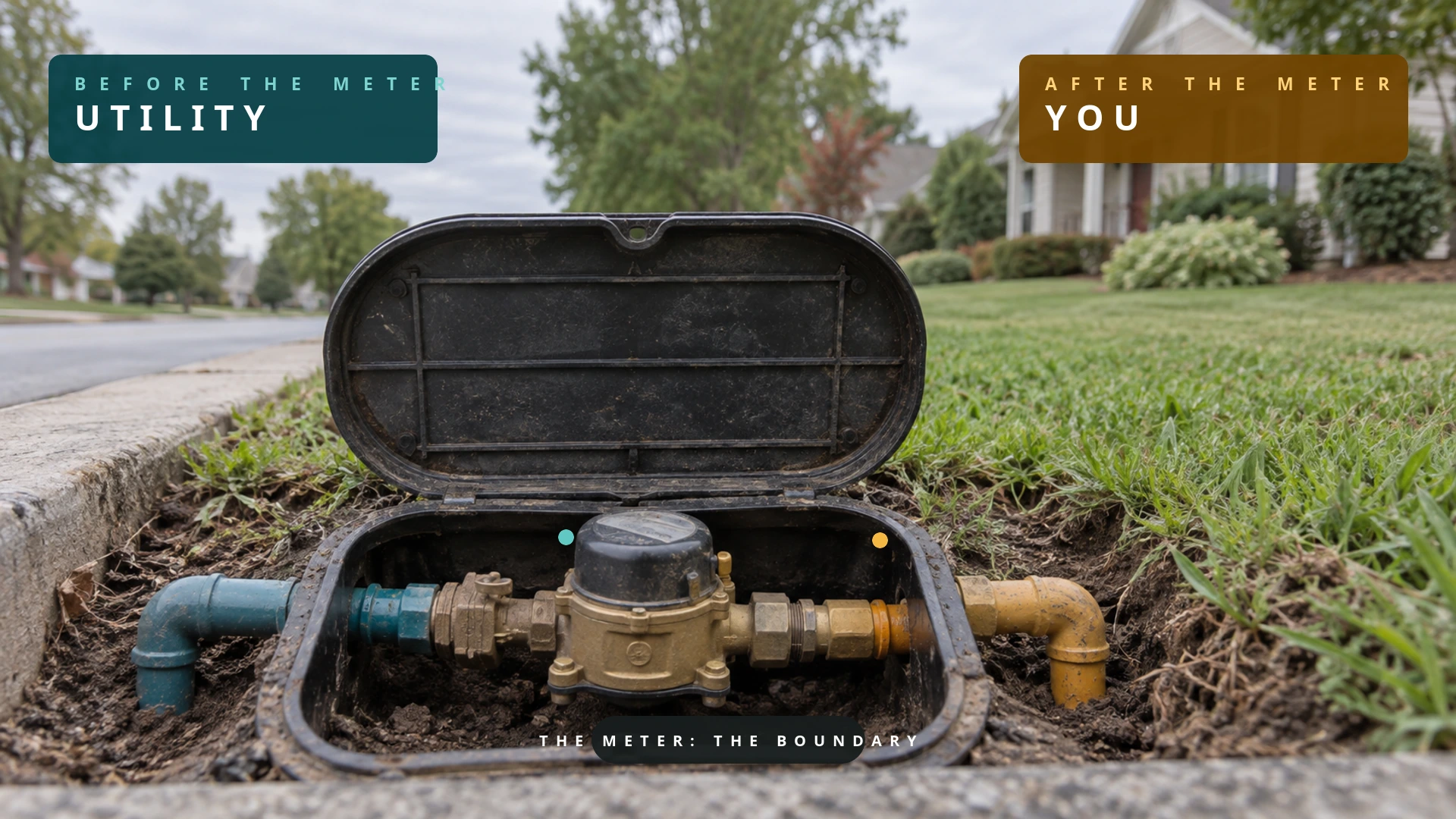
This page is the decision tree: rain vs. refill, the indicator test, and who to call tonight. For the deeper diagnostics this tree routes into — why the meter runs when no water is used and how to read the leak indicator — follow those next; for who pays for which side of the pipe, the before-vs-after-the-meter responsibility guide has the boundary map.
The 2-minute diagnostic: rain, refill, or leak
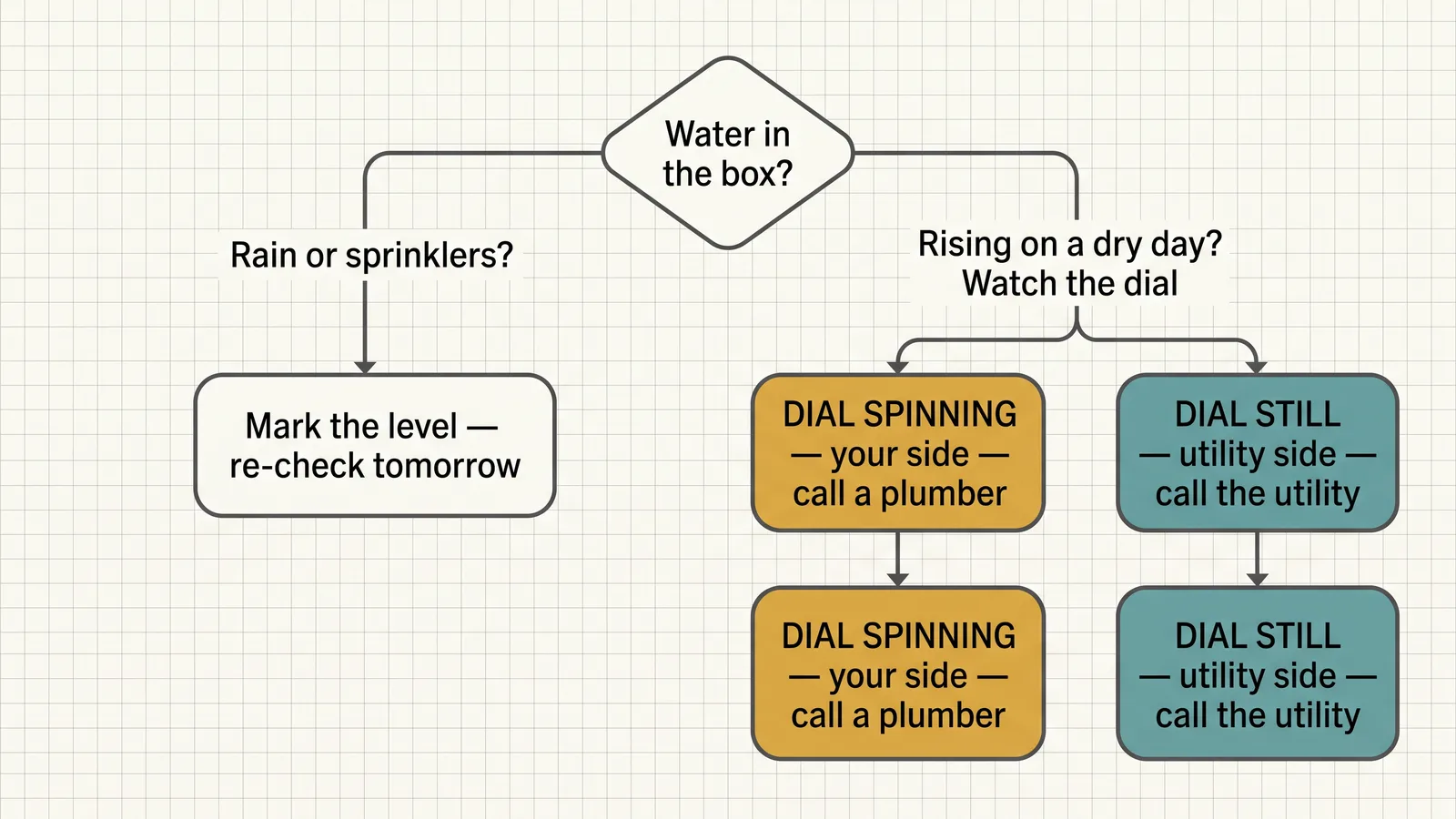
Work top to bottom; stop at the first yes.
- Did it rain in the last 1–3 days, or are sprinklers running near the box? Most standing water in meter boxes is rain runoff entering through the lid, or irrigation overspray pooling in a box that sits in a low spot. Mark the water level (a stone on the meter cap, or photograph it) and re-check tomorrow — rain water drains or seeps away on its own. [1][2]
- Is the water level rising, or staying flat? Flat or falling after weather = wait it out. Rising on a dry day with the sprinklers off = go to step 3.
- Shut off every fixture in the house and watch the meter’s low-flow indicator. Spinning or ticking with nothing running = water is moving through the meter — a leak on your side, somewhere between the meter and your faucets. Still as stone while the box refills = water is arriving before the meter — the utility’s side. [1]
The indicator is the instrument that settles it; how to find and read it takes two minutes if you’ve never looked. And if you want the isolation version of the test — house valve closed vs. open, which narrows your-side leaks to the yard run vs. the house — that’s the meter-still-moving walkthrough.
Why meter boxes collect water even without a leak
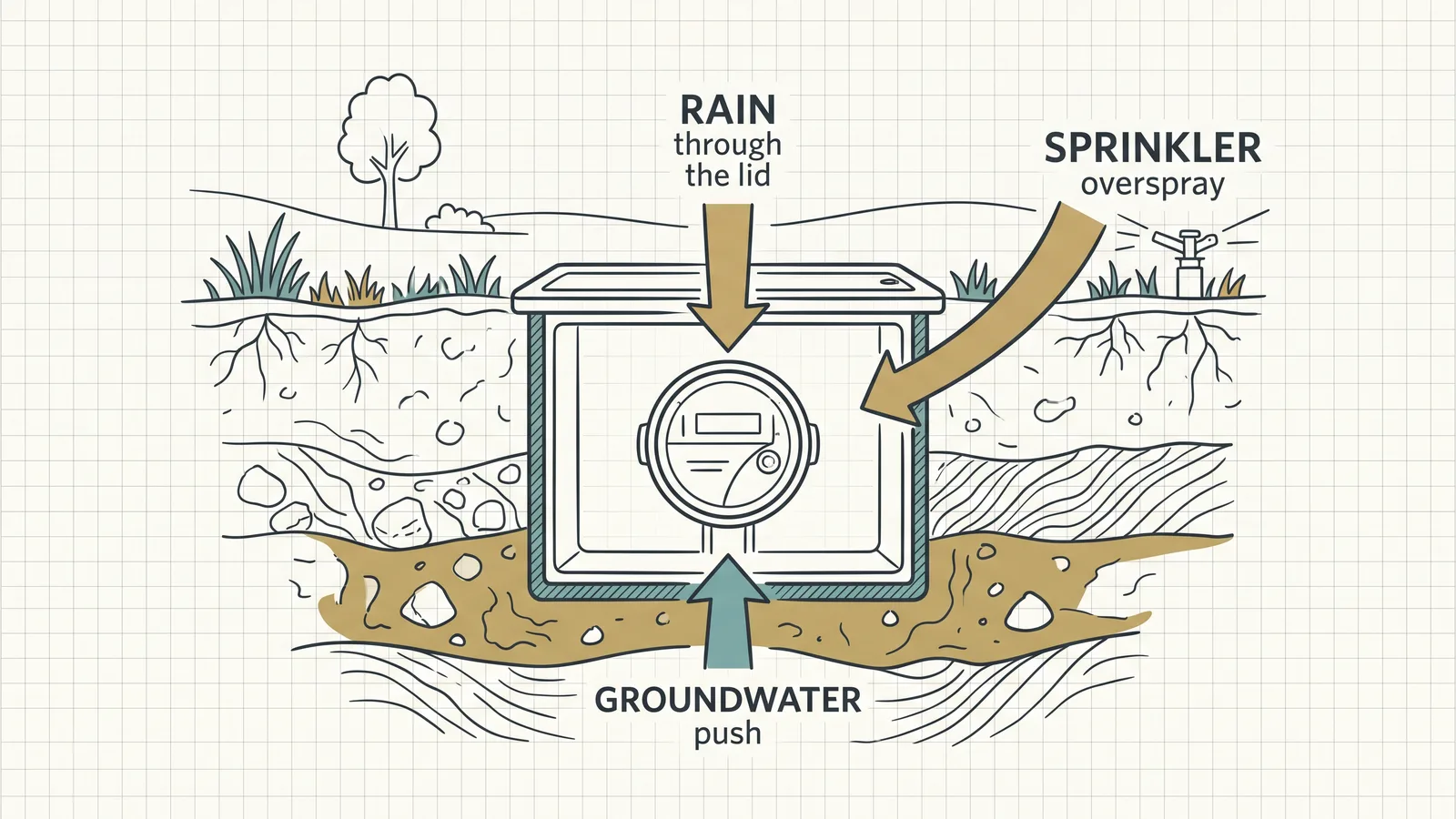
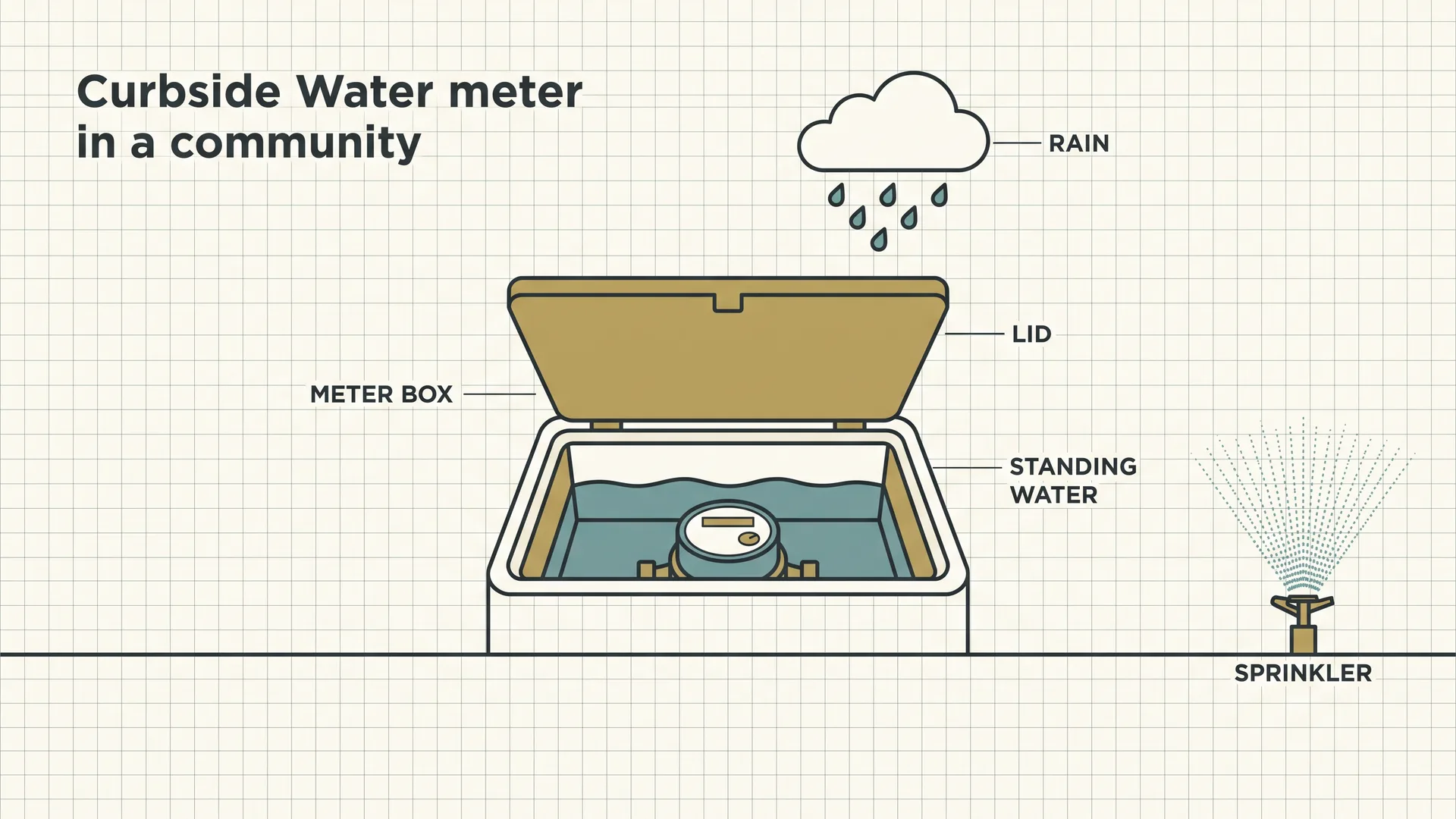
A meter box is a buried hollow with a loose-fitting lid — essentially a low spot by design. Three weather-and-landscape causes fill it with no leak anywhere:
- Rain runoff. The most common cause; boxes in low-lying yards or at the bottom of a slope collect surface water that seeps through the lid joint. It drains or seeps into the soil after the storm passes. [1]
- Irrigation overspray. A sprinkler head aimed anywhere near the box will top it up on every cycle. If your box is wet only on watering days, that’s the answer — adjust the timer or the head, and the problem is gone. [1]
- Groundwater and soil type. In heavy clay or a high water table, the box acts as a drain sump: saturated ground pushes water in, and slow soils take days to pull it back. Long dry spells are the only thing that empties some boxes — drainage is entirely dependent on the soil. [2]
None of these three need a phone call. The diagnostic above exists to prove the absence of a leak so you can file the water under weather and move on.
The two leak cases — and who owns each
The indicator test sorts a real leak into one of two ownership buckets, and the buckets have different phone numbers:
| Indicator (all fixtures off) | Water in box | What it means | Who you call |
|---|---|---|---|
| Spinning / flowing | Any | Leak on the customer side — the pipe from the meter to and inside your house | Plumber (your cost); document everything for a leak-adjustment claim |
| Still / stopped | Refilling or staying high on a dry day | Leak on the utility side — the main, the connection, or the meter fittings themselves | The water utility’s emergency line (their cost) |
[1]
Two practical notes before you dial:
- The meter and its fittings belong to the utility. Water pooling specifically around the meter connections — or a box that won’t stop filling with the indicator still — is nearly always a utility work order, not a plumbing bill. Don’t excavate, don’t tighten anything on the meter; tampering with it is prohibited nearly everywhere. The ownership boundary, and what to do when the utility says “not ours,” is covered in the responsibility guide.
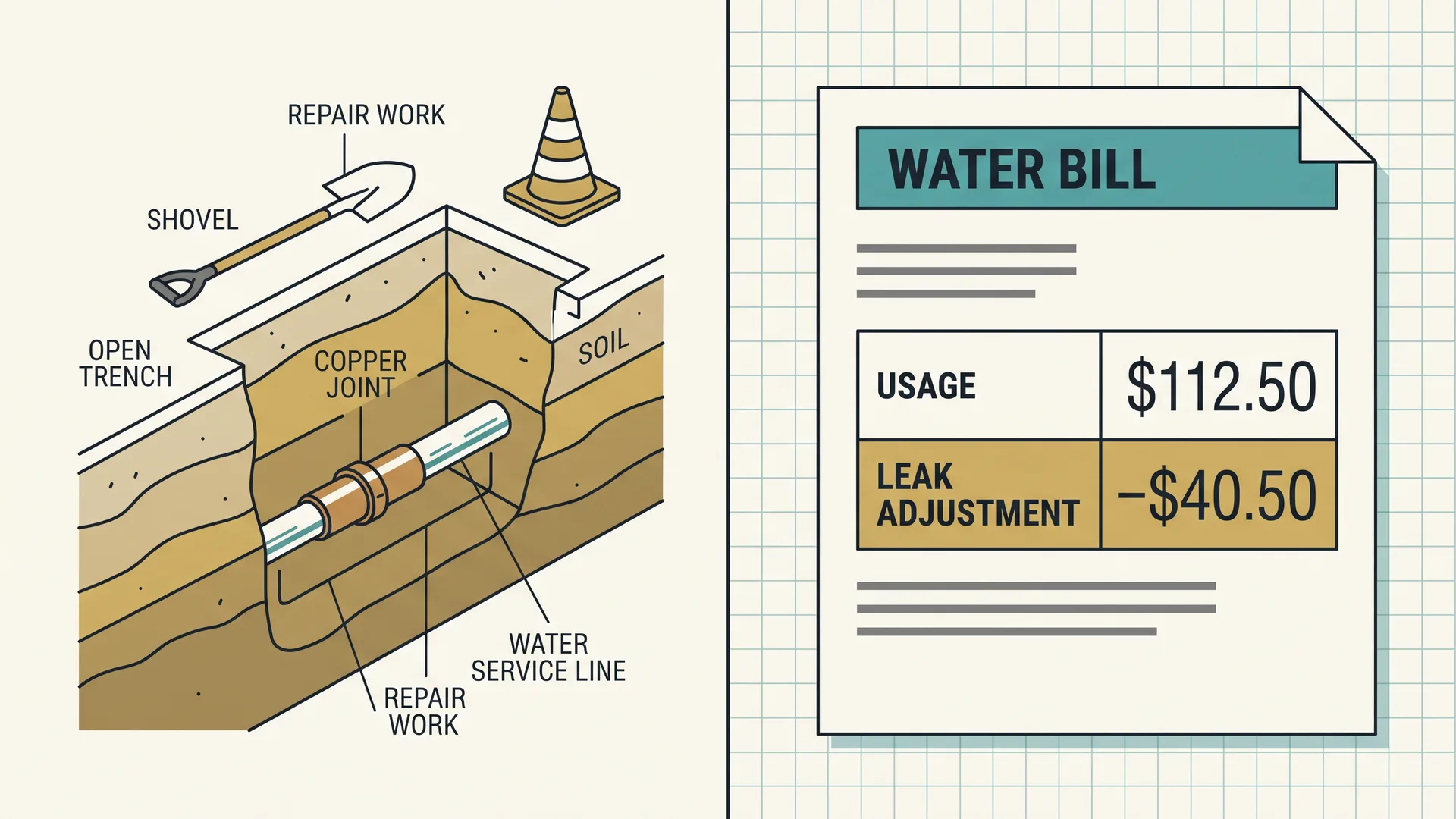
- Photograph the box and the meter before and after. If this turns out to be a bill event, the timestamped photos are the case file for both the boundary determination and the leak-adjustment request. [1]
“Who do I call tonight?” — the urgency ladder
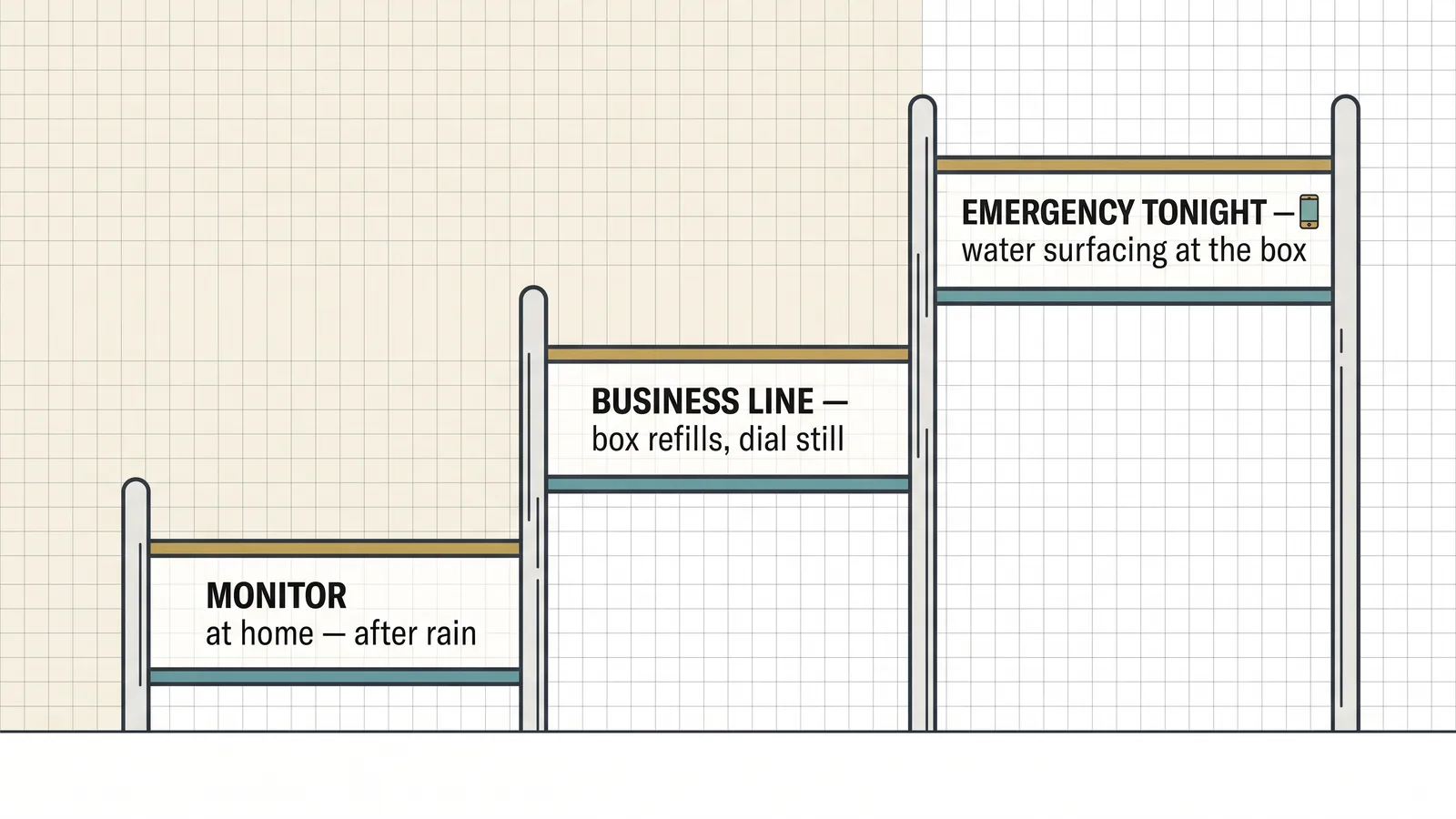
Most wet boxes are a tomorrow problem. The exceptions, in escalating order:
- Monitor at home — water after rain or on watering days, indicator still. No call; re-check in 24–48 hours.
- Utility business-hours line — dry weather, box keeps refilling, indicator still. Ask for a “meter box leak investigation” and reference the still indicator; utilities handle district-side seepage as routine maintenance. [1]
- Utility 24-hour emergency line, tonight — water surfacing around the box (flowing, bubbling, or eroding soil), a frost-split box in freezing weather, or any suspicion the leak is before the meter and growing. Utility-side leaks waste treated water continuously; utilities want these calls at 2 AM. [1]
If the surfacing water is on your side of the meter — indicator spinning, and the wet area is between box and house — the emergency is yours: shut the main valve at the box if it turns, and start the plumber calls.
The freeze-season version of this problem
Box flooding clusters twice a year: spring rains, and freeze-thaw cycles. In cold-winter areas, standing water in a meter box is a freeze risk to the meter and the service-line fitting — water that freezes in the box can split fittings and the box itself, turning weather into a genuine leak. If your box stands wet through a hard-freeze forecast, that upgrades step 2 above to a same-week call: many utilities will pump or insulate a flood-prone box on request. A broken lid — the other freeze casualty — is also utility property to replace; don’t improvise a cover that seals moisture in. [2]
The cheap long-term upgrade for box-and-yard-run worries is a strap-on meter monitor: it reads the meter continuously and flags slow flow weeks before any box tells you — point sensors vs. whole-home monitors compares the options.
Related Reading
- Water meter running when no water is used — the isolation test that narrows a spinning indicator to yard run vs. house.
- Water meter leak indicator explained — find and read the small dial that decides this whole page.
- Who’s responsible for a water leak: before or after the meter — the boundary map and the escalation path when the utility says “not ours.”
- Water bill leak adjustment: how to get credit — if the wet box turns into a bill event, the letter and evidence checklist.
- Where to place water leak sensors — the indoor seats that catch the leaks a box never shows.
Is it normal to have water in my water meter box?
How do I know if the water in my meter box is a leak?
Who do I call about a flooded meter box?
Will a flooded meter box freeze and damage the meter?
Can I pump the water out of my meter box myself?
Most Wet Boxes Are Weather. Prove It, Then Act.
The indicator dial in your meter box is the cheapest diagnostic instrument you own: two minutes with every fixture off sorts rain from your-side leak from utility-side leak, and each of those three answers has a different — and cheap — next step. Photograph the box, run the test, and file the water under weather unless the dial says otherwise.
Where to go next: run the 2-minute diagnostic the next time the box is wet; if the indicator spins, isolate the leak the same day; if the box refills with a still meter, call the utility with that exact observation — “still indicator, box refilling, no rain” — and let the boundary guide handle anything they dispute.
This page is part of the Water hub; terms are defined in the utility glossary.
Sources
- Carmichael Water District (CA) — Troubleshoot Water in My Meter Box — utility-published guidance: rain and over-irrigation as the common causes; the low-flow-indicator decision (spinning = private side, still + refilling = district side); contact guidance, retrieved September 29, 2026.
- How to Look at a House — Why is my water meter box full of water? — low-spot placement and soil-dependent drainage; grade-slope context; meter box cover ownership, retrieved September 29, 2026.
- EPA WaterSense — Leak Detection — household leak-detection basics, retrieved September 29, 2026.
- San Antonio Water System — Leak resources — utility-side example of a formalized leak process, retrieved September 29, 2026.