Quick Answer
Most US water utilities have a leak-adjustment policy: if a hidden leak on your side of the meter was repaired, they will credit part of the excess — usually the usage above your historical average, sometimes at half the volumetric rate — once, in writing, with proof of repair. The two rules that sink most requests: the leak must be the hidden, underground or in-wall kind (running toilets and dripping faucets are routinely excluded), and the repair must already be done, with a plumber’s invoice or parts receipt to prove it. Ask for it by name — “leak adjustment,” not “bill dispute” — and expect a window of roughly 6–12 months from the repair to file. [1][2]
This page is step 2 of the sequence: the leak is diagnosed (meter running with no water used) and fixed (who’s responsible for which side); now the money. Below: what policies actually say, the math utilities use to size the credit, the evidence checklist, and a fill-in-the-blanks letter that mirrors what utilities ask for.
What a leak-adjustment policy actually says
The pattern is remarkably consistent. Two real published policies, side by side:
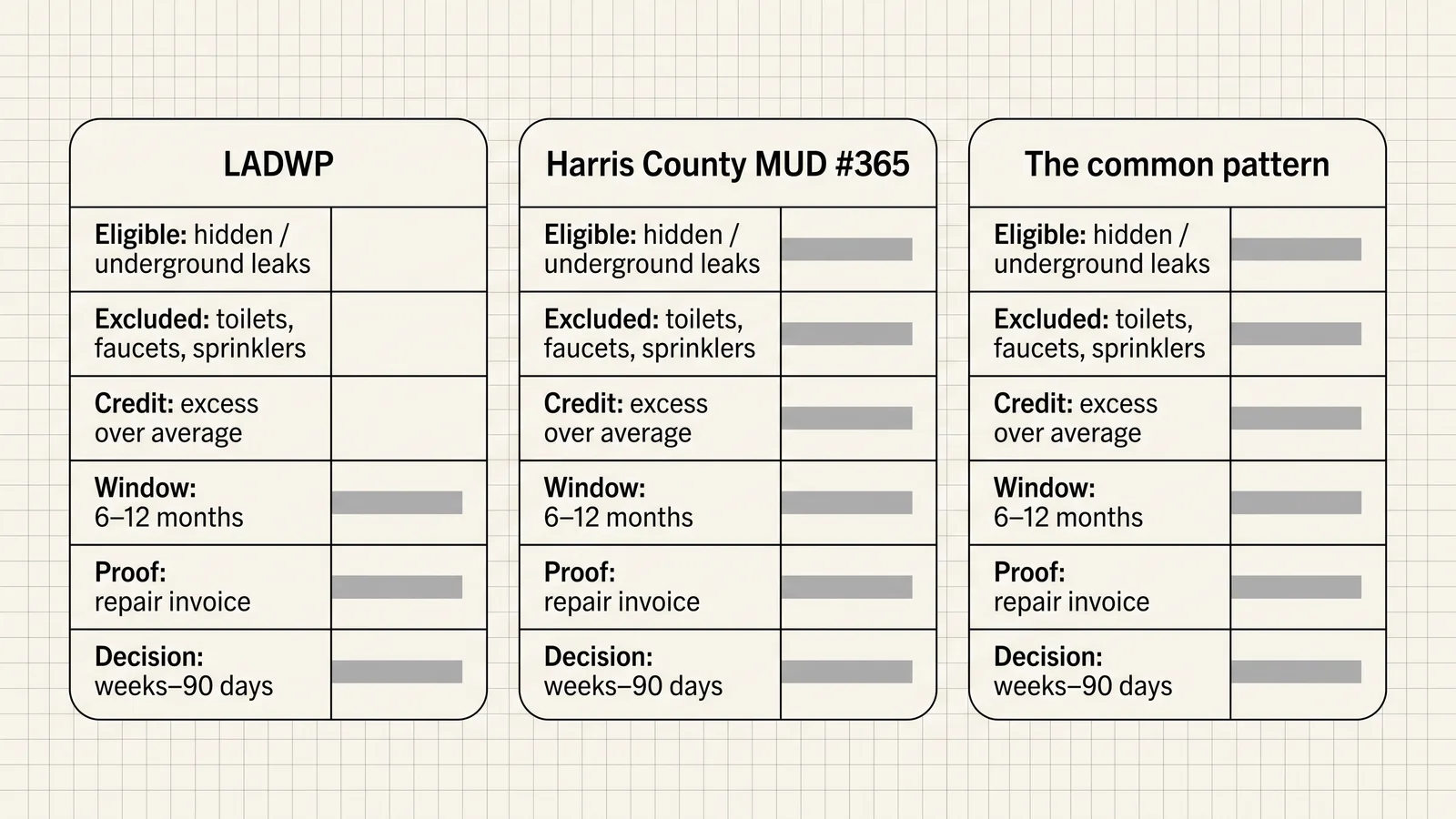
| Term | LADWP (Los Angeles) | Harris County MUD #365 | The common pattern |
|---|---|---|---|
| Eligible leak | Underground leaks on private property, repaired | “Excusable defect”: rupture from freezing, settlement, corrosion, wear, or accident | Hidden/underground leaks qualify; visible ones don’t |
| Explicitly excluded | Sprinklers, water heaters, faucets, toilets | Visible faucet/hose leaks; leaks inside the structure | Running toilets and dripping fixtures almost never qualify |
| Credit basis | Determined by field investigation | One-half of the rate charged on usage above your average for that time of year | The excess over average, not the whole bill |
| Filing window | Within 12 months of the occurrence | Within 6 months of the repair | Roughly 6–12 months — check yours |
| Frequency limit | — | Max 2 adjustments per 12 months | Typically 1–2 per 12–24 months |
| Proof required | Copies of repair receipts | Plumber’s statement/bill or parts receipt; field verification possible | Repair documentation is non-negotiable |
| Decision time | 2–4 weeks to first contact | ~90 days by mail | Weeks to a few months |
[1][2]
Why the exclusions make sense once you see them: a toilet that runs for months is a maintenance neglect issue in the utility’s eyes, while a buried service line that splits in a freeze is a failure you couldn’t have watched. Your letter should place your leak firmly in the second category — sudden, hidden, repaired.
Your one unavoidable homework: find your own utility’s policy page (search “[your utility] leak adjustment”). The terms above are the pattern, not the law; your utility’s page is the law for your bill. If the utility has no published policy, call and ask whether one exists — many apply an unpublished one.
The math: how the credit is sized
Nearly every policy credits the excess — your spike-month usage minus your normal usage for that season — never the full bill. A worked example with round numbers:
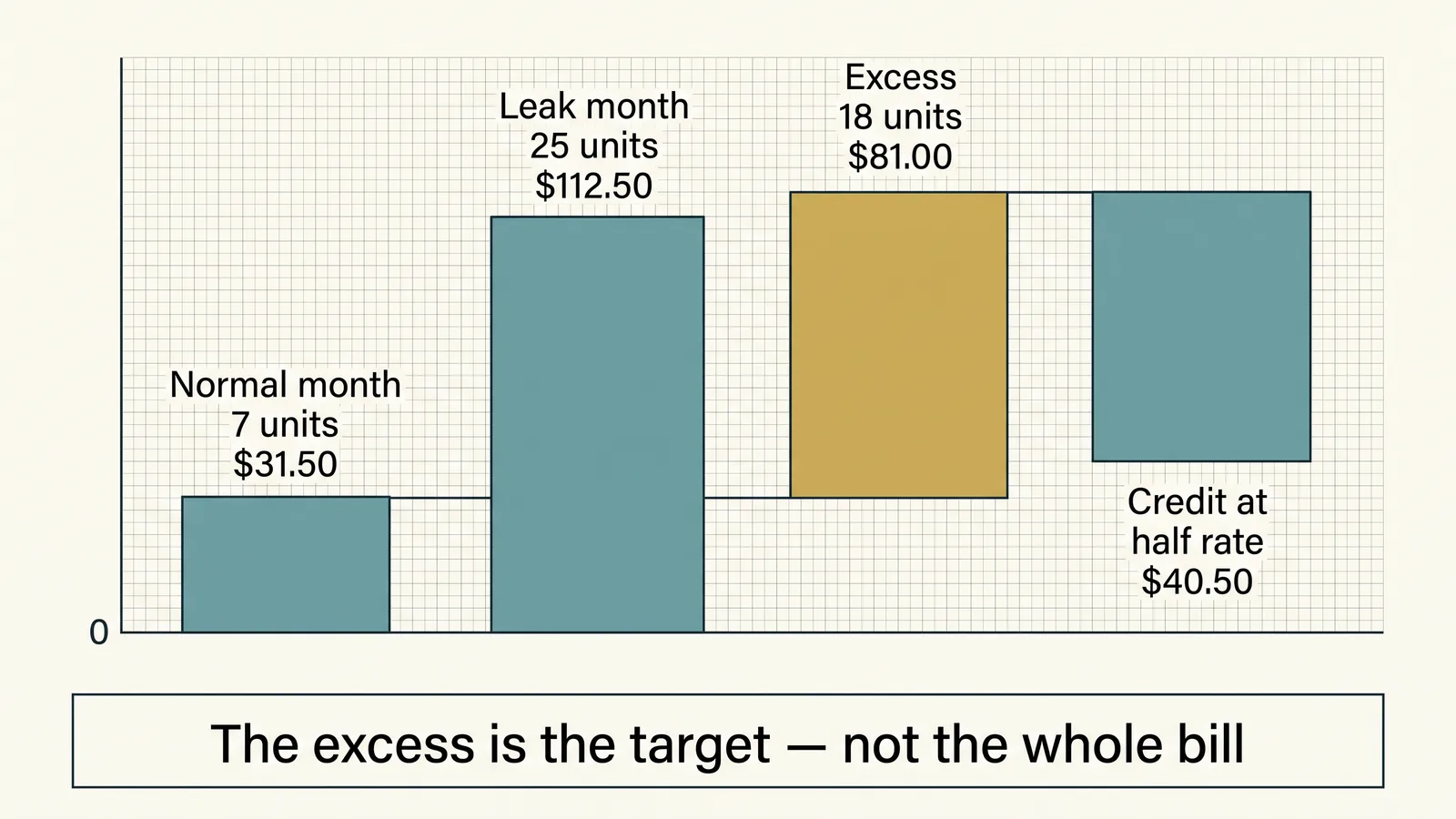
| Line | Usage | At $4.50 per unit (CCF) |
|---|---|---|
| Your normal month (seasonal average) | 7 units | $31.50 |
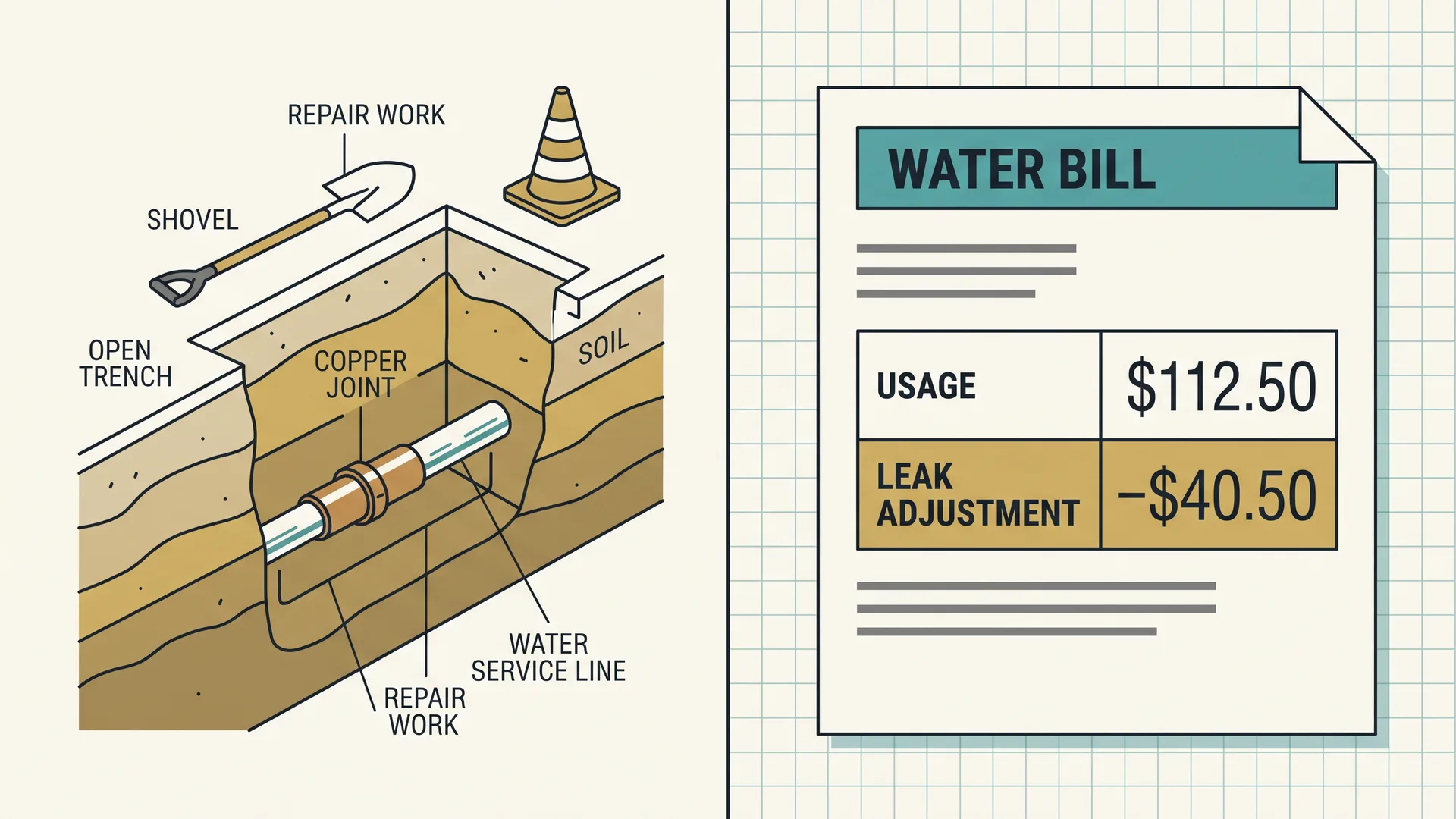
| The leak month | 25 units | $112.50 |
| The excess the policy targets | 18 units | $81.00 |
| Credit at half the excess rate (MUD-style) | — | $40.50 |
The credit lands on the usage charge. Sewer charges are a separate fight worth having — many utilities bill sewer on water volume and will adjust both if asked; how sewer charges work explains which parts move. Fixed service charges (the base account fee) are almost never credited — which is why a $400 bill shrinks to a $250–350 bill, not to zero.
Five stick-anywhere detectors with a gateway for phone alerts — covers the water heater pan, washer box, sump rim, kitchen sink, and a toilet. Loud on-unit sirens work even if Wi-Fi drops.
Check price on Amazon As an Amazon Associate we earn from qualifying purchases. Price & availability shown on Amazon.com.Two details that change the arithmetic:
- Use a seasonal average, not an annual one. Utilities compute your baseline for the period of the year in question — irrigation-heavy summer against irrigation-heavy summers. Pull the same 2–3 months from prior years, not January’s bill. [2]
- Long leaks cap out. Policies commonly limit the credit to 2–3 consecutive billing cycles even if the leak ran longer — one more reason the meter-mounted monitors that catch a slow leak in week one pay for themselves.
The evidence checklist (collect before you write)
The letter is the easy part. Approvals hinge on the attachments:
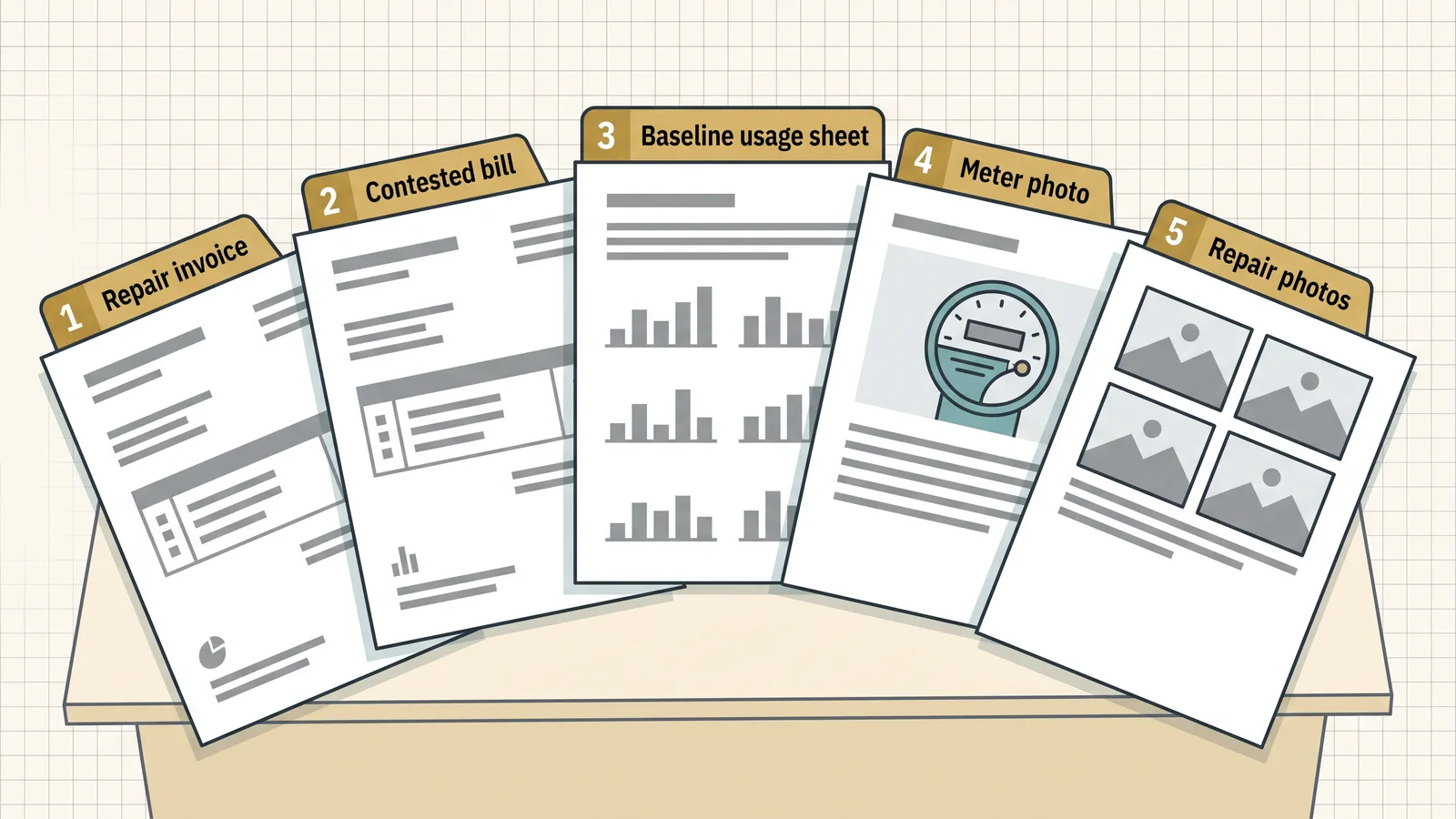
- The repair invoice or plumber’s statement — with date, address, type of repair, and cost. A parts receipt with photos of the repair can substitute for DIY fixes; one utility accepts a statement signed by two employees for in-house maintenance — the standard is verifiable documentation of what was fixed and when. [2]
- The bill(s) you’re contesting — copies, annotated if you like.
- Your baseline math — same months, prior 1–2 years, usage units. You want the reviewer to confirm your arithmetic, not reconstruct it.
- Meter evidence, if you have it — a photo of the leak indicator moving before the repair and a reading after the repair is the strongest single document in the file. It shows the leak existed, then stopped — exactly what the policy pays for.
- Repair photos — the exposed pipe, the split, the completed joint. Timestamped beats polished.
One more eligibility gate to check early: some utilities require at least a year of usage history in your name at the address — new homeowners and recent movers can be ineligible through no fault of their own. [2]
The letter template
Mirrors what LADWP and municipal districts actually ask to receive. Fill every bracket, attach everything above, and send it the way your utility requires — many accept these only by mail or in person, not email. [1]
[Your name]
[Service address]
[Account number]
[Phone]

[Date]

[Utility name]
[Billing / Field Investigations address from your utility's policy page]

Re: Request for Leak Adjustment — Account [number], [service address]

To whom it may concern:

I am requesting a leak adjustment under the utility's leak-adjustment
policy for account [number] at [service address].

1. The leak. On or about [discovery date], I discovered a leak in
   [location: e.g., the underground service line between the meter and
   the house foundation]. The leak was hidden — it caused no visible
   surface water and was found via [how: e.g., the meter register
   moving with all fixtures off / a plumbers' diagnosis]. Based on
   [evidence], it appears to have begun on or about [estimated start].

2. The repair. The leak was repaired on [repair date] by
   [plumber name / "myself"]. The repair consisted of
   [one-line description: e.g., excavation and replacement of 8 feet
   of failed galvanized service line with Type K copper]. Attached is
   the [invoice / parts receipt] documenting the date and work.

3. The bills. The leak affected the billing period(s) [month(s)],
   with usage of [N] units against my seasonal average of [M] units
   (attached: same-month usage for the prior [1–2] years). I request
   adjustment of the excess usage charge of approximately $[amount]
   per the policy's terms.

4. Proof the leak is fixed. Attached: [meter photo/reading after
   repair; zero-flow confirmation with all fixtures off]. My usage
   returned to normal in the [month] billing period.

Please confirm receipt and let me know if any additional
documentation is required. I can be reached at [phone] or
[email]. Thank you for your consideration.

Sincerely,
[Signature]
[Printed name]
Adjust the bracketed facts, never the structure — the numbered claims map directly onto what reviewers check (eligible hidden leak → documented repair → quantified excess → proof of cure). For the diagnosis story if the meter caught it, the isolation walkthrough describes the test in the reviewer’s language.
If the answer is no
A denial is usually one of four things, each with a next move:
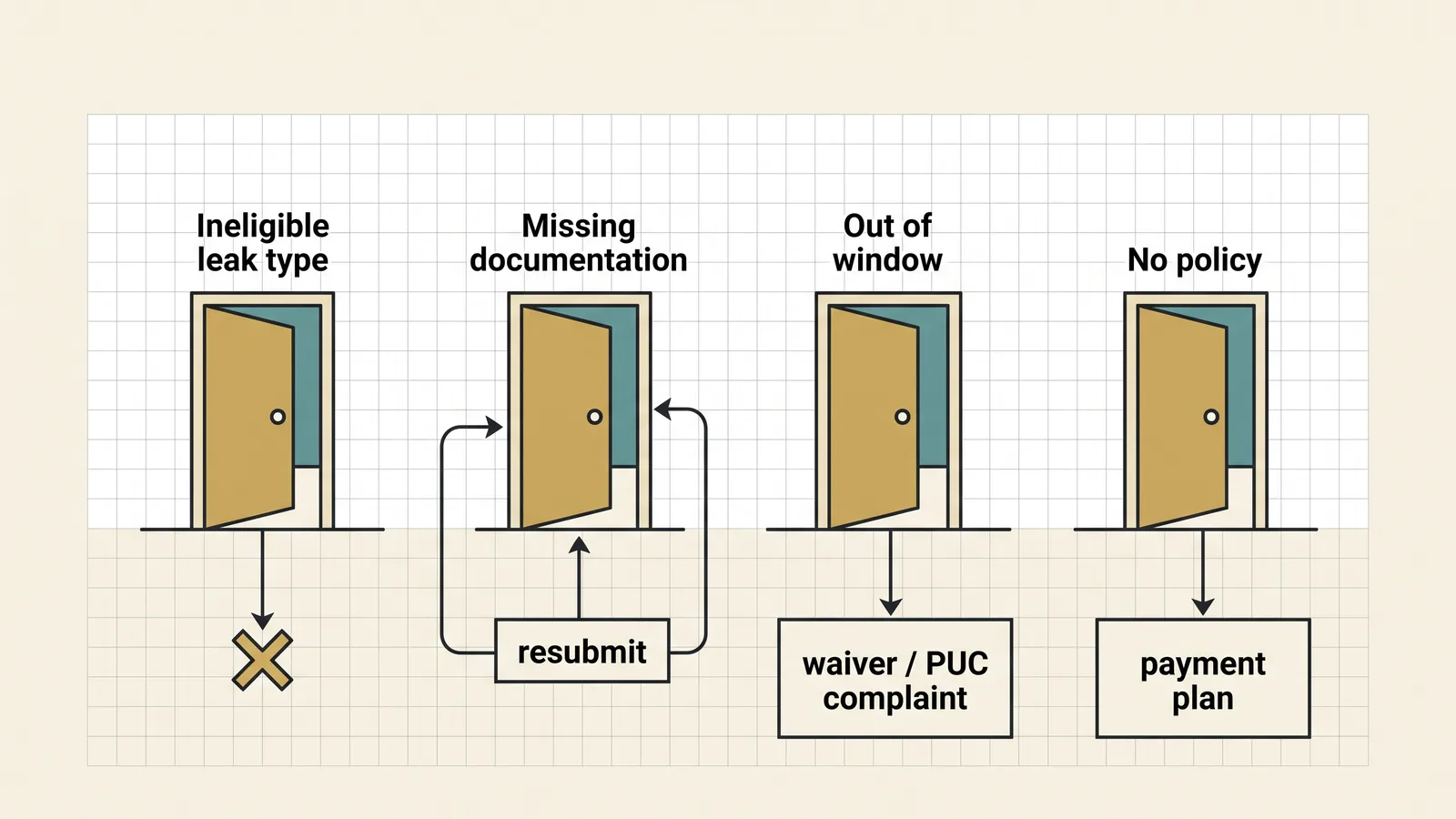
- “Ineligible leak type” (toilet, faucet, sprinkler head) — the policy is the policy; the honest path is prevention (below), not appeal.
- “Missing documentation” — the most winnable denial. Get the plumber to reissue the invoice with date and scope, resubmit.
- “Out of window” — ask for the deadline waiver in writing; some utilities grant first-time good-faith waivers, and a state PUC complaint is the backstop if a genuine policy exists but the utility stonewalls.
- “No policy” — ask what hardship or payment-plan options exist; a stretched payment plan on a $400 bill is a partial win. For the bigger bill-side playbook, see why your water bill suddenly increased.
Make sure there’s no next letter
The bitter math of leak adjustments: even approved, you keep roughly half the excess cost, and the policy is once-a-year at best. Prevention is cheaper:
Wraps around your existing water meter in minutes — no pipe cutting. Tracks usage by the minute, flags continuous flow (the signature of a hidden leak), and works with the leak pages above.
Check price on Amazon As an Amazon Associate we earn from qualifying purchases. Price & availability shown on Amazon.com.- Point sensors at the five high-consequence spots (water heater pan, washer box, sump rim, kitchen sink, toilet) catch indoor failures in minutes for about the cost of one excess unit. Where to place water leak sensors maps the seats.
Five stick-anywhere detectors with a gateway for phone alerts — covers the water heater pan, washer box, sump rim, kitchen sink, and a toilet. Loud on-unit sirens work even if Wi-Fi drops.
Check price on Amazon Price & availability shown on Amazon.com — we may earn a commission.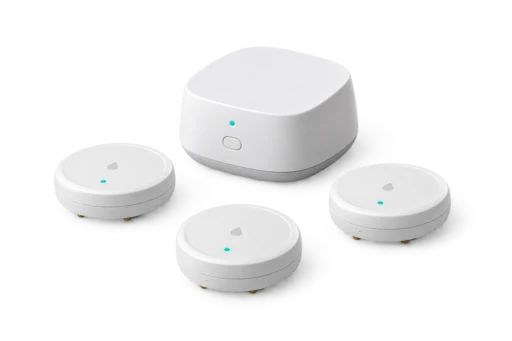
- A meter-mounted monitor is the one that prevents this letter: it straps on the existing meter (no plumbing) and catches the slow underground service-line leak weeks before the bill does — the exact leak class adjustments exist for. The point-sensor vs whole-home comparison and the Flume vs Flo vs Phyn head-to-head cover the field.
Wraps around your existing water meter in minutes — no pipe cutting. Tracks usage by the minute, flags continuous flow (the signature of a hidden leak), and works with the leak pages above.
Check price on Amazon Price & availability shown on Amazon.com — we may earn a commission.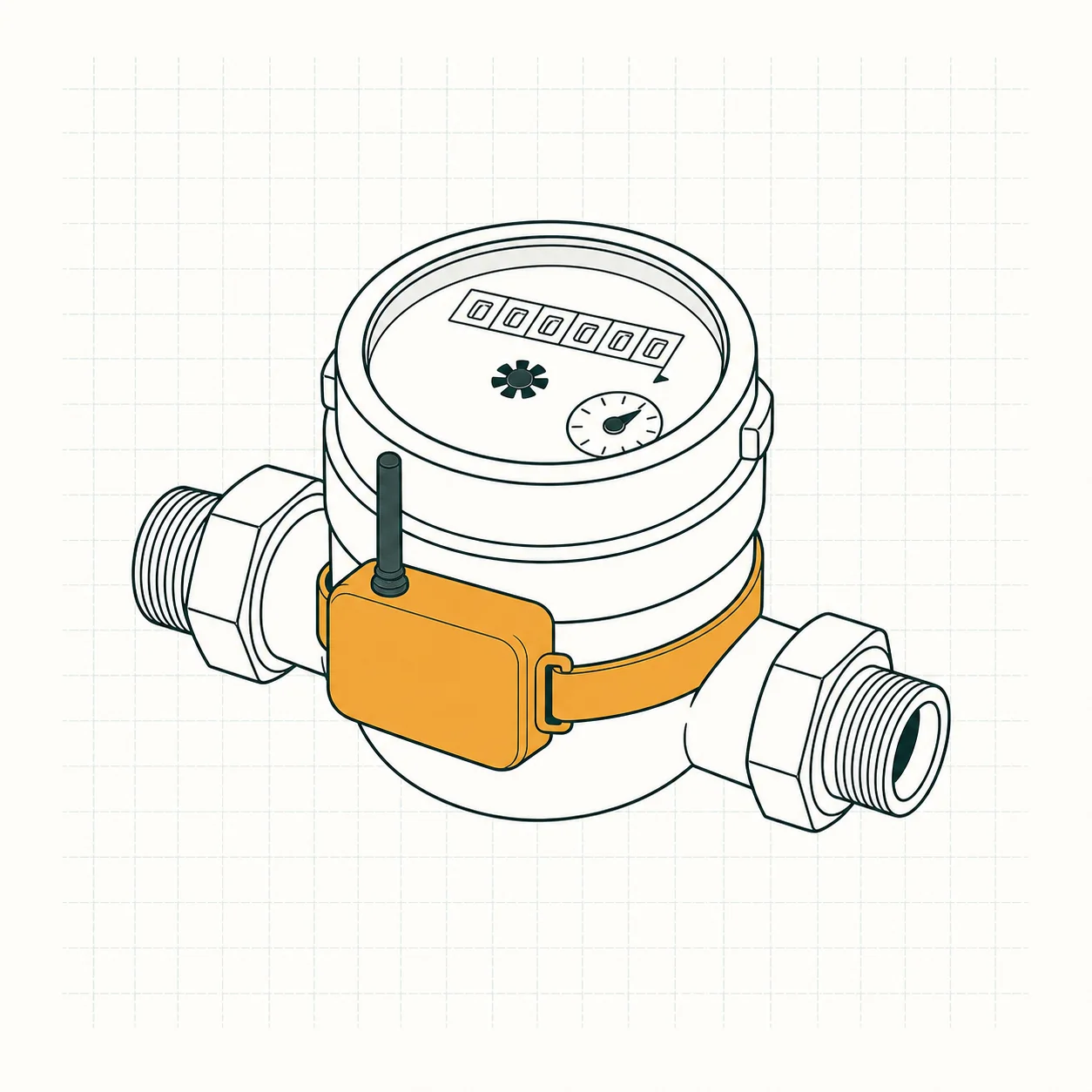
And before winter: know where your main shutoff is and that it turns. Freeze breaks are the most common “excusable defect” — and the most preventable.
Related Reading
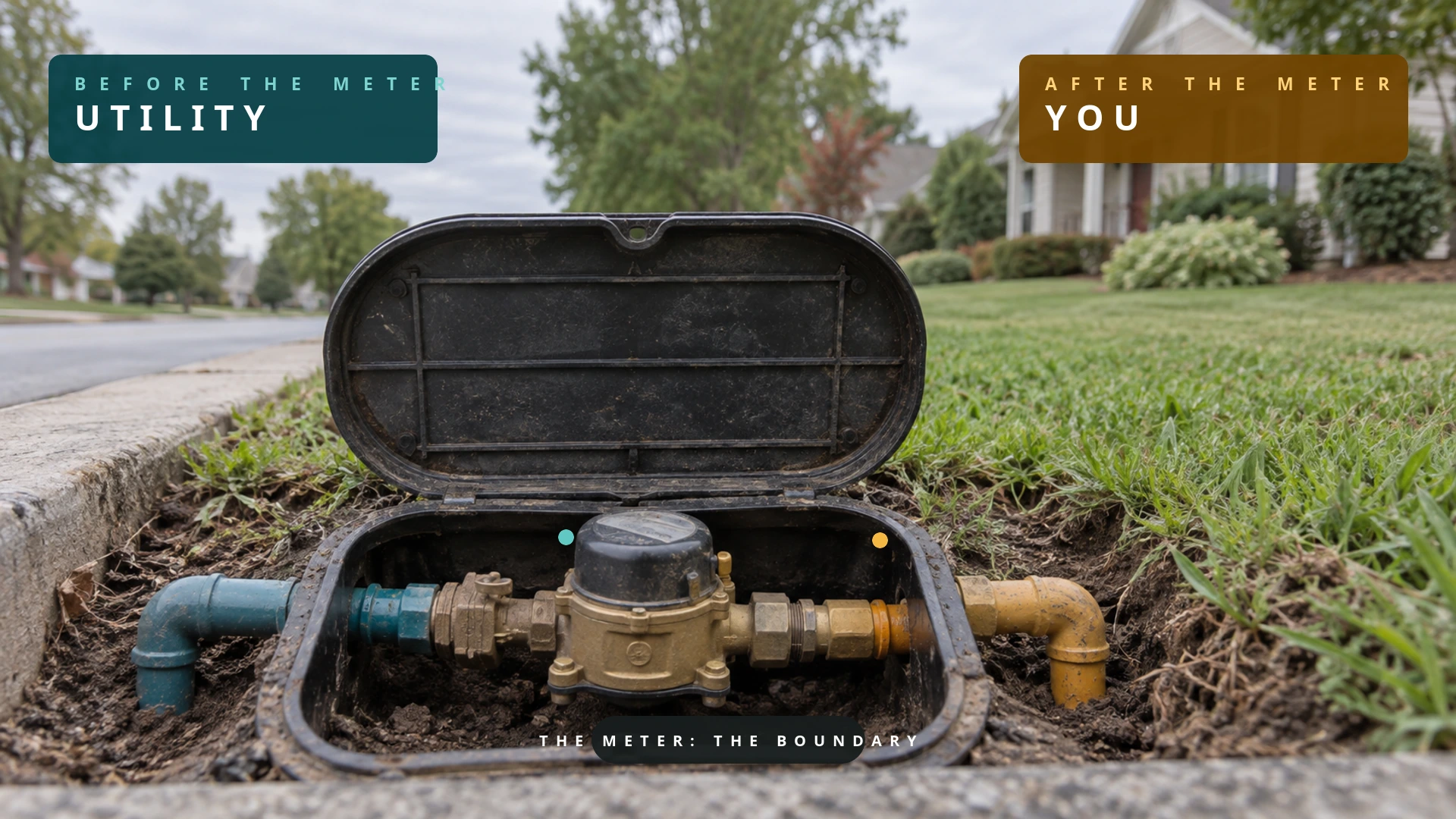
- Who’s responsible for a water leak: before or after the meter — the boundary rule and escalation path this page assumes.
- Water meter running when no water is used — the isolation test that proves which side the leak is on.
- Why did my water bill suddenly increase? — the full diagnosis ladder, from meter math to utility error.
- Where to place water leak sensors — the six placements that matter and two that don’t.
- How sewer charges work — the other half of the bill, and often the other half of the credit.
How much of the bill will a leak adjustment actually remove?
Does a running toilet qualify for a leak adjustment?
How long do I have to request a leak adjustment?
Can I get a leak adjustment twice?
Do I need a plumber's receipt if I fixed the leak myself?
Ask in the Language the Utility Wrote
Every element of this page — the eligible leak class, the excess-over-average math, the proof-of-repair requirement, the filing window — comes from published utility policies, because the reviewer on the other end is checking your request against exactly that document. Arrive with the right leak type, the arithmetic pre-done, the invoice attached, and the meter evidence, and a policy that looks like a bureaucratic maybe becomes a routine approval.
Where to go next: find your utility’s leak-adjustment page, assemble the five attachments, and send the letter this week — windows close. Then close the loop that opened the letter in the first place: place the sensors that make the next leak a 2 AM alarm instead of a $400 bill.
This page is part of the Water hub; terms are defined in the utility glossary.
Sources
- LADWP — Water Billing Adjustment for Underground Leak Repair — eligibility (underground leaks only; sprinklers/water heaters/faucets/toilets excluded), 12-month window, required contents, 2–4 week response, retrieved September 28, 2026.
- Harris County MUD No. 365 — Leak Adjustment Form — “excusable defect” definition, one-half of excess-over-average credit basis, 6-month window, 2-per-12-months limit, 3-month cap, proof requirements, one-year history rule, ~90-day decision, retrieved September 28, 2026.
- San Antonio Water System — Leak resources — utility-side example of a formalized leak/adjustment process, retrieved September 28, 2026.
- EPA WaterSense — Understanding Your Water Bill — bill structure: usage vs. fixed charges, retrieved September 28, 2026.