Quick Answer
A tiered or block rate changes the electricity price according to the amount consumed under the serving utility’s tariff. DOE describes a block rate as a pricing structure where the electricity cost varies with the amount consumed.[1] The thresholds, prices, seasons, service classes, and calculation method are provider-specific.
Do not apply a generic baseline, assume the entire bill moves to a higher price, or use a state/utility comparison table instead of the tariff currently assigned to your account.

Find the Applicable Rate Schedule
Start with the bill and identify the rate-plan or service-class name. Then obtain the current tariff and record:
| Item | What to verify |
|---|---|
| Block definition | Usage range and unit for each block or tier |
| Rate | Price, effective date, season, and time-period conditions |
| Billing period | Start/end dates and total days |
| Usage | Meter-read status, billed kWh, and any adjustment |
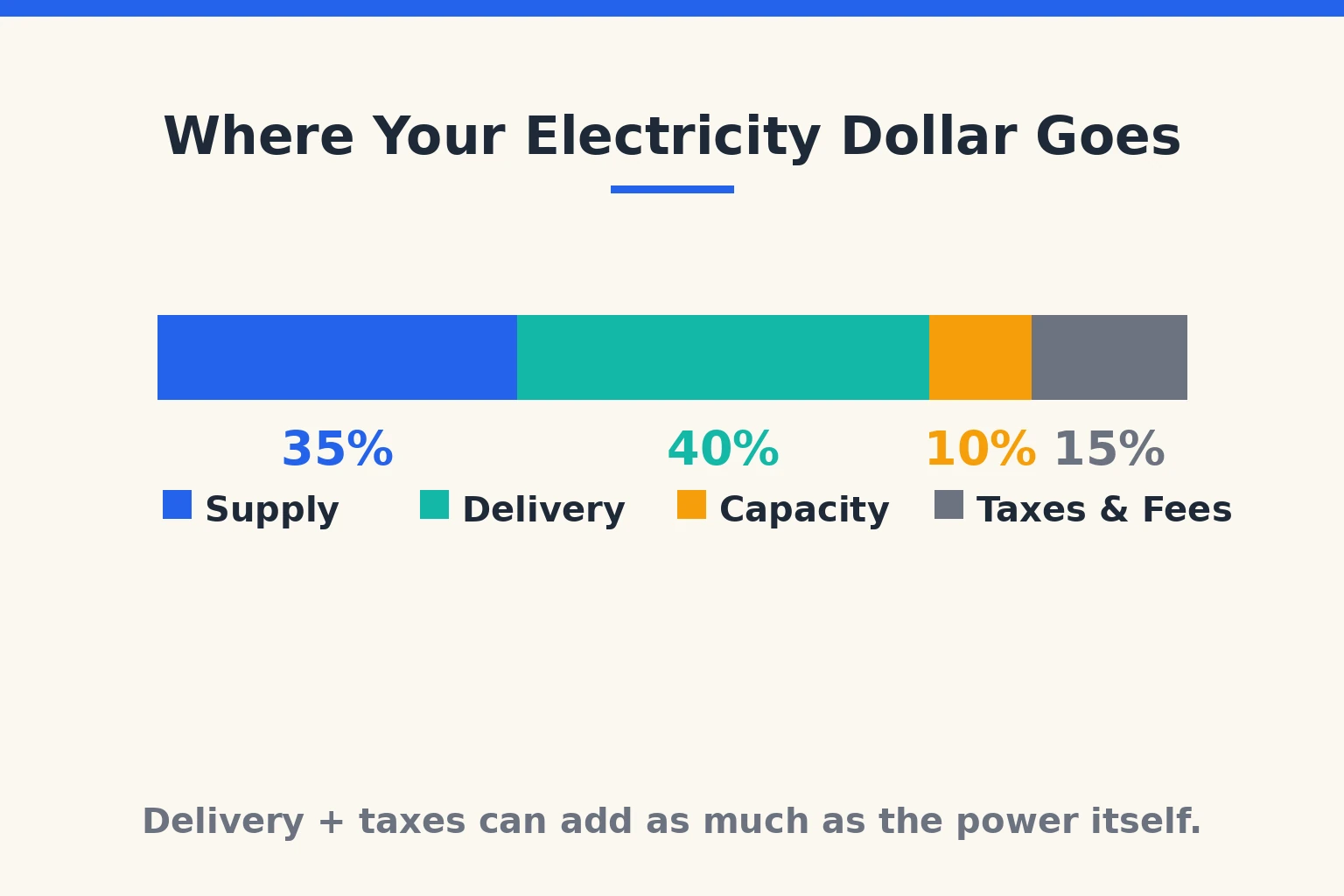
| Other charges | Delivery, supply, fixed charges, riders, taxes, credits, and one-time items |
Some accounts use a flat rate, time-variable rate, demand component, block rate, or a combination. DOE notes that bill components can be determined differently and can respond differently to changes in use.[1]
A Worked Tier Example (Illustrative)
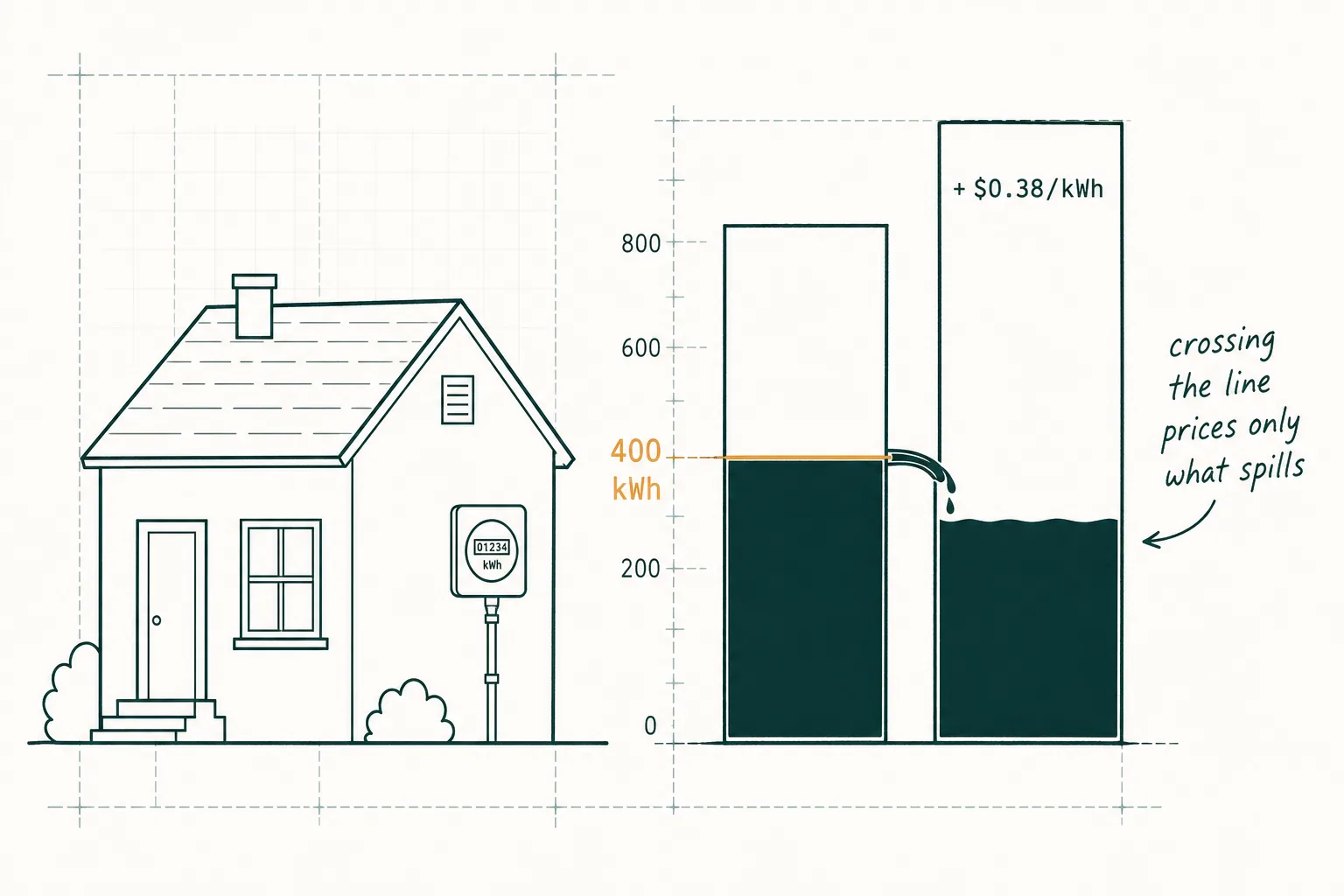
The following numbers are illustrative only — thresholds and rates are always tariff-specific. The point is the arithmetic pattern: only the usage above each threshold is charged at the higher price, never the whole bill.
Suppose a tariff prices Tier 1 at $0.28/kWh for the first 400 kWh of a billing period and Tier 2 at $0.38/kWh for usage above 400 kWh:
| Line | Calculation | Amount |
|---|---|---|
| Tier 1: first 400 kWh | 400 × $0.28 | $112.00 |
| Tier 2: next 150 kWh (550 total) | 150 × $0.38 | $57.00 |
| Usage-related subtotal | $112.00 + $57.00 | $169.00 |

A reader using 550 kWh pays $169 in usage charges — not 550 × $0.38 = $209. Crossing the threshold raises the price only on the units beyond it. When you check your own bill, reproduce exactly this table from your tariff’s thresholds and rates, then compare it against the statement line by line. The same pattern drives why an electric bill climbs without a rate change, and it is separate from when you use power under time-of-use pricing. For how tiers sit among all the other line items, see the electric bill breakdown.
Check the Statement Line by Line
Compare each tier or block line with the tariff — if the block lines themselves are hard to find on the statement, reading your electric bill line by line walks the statement top to bottom first. Confirm the quantity assigned to the block, the rate, and the displayed amount. If the calculation does not reconcile, ask the provider for the account-specific billing calculation rather than inferring an error from the total due.

When comparing months, first account for a changed billing period, rate version, read status, season, or credit. A higher total does not by itself prove a tier threshold caused the increase.
Keep Tiered and Time-Based Pricing Separate
Block pricing concerns the amount of electricity consumed. Time-variable pricing concerns when electricity is consumed under the schedule specified by a rate plan, as covered on the time-of-use page above. And there is a third structure that sounds similar but bills on power drawn rather than energy used: see demand charges on electricity bills: how they differ from tiered rates. A bill may use one, neither, or both. Review the actual tariff before changing appliance use or enrolling in another plan.
Questions for the Provider
- Which tariff and service class apply to my account?
- What blocks, thresholds, units, and rates apply for this billing period?
- Were there seasonal, time-based, or billing-day adjustments?
- Which line items are outside the block-rate calculation?
- Can you provide the full account-specific billing calculation and tariff version?
Those five questions settle how your account’s tiers work; which plan should be on your account in the first place is a different decision — which rate plan is right for you weighs flat, tiered, and TOU side by side.
The habit to take away from this page is small and repeatable: reproduce the tier table from your tariff, check the math against the statement line by line, and confirm which line items the block calculation does and does not cover — once the tiers reconcile, the rest of the bill either follows or identifies itself as the thing to question.
Related Reading
- Why Is My Electric Bill So High? The Full Diagnosis Checklist — the tiered-rate mechanism in the context of a rising bill.
- Time-of-Use Electricity: How TOU Differs From Tiered Pricing — the when-you-use-it counterpart to how-much.
- Electric Bill Breakdown: Every Charge Explained — where tiers sit among delivery, supply, and fixed charges.
- Demand Charges on Electricity Bills: How They Differ From Tiered Rates — the third rate structure, and how it differs.
- Which Rate Plan Is Right for You? Flat, Tiered, or TOU — the plan-choice guide for after the tariff review.
- How to Read Your Electric Bill Line by Line — the statement-reading prerequisite to all of this.
Why did my bill go up when my usage stayed the same?
Does the higher tier rate apply to all my usage, or just part of it?
How do I find my utility's tier thresholds?
What is the difference between tiered rates and time-of-use rates?
What is the difference between tiered rates and demand charges?
Sources
- U.S. Department of Energy: Evaluating Your Utility Rate Options — rate-structure components and how each responds differently to changes in use (retrieved 2026-08-29).