Quick Answer
A tankless water heater is 24–34% more energy-efficient than a standard tank model on paper — but the honest savings depend on how much hot water you actually use, and the Department of Energy’s own guidance is that homes using under about 41 gallons a day benefit most.[1] That’s the whole trade in one sentence: tankless units eliminate standby loss (the tank’s constant reheating), but they cost more upfront, need proper gas or electric service, and deliver hot water at a flow rate that depends on your groundwater temperature. For a low-usage household, the efficiency edge is real but small; for a high-usage household, it’s the difference between a 10–13 year tank and a ~20 year tankless unit.
This is an informational comparison — no product picks, because the right unit is sized to your home’s flow demand, not to a list. If your bill is the actual problem, start with Is Your Gas Bill Too High?, How to Read Your Gas Bill, and The Complete Guide to Understanding Your Utility Bill — the leak is often in the bill, not the appliance.
First, What Each One Actually Does
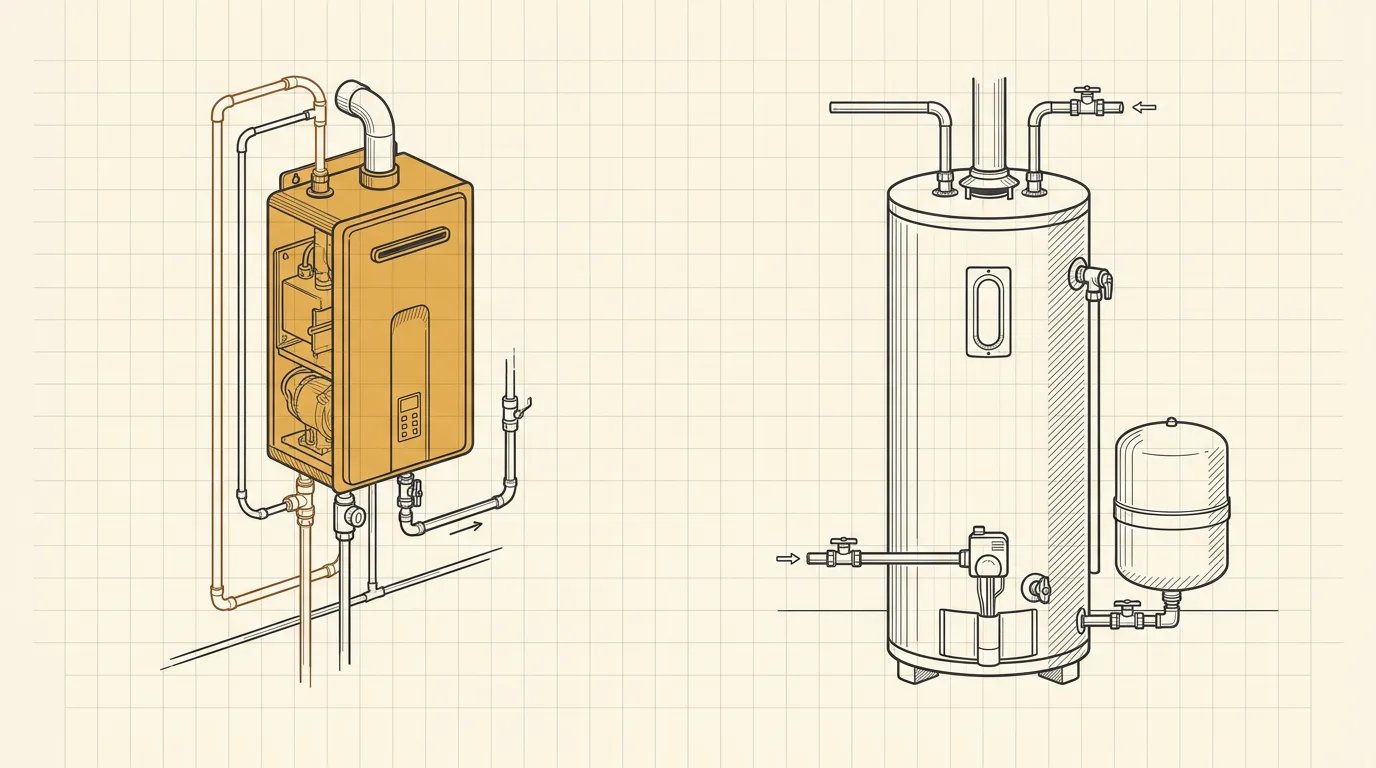
A tank water heater stores 40–80 gallons of hot water and keeps it hot around the clock. A tankless (on-demand) water heater heats water only when a tap opens — cold water flows through a gas burner or electric element and arrives at the faucet hot, with no storage at all.
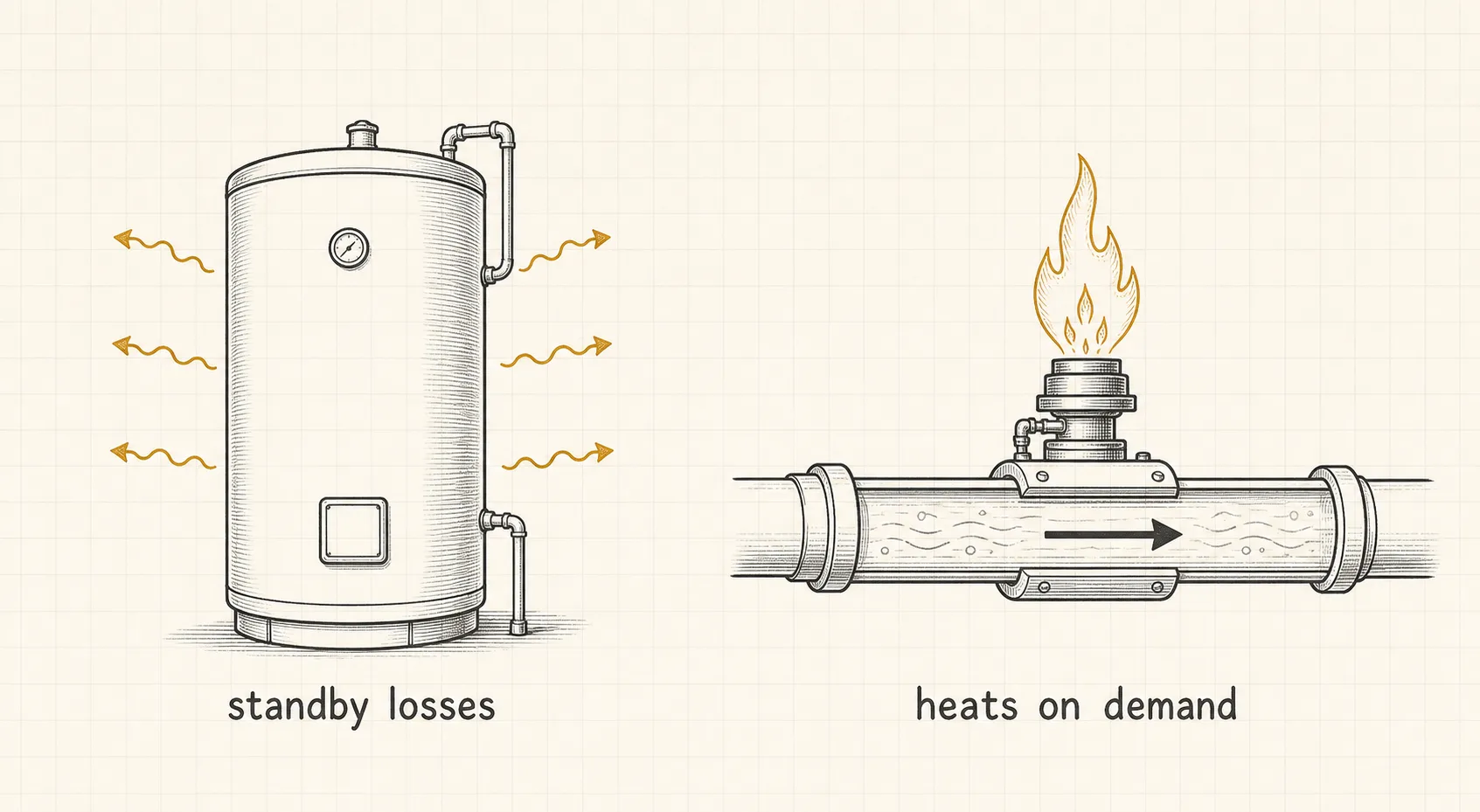
The efficiency difference is almost entirely standby loss. A tank reheats itself dozens of times a day even when nobody uses hot water; a tankless unit has nothing to reheat. The U.S. Department of Energy’s water-heating guidance puts the efficiency edge of on-demand units at 24–34% for homes that use less than about 41 gallons of hot water per day — and notes that the advantage shrinks for high-usage households, where the tankless unit’s higher output demands and installation costs eat into the savings.[1]
That 41-gallon figure is the single most important number in this comparison, because it’s the honest scope caveat: the 24–34% stat is not universal. It’s the DOE’s estimate for the homes where tankless shines — and a family of four taking long showers is not that home.
The Efficiency Math: What 24–34% Actually Buys
Here’s the arithmetic with assumptions stated. National average residential electricity is 18.34¢/kWh (EIA, June 2026),[2] and the average household uses about 899 kWh/month.[3] Water heating is typically about 18% of a home’s energy use.[1]
The tank baseline: a typical household spends roughly $400–600/year on water heating. Take the middle, $500/year.
The tankless edge, honestly applied:
- At 24% savings: $500 × 0.24 = $120/year
- At 34% savings: $500 × 0.34 = $170/year
So the honest band is $120–170/year — but only for the low-usage households the DOE stat describes. For a high-usage household, the real-world edge is often closer to 10–15%, or $50–75/year, because the tankless unit runs harder and longer to keep up.
The lifetime view:
- Tank: ~$500–1,200 installed, lasts 10–13 years, then replace.
- Tankless: ~$1,500–3,500 installed (gas units with proper venting and gas line upgrades cost more), lasts ~20 years.
- Over 20 years: two tanks at
$800 average = **$1,600 in replacements**, versus one tankless at$2,500 average = **$2,500 upfront** — and the tankless saves $120–170/year in energy along the way.
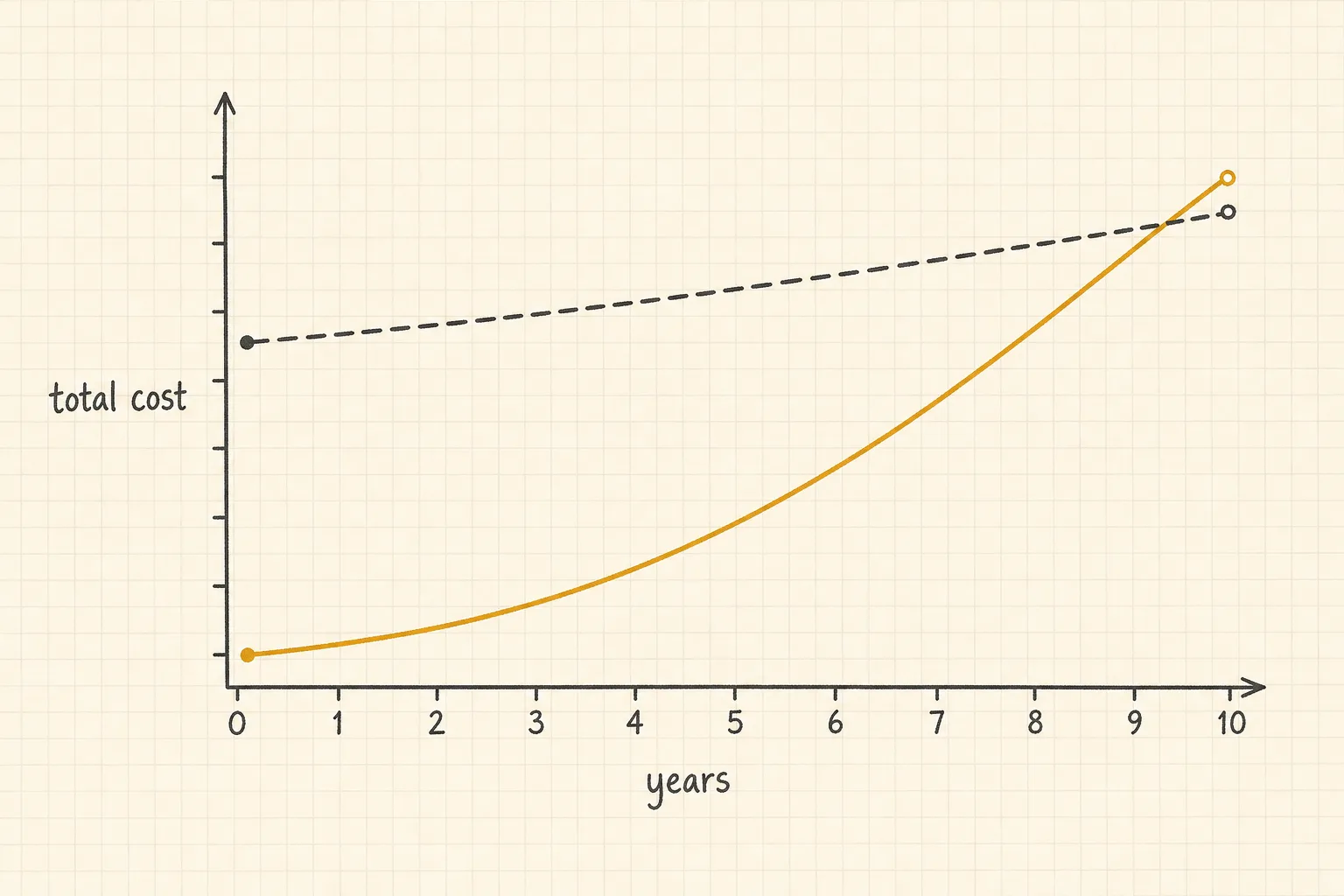
The honest summary: the tankless pays back its higher upfront cost over roughly 8–15 years depending on usage and installation complexity — which means it only makes sense if you plan to stay in the house that long. If you’re moving in five years, the tank is the financially rational choice.
The Flow-Rate Reality: GPM and Groundwater Temperature
The “endless hot water” claim is true with a caveat: tankless units deliver hot water at a fixed flow rate, and that rate depends on how cold your incoming water is.
Every tankless unit is rated in gallons per minute (GPM) at a given temperature rise. The rating means: “this unit can raise incoming water by X degrees at Y gallons per minute.” The colder your groundwater, the harder the unit works, and the lower the actual GPM it can sustain.
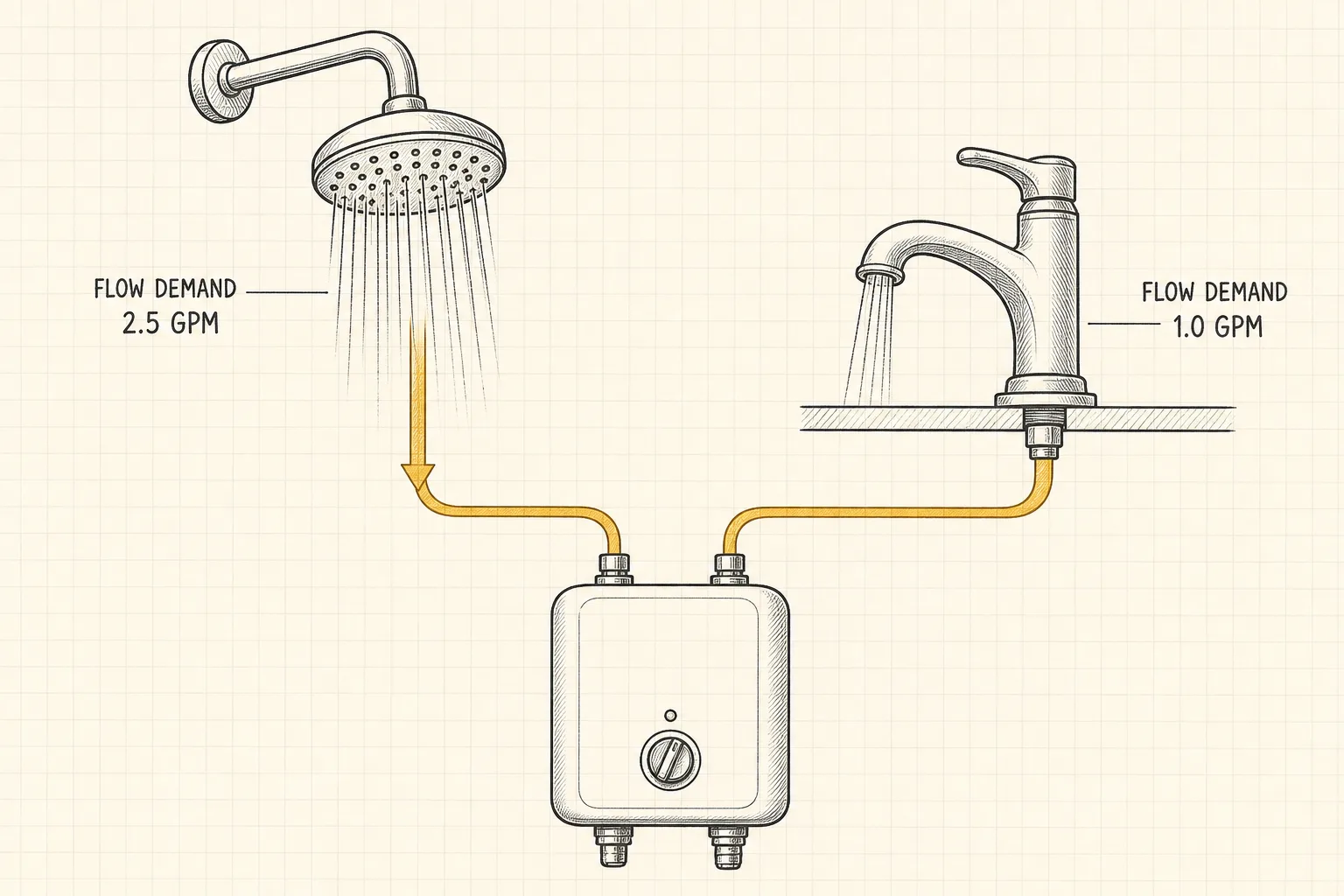
The practical numbers:
- A shower runs about 1.5–2.5 GPM; a shower plus a running faucet or dishwasher is 3–4 GPM.
- In a warm climate, groundwater might enter at 60–70°F, so a unit rated at 6 GPM at a 45°F rise has headroom.
- In a cold climate, groundwater can enter at 40–50°F in winter, so the same unit’s real capacity drops — sometimes to the point where one shower is fine but a second simultaneous shower isn’t.
That’s the real trade behind “endless hot water vs simultaneous showers”: a tankless unit sized for one shower handles one shower; a tank sized for 50 gallons handles two showers back-to-back but runs out eventually. The tank runs out; the tankless runs out of flow. Which failure mode you prefer is a lifestyle question, not an efficiency one.
The service-side reality: a tankless unit is not a drop-in replacement for a tank. Gas units need a larger gas line in many homes, dedicated venting (often stainless steel, which is not the same as a tank’s vent), and sometimes a condensate drain for condensing models. Electric units can need a 240-volt circuit upgrade — often a 100+ amp draw for a whole-house unit, which can mean a panel upgrade. These are real line items on the quote, and they’re why the installed cost band ($1,500–3,500) is so wide. Get a written quote that includes the gas line, venting, and electrical work before you compare it to a tank’s sticker price — the “tankless costs more upfront” line is usually an understatement once the service work is itemized.
Maintenance is a line item too: a tankless unit’s heat exchanger should be flushed (typically with vinegar or a descaling solution) once a year in hard-water areas, and the inlet filter cleaned. A tank’s maintenance is a yearly drain-and-flush plus an anode rod check. Neither is expensive, but the tankless flush is the one homeowners most often skip — and a scaled heat exchanger is the most common cause of premature tankless failure. Budget the annual flush into the lifetime math above; it’s ~$20–50/year in parts or a plumber’s visit.
The Lifetime-Cost Math, Done Twice
Here’s the honest way to compare the two over a 20-year horizon, with assumptions stated. National average residential electricity is 18.34¢/kWh (EIA, June 2026),[2] and the average household uses about 899 kWh/month.[3]
Scenario A — low usage (under ~41 gal/day), the DOE’s tankless sweet spot:
- Tank: $800 installed, 10–13 year life → two tanks over 20 years = $1,600 in hardware, plus $500/year energy = $10,000 over 20 years.
- Tankless: $2,500 installed, ~20 year life = $2,500 in hardware, plus $500 × (1 − 0.29) ≈ $355/year energy = $7,100 over 20 years.
- Difference: ~$2,000 in the tankless’s favor over 20 years — $2,900 gross energy savings (about $145/year, matching the 24–34% efficiency band[1]) minus the ~$900 higher buy-and-install cost.
Scenario B — high usage (family, simultaneous showers):
- The efficiency edge shrinks to ~10–15% because the unit runs harder. Call it $500 × 0.12 = $60/year saved.
- Tankless: $2,500 + $440/year × 20 = $11,300.
- Tank: $1,600 + $500/year × 20 = $11,600.
- Difference: ~$300 over 20 years — within the noise of installation quotes, and the tank’s lower upfront cost wins on cash flow.
That’s the honest summary of the whole article: the tankless wins big only in the low-usage, long-ownership case. In the high-usage case, the two are nearly a wash over two decades, and the tank is easier to buy, install, and replace.
Head-to-Head
| Tank water heater | Tankless water heater | |
|---|---|---|
| Efficiency edge | Baseline | 24–34% (low-usage homes)[1] |
| Upfront cost (installed) | ~$500–1,200 | ~$1,500–3,500 |
| Lifespan | ~10–13 years | ~20 years |
| Hot water | Limited by tank size | Limited by flow rate (GPM) |
| Standby loss | Yes, constant | None |
| Service requirements | Standard gas/elec | May need gas line, venting, or electrical upgrade |
| Best for | High usage, short ownership | Low usage, long ownership, space savings |
Which Should You Actually Buy?
- Low hot-water usage (under ~41 gal/day), staying 10+ years → tankless. The 24–34% edge compounds over a 20-year lifespan.
- Family with simultaneous showers, high usage → tank. The flow-rate reality of a tankless unit in a cold climate will frustrate you more than the standby loss will cost you.
- Cold climate, tankless curious → size it for your winter groundwater temperature, not the brochure GPM. Ask for the unit’s rating at your actual temperature rise.
- Planning to move within 5–8 years → tank. The payback horizon doesn’t fit your ownership horizon.
- Bill is the actual problem → neither. Read Is Your Gas Bill Too High?, How to Read Your Gas Bill, and The Complete Guide to Understanding Your Utility Bill before you spend thousands on an appliance.
And the standing rule: the appliance is the last line item, not the first. A tankless unit saves $120–170/year only if your usage pattern matches the DOE’s low-usage profile — and no unit saves anything if the bill’s real driver is a rate change, a leak, or a thermostat set to 140°F. Measure the bill first, then size the appliance to the house you actually have.
Sources
- U.S. Department of Energy — Water Heating — 24–34% efficiency edge for on-demand units; ~41 gal/day usage scope caveat; water heating as ~18% of home energy use. Retrieved 2026-09-11. Archived copy: Wayback Machine, 2026-08-08.
- U.S. EIA — Electricity Monthly Update, End-Use Consumption — national average residential price 18.34¢/kWh, June 2026. Retrieved 2026-09-11.
- U.S. EIA — How much electricity does an American home use? — ~899 kWh/month average household use. Retrieved 2026-09-11.
- ENERGY STAR — Heat & Cool Efficiently — water heater efficiency and sizing context. Retrieved 2026-09-11.