Quick Answer
A stormwater fee is a separate charge that pays for the pipes, drains, and treatment systems that handle rain runoff — and most cities bill it as a flat monthly charge, by impervious-area tiers, or by an “equivalent residential unit” (ERU). For a typical single-family home it runs from about $5 to $35 a month in the cities we checked, and some cities bill it once a year on the property tax instead. It is not based on how much water you use, so using less water will not lower it.
What a Stormwater Fee Pays For
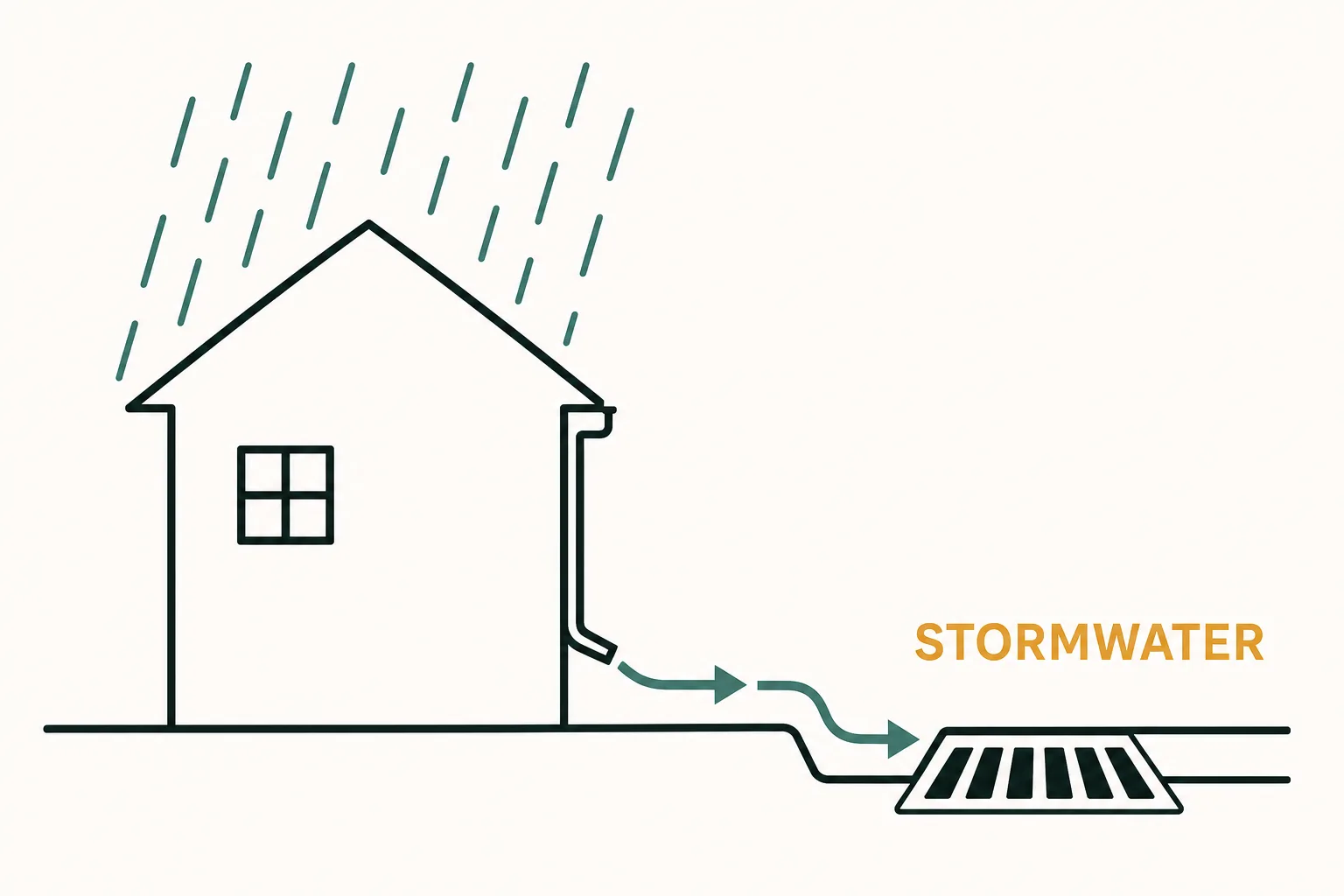
When rain falls on a roof, driveway, or parking lot, it cannot soak into the ground. It runs off hard surfaces, picks up oil, fertilizer, pet waste, and trash, and flows into storm drains, pipes, and local creeks. Someone has to build and maintain that system — and under the federal Clean Water Act, many cities are required to manage this runoff through a municipal separate storm sewer system (MS4) permit.[7]
The fee typically funds:
- Storm drain pipes, inlets, and catch basins
- Flood control projects and drainage channels
- Treatment facilities that capture pollution before it reaches rivers and streams
- Street sweeping and maintenance of the drainage system
- Monitoring water quality in local waterways
Philadelphia, for example, says its annual stormwater management costs exceed $100 million, and revenue from its stormwater charge funds the city’s network of pipes and inlets plus pollution-reduction programs.[1] Baltimore says the primary expenses paid for with its fee are maintaining, operating, and improving the stormwater management system, monitoring the city’s water bodies, and reducing pollutants that enter waterways.[5]
The Three Ways Cities Bill Stormwater
Cities use three main billing structures. Check your bill or your city’s rate page to see which one applies to you.
| Billing structure | How it works | Verified example |
|---|---|---|
| Flat rate | Same charge for every residential property, based on the citywide average home | Philadelphia: one flat monthly stormwater charge for all residential properties, based on average property size and impervious area [1][2] |
| ERU (equivalent residential unit) | 1 ERU = the impervious area of a typical home; you pay per ERU | Baltimore: 1 ERU = 1,050 sq ft of impervious area; non-single-family properties pay $78 per ERU per year, and single-family homes pay 2/3, 1, or 2 times that rate by tier [5] |
| Impervious-area tiers | Fee rises with measured hard surface (roof, driveway, patio) | Charlotte: tiered monthly fees for detached single-family homes, roughly $10 to $35 across tiers [3]; Seattle: flat annual rate by parcel size, billed on the property tax [4] |
A few things to notice. First, the same city can mix structures: Charlotte bills detached single-family homes by tier but bills apartments and commercial properties per acre of impervious area.[3] Second, the fee is usually tied to the property, not to the person or the meter. Philadelphia charges every residential property — even one with no water service at all.[2]
Why It Sits on a Water Bill (or a Property Tax Bill)
Stormwater is a property problem, not a water-usage problem. The amount of runoff your property creates depends on how much roof and pavement it has, not on how many gallons you use. That is why the charge is often attached to the water bill (the utility already has your account) or, in some cities, to the property tax bill.
- On the water bill: Philadelphia bills the stormwater charge as a separate line item on the monthly water/sewer bill, and it is not based on water consumption.[1][2]
- On the property tax bill: Seattle charges property owners a drainage fee based on each property’s estimated impact on the city’s drainage system, and it is collected with King County property taxes — shown on the tax bill as SWM (Surface Water Management) or Drainage.[4]
If you rent, the fee may not appear on your bill at all — see the renter section below.
Can You Reduce It? Credits, Rain Barrels, and Permeable Surfaces
Sometimes, but not always. The honest answer depends on your city’s rules.
- Portland offers Clean River Rewards: if you manage rain on your property so it soaks into the ground instead of entering the sewer and stormwater system, you can get a discount on the stormwater portion of your bill — up to 35% of the total stormwater fee.[6]
- Charlotte says property owners may qualify for a fee credit by reducing impacts to the storm drainage system, for example if runoff drains to a neighboring county.[3]
- Philadelphia is the cautionary tale: stormwater credits are not currently available for residential properties, and installing rain barrels or other stormwater tools will not reduce the monthly charge — even though the city offers free rain barrels through its Rain Check program.[2]
So before you spend money on a rain barrel or permeable pavers expecting a bill credit, check your city’s stormwater credit policy first. Some cities reward the behavior; others simply encourage it. For the full list of water-bill savings that do work, see how to lower your water bill.
Renters vs. Owners: Who Pays?
Because the stormwater fee is tied to the property, the owner usually pays it — but the cost can still reach you.
- If the fee is on the water bill and you pay the water bill, you are paying it directly.
- If the fee is on the property tax bill, the landlord pays it — but that cost is often factored into rent.
- If you live in an apartment building, the building is billed for its impervious area (Charlotte bills apartments per acre of impervious area; Baltimore bills non-single-family properties per ERU), and the cost is spread across all units through rent or a building water bill.[3][5]
The practical takeaway: a stormwater fee is a property infrastructure cost, so it behaves more like a tax than a usage charge. Reducing your personal water use will not reduce it.
How to Check What Your City Charges
- Look at your bill for a line called “stormwater,” “drainage,” “SWMS,” “surface water management,” or “storm water services.”
- If it is not on the bill, check your property tax statement for a drainage or SWM line.[4]
- Search your city or utility website for “stormwater fee” or “stormwater rate” — most publish the rate schedule.
- If the charge looks wrong, ask about appeals: Philadelphia allows property owners to appeal incorrect parcel data or property classification.[2]
For the full picture of how water bills fit together, start at the water explained hub. If your water bill also includes sewer charges, see how sewer charges work on your water bill to separate the two. And if the whole bill feels high, start with the high-water-bill investigation guide and the water meter leak indicator to rule out leaks before assuming the fee is the problem. To understand the usage units on the rest of the bill, see what is CCF on a water bill.
Sources
- Philadelphia Water Department — Stormwater Billing (retrieved 2026-08-30)
- Philadelphia Water Department — Residential Stormwater Charge (retrieved 2026-08-30)
- City of Charlotte — Storm Water Services Fees (retrieved 2026-08-30)
- Seattle Public Utilities — Drainage Rates (retrieved 2026-08-30)
- Baltimore City Department of Public Works — Stormwater Fee (retrieved 2026-08-30)
- City of Portland — Clean River Rewards (retrieved 2026-08-30)
- EPA — Stormwater Discharges from Municipal Sources (retrieved 2026-08-30)