Quick Answer
Single-stage equipment operates at one capacity when it is on. Two-stage equipment has two operating capacities. Variable-speed equipment can adjust compressor speed to vary output rather than operating only at a single full capacity. Exact features, controls, and capacities vary by product, so compare the quoted equipment rather than relying on a label alone.[1][2]
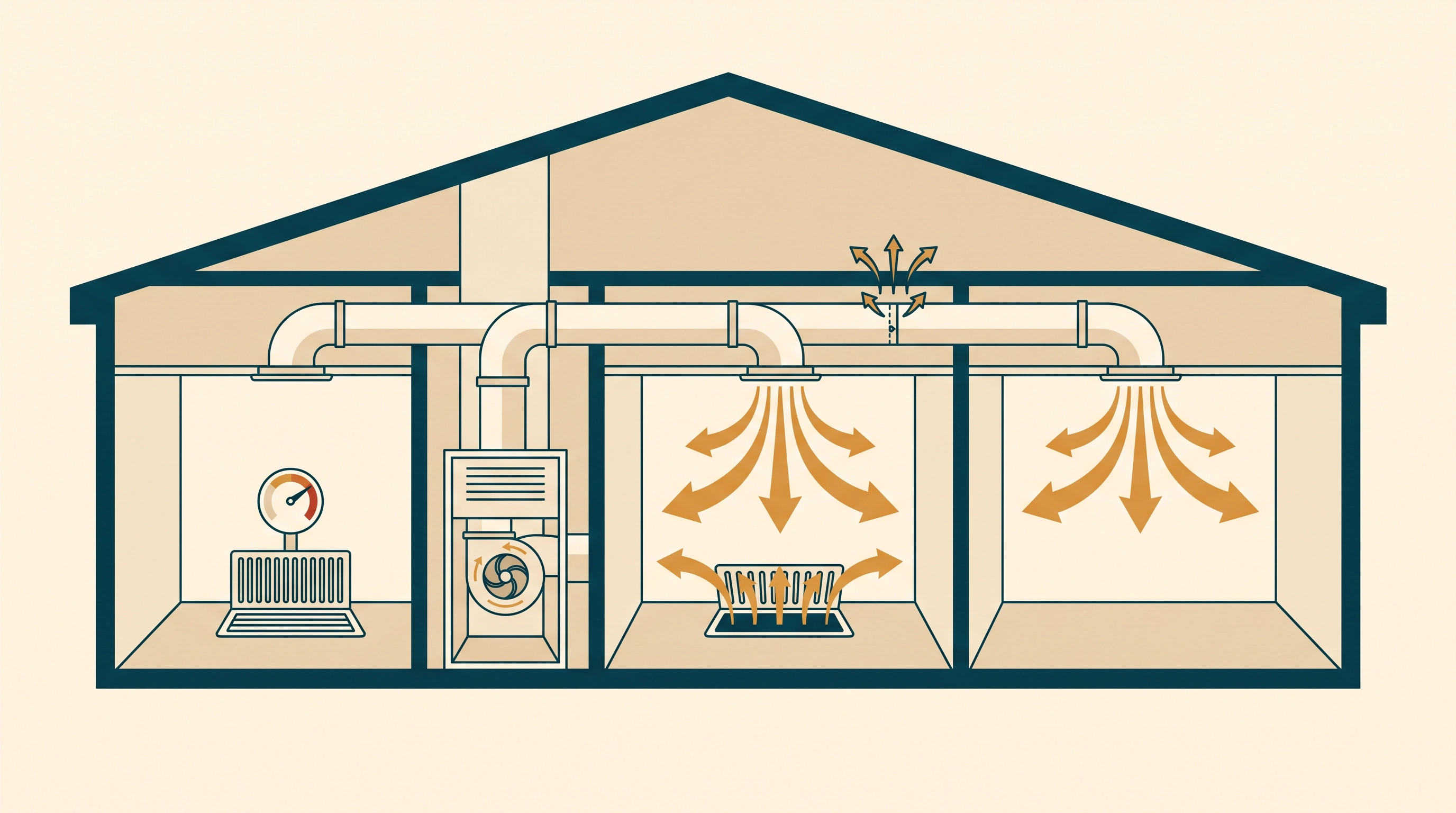
For a central HVAC replacement, stage count is only one part of the decision. DOE guidance emphasizes matching equipment capacity and air-distribution design to the home’s calculated heating and cooling loads.[2]
What the Terms Mean

Single-stage
A single-stage system has one operating capacity when it runs. ENERGY STAR describes a conventional air-conditioner compressor as operating like an on/off switch: it is on at maximum capacity when cooling is called for or off after the desired temperature is reached.[1] This means the system always runs at 100% output, then cycles off completely.
Runtime behavior: Short cycles, especially in mild weather. In spring and fall, a properly sized single-stage AC might run for 10–15 minutes, then stay off for 20–30 minutes. This on/off cycling means it rarely runs long enough for the coil to reach full dehumidification, which happens only after about 10 minutes of continuous operation.
Comfort and humidity: Because single-stage systems run at full capacity and shut off abruptly, they remove less moisture per cooling cycle than longer-running systems. The evaporator coil gets cold quickly but the condensate may not have time to drip off before the cycle ends. In humid climates, the indoor humidity may stay 55–65% instead of the preferred 40–50% range.
Two-stage
Two-stage equipment has two capacities — typically 100% (high stage) and around 60–70% (low stage). The capacity split and controls vary by model; DOE’s two-stage furnace example illustrates the concept and is not a universal specification.[2]
Runtime behavior: In mild conditions, the system runs in low stage for longer periods — 45–60 minutes rather than 10–15 minutes — then cycles to high stage only when the thermostat demands more capacity. Longer run times mean the system spends more time actually moving air and cycling the refrigerant, which improves temperature consistency (typically ±1°F vs ±3°F for single-stage).
The ecobee Premium supports up to 2-stage heat pumps, 2-stage conventional heating, and 2-stage cooling systems — including variable-speed air handlers (ecobee.com spec page). Built-in air quality monitor, smart sensors, and remote sensor kit. Compatible with most 24V HVAC systems. Compare: the Nest Learning Thermostat (4th gen, B0D5BBYRJM) already sold on this site also supports multi-stage systems but requires the Nest Power Connector for some systems without a C-wire.
Check price on Amazon As an Amazon Associate we earn from qualifying purchases. Price & availability shown on Amazon.com.Comfort and humidity: The longer low-stage cycles allow the coil to stay cold for extended periods, which means more moisture is removed per unit of cooling. Two-stage systems typically remove 20–30% more humidity than a single-stage equivalent during mild cooling conditions because the coil stays below dew point for longer.
Variable-speed
Variable-speed equipment can vary compressor speed to control output more continuously — typically from 30–40% up to 100% in small increments. ENERGY STAR explains that variable-speed compressor technology can change the speed of the internal compressor motor to control temperature.[1]
Runtime behavior: Variable-speed systems can run for 8–16 hours or even continuously in mild conditions, ramping up and down to match the load exactly. Instead of cycling on and off, the system adjusts its output in real-time. This eliminates the temperature swings of single-stage equipment entirely. Inverter-driven heat pumps can maintain target temperature within ±0.5°F.
Comfort and humidity: Because the system runs almost continuously at low speeds, the coil stays cold and the airflow is reduced (the fan slows with the compressor), allowing maximum moisture removal. Variable-speed systems can achieve indoor humidity levels of 40–45% even in humid climates, which is better than any staged system. The continuous air movement also reduces temperature stratification (warm ceiling, cool floor).
Comparison: Runtime Behavior and Comfort
| Feature | Single-Stage | Two-Stage | Variable-Speed |
|---|---|---|---|
| Operating levels | 1 (100%) | 2 (~60–70% and 100%) | Continuous (30–100%) |
| Typical run time per cycle | 8–20 min | 30–60 min | 8–16+ hours or continuous |
| Temperature swing | ±3°F – ±4°F | ±1°F – ±2°F | ±0.5°F |
| Humidity removal in mild weather | Poor | Moderate | Excellent |
| Indoor air filtration | Minimal (fewer air passes) | Moderate | Extensive (continuous filtration) |
| Sound (indoor, low stage) | Full speed fan noise | Quieter in low stage | Very quiet at low speeds |
| Dehumidification mode | None built-in | May have separate mode | Built-in (overcool or fan slow) |
Which Stage for Which Climate and Home
The following table gives general guidance. Always get a Manual J load calculation from a contractor — the right choice depends on your specific home envelope, duct design, and local climate.
| Home / Climate Profile | Recommended Type | Why |
|---|---|---|
| Hot-dry climate (Southwest, inland California) | Single-stage or two-stage | Low humidity means dehumidification is less critical. Single-stage is lower cost. Two-stage adds comfort in shoulder seasons. |
| Hot-humid climate (Southeast, Gulf Coast, Mid-Atlantic) | Variable-speed or two-stage | Humidity control is essential. Variable-speed provides the best dehumidification. Two-stage is a cost-effective middle ground. |
| Cold climate (Northeast, Midwest, mountain states) | Two-stage or variable-speed (heat pump) | Two-stage furnaces reduce temperature stratification. Variable-speed heat pumps can operate efficiently at low temperatures with better capacity modulation. |
| Mixed climate (Pacific NW, Ohio Valley, Southern Plains) | Variable-speed (heat pump) or two-stage | System must handle both heating and cooling loads that change dramatically by season. Variable-speed adapts best. |
| Small home / condo / apartment (<1,200 sq ft) | Single-stage or two-stage | Lower total load means staging adds less benefit. A well-matched single-stage system is cost-effective. |
| Large home / multi-zone (>3,000 sq ft) | Variable-speed or two-stage with zoning | Longer duct runs and multiple zones benefit from modulating air volume and capacity. |
| Existing home with undersized ducts | Variable-speed | Variable-speed air handlers can ramp down to match restricted ductwork, reducing noise and static pressure problems. |
| Home with allergy concerns | Variable-speed | Continuous filtration (fan-on mode) with variable-speed uses less energy than full-speed fan operation. |
Compatibility with Thermostats
Before buying any multi-stage or variable-speed system, confirm the thermostat can control it. Not all thermostats support multiple stages or communicating protocols.
The ecobee Smart Thermostat Premium (linked below) supports up to 2-stage heat pumps, 2-stage conventional heating, and 2-stage cooling systems, including variable-speed air handlers per the ecobee compatibility page.[3][4] It also supports dehumidification control via overcooling or accessory relay and can be configured for heat pump with auxiliary heat.
Nest Learning Thermostat (4th gen): Also supports multi-stage systems (up to 2H/2C conventional, or 2H/3C heat pump with auxiliary heat) but requires a C-wire or the Nest Power Connector for systems without an existing common wire. Compatibility should be verified at the Nest compatibility checker.
Key thermostat compatibility points to verify:
- Does your thermostat communicate via standard 24V HVAC wiring or a proprietary communicating protocol? Variable-speed systems from some manufacturers (Carrier Infinity, Trane XL, Lennox iComfort) require a communicating thermostat from the same brand.
- For standard 24V systems, the thermostat must have enough stages available. A single-stage thermostat with a two-stage furnace will only use the high stage, defeating the purpose.
- Does the thermostat support dehumidification control? Some require a separate dehumidistat or a thermostat with a dry-contact input.
The ecobee box below is already linked on this page. Compare its features to your wired system before purchase.
The ecobee Premium supports up to 2-stage heat pumps, 2-stage conventional heating, and 2-stage cooling systems — including variable-speed air handlers (ecobee.com spec page). Built-in air quality monitor, smart sensors, and remote sensor kit. Compatible with most 24V HVAC systems. Compare: the Nest Learning Thermostat (4th gen, B0D5BBYRJM) already sold on this site also supports multi-stage systems but requires the Nest Power Connector for some systems without a C-wire.
Check Price on Amazon Price & availability shown on Amazon.com — we may earn a commission.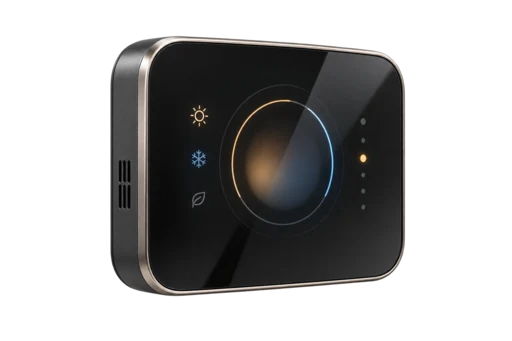
Related Reading
- AFUE vs SEER vs HSPF vs COP — what the efficiency ratings actually measure
- Ductless Mini-Split vs Central Air — the other big system decision
- Heat Pump Running All Day in Winter? — staging meets runtime behavior
- Why Is My Furnace Blowing Cold Air? — when staging is not the issue