Quick Answer
Net metering is a billing arrangement between a solar-system owner and a utility. When a qualifying system exports electricity to the grid, the utility may apply a credit under its current tariff. The credit rate, rollover rules, settlement date, fees, eligibility, and whether net metering is available all depend on the serving utility and local rules.[1][2]
Do not use a national payback table or another state’s policy to predict your bill. Ask your utility for the current interconnection agreement and tariff that apply to your address.
How the Arrangement Works
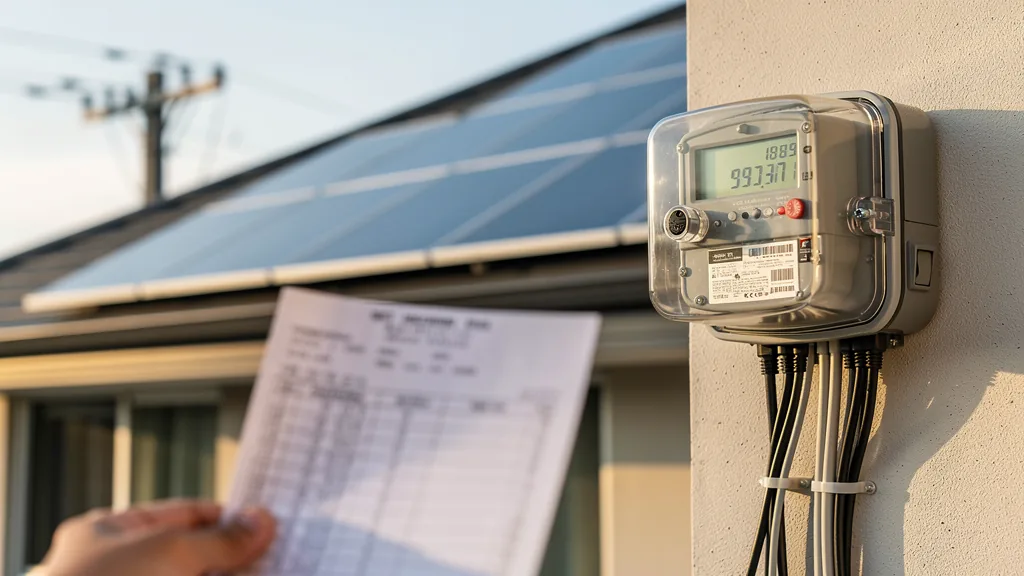
DOE describes net metering as electricity flowing both to and from a customer, typically through a bidirectional meter.[1] When solar generation is greater than use at a given time, electricity can be exported. When on-site generation is lower than use, electricity is imported from the grid.
The bill then applies the utility’s own rules to imports, exports, credits, fixed charges, taxes, and any minimum bill. A bill may show some combination of imported kWh, exported kWh, generation, usage, credits, and a remaining balance, but labels vary by utility.
What to Check Before You Sign or Install
- Eligibility: Does the utility offer an export-credit or net-metering arrangement for your system type and location?
- Credit calculation: Is the export credit based on retail price, another published rate, or a program-specific calculation?
- Credit timing: When do credits apply, expire, settle, or carry forward?
- Fixed charges: Which customer, delivery, interconnection, or minimum charges still apply?
- Rate plan: Does your current plan affect the value of imports or exports?
- Interconnection: What application, inspection, meter, insurance, and operating requirements apply?
Keep copies of the tariff, interconnection agreement, and first several solar bills. They are more useful than a generic online example when a credit or charge looks unfamiliar.
How to Read a Solar Bill
Compare the current bill with the utility’s tariff and look for:
| Item | Question to ask |
|---|---|
| Grid import | How much electricity did the account receive from the grid? |
| Grid export | How much eligible electricity did the account send to the grid? |
| Credit | What tariff rule determined its value? |
| Fixed charges | Which charges apply regardless of solar generation? |
| Billing period | Do the dates match the utility’s solar settlement rules? |
| Rate plan | Does the account use a time-varying or other special rate? |
DOE’s homeowner solar guide explains that compensation for exported solar power is an arrangement between the system owner and the utility.[2] That is why the utility’s current documents—not a national “Net Metering 1.0/2.0/3.0” label—should control your decision.
Questions to Ask the Utility
- Which tariff applies to my proposed or existing system?
- How are exports measured and credited?
- Which charges remain when production exceeds use?
- What happens to unused credits at the end of a billing period or program year?
- Can a rate-plan change alter the value of exported electricity?
- Where can I read the current interconnection and consumer-disclosure documents?
What Exports Actually Pay: A Real-State Example
California shows how far export compensation can move. Under the state’s older NEM 2.0 rules, exported solar energy was credited near the full retail electricity rate—roughly 30 cents per kWh at reported averages. That made a solar array’s spare daytime generation relatively valuable.
In 2023, California moved most new customers to the Net Billing Tariff (often called “NEM 3.0”). Unlike NEM 2.0, the Net Billing Tariff does not credit exports at the retail rate. Instead, Southern California Edison (SCE) explains that export credits “reflect the electricity’s value to the electric grid during each hour of the day,” with prices set from the CPUC Avoided Cost Calculator as of January 1 of the calculation year.[3]
The practical result, as reported by secondary sources, is that average export credits now run roughly 5–8 cents per kWh—about 75% below NEM 2.0 levels. That figure is reported by industry commentators and is not a tariff-verified number; always check the current tariff for your own utility and interconnection vintage.[4]
One piece of structure does give California customers a degree of certainty: SCE confirms that Net Billing Tariff vintages 2023 through 2026 “have fixed prices for 9 years” from interconnection. After that period, export prices may reset.[3] That 9-year lock is the one planning certainty in the structure, though it does not fix imported-energy rates, fixed charges, or other bill items.
What That Means in Dollars
To make the impact concrete, here is labeled illustrative math—not a quote, a tariff, or a promise:
- A home exports 400 kWh in a month.
- At an average export credit of 6 cents per kWh, that export is worth about 400 × $0.06 = $24 per month.
Now consider the same export shifted to evening hours under a time-of-use battery strategy. Because NBT export prices vary by hour and typically pay more in the evening, the same 400 kWh moved to a higher-value window is worth multiples of $24. That gap is a large part of why the Net Billing Tariff pushes customers toward battery storage: storage lets a customer keep daytime solar and export it when grid value is higher.[4]
The national picture still varies. Policies remain state-by-state: many states still credit exported solar near the retail rate, and California’s shift does not mean net metering is disappearing everywhere. Before relying on any estimate, get the current tariff and interconnection agreement for your own service address.
A Different Shape Entirely: Buy-All/Sell-All (Illustrative)
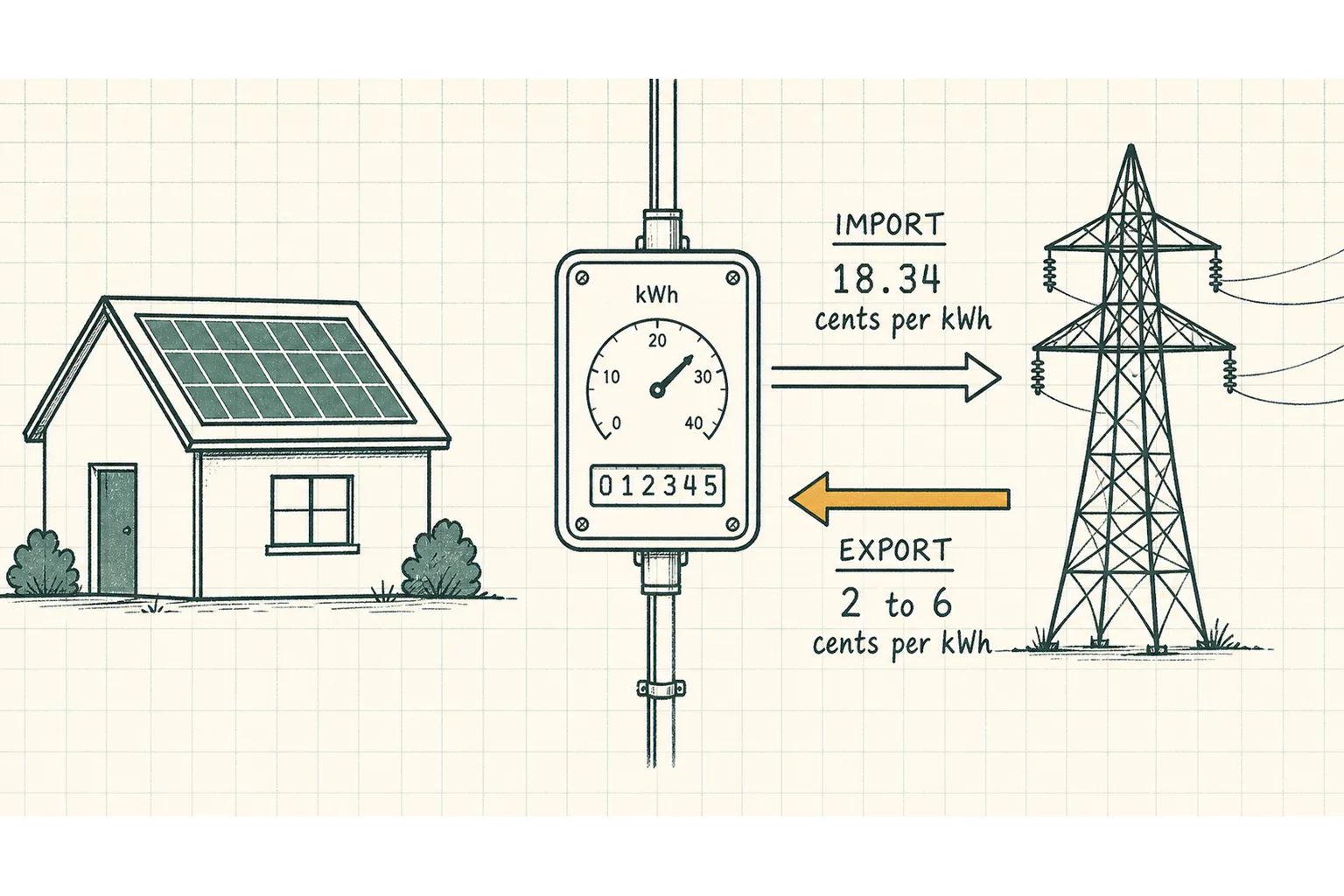
Not every state prices exports by hour. Some tariffs are buy-all/sell-all: the utility meters everything the array produces and buys all of it at a set export rate, while the household buys 100% of the power it consumes at the normal retail rate. Two flows, two prices, never netted — the bill is simply purchases minus sales.
All figures below are illustrative: the buying side uses the site-canonical national average, the selling side a round-number export rate — the same 400 kWh and 6¢ as the worked example above, now on the other side of the ledger.
- Buying side: a typical U.S. home uses about 899 kWh in a month; at the national residential average of 18.34¢ per kWh (EIA, June 2026), that costs 899 × $0.1834 ≈ $164.88.
- Selling side: the same month, the array exports 400 kWh, which the utility buys at an illustrative 6¢ per kWh → $24.00.
- Net for the month: $164.88 − $24.00 = $140.88.
The structure is the lesson. Under buy-all/sell-all, every kWh consumed on-site the moment it is generated is still worth the full retail price to the household, while every exported kWh earns only the export rate — that spread is why self-consumption gets rewarded in these territories, and why storage economics differ from California’s hour-varying model. At the opposite pole sit states that still credit exports near retail: the same month on such a tariff would bill closer to 499 × $0.1834 ≈ $91.52 — about $49 below the buy-all/sell-all net above, on nearly identical roofs. Between the poles sit successor tariffs with hour-varying export values, minimum-bill rules, and credit rollover terms. Whatever your state’s current design, the reading habit is identical: find the buy rate, the export rate, and the settlement rules in your own tariff before signing anything.
Where This Lands on Your Bill
A solar credit line never travels alone — it sits inside a bill built from delivery charges, fixed charges, and the rate plan you were on before the panels went up. Five pages take you from the export line to the rest of the statement:
- Which rate plan is right for me — your rate plan decides what your imports cost and when exports are worth keeping or selling.
- Time-of-use electricity, reviewed — how peak and off-peak windows are priced, and how to audit a TOU plan before joining it.
- What time is electricity cheapest? — the hour-by-hour picture behind every export-credit decision.
- Demand charges on an electricity bill — solar lowers averages, not necessarily your worst half-hour; know whether your tariff bills the peak.
- Electric bill breakdown: every charge explained — where the credit, delivery, and fixed lines actually sit on the statement.