Quick Answer
Schedule the turn-OFF at your old place for the day AFTER you move out, and the turn-ON at the new place for the day BEFORE you arrive. You want power while you clean and load the truck, and you want the new home lit, cooled, or heated before you walk in.
- Call 2+ weeks ahead if you’re crossing into a new provider’s territory — that means a new account and possibly a new deposit
- Same provider? Ask for a transfer instead of a close-and-reopen — it’s usually the smoothest path and avoids a deposit
- Never let both homes overlap more than a day — every overlapping day is a bill you’re paying for a house you no longer live in
If you’re mid-move right now, the two numbers that matter are: the day after you leave (old home off) and the day before you arrive (new home on).
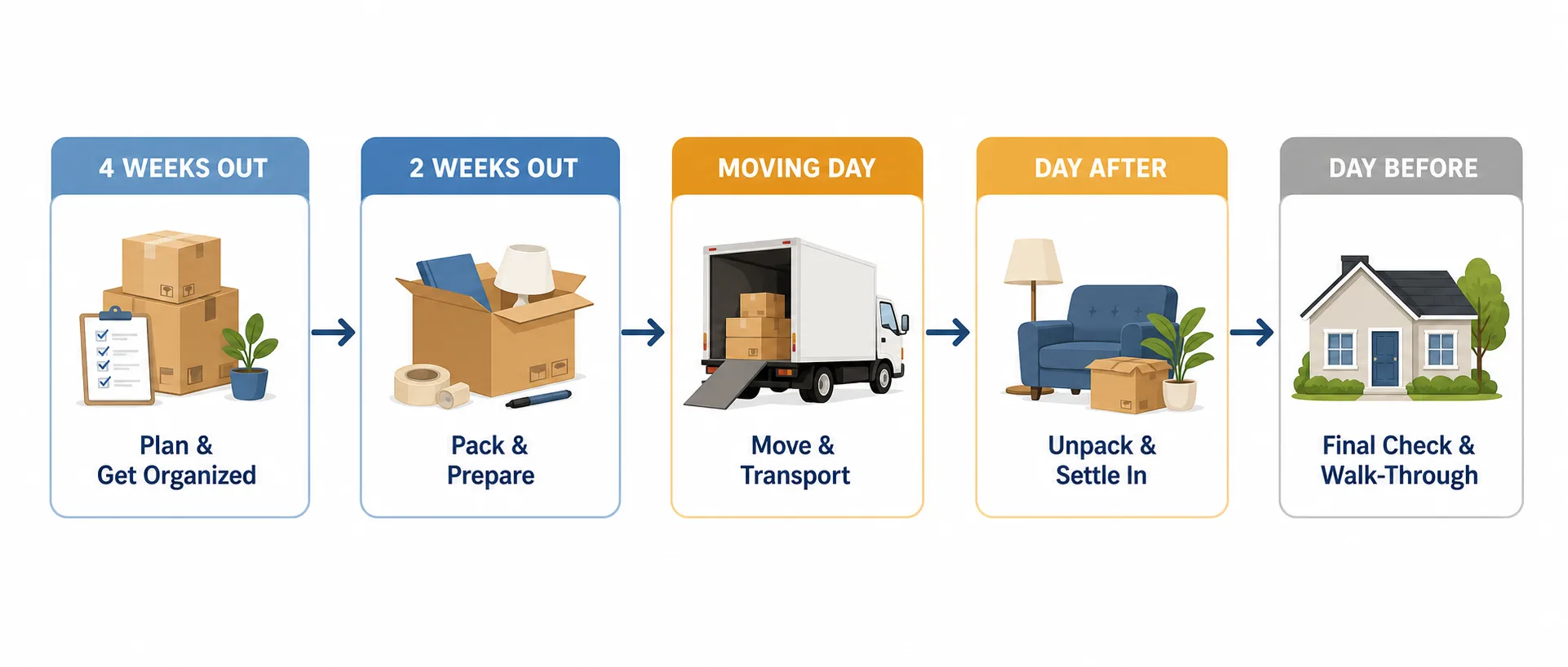
The Timeline: 4 Weeks Out → Moving Day
Start early, and the move gets dramatically easier. Here’s the week-by-week plan.
| When | What to do | Why it matters |
|---|---|---|
| 4 weeks out | List every service at both addresses: electric, gas, water, trash, internet, and any city-billed utilities | You can’t schedule what you haven’t inventoried |
| 3 weeks out | Call each provider. Ask: transfer or close? What’s the deposit? What’s the notice window? | Locks in dates before the busy season fills up |
| 2 weeks out | Confirm the turn-off and turn-on dates in writing. Note the account numbers and reference numbers | Written confirmation is your protection if a date slips |
| 1 week out | Set up mail forwarding for the final bill [1]. Photograph both meters | Forwarding stops collections surprises; photos settle disputes |
| 2 days before | Confirm the new-home turn-on is still scheduled. Ask about the connection window | Avoids arriving to a dark, cold, or dry house |
| Moving day | Turn off at old home (after you’re done loading). Turn on at new home (if not already live) | The two dates you planned for |
| Day after | Walk the old home, photograph the empty rooms and the meter one last time | Proof of condition and final reading |
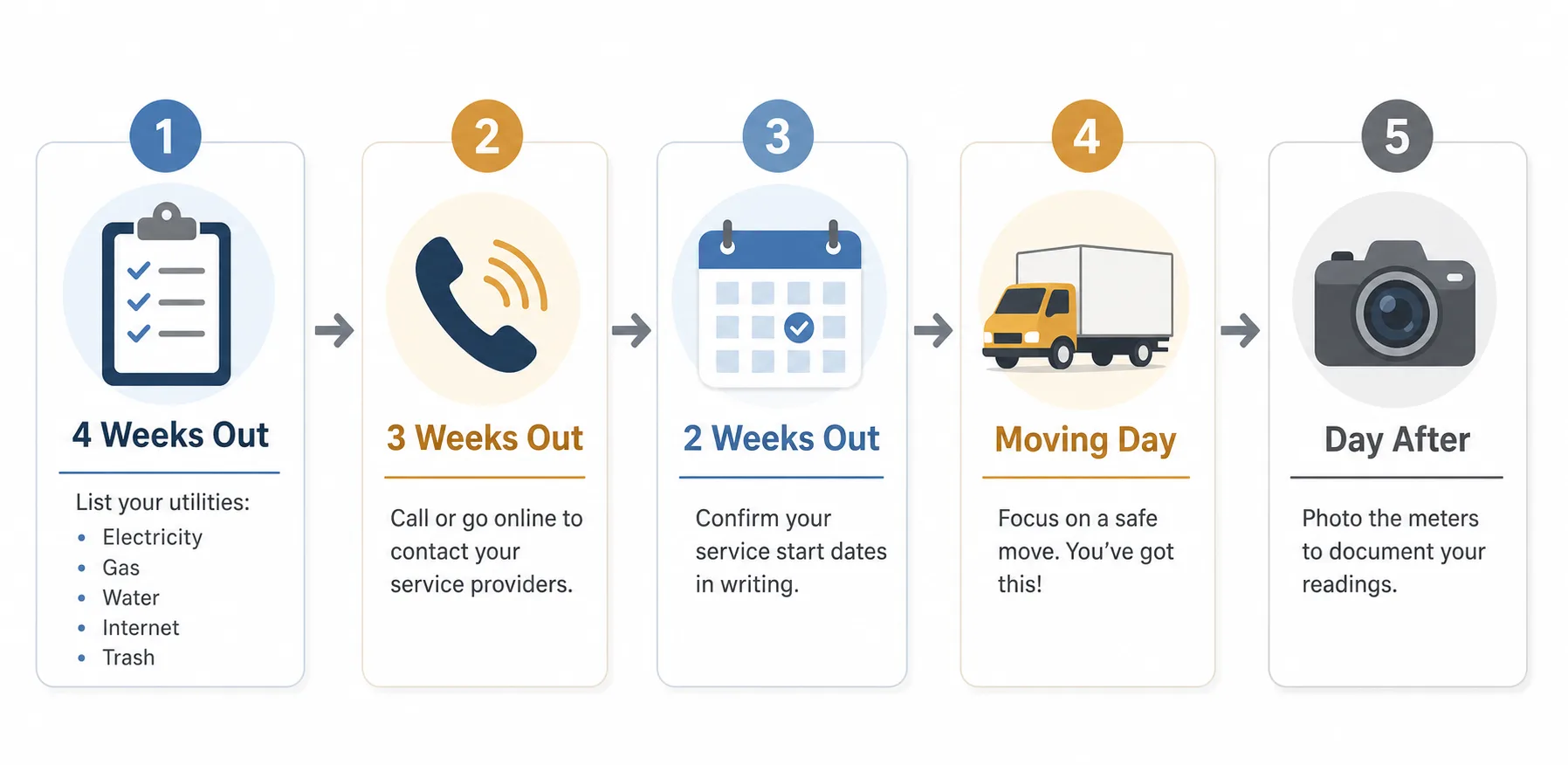
Two things to note. First, the 2-week mark is the real deadline for most providers — each utility sets its own lead time, so confirm the notice window when you schedule [2]. Second, if you’re moving into a new provider’s territory, start at 3 weeks, not 2 — a new account can require a credit check and a deposit, and that takes time.
Turn-Off vs. Transfer: Which Applies to You
The single most important question to ask each provider is: “Can I transfer this account, or do I need to close and reopen?” The answer changes everything.
Same provider, same territory = transfer. If your new address is served by the same electric, gas, or water company, you can usually transfer the account. The service moves with you, your history carries over, and there’s typically no new deposit. It’s the smoothest path — ask for it first.
Different provider or different territory = close old + open new. If you’re moving across a service boundary, the old account gets a final bill and the new one starts fresh. That fresh start often means a deposit — especially if your credit check comes back thin. Budget for it, and ask whether the new provider will waive it if you set up autopay or provide a letter of good standing from your old utility.
Renters have extra rules. Before you cancel anything, check your lease. Many leases require you to keep electricity or water on through the end of the term, and some landlords bill utilities through the building — in which case you don’t cancel anything at all, you just notify the landlord of your move-out date. Never cancel a shared or building-billed service on your own; you could be on the hook for a disruption fee or a lease violation.
Deposits, Connection Fees, and How to Avoid Paying Twice
Moving is expensive enough without paying for utilities you never used. Three costs to watch.
New-service deposits. When you open a new account, the provider may run a credit check. A strong history usually means no deposit; a thin one means a deposit that can be substantial. Ask three things: (1) can the deposit be waived with autopay or a good-credit letter, (2) can it be paid in installments, and (3) is it refundable after a year of on-time payments. Many utilities will work with you if you ask.
Connection fees. The new provider may charge a connection fee to turn the service on — a flat amount separate from any deposit. Ask for it in writing when you schedule, so there’s no surprise on the first bill.
The old deposit. If you had a deposit at the old place, it’s usually refunded after the final bill is settled — not before. Ask the old provider when the refund will be issued and whether it can be transferred to the new account if it’s the same company.
Why your final bill arrives later. Your old provider won’t bill you on your normal cycle after you move. Instead, they’ll issue a final bill based on a final meter reading, and that takes time — often a few weeks. It’s not a mistake, and it’s not a double charge. It’s just the billing cycle catching up to your actual usage. Plan for it to arrive after you’ve already settled in.
The Final Bill: Catching Old-Home Charges
The final bill is where mistakes happen — and where a little documentation saves you real money.
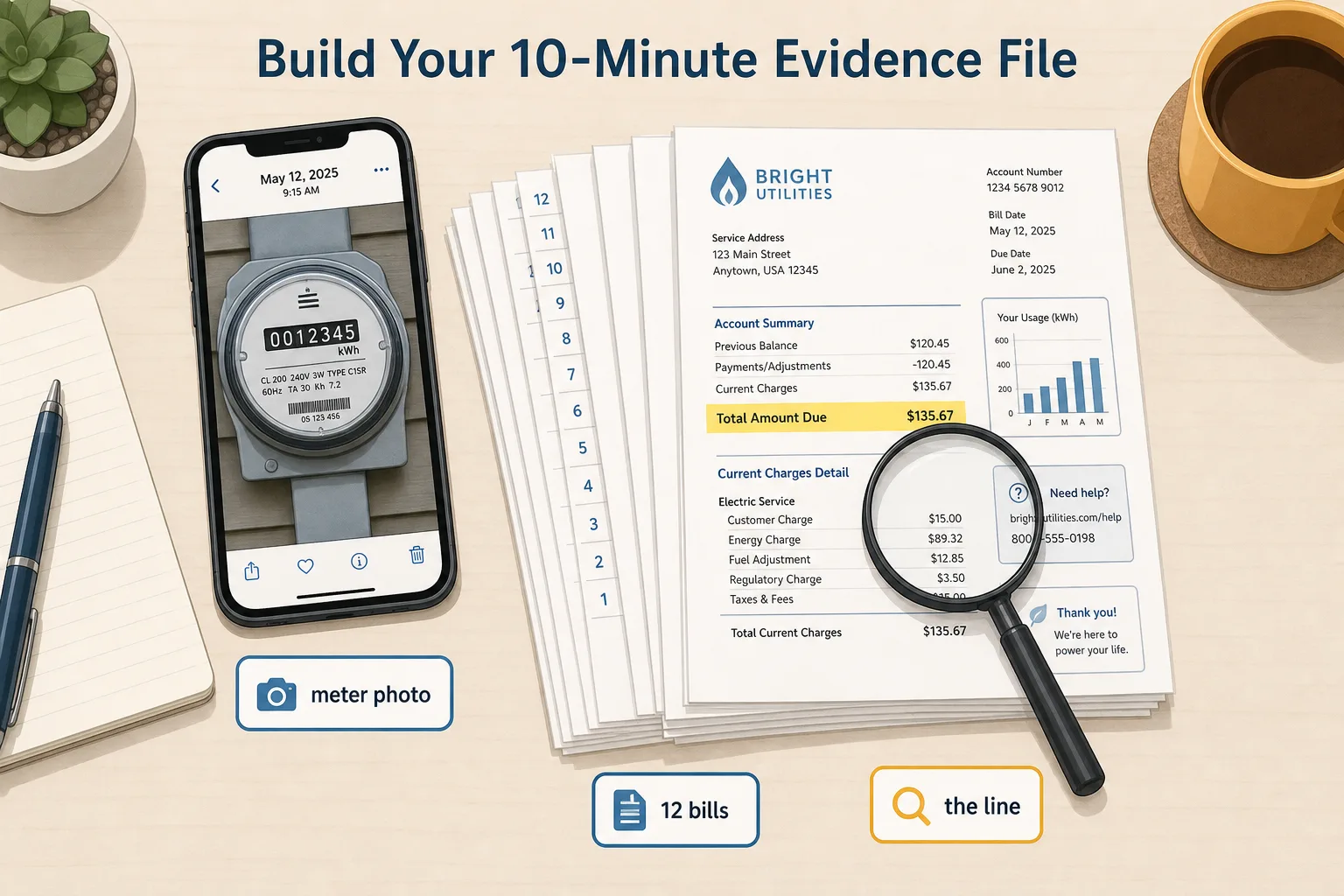
Be present for the final reading if you can. When the utility schedules the final meter read, try to be there. If you can’t, take your own photo of the meter on move-out day with the date visible. That photo is your evidence if the final bill doesn’t match. If you’re not sure how to read the dials, check our guides for electric, gas, and water meters before you go.
Expect prorated charges. Your final bill will be prorated — you pay only for the days you actually used service, not a full month. That’s normal and correct. If the bill looks like a full month when you moved out on the 10th, that’s a red flag worth disputing.
Dispute residual charges promptly. If the final bill includes charges you don’t recognize — a late fee, a full month instead of prorated, or a reading that doesn’t match your photo — don’t just pay it. A disputed final bill can often be held while it’s investigated, and the same protections that apply to a shutoff dispute apply here. Call, cite your meter photo, and ask for a review in writing.
What People Forget (The Mistakes Section)
These are the quiet ways a move turns into a collections call or a double bill.
- Auto-pay left on the old account. If you had autopay, cancel it the day you schedule the disconnect — or the old account keeps pulling money after you’re gone. Cancel it, then confirm the cancellation in writing.
- No mail forwarding for the final bill. If the final bill goes to the old address and you’ve moved, you may never see it — and an unpaid final bill can go to collections. Set up forwarding at least a week before you leave [1].
- Forgetting trash and sewer. City-billed utilities are often tied to the property, not the person. If you don’t close the account, the new owners may inherit the bill — or you may be billed for a house you no longer own. Ask your city which services follow the property and which follow you.
- Not photographing the meters at BOTH ends. The old meter photo settles the final bill; the new meter photo proves your starting reading so the new provider doesn’t bill you for the previous tenant’s usage. Take both.
- Pool or irrigation water at the old home. If you had a pool or an irrigation system, that water bill can be large — and it’s easy to forget to close it. Add it to your inventory list.
Special Cases
Moving mid-month. If you move on the 15th, both bills get prorated — you pay for half a month at each place. That’s expected, but it means two partial bills in the same month. Budget for it, and don’t mistake the proration for an error.
First apartment. If this is your first place with utilities in your name, expect a deposit — you have no history yet. Budget for it, and read our guide to budgeting for utilities in your first apartment so the first bills don’t blindside you.
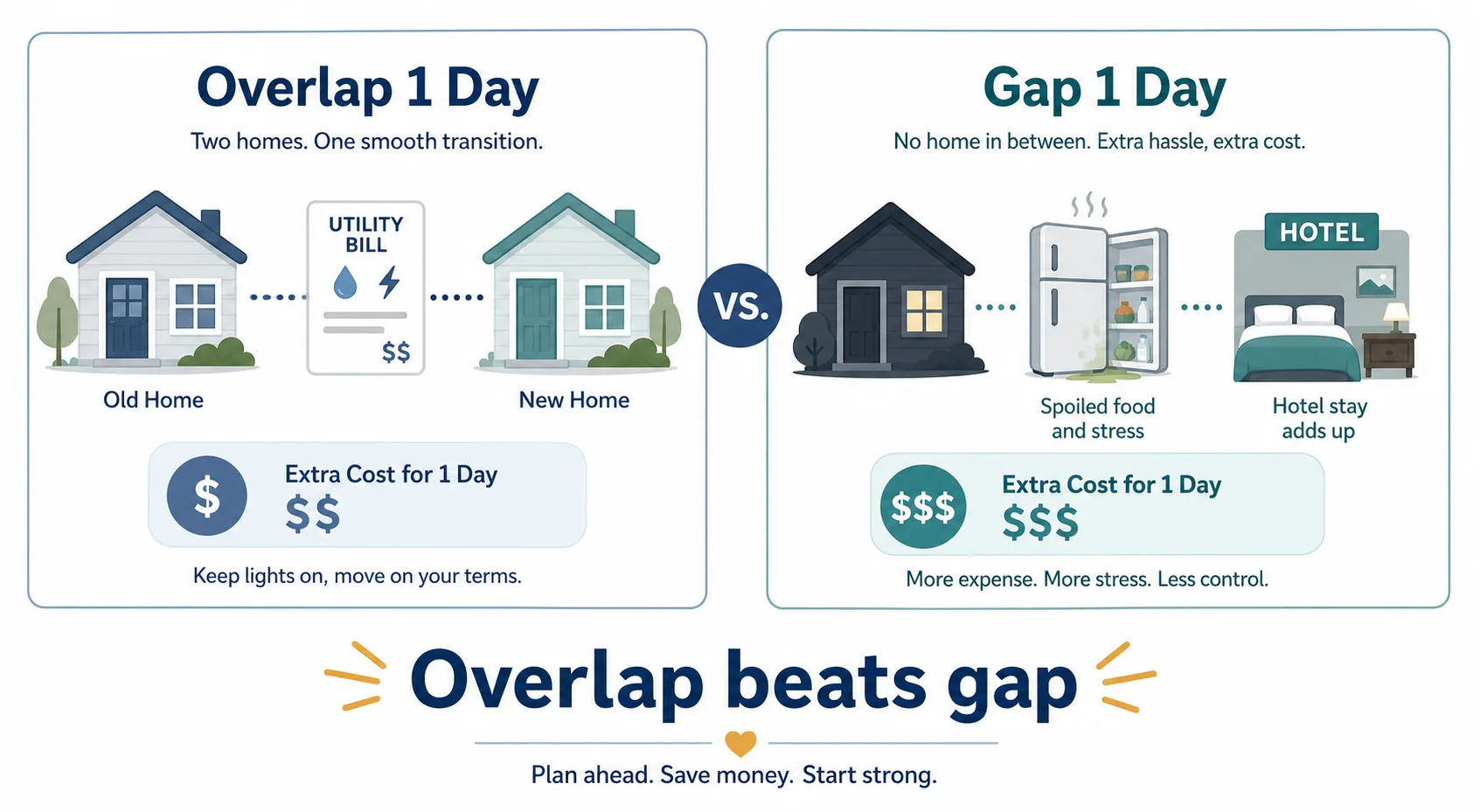
Service gaps: what one dark day actually costs. If you let the old service end and the new one start a day late, you spend one night with no power. That’s not just inconvenient — it can mean a fridge full of food going bad, or no heat in winter. The cost of one night in a hotel or a spoiled fridge is almost always more than the cost of one overlapping day of utility service. When in doubt, overlap by a day rather than gap by a day.
Checklist: The One-Page Printable Version
Print this, tape it to the fridge, and check it off as you go. It’s designed for a 2-minute scan on moving day.
4 weeks out
- List every service at both addresses (electric, gas, water, trash, internet, city-billed)
- Note which are in your name and which are the landlord’s or property’s
3 weeks out
- Call each provider; ask transfer or close?
- Ask about deposits, connection fees, and notice windows
- If new territory, start the new-account process
2 weeks out
- Confirm turn-off date (day after move-out) and turn-on date (day before move-in) in writing
- Record account numbers and reference numbers
- Cancel autopay on the old account
1 week out
- Set up mail forwarding for the final bill [1]
- Photograph the old meter with the date visible
- Notify the landlord if you’re a renter
2 days before
- Confirm the new-home turn-on is still scheduled
- Ask about the connection window and any fees
Moving day
- Turn off at the old home after loading is done
- Confirm the new home is live (or will be today)
- Photograph the empty old home and the meter one last time
After move-in
- Photograph the new meter (your starting reading)
- Watch for the old final bill; verify it’s prorated
- Track the old deposit refund
- Dispute any charge that doesn’t match your photos
FAQ
How far in advance should I schedule utility turn-off and turn-on?
Can I transfer my utilities on the same day I move?
What happens to my utility deposit when I move?
Do I need to be home for the utility connection?
This checklist is part of the Utility Bills Explained hub. Terms on your new statements are defined in the utility glossary.
Sources
[1] USPS Standard Forward Mail & Change of Address — online verification fee $1.25; forwarding may begin within 3 business days, best to allow up to 2 weeks; standard forwarding lasts 12 months with paid extensions available (6, 12, or 18 additional months). https://www.usps.com/manage/forward.htm (accessed 2026-08-29)
[2] Each utility sets its own notice period for service start/stop requests. Confirm the required notice window when you schedule your move — lead times vary by provider and region. For example, Dominion Energy offers “Start, Stop or Move Service” online scheduling; check your specific provider’s page for their stated lead times. https://www.dominionenergy.com/ (accessed 2026-08-29)