Quick Answer
Level 1 EV charging — the 120-volt cord that comes in the trunk — is not free, but it is cheap: an overnight 8-hour session adds roughly 11.5 kWh to your bill, about $2.11 at the June 2026 national average of 18.34¢/kWh, and a typical daily commute lands in the $46–64/month range. The honest way to know your own number is to measure the car’s actual draw with a pass-through meter like the Poniie PN2500 Level 1 pass-through meter — kWh read off the display, multiplied by your rate, with no guessing. This page is the Level 1 deep-dive: the outlet math, the “free charging” myth, and how to measure your own car. For the general question of how EV charging moves your whole bill — including Level 2, time-of-use rates, and cost-per-mile — that’s the companion guide, how EV charging affects your electric bill.
First, What Level 1 Charging Actually Is
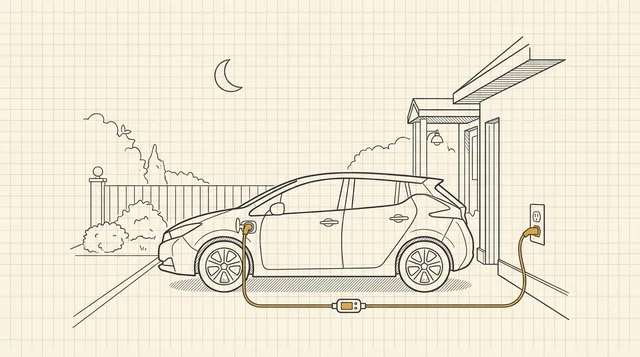
Level 1 is the charging method that needs nothing installed: the cord that ships in the trunk of most EVs plugs straight into a standard 120-volt household outlet — the same kind that powers a lamp or a phone charger. There is no wall box, no electrician, no 240-volt circuit. That is its whole appeal, and its whole limitation.
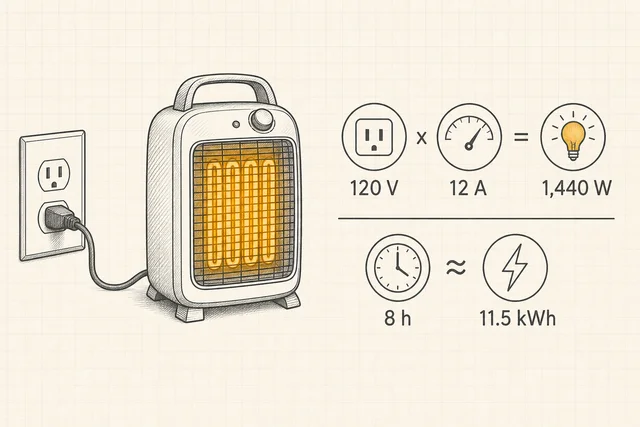
The math behind the name is simple. A standard North American outlet delivers 120 volts, and the Level 1 cord that comes with most EVs draws about 12 amps — the maximum a typical 15-amp household circuit is meant to carry continuously. Multiply them:
120 V × 12 A = 1,440 W
That is 1.44 kilowatts of continuous draw while charging. To put it in household terms, that is roughly the same as running a large space heater or a hair dryer on high — continuously, for hours. It is a real load, and it is metered electricity like any other. The car does not care whether the electrons came from a “charger” or a wall outlet; the utility bills them the same way.
Because 1.44 kW is modest, Level 1 is slow. It adds roughly 3–5 miles of range per hour of charging[3] — enough to top up a plug-in hybrid overnight or to cover a short daily commute, but not enough to refill a large battery-electric vehicle from empty in a single night. That speed reality is exactly why the Level 1 vs Level 2 decision matters, and it is covered in depth in how EV charging affects your electric bill. This page stays on the Level 1 specifics: what the outlet draw costs, why “free” is a myth, and how to measure your own car.
The Honest Math: What an Overnight Charge Costs
The cleanest way to think about Level 1 cost is one overnight session. Assume you plug in at night and charge for 8 hours — a realistic overnight window for most households.
8 h × 1,440 W = 11,520 Wh ≈ 11.5 kWh
At the June 2026 national average residential price of 18.34¢/kWh (EIA),[1] that session costs:
11.5 kWh × $0.1834 = $2.11
So one full overnight Level 1 session is about $2.11 — roughly the price of a single gallon of gas, for a charge that adds about 40 miles of range to a typical midsize EV (at ~3.5 miles per kWh, 11.5 kWh × 3.5 ≈ 40 miles). That is the honest headline: Level 1 charging is cheap per session, but it is not free, and it is not nothing.
The Monthly Commuting Scenario
Now scale it to a real month. A daily commute of, say, 30 miles round-trip needs about 8.6 kWh of delivered energy per day (30 miles ÷ 3.5 miles/kWh). With Level 1’s roughly 80–85% charging efficiency[4] — some energy is lost as heat in the conversion — the wall draws closer to 10–11 kWh per day. Over a 25-driving-day month:
Pass-through meter rated for Level 1 EV charging (60–240V, up to 25A): plug the car's cord into it, plug it into the wall, and read cumulative kWh off the display. Multiply by your rate for your real per-charge cost. Also works as a general appliance meter.
Check price on Amazon As an Amazon Associate we earn from qualifying purchases. Price & availability shown on Amazon.com.10.5 kWh/day × 25 days ≈ 262 kWh/month
At the national average rate:
262 kWh × $0.1834 ≈ $48/month
A lighter commute (say 20 miles/day) falls below this band — closer to $32/month — and a heavier one (40 miles/day) near the high end — call the honest monthly band 250–350 kWh and $46–64/month for a typical Level 1 commuter at the national average. Your actual number depends on three things: your miles, your car’s efficiency, and your rate. The rate is the biggest variable — the same 262 kWh costs about $29 at a cheap 11¢/kWh off-peak rate and about $79 at a 30¢/kWh flat rate. That rate spread is the heart of the companion guide, how EV charging affects your electric bill.
Compare It to a Tank of Gas, Honestly
The fair comparison is not “free vs. gas” — it is “billed electricity vs. gas.” A midsize EV at ~3.5 miles/kWh and 18.34¢/kWh costs about 5.2¢/mile in electricity (1 kWh ÷ 3.5 miles × $0.1834). A gas car at 25 MPG and $3.50/gallon costs 14¢/mile ($3.50 ÷ 25). So Level 1 charging is roughly a third the per-mile fuel cost of a comparable gas car — a real saving, but a saving measured in dollars, not a free lunch. The electricity still shows up on the bill, line by line, kWh by kWh.
The “Free Charging at Home” Myth
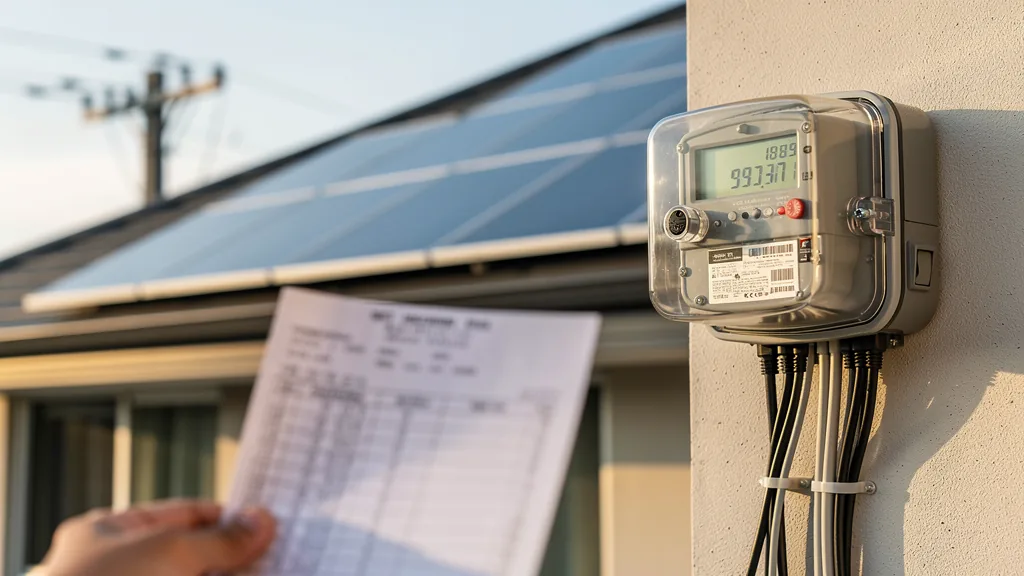
There is a persistent idea that charging at home — especially Level 1, since it uses “just a wall outlet” — is free. It is not, and the reason is worth stating plainly: every kilowatt-hour that goes into your car is a kilowatt-hour your utility meter counts and bills. The outlet does not have a separate meter that ignores the car; it is the same meter that runs the fridge and the lights. When you charge overnight, the utility’s meter spins (or its digital register ticks) exactly as it does for anything else in the house.
The myth probably survives because Level 1 sessions are small and spread out — a few dollars a night, easy to miss on a $150–200 monthly bill. But “easy to miss” is not “free.” If you want proof from your own account, the cleanest way is to measure the car’s draw directly (next section) or to compare your bill across a charging month and a non-charging month. The general method for separating the car from the rest of the house — including how to read the meter and spot the car’s share — is in how to read your electric meter.
One more honest note: some workplaces, dealers, and public stations do offer genuinely free charging, and that is real. But “free charging” at those locations is a perk paid for by someone else — the employer, the dealership, the station operator. At home, there is no third party; the bill is yours.
The Cheap-Outlet Caveats (Before You Plug In)
Because Level 1 draws 1,440 W continuously for hours, the outlet and the wiring matter more than most people expect. A few rules worth taking seriously:
- Use a dedicated outlet. The Level 1 cord should be the only thing on the circuit while charging. A 15-amp circuit running a 12-amp charger plus a microwave or a space heater on the same branch is overloaded — the breaker may trip, and sustained overload is how wiring heats up.
- A warm plug means stop. After an hour or two of charging, feel the plug and the outlet face. If either is warm to the touch, stop charging and have the outlet inspected. Warmth is the early warning sign of a loose connection or undersized wiring — the kind of thing that causes the rare but real outlet fires associated with continuous high-draw loads.
- Extension cords are the wrong tool. A standard household extension cord is not rated for 12 amps continuously, and the voltage drop over a long cord makes the charger work harder and run hotter. If the cord won’t reach, the honest answer is a different outlet or a Level 2 install — not a longer extension cord. This is a safety point, not a cost point, but it belongs in any honest Level 1 discussion.
These are the practical realities of charging from a wall outlet. The general equipment-and-safety guidance for home charging — including when a dedicated circuit or Level 2 makes sense — is in how EV charging affects your electric bill.
Measuring Your Own Car: kWh = Dollars, No Guessing
The most reliable way to know what Level 1 charging costs you is to measure it — not to rely on a generic internet table or a national average. A pass-through meter sits between the wall outlet and the car’s charging cord and counts the kilowatt-hours the car actually draws. Multiply that number by your rate, and you have your real cost, from your real car, on your real outlet.
The Poniie PN2500 is built for exactly this job: it is a pass-through power-usage monitor rated for the Level 1 charging range (60–240 V, up to 25 A), so it comfortably handles the 12-amp draw of a standard Level 1 cord, and it shows cumulative kWh on the display. At roughly $66 (the box shows current pricing), it is a one-time purchase that answers the “what does my car actually cost” question permanently — and it doubles as a general appliance meter for anything else you plug into it.
Pass-through meter rated for Level 1 EV charging (60–240V, up to 25A): plug the car's cord into it, plug it into the wall, and read cumulative kWh off the display. Multiply by your rate for your real per-charge cost. Also works as a general appliance meter.
Check price on Amazon Price & availability shown on Amazon.com — we may earn a commission.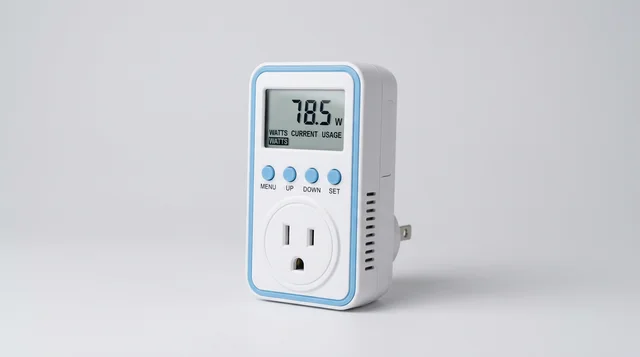
The method is three steps:
- Plug the meter in between the wall outlet and the car’s Level 1 cord.
- Charge as you normally would for a week or a month, and note the cumulative kWh on the display.
- Multiply by your rate. If the meter reads 262 kWh in a month and your rate is 18.34¢/kWh, that’s 262 × $0.1834 ≈ $48 — your car’s real monthly cost, no guessing.
The same pass-through idea works for any appliance — smart plugs and whole-home monitors extend it to whole circuits. For the Level 1 question specifically, the Poniie is the direct answer: it measures the exact thing you’re asking about, the car’s draw from the wall.
When Level 1 Is Genuinely Enough — and When Level 2 Pays
Level 1 is not a compromise for everyone; for some drivers it is the right answer, and for others it is a daily frustration. The honest split:
Level 1 is genuinely enough when:
- You drive a plug-in hybrid with a small battery — an overnight Level 1 session can fully recharge it.
- Your daily commute is short (under ~30 miles round-trip) and you can charge overnight every night.
- You charge occasionally — a weekend car, a second car, or a car that mostly sits.
Level 1 is not enough when:
- You drive a large battery-electric vehicle more than ~30–40 miles a day — Level 1 cannot replace that much range overnight, and the car starts each day behind.
- You want to charge only in a short off-peak window — Level 1’s 3–5 miles/hour cannot reliably fill a battery in a 4–6 hour cheap-rate window, which is the main financial argument for Level 2.
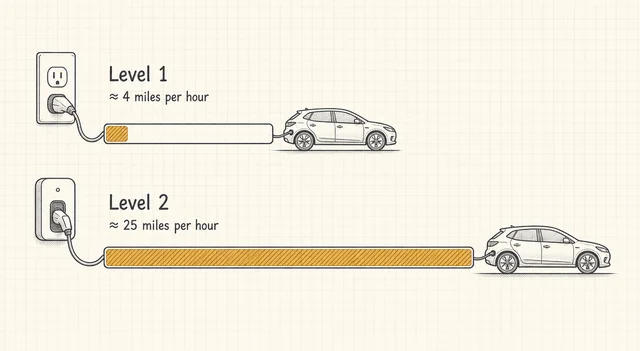
The full Level 2 case — equipment cost, install, the off-peak payback math, and when a Level 2 charger pays for itself — belongs to the companion guide, how EV charging affects your electric bill. The short version here: Level 2’s value is not speed for its own sake; it is the ability to fit a day’s driving into the cheap overnight window. If your utility has no time-of-use rate, Level 2 buys convenience, not savings — a fine reason, but a different one.
Head-to-Head: Level 1 vs Level 2 at a Glance
| Level 1 (the trunk cord) | Level 2 (wall charger) | |
|---|---|---|
| Draw | 120 V × 12 A = 1,440 W | 240 V, 3–11 kW |
| Speed | ~3–5 miles of range per hour | ~20–30 miles of range per hour |
| Overnight (8 h) | ~11.5 kWh ≈ $2.11 | ~40–70 kWh (fills most EVs) |
| Hardware cost | $0 — cord included | $300–800 + electrician |
| Best for | Plug-in hybrids, short commutes | Long commutes, off-peak windows |
The full Level 2 economics — equipment, time-of-use rates, cost per mile — live in the companion guide, how EV charging affects your electric bill. This table is the two-second version.
Which Should You Actually Do?
- Short commute, plug-in hybrid, or occasional charging → Level 1 is genuinely enough. Plug in overnight, measure once with the Poniie to know your real cost, and move on. No install, no equipment spend.
- Long commute in a battery-electric vehicle → Level 1 will leave you behind. Read the Level 2 payback case in how EV charging affects your electric bill before buying anything.
- You want to know your real cost, not a national average → buy the Poniie PN2500 once, measure for a month, and multiply by your rate. That number is yours.
And the standing rule for this page, the same as every page on this site: measuring beats guessing. A national average tells you what the typical driver pays; a pass-through meter tells you what your car costs on your outlet at your rate. The $66 meter pays for itself the first time it stops you from over- or under-estimating a $50-a-month line on your bill — and it keeps working for every other appliance you plug into it. If you want to understand the kilowatt-hour itself before you trust any of these numbers, what a kilowatt-hour is is the two-minute primer.
Sources
- U.S. Energy Information Administration — Electricity Monthly Update, End-Use — national average residential price 18.34¢/kWh, June 2026. Retrieved 2026-09-12.
- Poniie PN2500 Pass-Through Power Usage Monitor — Amazon — product specifications (60–240V, up to 25A, Level 1 EV charging pass-through meter) and current pricing. Retrieved 2026-09-12.
- U.S. Department of Energy Alternative Fuels Data Center — Charging Electric Vehicles at Home — home-charging context and Level 1/Level 2 framing. Retrieved 2026-09-12.
- U.S. Department of Energy, Fuel Economy — All-Electric Vehicles — charging efficiency losses and Level 1 charge-rate context. Retrieved 2026-09-12.