
Quick Answer: Is Your Toilet Running?
A running toilet can waste water without making an obvious sound. The EPA WaterSense dye test is a quick way to check: add a dye tablet or a few drops of food coloring to the tank, wait 5–10 minutes without flushing, then look for color in the bowl. Color in the bowl means the flapper or flush-valve seal is leaking.
Run the 10-Minute Dye Test
The dye test is the fastest way to confirm a toilet leak without any tools. It isolates the flapper, which causes the majority of running-toilet problems.
- Remove the tank lid and set it somewhere safe (they crack if dropped).
- Add a few drops of food coloring (or one dye tablet) to the tank water.
- Wait 5–10 minutes. Do not flush during this window.
- Check the bowl. If any color shows up in the bowl water, water is leaking from the tank into the bowl — the flapper is the prime suspect.
- Repair or replace the failed seal. Use the toilet manufacturer's instructions or ask a qualified plumber if you are not comfortable making the repair.
Want a second confirmation? Turn off every faucet and appliance, then watch the leak indicator dial on your water meter. If it spins, water is moving somewhere. If the dye test was clean but the meter is still moving, you likely have a hidden leak elsewhere.
The dye test finds today's leak. A sensor like this Govee 5-pack catches the one that starts next year — place one behind the toilet, under the sink, and near the water heater. Alerts via SMS/app/email at 105 dB with IP67-rated sensors. 5-year battery life.
Check Price on Amazon Price & availability shown on Amazon.com — we may earn a commission.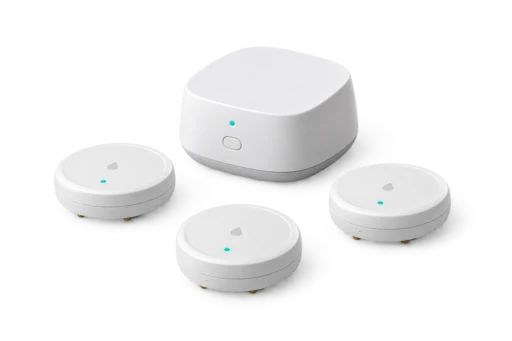
Estimate the impact from your own bill
Utility rates and sewer calculations are local, so do not use a national dollar estimate. Compare your meter reading before and after the repair, then use the rate and fee structure printed on your own bill to see the change. If your utility offers a leak-adjustment policy, ask what documentation it requires.
Why Running Toilets Are Easy to Miss
A running toilet is uniquely good at hiding. The leak is inside a closed tank, the sound is often masked by a noisy house, and the bowl refills on its own — so nothing looks "broken" to the eye.
What you do see is the bill. A flapper that lets a thin stream seep from tank to bowl can run 24 hours a day for weeks before anyone notices. By the time a higher bill arrives, the leak has already cost you.
The dye test finds today's leak. A sensor like this Govee 5-pack catches the one that starts next year — place one behind the toilet, under the sink, and near the water heater. Alerts via SMS/app/email at 105 dB with IP67-rated sensors. 5-year battery life.
Check price on Amazon As an Amazon Associate we earn from qualifying purchases. Price & availability shown on Amazon.com.If you want a refresher on what every line on that bill means, start with [how to read your water bill](/blog/complete-guide-understanding-utility-bill/). If you are in "why did this just spike?" mode, jump to [why water bills suddenly increase](/blog/why-did-my-water-bill-suddenly-increase/).
The meter test (confirms any continuous flow)
Turn off every faucet, ice maker, and appliance that uses water. Then watch your water meter. Most meters have a small leak indicator — a triangle, star, or tiny spinning disk — that moves with very small flows.
- If the indicator moves: water is flowing somewhere in the house.
- If the indicator is still: no continuous leak right now.
Need help reading the dial? See [how to read a water meter](/blog/how-to-read-a-water-meter/).
How a Running Toilet Raises Your Water and Sewer Bill
Every gallon that leaks out of the tank is a gallon your meter counts — and in most U.S. cities, the sewer charge is tied directly to your metered water usage. So one toilet leak can quietly double-dip your bill: once on the water side, and again on the sewer side.
Use a before-and-after comparison
After the repair, compare a similar billing period with your prior meter reading and local rate schedule. If a number like CCF appears on your bill and you are not sure what it means, see [what CCF means on your water bill](/blog/what-is-ccf-on-a-water-bill/). For the sewer portion, see [how sewer charges work on your water bill](/blog/how-sewer-charges-work-on-your-water-bill/).
How to spot it in your own usage
Compare your current month's usage to the [average water usage per person](/blog/average-water-usage-per-person/) for your household size. If you are running 30–50% higher than expected with no lifestyle change, a running toilet or silent leak is the most common reason.
Common Causes of a Running Toilet
Most running-toilet problems come from three parts inside the tank. You do not need to be a plumber to recognize the categories.
- Flapper valve (most common): a worn, warped, or mis-seated flapper lets tank water seep into the bowl. The dye test is designed to catch exactly this.
- Fill valve: the valve that refills the tank can stick partially open or fail to shut off cleanly, causing the tank to top off every few minutes.
- Tank water level too high: if the float is set above the overflow tube, water trickles down the tube continuously.
Confirm the leak with the dye test or meter test before choosing a repair. If you cannot identify the failed part safely, ask a qualified plumber.
What to Do After You Confirm a Leak
Once the dye test or meter test says "yes, water is moving," you have a few safe next steps.
- Repair the confirmed cause. Follow the fixture manufacturer's instructions or use a qualified plumber.
- Re-test after any change. Repeat the dye test. If the bowl stays clear after the EPA's 5–10 minute test window, the tank-to-bowl leak is no longer indicated.
- Verify with a meter reading. Take a meter photo at night (no water use) and again in the morning. If the numbers match, you have a true zero.
- Ask your utility about a leak adjustment. Many utilities have a one-time leak adjustment policy if you can document the repair. Policies vary by state and provider (state public utility commission).
Not comfortable working inside the tank? Contact a qualified plumber and request an estimate before authorizing work.
Common Misconceptions About Running Toilets
- "If it is silent, it is fine." Silent leaks are the most common kind. Many flappers seep without making a sound.
- "It is only a little water." A slow, continuous flow adds up to thousands of gallons a month. The cost table above shows the math.
- "My bill would show it right away." Bills are delayed. The leak may have been running for 3–4 weeks before it appears on a statement.
- "A new toilet can't leak." Even brand-new flappers can misseat or wear out within a few years, especially with hard water.
Next Step: Confirm the Fix on Your Bill
After the repair, compare your next similar billing period with the prior one. If usage does not change, the leak may not be fully fixed or another source of water use may be present. The [complete guide to lowering your water bill](/blog/44-how-to-lower-water-bill/) walks through other checks, including irrigation and fixture use.
Can a running toilet really cause a high water bill?
How do I know if my toilet is leaking?
How much does a running toilet add to a water bill per month?
Will a running toilet increase my sewer charge too?
What is the most common cause of a running toilet?
Can a running toilet stop on its own?
This test is part of the Water Explained hub. For catching future leaks automatically: where to place water leak sensors.
Sources
- U.S. Environmental Protection Agency WaterSense: Home Maintenance — household leak-maintenance guidance and dye-test instructions.
- U.S. Environmental Protection Agency WaterSense: Free of Water Leaks Technical Sheet — toilet leak-test protocol.


