Quick Answer
Record the complete reading shown by your meter, confirm its unit and any multiplier with your utility, then subtract an earlier reading from a later reading to calculate the recorded change. Meter displays and billing rules vary by utility.
- Analog meters: follow the dial-reading instructions provided for your specific meter.
- Digital meters: record the full reading and compare it with the billing period and meter-read date on your statement.
For more detail, see Understanding Your Utility Bill.
Why reading your meter is worth it
If your bill ever feels too high, the meter is the starting point. Knowing how to read it gives you a simple reality check: "Does the usage on the bill match what my meter shows?"
It also helps you spot unusual usage early. If you catch a spike mid- month, you can troubleshoot before the bill arrives. For the baffling version — a big bill with no change in habits — work through sudden spike in electricity bill with no usage change.
Not sure what the meter is measuring? Read what a kilowatt-hour is first -- it makes the numbers feel less abstract.
Step 1: Identify your meter type
Most homes have one of these:
- Analog dial (mechanical) meter with several small dials.
- Digital meter that displays a kWh number.
- Smart meter (often digital) that can send readings automatically to the utility.
If your utility provides an online usage portal, you likely have a smart meter -- but the meter face still matters if you want to verify with your own eyes.
How to read an analog dial electric meter
Dial meters are the most error-prone because the dials alternate direction. Here is the reliable approach:
- Read the dials left to right.
- If a pointer is between two numbers, write down the lower number.
- If a pointer looks exactly on a number, check the dial to the right. If the right dial has not passed zero, use the lower number.

Take a clear photo when you read it. That makes it easier to compare with the bill later.
How to read a digital electric meter
Digital meters show a number directly, usually labeled kWh.
Some digital meters cycle through multiple screens. When you read one:
- Wait until you see the total kWh reading (not voltage or test codes).
- Write down the full number.
- Take the reading at the same time of day once per week — a simple "usage trend" without any special tools.
How to use smart meter data (without getting overwhelmed)
Smart meters often give you daily or hourly usage in an online portal. That can be incredibly helpful -- but only if you focus on a few things.
- Look for your highest-usage day each week. What happened that day?
- Compare weekdays vs weekends (different routines show up fast).
- If you have time-of-use rates, watch your peak-hour usage.
If your bill varies a lot month to month, our utility bills guide explains how rate structures can change the total. And if the total keeps climbing, start from why is my electric bill so high and rule out causes one by one.
How to calculate your usage from two readings
Meter usage is just subtraction.
| Reading | Example |
|---|---|
| Previous reading | 48,120 kWh |
| Current reading | 48,540 kWh |
| Usage | 420 kWh |

If your utility bills monthly, you can compare this calculated usage to the kWh shown on the statement. Small differences can happen if you read the meter on a different day than the utility.
To judge whether 420 kWh — or whatever your two readings gave you — is typical, see understanding kWh usage: what a normal month looks like.
Test your meter’s accuracy yourself
If your calculated usage does not match the bill — or usage jumped with no change in habits — you can test the meter with a load of known size before paying for a utility test:
- Read the meter, then leave everything off except one appliance with a labeled wattage (a 1,500 W space heater or kettle works).
- Run it for exactly one hour.
- Read the meter again. A 1,500 W load for one hour should add about 1.5 kWh to the register.
A small deviation (a few percent) is normal meter tolerance. A large one — or a reading that moves with the main breaker off — is grounds to request a meter test. Most utilities will test a residential meter for free or for $5–25 on request, and several states require them to correct bills when the meter is proven fast. The full escalation path, including the paper trail to keep, is in sudden spike in electricity bill with no usage change.
Want to go one step further and see which device is using the electricity, not just how much the whole house used? Plug-in meters like the Kill A Watt measure individual appliances — see Kill A Watt alternatives — and whole-home energy monitors track every circuit in real time; the current options are compared in the best home energy monitors. The same reading discipline from this page is what makes those tools useful: your meter is the reference they are checked against.
How to verify your bill using the meter
When the bill arrives, find the "previous reading" and "current reading" lines. Then:
- Confirm the bill says "actual" (not estimated) if possible.
- Compare your own reading around the same date.
- If something seems off, confirm the billing period length first — how utility billing cycles work explains why two bills can cover different day counts.

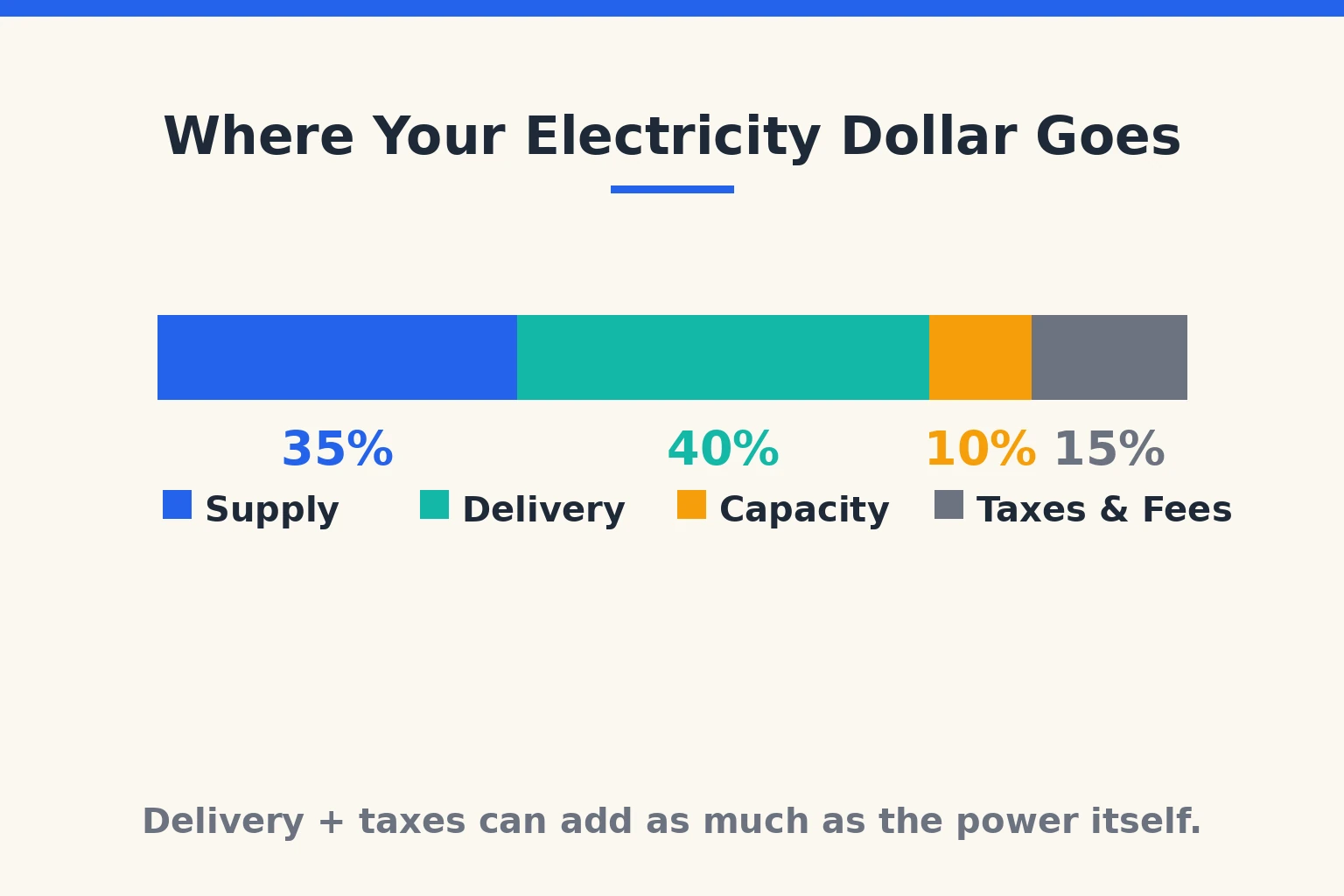
If you want to understand how the meter reading turns into line items
and fees, read
Take a photo or written reading at a consistent time, then compare it with a later reading and the matching utility billing period. The U.S. Department of Energy notes that electric meters come in several varieties, including analog dial, analog mechanical, and digital meters; use the guidance from the utility that installed yours before interpreting a display.[1] If the number, billing date, or meter identifier does not make sense, contact the utility and ask how it read the meter and calculated the bill. Where to go next: Pick one meter reading to check this week — five minutes is enough. If your numbers match the bill, you are done; if they do not, take the reading history to how to read your electric bill line by line and check the meter lines there against the charges on electric bill breakdown: how your meter reading becomes charges. This walkthrough is part of the Electricity Explained hub; meter and billing terms are defined in the utility glossary. our electric bill breakdown
</a>
.
</p>
<p>
For the reading side of that statement — period, read type, charges —
use <a href="/blog/01-how-to-read-your-electric-bill/">how to read your electric bill line by line</a>
alongside your own bill.
</p>
Related Reading
How often should I read my electric meter?
Why does my reading not match my bill exactly?
What does it mean if my bill was estimated?
Do smart meters eliminate estimated bills?
Can I read my meter to see what uses the most electricity?
Use Your Meter as a Personal Record
Sources