About our numbers: The figures in this guide are typical U.S. ranges compiled from U.S. Energy Information Administration (EIA) and U.S. Department of Energy (DOE) data (see Sources in the frontmatter). They reflect national averages and common assumptions, not a measurement of your home. Your actual bill depends on your local rate, weather, home envelope, appliances, and habits — individual results vary widely.
Quick Answer
You can cut your electric bill 20–40% with the highest-ROI moves: raise summer AC to 78°F (or drop winter heat to 68°F) saving $100–$300/year, switch to LEDs ($150–$200/year), lower the water heater to 120°F ($60–$120/year), seal air leaks ($60–$200/year), shift laundry and dishwashing to off-peak hours, and kill vampire loads with smart strips ($120–$190/year for a typical three-strip setup).
- Heating and cooling drive more than half of home energy use — 52% in 2020 (EIA RECS) — start there.
- Most utilities run a free home energy audit; call before you spend a dollar.
Pick your route:
- “My bill jumped unexpectedly.” Your usage probably didn’t — rule out billing errors, estimated reads, and rate changes first: Why Your Electric Bill Is So High walks the 15-minute check (free).
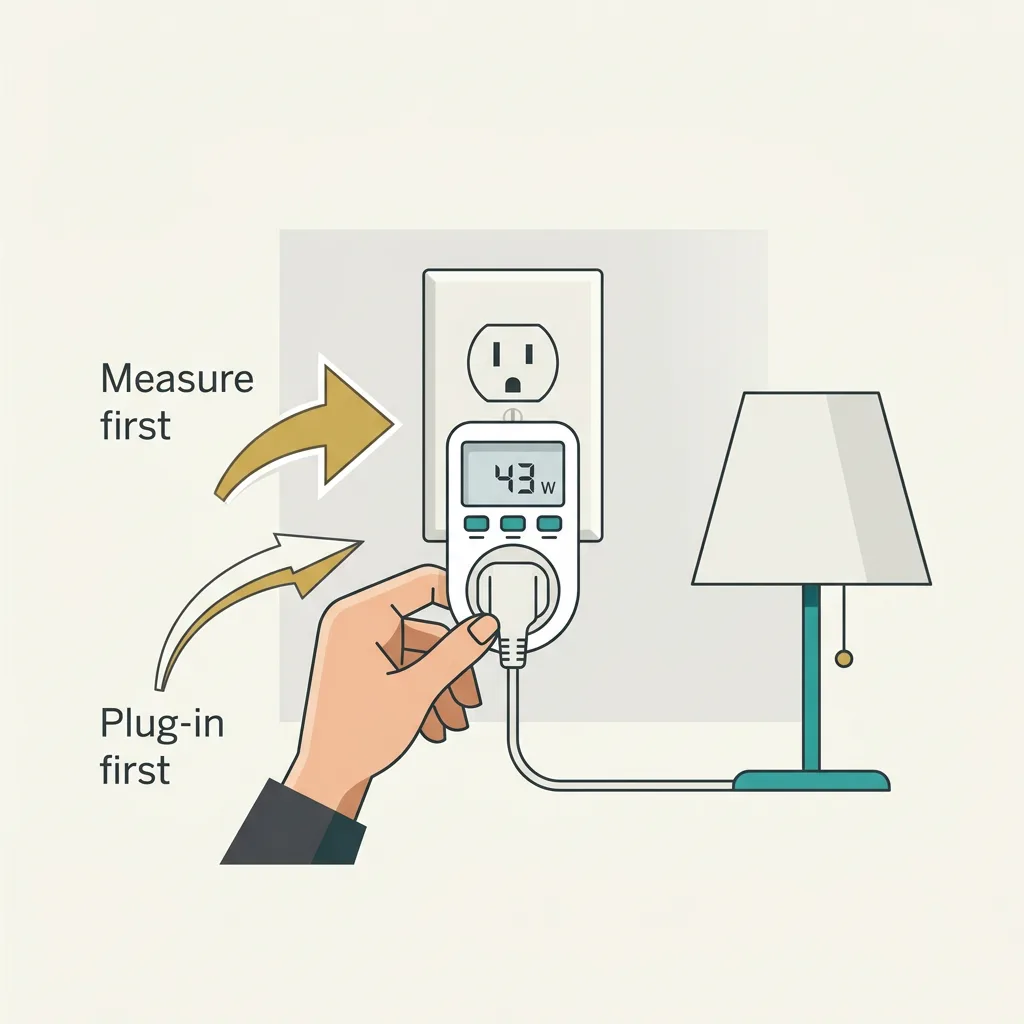
- “I know usage is high, but not what’s causing it.” Measure before you spend. One weekend with a plug-in meter — P3 Kill A Watt P4400 (~$30) — finds your actual hogs; pair it with the free unplugging pass in step 3.
- “Heating/cooling is my main cost.” True for most homes (52% of energy use, EIA RECS 2020). Set the free thermostat schedule in step 1 today; if you want it automated, a learning thermostat like the Nest (4th gen) — covered honestly in step 13 — is the single highest-impact device.
Want the same relief with no equipment at all, ranked shortest-first? The no-solar-necessary route is the condensed path. This guide is the electric deep-dive in the site’s Lower Your Bills hub — cross-utility prioritization, measure-first tools, and envelope work live there.
Read the section percentages honestly: each heading’s “Save X%” is that category’s own ceiling against the part of your bill it touches — they do not stack. A realistic whole-home outcome from executing this guide is the Quick Answer’s 20–40% ($33–$66/month on the $164.88 national-average bill), because categories overlap (the same kWh can only be saved once) and every home starts from a different mix.
Your electric bill is too high. You’ve tried turning off lights, but it barely made a dent. You want real savings—$50, $100, even $150 per month—and you want to know exactly what to do and what it’ll cost.
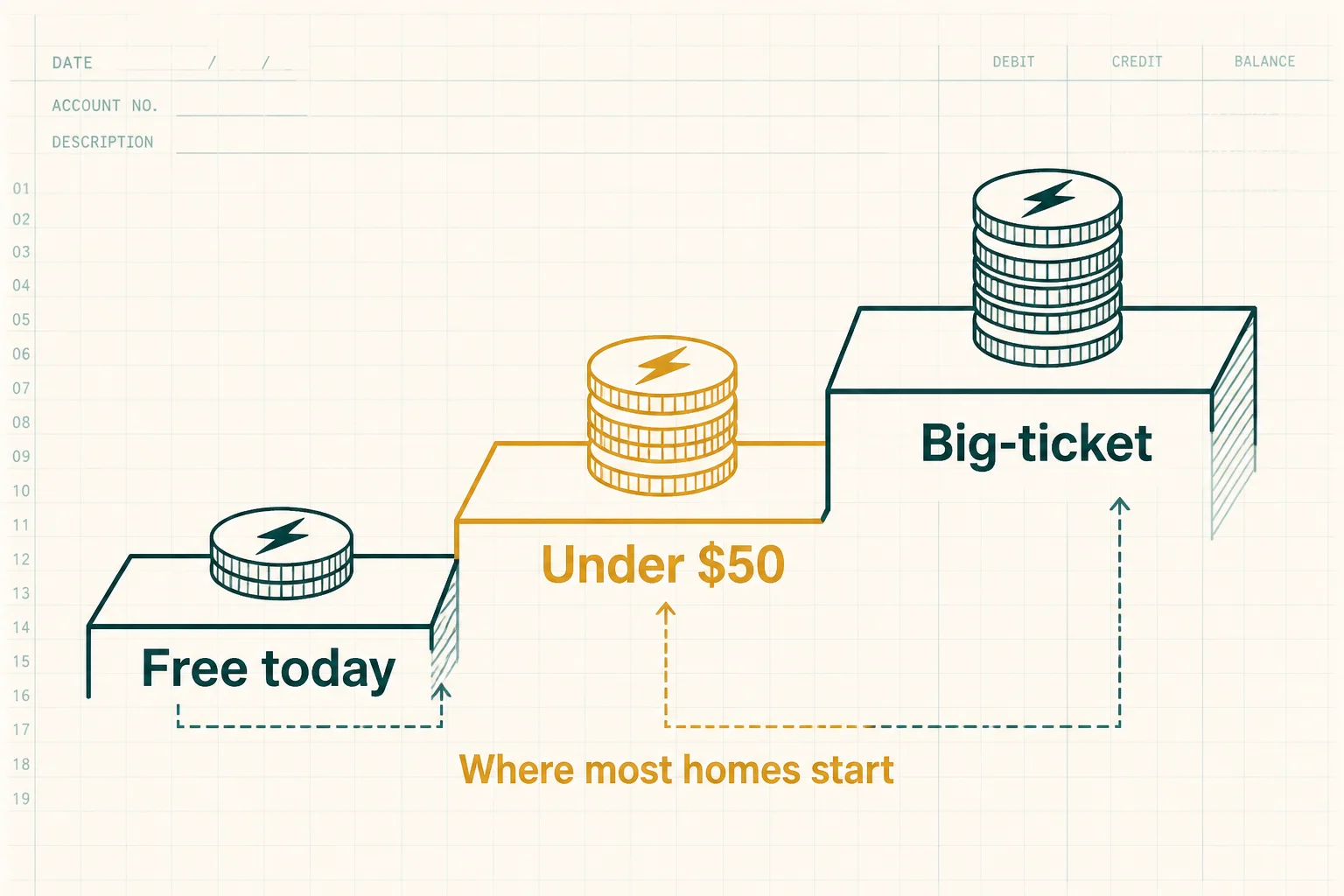
This guide gives you 20+ proven ways to lower your electric bill, organized by cost: free changes you can make today, under-$50 upgrades for this week, under-$500 investments for this month, and long-term upgrades that pay for themselves.
Every tip includes the math: what it costs, what it saves, and how long until it pays you back. If your bill looks high before you cut anything, walk through Why Your Electric Bill Is So High first to rule out billing errors, estimated reads, and rate changes.
Why Your Electric Bill Is So High
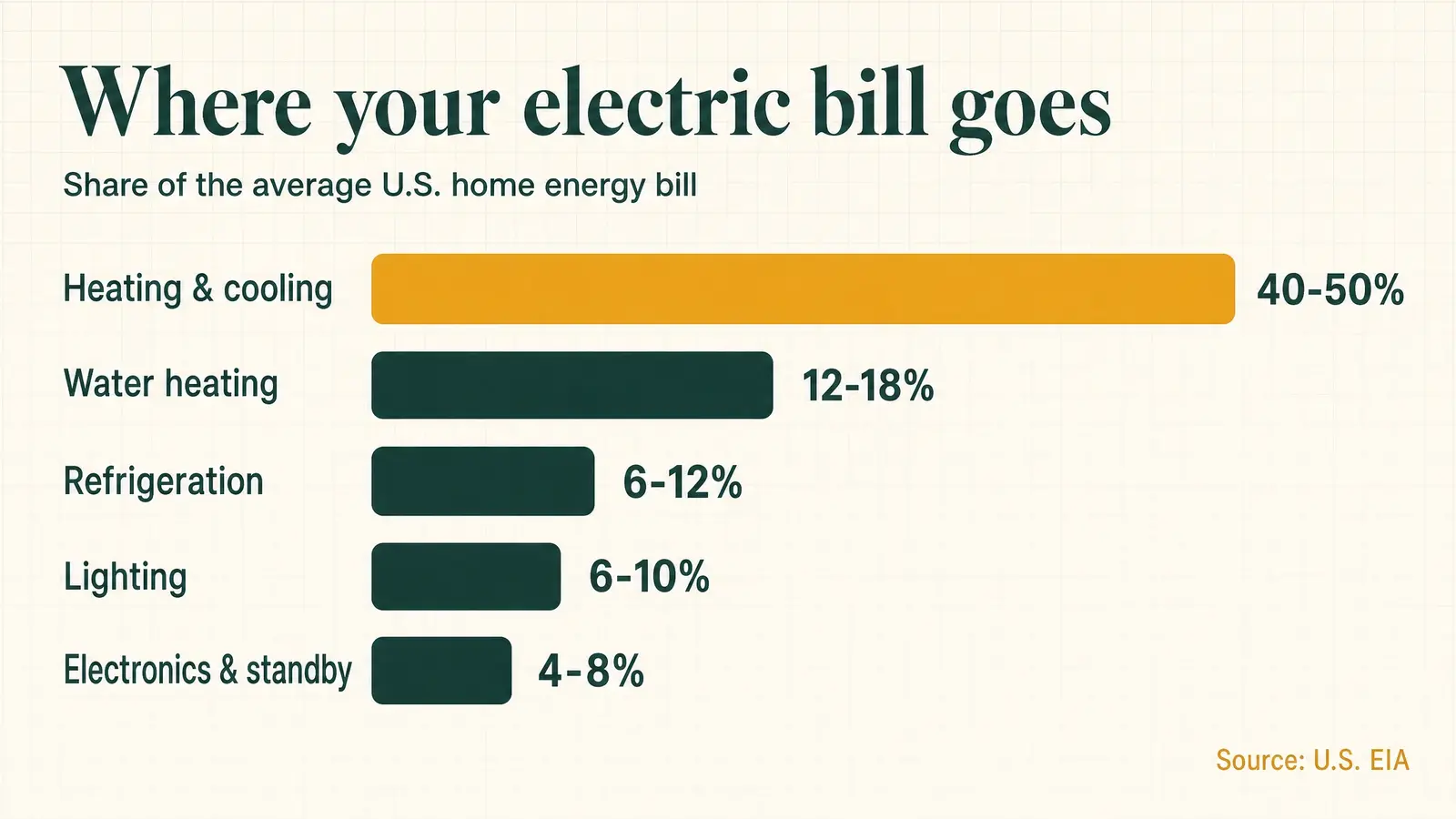
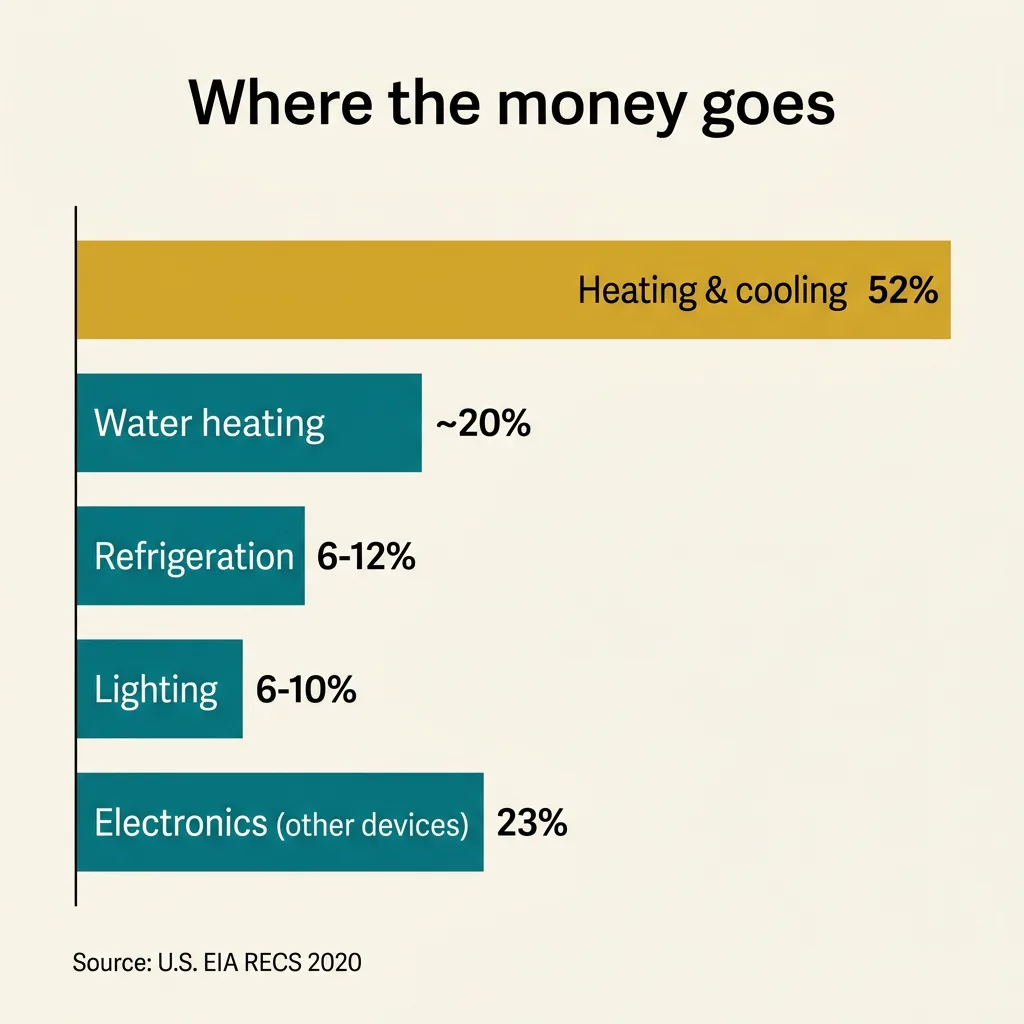
Before you can lower your bill, you need to know what’s driving it. For most U.S. households, it comes down to 5 things (U.S. EIA Residential Energy Consumption Survey, share of household site-energy use):
The Top 5 Energy Hogs
| Appliance | Typical Monthly kWh | % of Home Energy Use | Annual Cost |
|---|---|---|---|
| HVAC (heating/cooling) | 350–700 | 52% (EIA RECS 2020) | $600–$1,200 |
| Water heating | 100–150 | ~20% (DOE) | $150–$300 |
| Refrigeration | 50–100 | 6–12% | $80–$150 |
| Lighting | 50–80 | 6–10% | $70–$120 |
| Electronics/phantom loads | 30–60 | part of EIA’s 23% “other devices” category | $75–$220 fully-loaded; see step 3 |
The average US household: roughly 899 kWh/month (EIA FAQ) with an average bill of $144/month in 2024 (U.S. EIA, Today in Energy). At the June 2026 national average of 18.34¢/kWh (EIA), the same usage lands at $164.88/month — 899 × $0.1834. Our average utility bills by state page breaks this down state by state.
Your actual bill depends on:
- Climate (heating/cooling degree days)
- Home size and insulation
- Appliance efficiency
- Thermostat settings
- Number of people and habits
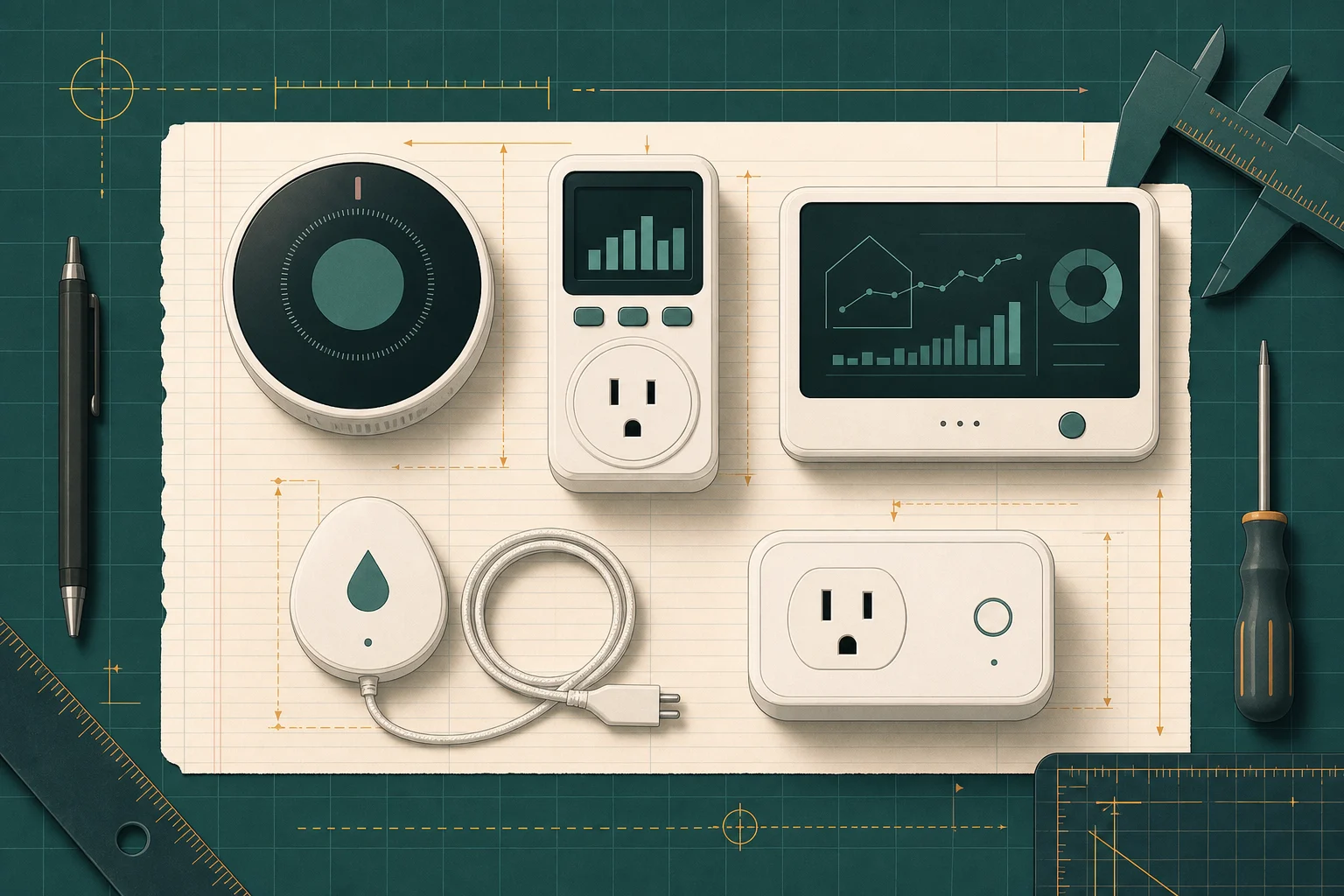
Tools that pay for themselves
Measure first, then buy. The primary pick depends on your route from the top of this page: bill-jumped → no tool needed yet; usage-unknown → the Kill A Watt meter; heating/cooling-dominated → the learning thermostat. The other two are clearly-labeled alternatives for specific steps:
Plug-in meter that displays watts, kWh, and projected cost for whatever's on the outlet. P3 International spec sheet: 0.2% accuracy, 120V/15A, UL listed. The cheapest way to actually *measure* the phantom loads in step 3 and the per-appliance cost in the standby-power guide — measure first, then spend on smart strips.
Check price on Amazon Price & availability shown on Amazon.com — we may earn a commission.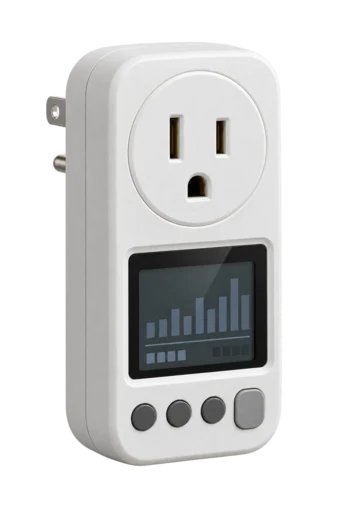
Self-programming thermostat that builds your schedule in about a week. Google's manufacturer-reported savings: ~12% on heating, ~15% on cooling (Nest product page, 2024; vendor figures — independent results vary). The single highest-impact device for the ~52% of home energy use driven by heating and cooling (EIA RECS 2020) — pair with step 13 and the HVAC optimization section.
Check price on Amazon Price & availability shown on Amazon.com — we may earn a commission.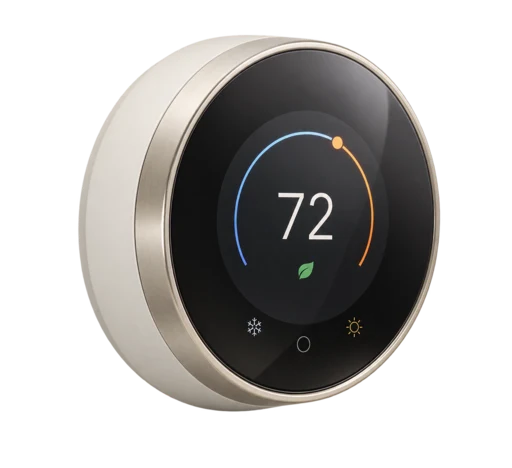
Wi-Fi smart plug with built-in energy monitoring that logs watts, kWh, and runtime in the Tapo app. TP-Link spec sheet: Matter-compatible, 15A max, 1800W, 120V, 2.4 GHz Wi-Fi, ETL listed (2-pack). Best for step 3 (phantom loads) and step 10 (smart strips) when you want per-outlet data, schedules, and away-mode randomization without buying a whole-home monitor.
Check price on Amazon Price & availability shown on Amazon.com — we may earn a commission.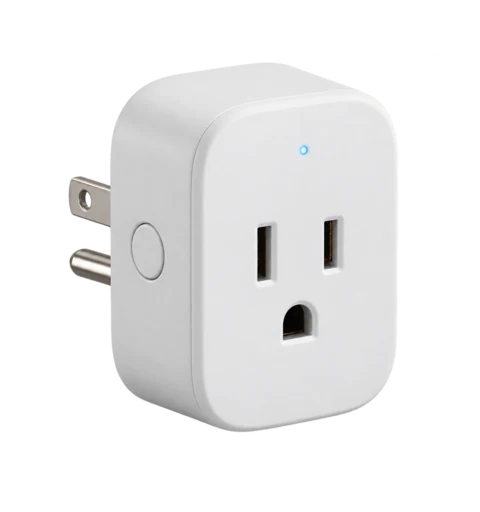
How to use them in this guide: Nest = step 13 and the HVAC optimization block. Kill A Watt = step 3 (one weekend, hunt the biggest phantom loads in your house) and the phantom-power-draw guide. Tapo P110M (2-pack) = step 3 and step 10, especially for entertainment centers and home offices where you want set-and-forget automation. For the full category-by-category rundown — leak sensors, whole-home monitors, smart strips, and what each realistically saves — see our guide to gadgets that lower utility bills.
Free Changes: Start Today (Save 10–25%)
These cost nothing and start saving immediately.
1. Adjust Your Thermostat
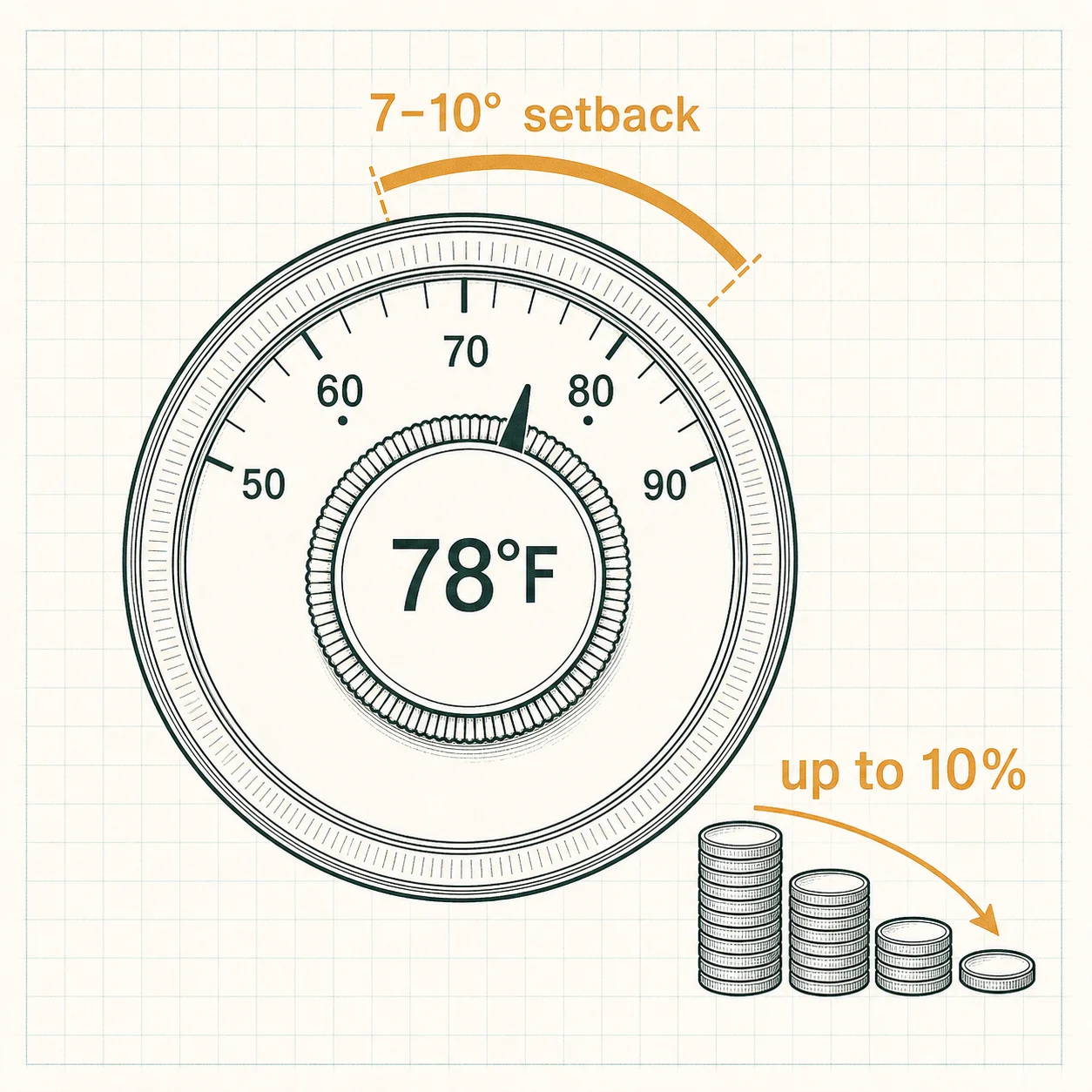
The single biggest saver: DOE figures an automatic setback of 7–10°F for 8 hours a day can save up to 10% a year on heating and cooling (U.S. Department of Energy, Home Upgrades, https://www.energy.gov/save/home-upgrades). A reasonable rule of thumb is roughly 1% of heating/cooling cost per 1°F of setback.
| Season | Recommended Setting | Savings per 2°F Adjustment |
|---|---|---|
| Summer | 78°F when home, 85°F when away | 6–9% |
| Winter | 68°F when home, 62°F when away/sleeping | 3–5% |
Annual savings: $100–$300 (depending on climate and home size)
How: Manual thermostat, or programmable if you have one
2. Turn Off Lights in Empty Rooms
Old incandescent bulbs cost roughly 1¢/hour to run; LEDs cost a fraction of a cent per hour — but why pay for light you’re not using? At the U.S. average residential rate of about 17–18¢/kWh (U.S. EIA, mid-2026), a 60W incandescent running 3 hours a day costs about $1/month; turning it off saves that dollar.
Savings: A handful of forgotten bulbs, $4.50–$15/month for a typical household.
Habit change: Train your family. “Lights out when you leave.”
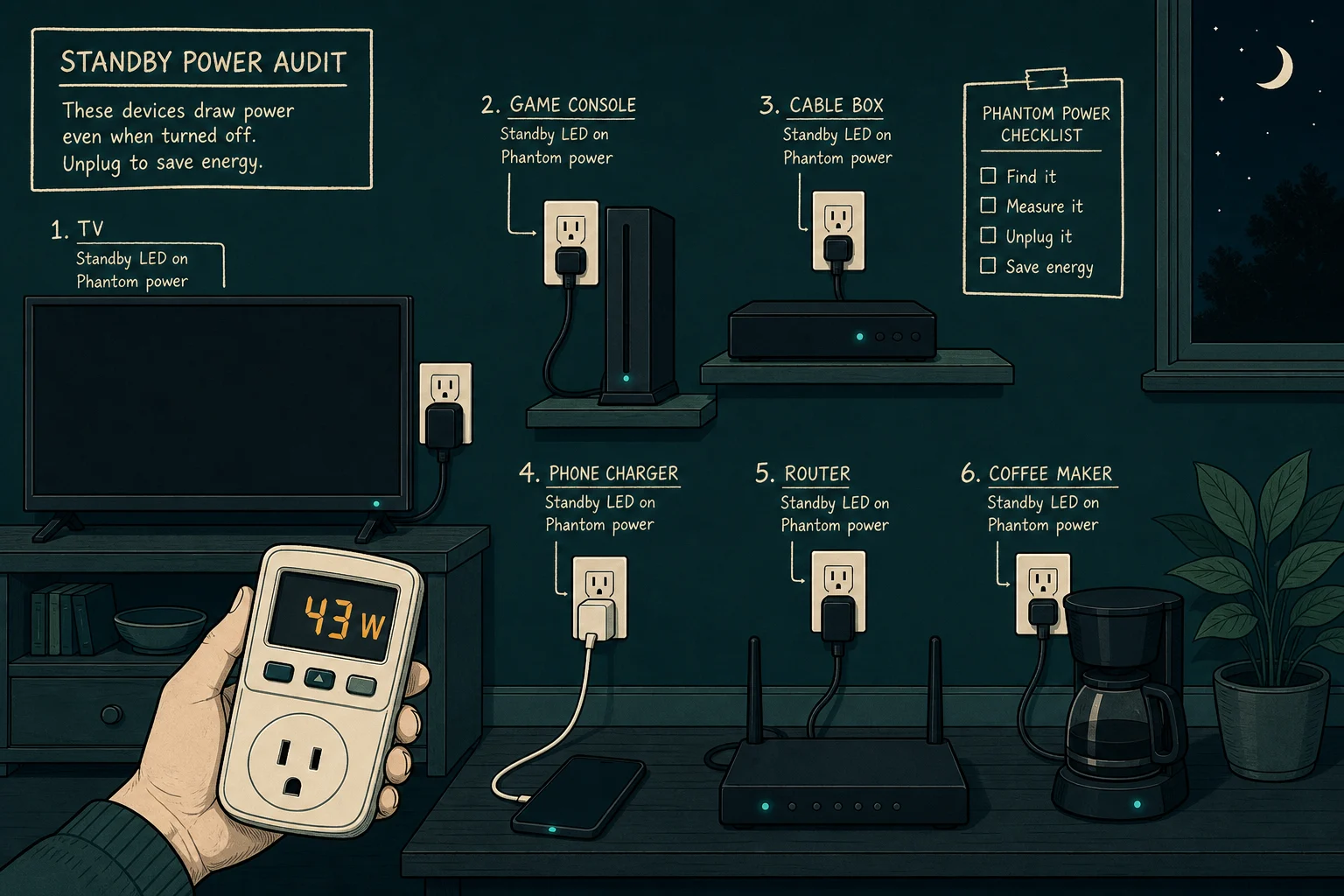
3. Unplug Phantom Loads
“Phantom loads” are devices that draw power even when turned “off.” They sit inside the 23% of household energy that EIA attributes to televisions, electronics, and other devices (EIA Energy Explained, 2020 data) — how much of that 23% is standby draw in your home is exactly what the Kill A Watt meter below will tell you. See phantom load basics for the full list of silent energy hogs.
| Device | Phantom Load (watts) | Annual Cost at 17¢/kWh |
|---|---|---|
| TV (standby) | 5–10 W | $7–$15 |
| Game console | 15–20 W | $22–$30 |
| Computer (sleep) | 5–10 W | $7–$15 |
| Microwave (clock) | 3–5 W | $4–$7 |
| Phone charger (not charging) | 0.5–2 W | $1–$3 |
Total phantom load: 50–150 W continuous = $75–$220/year (at ~17¢/kWh)
Solution: Use smart power strips ($15–$30) or simply unplug. If you would rather see every circuit at once instead of auditing outlet by outlet, the whole-home monitor below does that job in one install.
Smart plugs cover one outlet at a time — the Vue covers the whole house. Sixteen circuit-level sensors show exactly which appliances eat your kWh, in real time, in one app. Installs inside the electrical panel: DIY only if you are comfortable working in a live panel; otherwise budget an electrician. Buy this only after a Kill A Watt weekend shows the outlet-level picture isn't enough.
Check price on Amazon Price & availability shown on Amazon.com — we may earn a commission.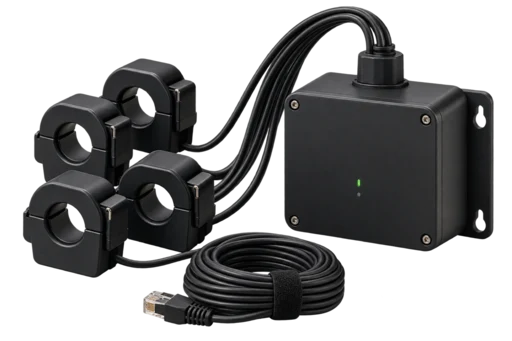
4. Line-Dry Clothes
Your dryer uses 3–5 kWh per load. At roughly 17¢/kWh (U.S. EIA mid-2026 average residential rate), that’s about 50–85¢ per load.
If you dry 5 loads/week: 20 loads/month = $10–$17/month
Solution: Use a drying rack ($15–$30) or clothesline (free). On a time-of-use plan, running the dryer after 9pm can cut that cost in half.
5. Wash Clothes in Cold Water
90% of the energy used by washing machines goes to heating water.
Cold vs. hot water:
| Setting | Energy per Load | Cost per Load (at ~17¢/kWh) |
|---|---|---|
| Hot | 3–4 kWh | 50–70¢ |
| Warm | 1.5–2 kWh | 25–35¢ |
| Cold | 0.3–0.5 kWh | 5–9¢ |
If you wash 5 loads/week in hot: $25–$35/month If you switch to cold: $3–$4/month Savings: $20–$30/month
6. Run Dishwasher Only When Full
Your dishwasher uses 1–2 kWh per load.
Running half-full: Wastes 50–100% of energy If you run 8 loads/week: $10–$20/month If you consolidate to 4 full loads: $5–$10/month Savings: $5–$10/month
Bonus: Skip the heated dry. Air-dry saves 15–20% on dishwasher energy. Running it after 9pm on a TOU plan adds another 20–30% off the same load.
7. Close Curtains/Blinds in Summer
Sunlight pouring through windows adds heat. Your AC works harder to remove it.
Savings: 5–15% on cooling costs
How:
- Close blinds on south/west-facing windows during peak sun
- Use blackout curtains or reflective film
- Plant shade trees outside (long-term)
8. Use Ceiling Fans
Ceiling fans use 20–50 W (0.5–1¢/hour) but make you feel 3–4°F cooler.
Result: You can raise AC temp by 3–4°F and feel just as cool.
Savings: 6–12% on AC costs = $10–$40/month (summer only)
Important: Fans cool PEOPLE, not rooms. Turn them off when you leave.
Under $50: This Week (Save 15–30%)
These upgrades cost a little but pay for themselves in months.
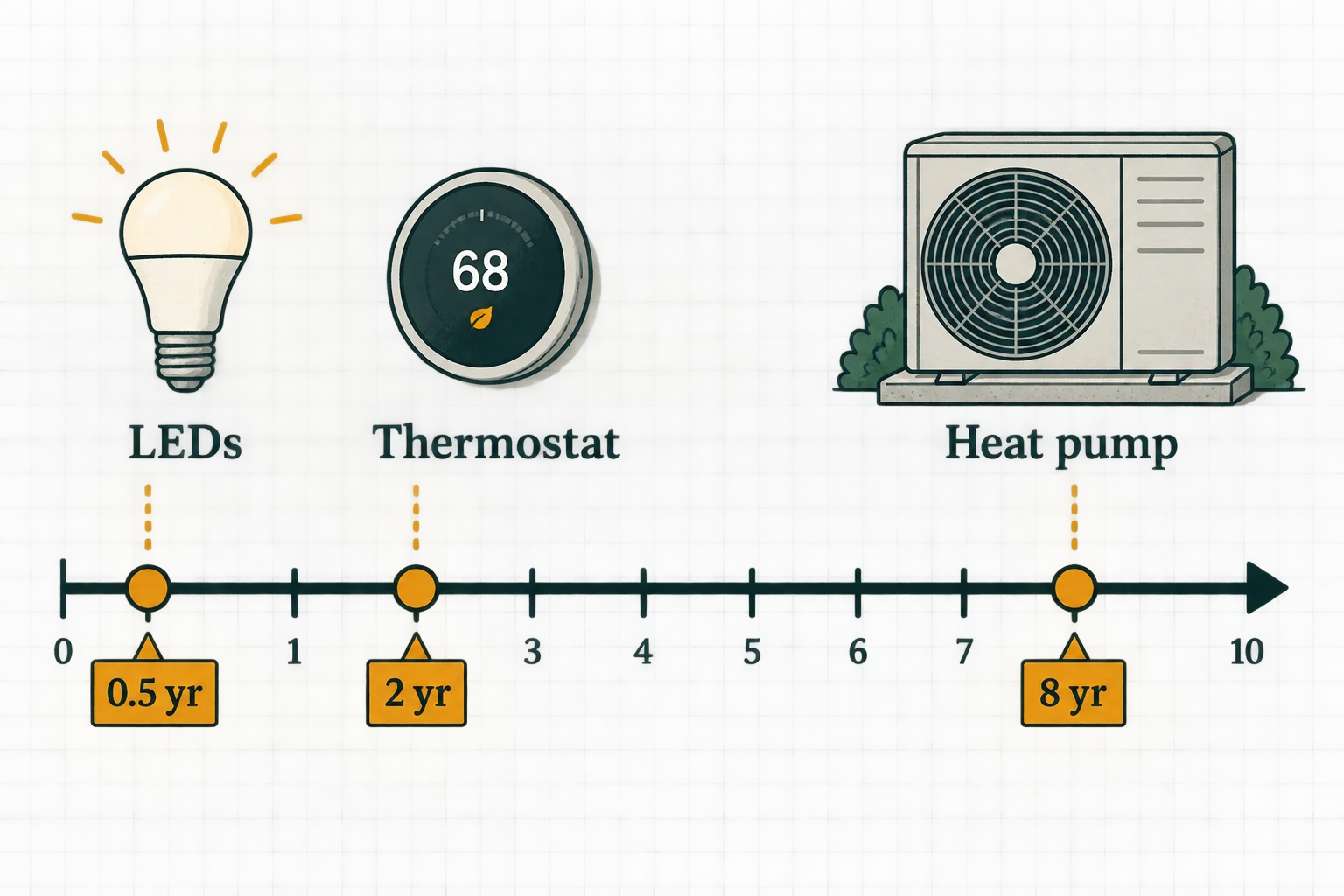
9. Switch to LED Bulbs
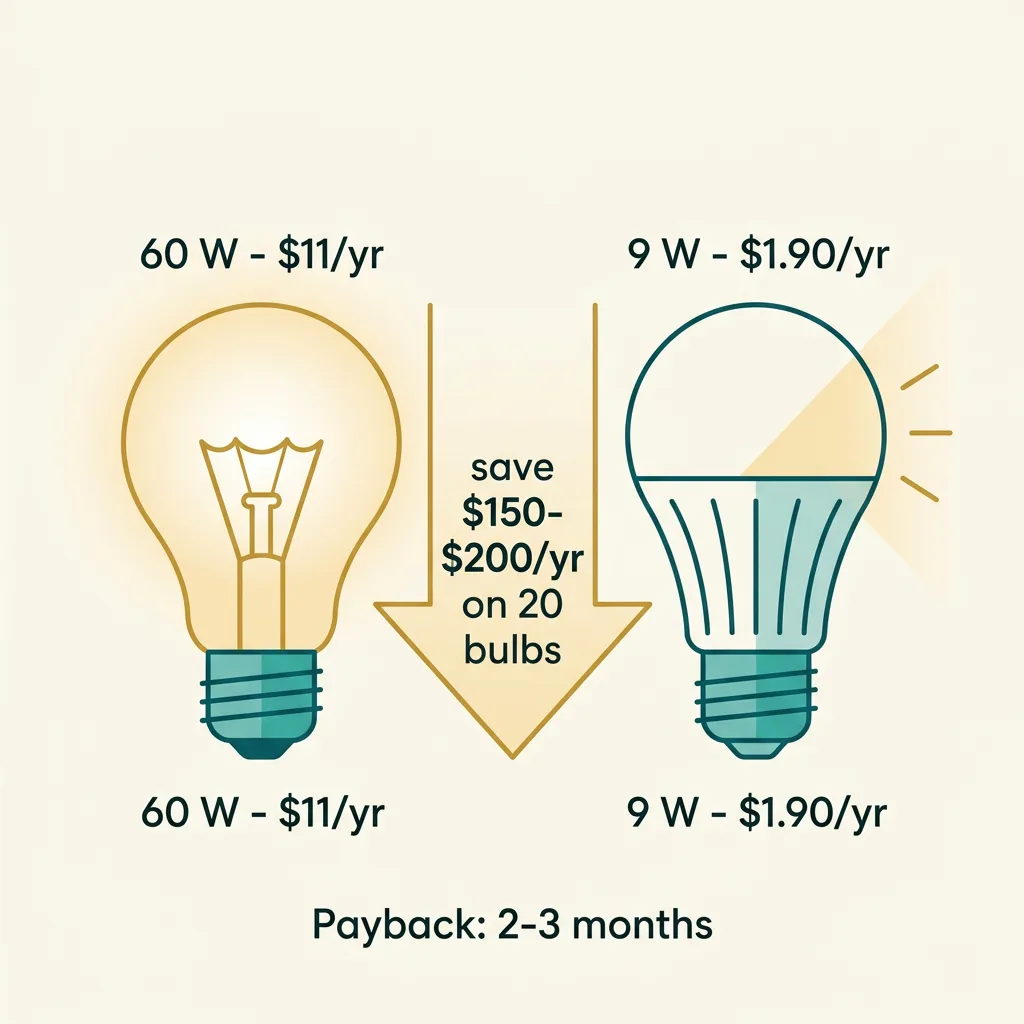
LEDs use roughly 75–90% less energy than incandescent bulbs and last 15–25 times longer (ENERGY STAR / U.S. DOE).
| Bulb Type | Wattage (60W equivalent) | Annual Cost at ~17¢/kWh (3 hrs/day) |
|---|---|---|
| Incandescent | 60 W | ~$11 |
| CFL | 13–15 W | $2.40–$2.80 |
| LED | 8–10 W | $1.50–$1.90 |
If you replace 20 incandescent bulbs with LEDs:
- Cost: $30 (20 × $1.50)
- Savings: $150–$200/year
- Payback: 2–3 months
10. Install Smart Power Strips
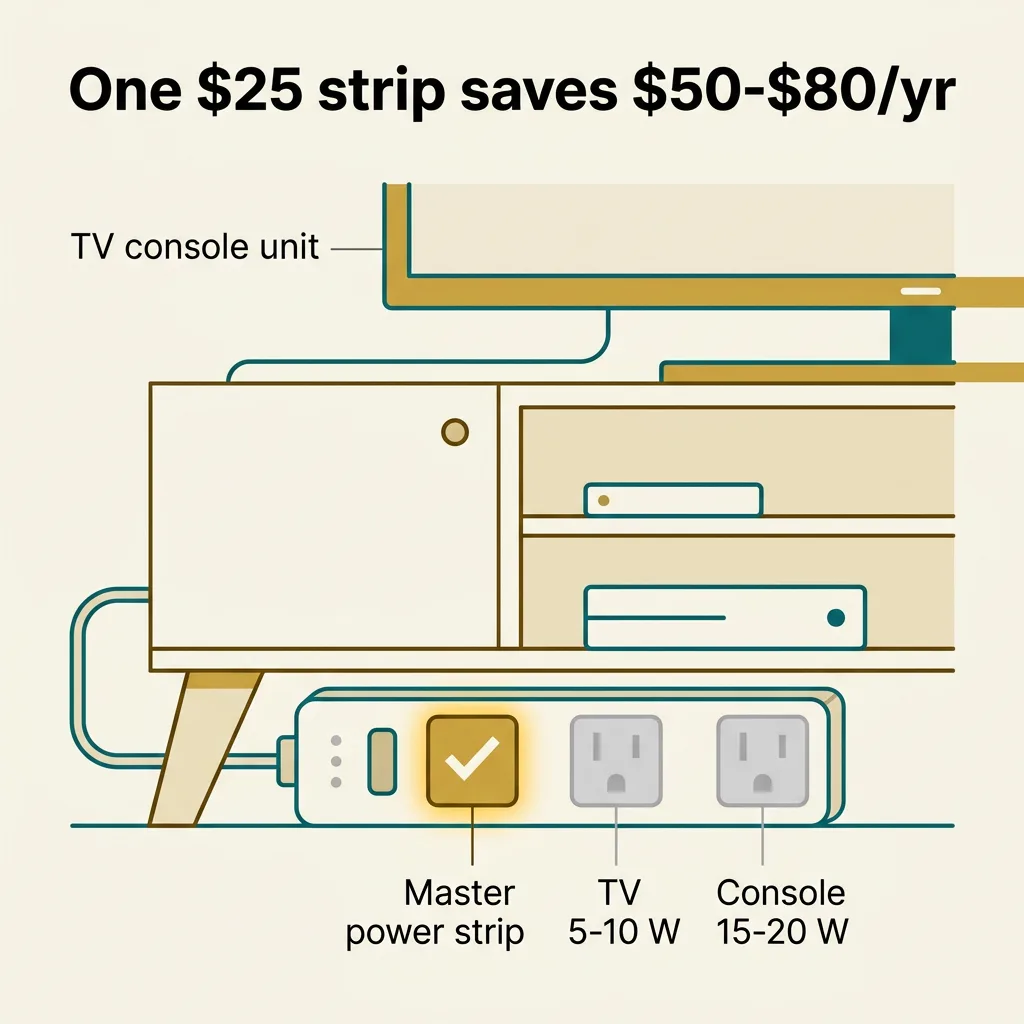
Smart power strips cut power to peripherals when the main device is off. For models that also report per-outlet kWh — useful for measuring phantom loads in real time — see the standby power and smart-plug guide before you buy.
| Setup | Cost | Annual Savings | Payback |
|---|---|---|---|
| Entertainment center | $25 | $50–$80 | 4–6 months |
| Home office | $25 | $40–$60 | 5–7 months |
| Kitchen counter | $20 | $30–$50 | 5–8 months |
Total: 3 smart power strips = $70, saves $120–$190/year
11. Seal Air Leaks with Caulk and Weatherstrip
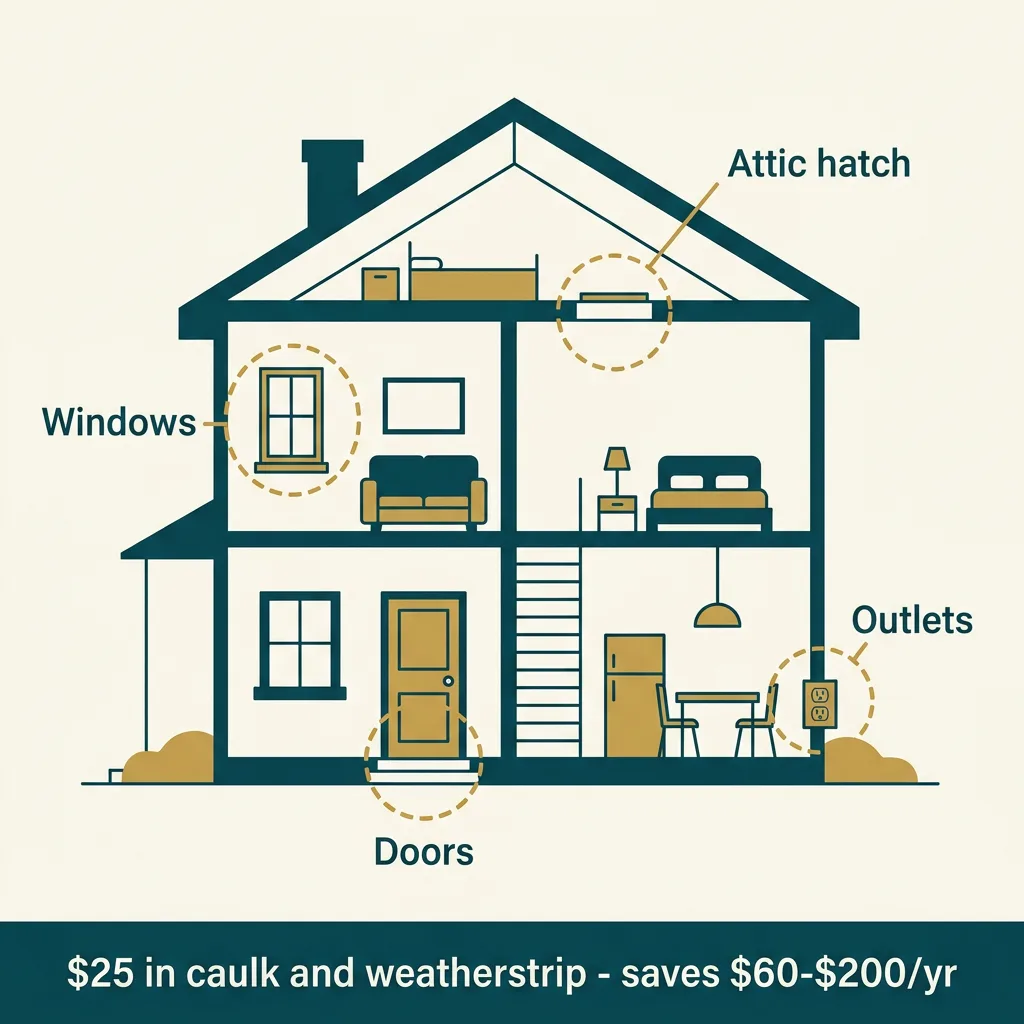
Air leaks through the building envelope waste 10–20% of heating and cooling energy — DOE’s Home Upgrades page puts the typical air-sealing / insulation gain in roughly that range, and leaks through ducts specifically can waste 20–30% of conditioned air (U.S. Department of Energy, https://www.energy.gov/save/home-upgrades). For a room-by-room DIY walkthrough, see How to Check for Energy Leaks in Your Home.
Where to seal:
- Windows (caulk gaps, add weatherstrip)
- Doors (weatherstrip, door sweep)
- Attic hatch (weatherstrip)
- Electrical outlets on exterior walls (foam gaskets)
Cost: $25 (caulk, weatherstrip, gaskets) Savings: 5–15% on heating/cooling = $60–$200/year Payback: 2–5 months
12. Install Low-Flow Showerhead
Low-flow showerheads reduce hot water use without sacrificing pressure.
| Type | Flow Rate (GPM) | Hot Water per 10-min Shower |
|---|---|---|
| Old showerhead | 2.5 GPM | 25 gallons |
| Low-flow (1.5 GPM) | 1.5 GPM | 15 gallons |
Savings: 10 gallons per shower × 30 showers/month = 300 gallons/month
At ~17¢/kWh to heat water: $10–$20/month saved
Cost: $15–$25 Payback: 2–3 months
Big-Ticket Upgrades: This Month and Beyond (Save 25–60%)
These cost more up front but save aggressively over the long run. If your old equipment is failing anyway, this is when the math flips: you’ll spend the money on a replacement either way, so the question is which replacement.
13. Install a Programmable Thermostat
A programmable thermostat automatically adjusts temperature based on your schedule. DOE attributes roughly up to 10% a year on heating and cooling to a 7–10°F setback for 8 hours a day (U.S. Department of Energy, Home Upgrades, https://www.energy.gov/save/home-upgrades); a well-tuned programmable schedule typically lands at the lower end of that range, with learning smart thermostats reaching the upper end. If you’re weighing a basic programmable model against a learning smart thermostat, see Do Programmable Thermostats Cut Heating Bills? for the head-to-head numbers before you buy.
| Schedule | Example | Savings |
|---|---|---|
| Weekday | 68°F (6am–8am), 62°F (8am–6pm), 68°F (6pm–10pm), 62°F (10pm–6am) | 8–10% |
| Weekend | 68°F (6am–10pm), 62°F (10pm–6am) | 4–6% |
Total savings: ~10% on heating/cooling = $100–$250/year (DOE-aligned range; smart-learning thermostats can do better with consistent schedules).
Cost: $80–$150 (Nest, Ecobee, Honeywell) Payback: 4–8 months
14. Add Attic Insulation
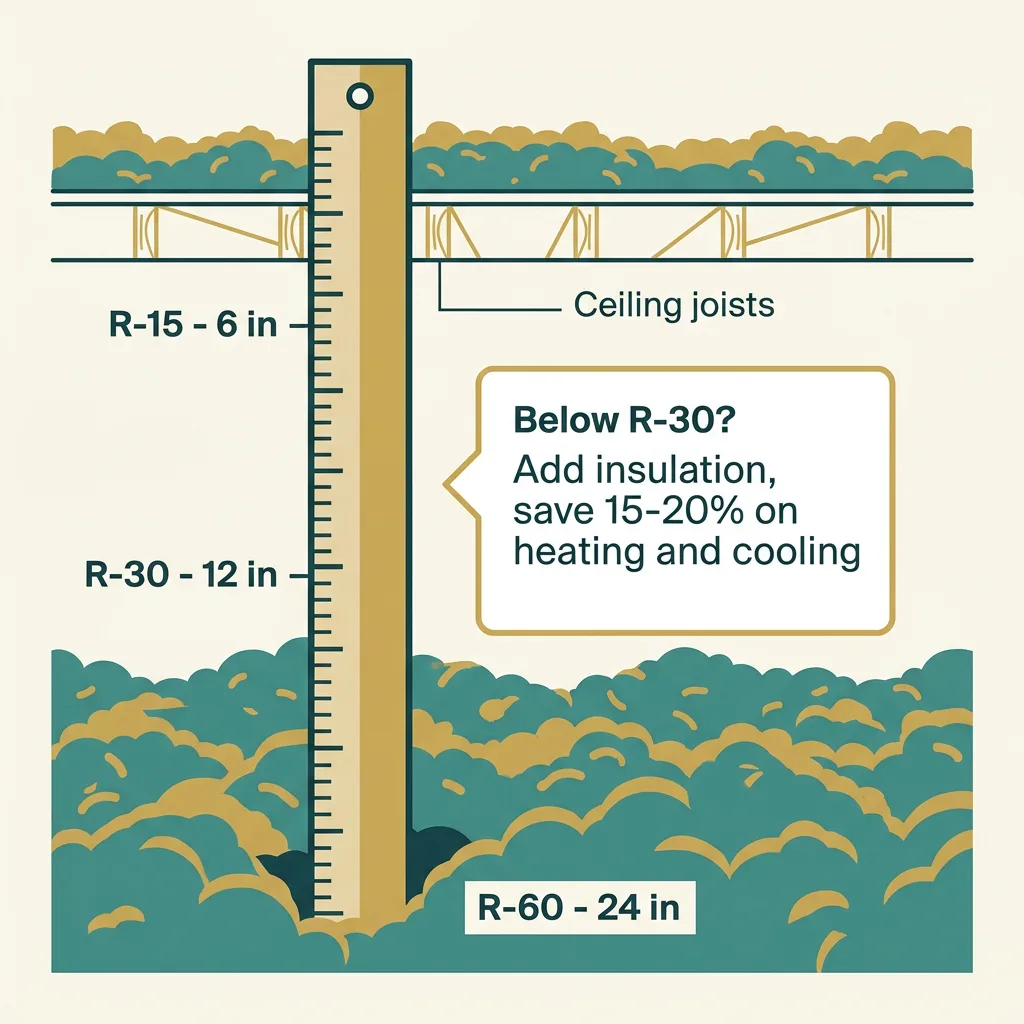
Most homes have insufficient attic insulation. Adding more is one of the highest-ROI energy upgrades.
| Current Insulation | Add R-30 | Savings | Cost | Payback |
|---|---|---|---|---|
| R-15 (6 inches) | Yes | 15–20% on heating/cooling | $400 (DIY) | 2–3 years |
| R-30 (12 inches) | Maybe | 5–10% | $300 | 4–6 years |
| R-60 (24 inches) | No | 0% | — | — |
How: DIY blown-in cellulose or fiberglass batts Savings: $150–$400/year (depending on climate)
15. Replace Old Refrigerator
If your fridge is 15+ years old, it’s costing you.
| Refrigerator Age | Annual kWh | Annual Cost | New Refrigerator Savings |
|---|---|---|---|
| 1995–2005 | 1,200–1,500 | $150–$180 | $80–$120/year |
| 2005–2015 | 800–1,200 | $100–$150 | $50–$90/year |
| 2015+ (ENERGY STAR) | 350–500 | $45–$60 | — |
Cost: $700–$1,200 (new fridge) Savings: $80–$120/year Payback: 6–12 years
Bonus: Your old fridge may be eligible for utility rebate ($50–$150)
16. Install a Heat Pump
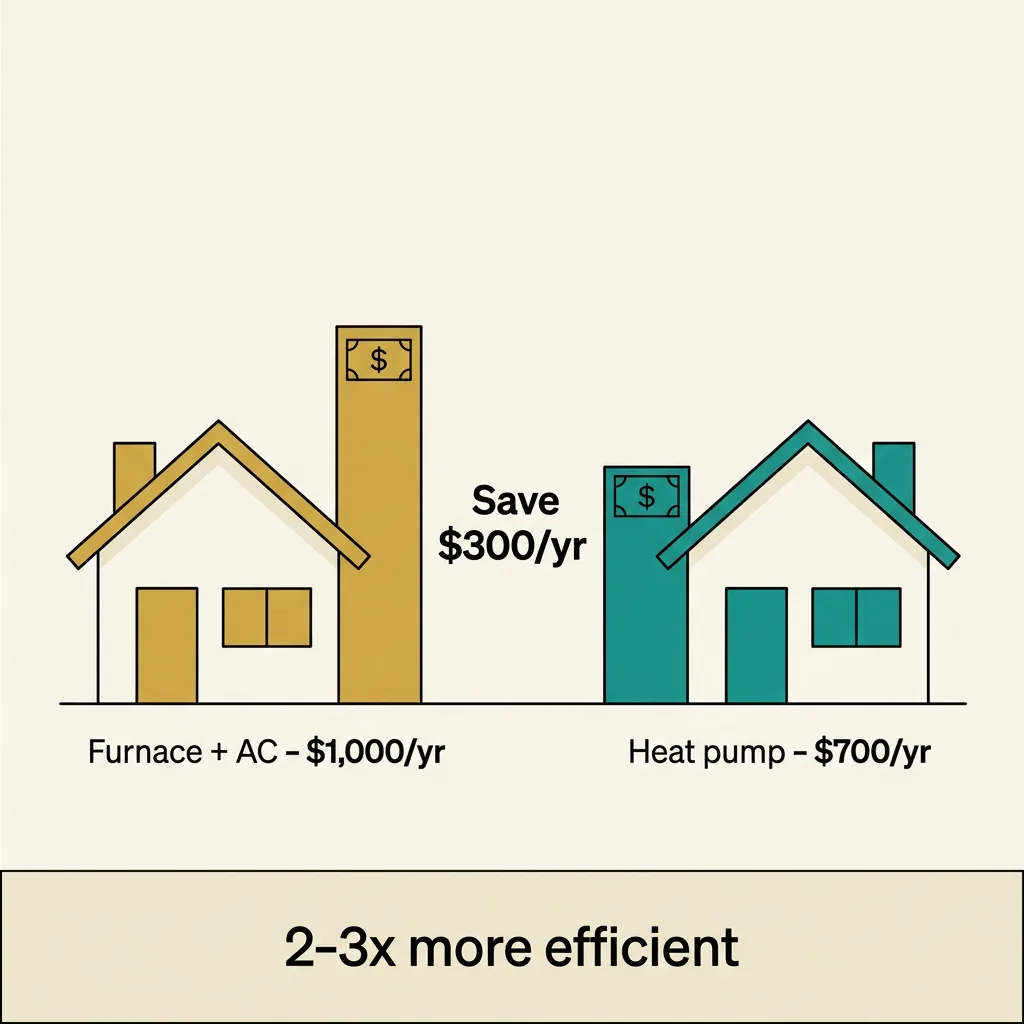
A heat pump replaces both your furnace and AC. It’s 2–3× more efficient than conventional heating. For the full fuel-cost math and a side-by-side with a new gas furnace, see Heat Pump vs Gas Furnace Savings.
| System | Efficiency (HSPF/SEER) | Annual Heating Cost | Annual Cooling Cost | Total Annual Cost |
|---|---|---|---|---|
| Gas furnace + AC | 90% AFUE, 14 SEER | $600 | $400 | $1,000 |
| Heat pump (electric) | 10 HSPF, 20 SEER | $450 | $250 | $700 |
Savings: $300/year Cost: $6,000–$10,000 Payback: 20–33 years on the fuel savings alone — but federal IRA tax credits (up to $2,000), state rebates, and the comfort and resilience value of all-electric heating typically bring the real-world payback to 8–15 years. It’s rarely a deal-killer when the full picture is counted.
Where it makes sense:
- Mild climates (not ideal for extreme cold)
- No natural gas (all-electric home)
- Replacing failed system anyway
17. Install Solar Panels
Solar generates your own electricity. With net metering, you can eliminate most of your electric bill. If panels are out of reach — cost, roof orientation, or renting — the same bill-cutting playbook works without them: see how to lower your electric bill without solar for the no-panels route through every step on this page.
Typical 6 kW system:
- Annual production: 8,000 kWh
- Covers: 80–100% of average home usage
- Annual savings: $1,000–$1,800
- Cost: $15,000–$25,000 (before 30% tax credit)
- After tax credit: $10,500–$17,500
- Payback: 9–15 years
Where it makes sense:
- High electricity rates (California, Northeast)
- Good sun exposure (south-facing roof, minimal shade)
- Strong net metering policy
HVAC Optimization (Save 20–35%)
Your HVAC is your biggest energy user. Optimize it first.
Programmable Thermostat Schedule
| Time | Wake | Leave | Return | Sleep |
|---|---|---|---|---|
| Weekday (heating) | 68°F | 62°F | 68°F | 62°F |
| Weekday (cooling) | 78°F | 85°F | 78°F | 78°F |
| Weekend (heating) | 68°F | — | — | 62°F |
| Weekend (cooling) | 78°F | — | — | 78°F |
Savings: 10–15% on heating/cooling costs
Replace Air Filters Monthly
Dirty airflow reduces efficiency by 5–15%.
Cost: $5–$10 per filter Savings: 5–15% on HVAC costs = $60–$200/year Payback: Immediate (plus extends equipment life)
Seal and Insulate Ductwork
Leaky ducts waste 20–30% of heating/cooling energy (U.S. Department of Energy, Home Upgrades, https://www.energy.gov/save/home-upgrades).
Signs of leaky ducts:
- Uneven heating/cooling (some rooms too hot/cold)
- High summer/winter bills
- Dusty rooms (air pulled from attic/crawlspace)
Cost: $500–$2,000 (professional sealing) Savings: 10–20% on heating/cooling = $120–$300/year Payback: 3–8 years
Water Heater Savings (Save 10–20%)
Your water heater is your second-largest energy user.
Lower Water Heater Temperature
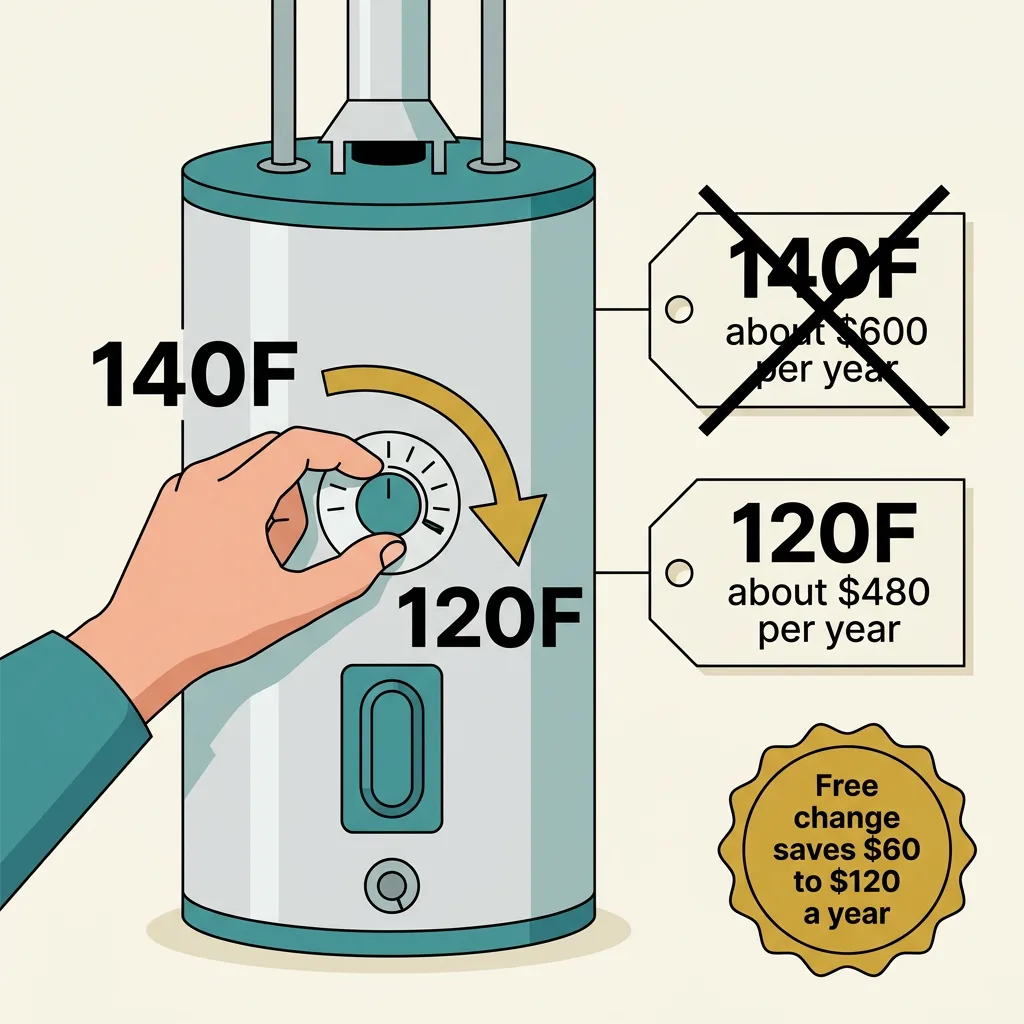
Most water heaters are set to 140°F by default. The U.S. Department of Energy recommends 120°F as the default household setpoint — it’s safe for normal use, prevents scalding, and cuts standby losses (U.S. DOE Home Upgrades, https://www.energy.gov/save/home-upgrades).
| Temperature | Annual Cost (50-gallon tank, ~17¢/kWh) | Savings vs. 140°F |
|---|---|---|
| 140°F | ~$600 | — |
| 130°F | ~$540 | ~$60 |
| 120°F | ~$480 | ~$120 |
Cost: Free (turn dial on water heater) Savings: $60–$120/year
Insulate Water Heater Tank
If your water heater is warm to the touch, it’s losing heat.
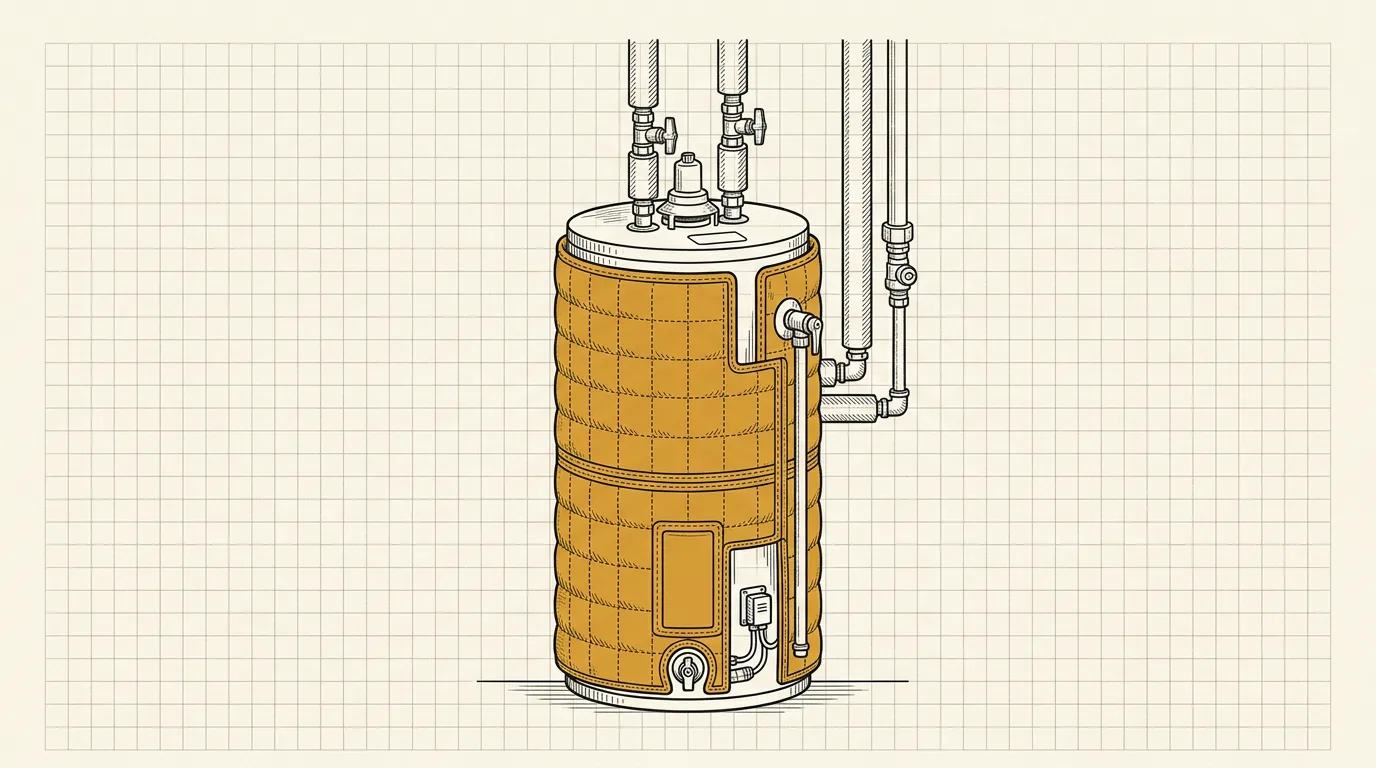
Solution: Wrap it in a water heater blanket (~$30–35) — our water heater blanket guide runs the honest math on when that pays
Savings: 4–7% on water heating = $10–$25/year Payback: 1–2 years (sooner on older, thin-walled tanks)
Insulate Hot Water Pipes
Foam pipe insulation ($10–$20) keeps hot water hot from heater to faucet.
Savings: 2–4% on water heating = $5–$15/year Bonus: You get hot water faster (less water wasted waiting)
Phantom Load Elimination (Save 5–15%)
Phantom loads account for roughly 4–8% of residential electricity use on a site-energy basis (U.S. EIA, Residential Energy Consumption Survey). For the full breakdown of what counts as a phantom load, see Phantom Power Draw Explained.
Common Phantom Loads
| Device | Standby Power | Annual Cost | Solution |
|---|---|---|---|
| Game console | 15–20 W | $22–$30 | Unplug or smart strip |
| TV (standby) | 5–10 W | $7–$15 | Smart strip |
| Computer (sleep) | 5–10 W | $7–$15 | Unplug or smart strip |
| Microwave | 3–5 W | $4–$7 | Unplug |
| Cable box | 10–15 W | $15–$22 | Smart strip |
| Phone charger (not in use) | 0.5–2 W | $1–$3 | Unplug |
(Costs computed at the guide rate of 17¢/kWh — same basis as the step-3 table above.)
Total phantom load elimination: $50–$100/year
Rate Plan Optimization (Save 10–25%)
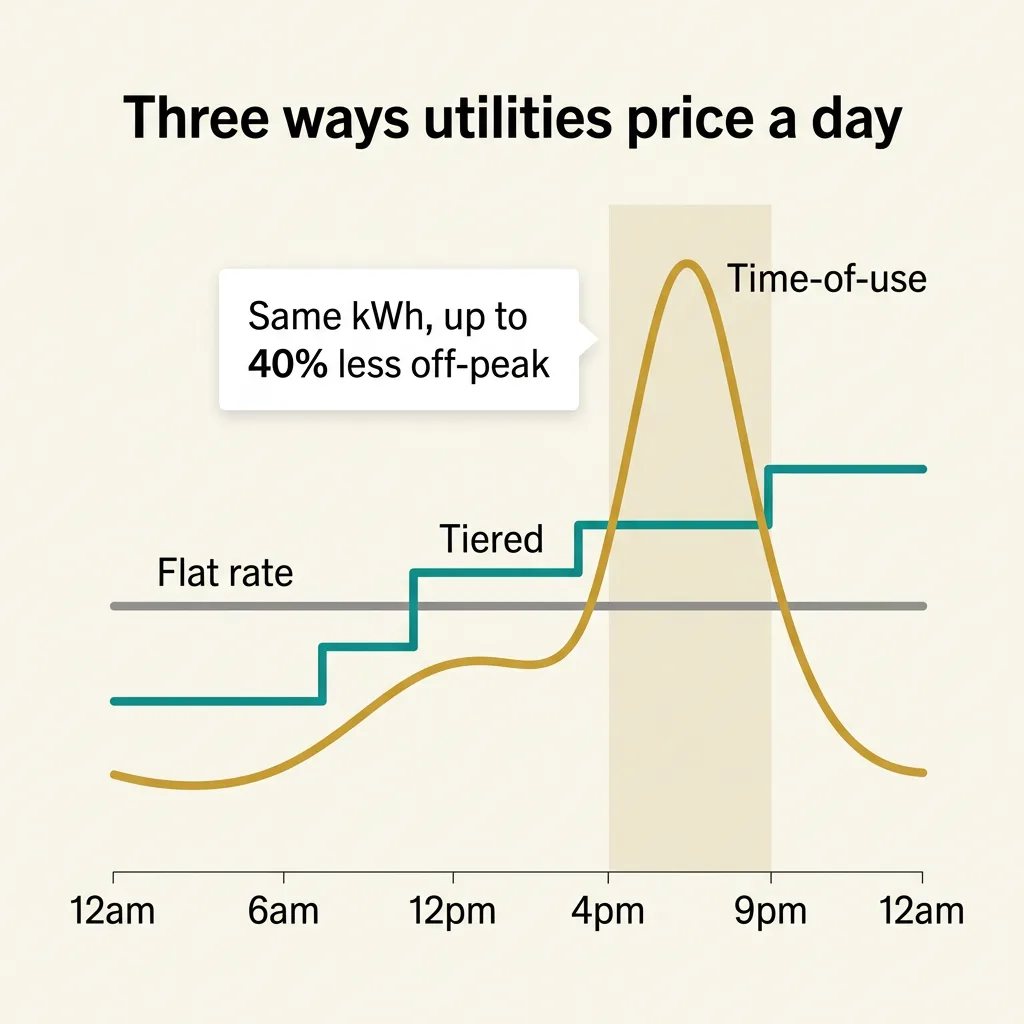
Your rate plan matters as much as your usage. The right structure — flat, tiered, or time-of-use — can quietly cut 10–25% off the same kWh you already use. For the mechanics, see Tiered Electricity Rates Explained and Time-of-Use Electricity.
Flat Rate vs. Tiered Rate vs. TOU
| Rate Type | Best For | Worst For | Typical Savings (vs. Flat) |
|---|---|---|---|
| Flat Rate | Consistent usage, inflexible schedule | — | Baseline |
| Tiered Rate | Low-to-average usage | High usage | Up to 15% (if you reduce usage) |
| TOU Rate | Flexible schedule, off-peak usage | Inflexible schedule, all-electric heat | Up to 40% (if you shift usage) |
Should You Switch to TOU?
TOU is right for you if:
- You’re away from home during peak hours (4–9pm weekdays)
- You can shift laundry, dishes, EV charging to off-peak
- You don’t have electric resistance heating
TOU is NOT right for you if:
- You work from home and use electricity during peak hours
- You have electric resistance heating or heat pump
- You can’t shift your usage
How to check: Ask your utility for a “rate comparison tool” or use their online calculator. Many utilities will run a 12-month lookback showing what you’d have paid on each plan.
Quick Reference Checklist
This Week (Free + Under $50)
- Adjust thermostat (up 2°F in summer, down 2°F in winter)
- Turn off lights in empty rooms
- Unplug phantom loads (game console, TV when not in use)
- Line-dry clothes
- Wash clothes in cold water
- Run dishwasher only when full
- Close curtains on south/west windows in summer
- Use ceiling fans
- Replace 10–20 bulbs with LEDs
- Install 2–3 smart power strips
- Seal air leaks with caulk and weatherstrip
- Install low-flow showerhead
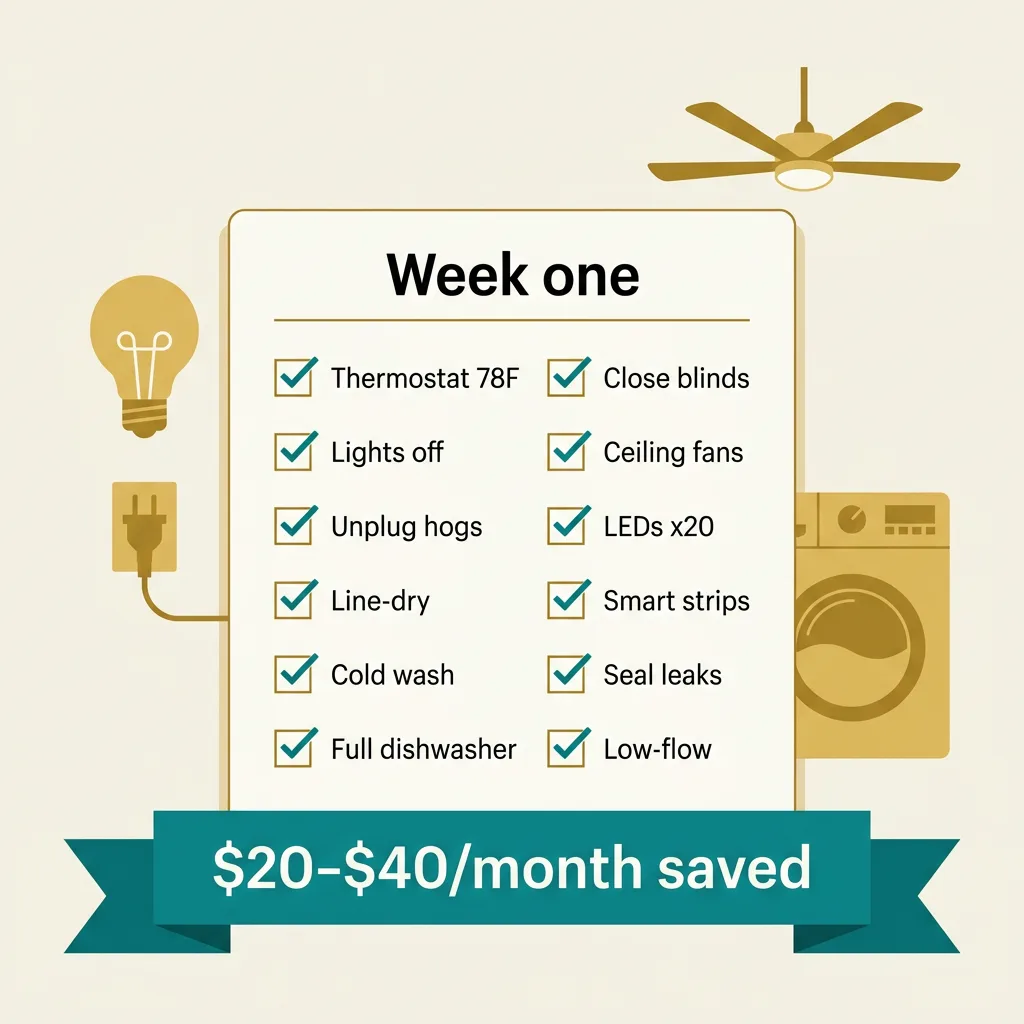
Expected savings if you adopt most of these: $20–$40/month on an average bill. The per-step ranges earlier in this guide are category ceilings — they overlap (a kWh the fan setback saves is the same kWh the thermostat schedule saves), so add habits, not line items.
This Month (Big-ticket, mid-range)
- Install programmable thermostat
- Add attic insulation (if deficient)
- Replace air filters
- Lower water heater to 120°F
- Insulate water heater tank
- Insulate hot water pipes
- Evaluate duct sealing
Expected additional savings: $5–$15/month on top of the habit changes. The water-heater measures overlap each other (the blanket and the 120°F setpoint act on the same tank), so the same add-habits-not-line-items rule applies.
Long-Term (Big-ticket, high-investment)
- Evaluate heat pump (when furnace/AC needs replacement)
- Evaluate solar panels (if high rates, good sun, net metering)
- Evaluate ENERGY STAR appliances (when old units fail)
Expected additional savings: these only pay when aging equipment retires anyway — then a high-efficiency replacement typically saves $10–$25/month versus the like-for-like option. Solar can offset most of a bill, but that is generation with its own payback math, not an efficiency step; don’t stack it against the 20–40% ceiling above.
What to Check Next
Before spending on upgrades, confirm nothing on the utility side is inflating your bill. Walk through Why Your Electric Bill Is So High to rule out billing errors, estimated reads, bad rate tiers, and faulty meters — a 15-minute check can prevent chasing the wrong problem.
Related Articles
- How to Read Your Electric Bill (Line by Line Guide)
- Understanding Your Utility Bill: The Complete Guide for 2026
- Why Is My Electric Bill So High?
- HVAC Efficiency: SEER, AFUE, and HSPF Explained
- Phantom Power Draw Explained
- Time-of-Use Electricity: How to Save by Shifting Usage
- Tiered Electricity Rates Explained
- How to Check for Energy Leaks in Your Home (DIY)