Quick Answer
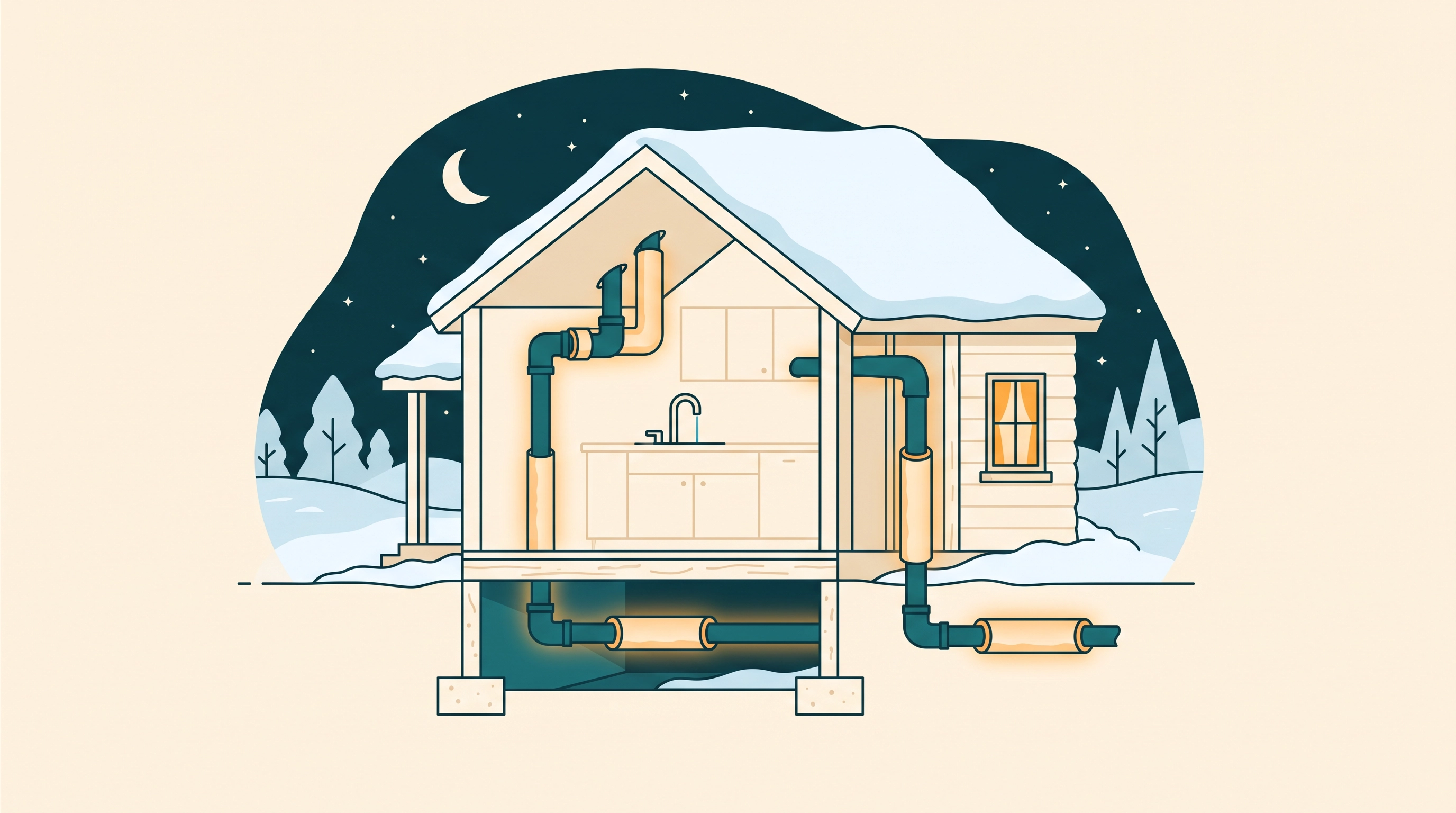
Pipes don’t freeze because a house is cold — they freeze because the water in them sits still in a pipe that heat can’t reach, long enough for the temperature to drop below freezing. Every fix on this page is one of two things: keep water moving, or get heat to the pipe. The American Red Cross playbook fits on a sticky note: keep the thermostat at 55°F or higher (even when you’re away), open kitchen and bathroom cabinet doors so warm room air reaches under-sink plumbing, and let cold water drip from the faucet fed by the pipe most at risk — moving water freezes far slower than standing water.
None of those requires the heating system to be working. That’s the point of this page: the ranked ladder below works during a heating outage, in a vacant house, or in a crawl space the furnace has never touched — and every rung is cheaper than the average burst-pipe insurance claim, which IBHS puts at more than $5,000 per incident. For what a small drip actually costs on your bill, see how much a dripping faucet adds to your water bill; for the catastrophe a burst can become on your water bill, start with why is my water bill so high.
Why pipes freeze (the 30-second physics)
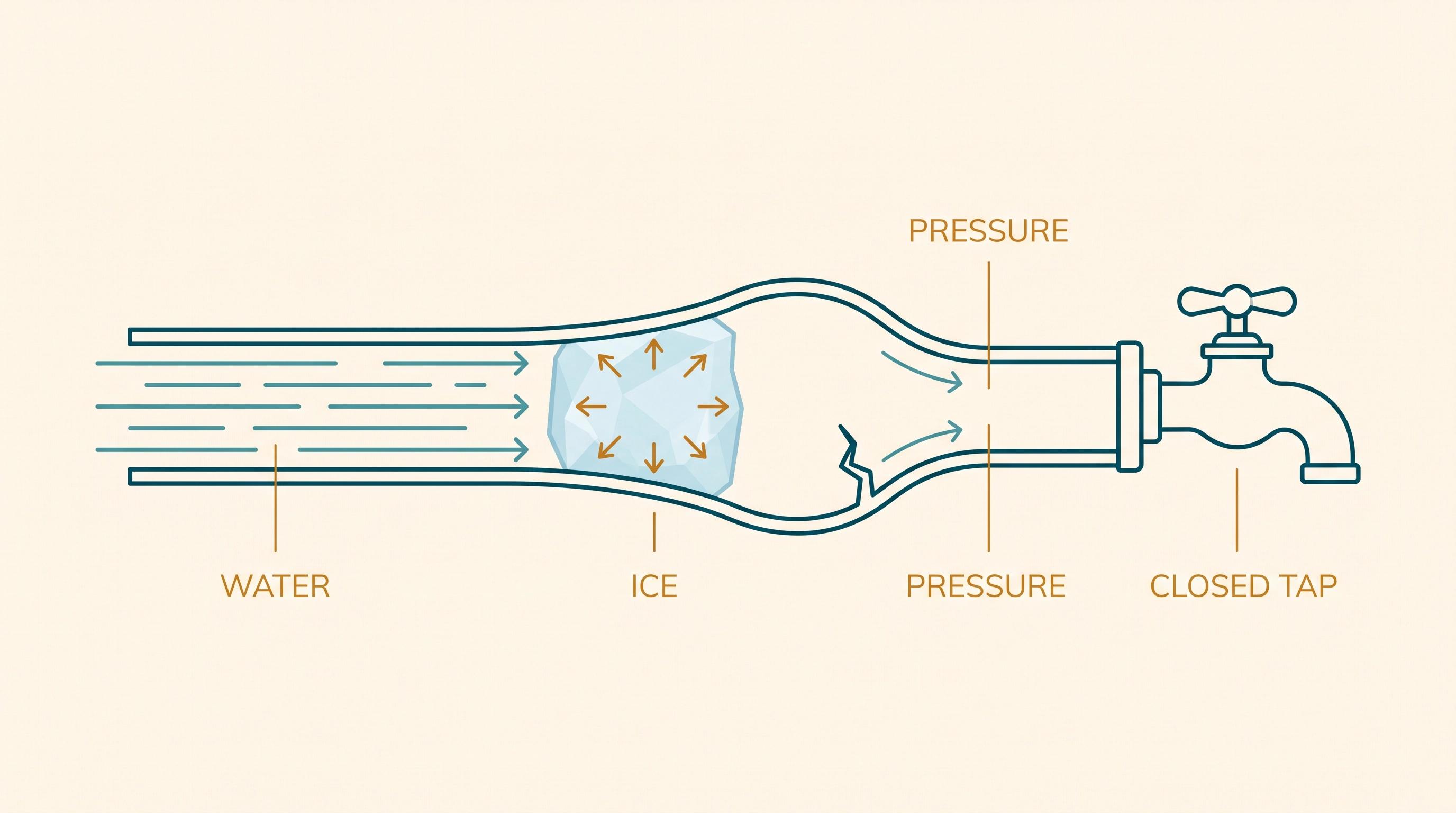
Water expands when it freezes — the only common liquid that does. Inside a pipe, that expansion doesn’t push outward into open air; it pushes against the pipe wall between the ice plug and a closed faucet, and the pressure can reach thousands of pounds per square inch. The pipe doesn’t usually burst where the ice is; it bursts downstream, between the ice and the tap. That’s why a “frozen pipe” and a “burst pipe” are two events separated by luck and hours.
Three conditions line up before it happens:
- The pipe is exposed — in a crawl space, on an outside wall, in an unheated garage, under a mobile home, or in a wall cavity with poor insulation.
- The water is still — nobody has run a tap in hours (overnight, or a vacant house).
- Cold has hours to work — sustained temperatures in the 20s°F or below, especially with wind, which strips heat from exposed runs fast.
Remove any one of the three and the pipe survives the night. The ladder below removes them in order of cost.
The prevention ladder (ranked by cost, tonight-first)
Rung 1 — Free, tonight
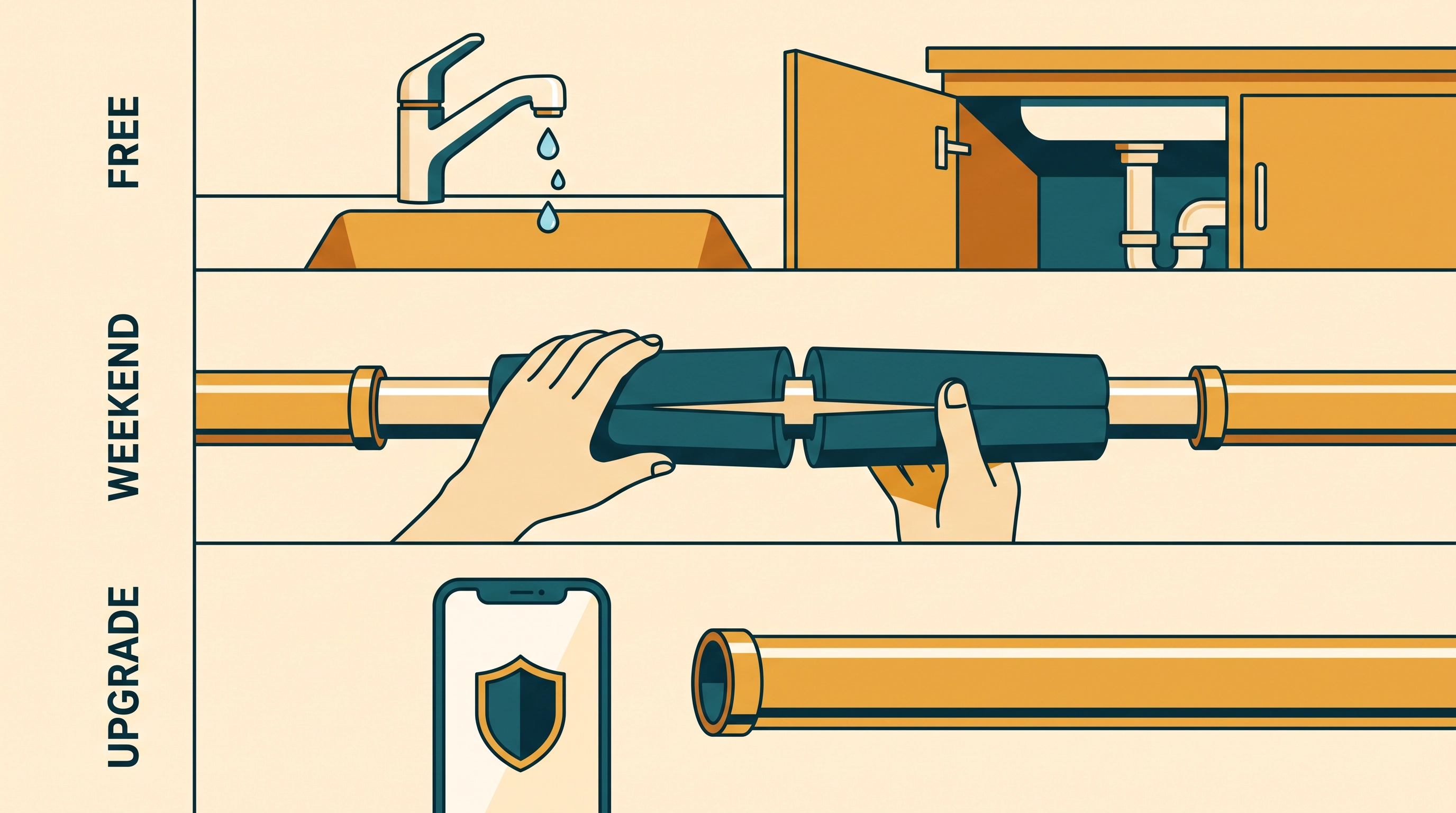
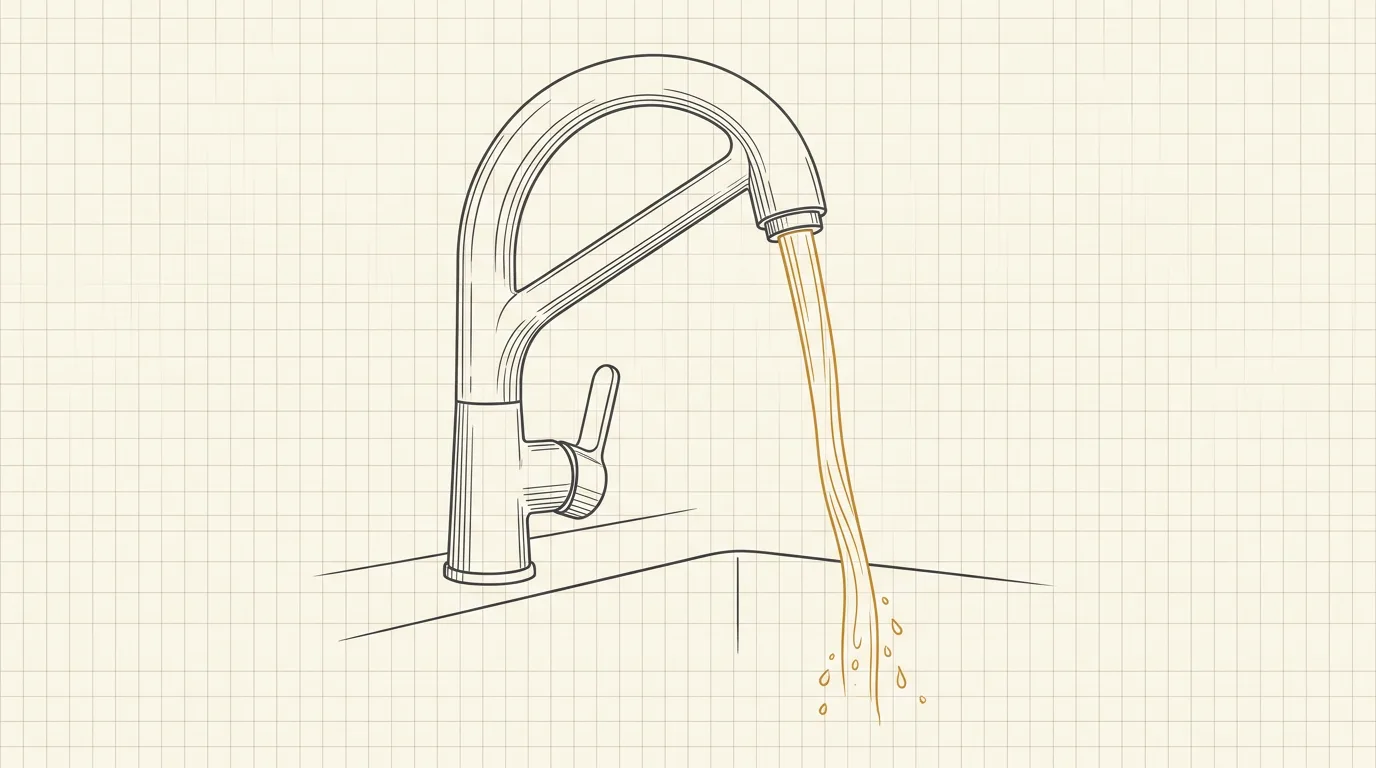
Drip the right faucet. Pick the faucet fed by the most at-risk pipe (outside wall, crawl space) and let cold water run at pencil-thin width. Moving water is harder to freeze, and an open tap gives any ice that does form somewhere to push. Cost: fractions of a cent per hour on your water bill — a pencil-width drip is roughly 40 gallons a day, on the order of the cost of one load of laundry. If you’re on a municipal bill measured in CCF, what CCF means on your water bill shows the conversion.
Open the cabinets. Kitchen and bathroom base cabinets trap cold air around plumbing that shares a wall with the outdoors. Opening them lets 68°F room air do what the missing insulation should.
Keep the thermostat at 55°F minimum, day and night. The Red Cross rule, and the one people break for a $2 setback saving. If you’re away for the season, 55°F is the floor, not the suggestion.
Self-regulating cable (3–5W per foot class) that adjusts its heat output to the pipe temperature — no thermostat to set, safe for plastic and metal pipe under insulation. For the one run that freezes every year: well lines, crawl-space feeds, mobile-home supply. Match the length to your run and follow the manufacturer's install instructions exactly.
Check price on Amazon As an Amazon Associate we earn from qualifying purchases. Price & availability shown on Amazon.com.Shut and drain outdoor supply. Close the indoor shutoff valve feeding outdoor faucets, then open the spigot outside to drain the line. A spigot that holds no water cannot burst. (Faucet covers help — we cover them below — but draining beats covering.)
Rung 2 — Cheap, this weekend ($10–$50)
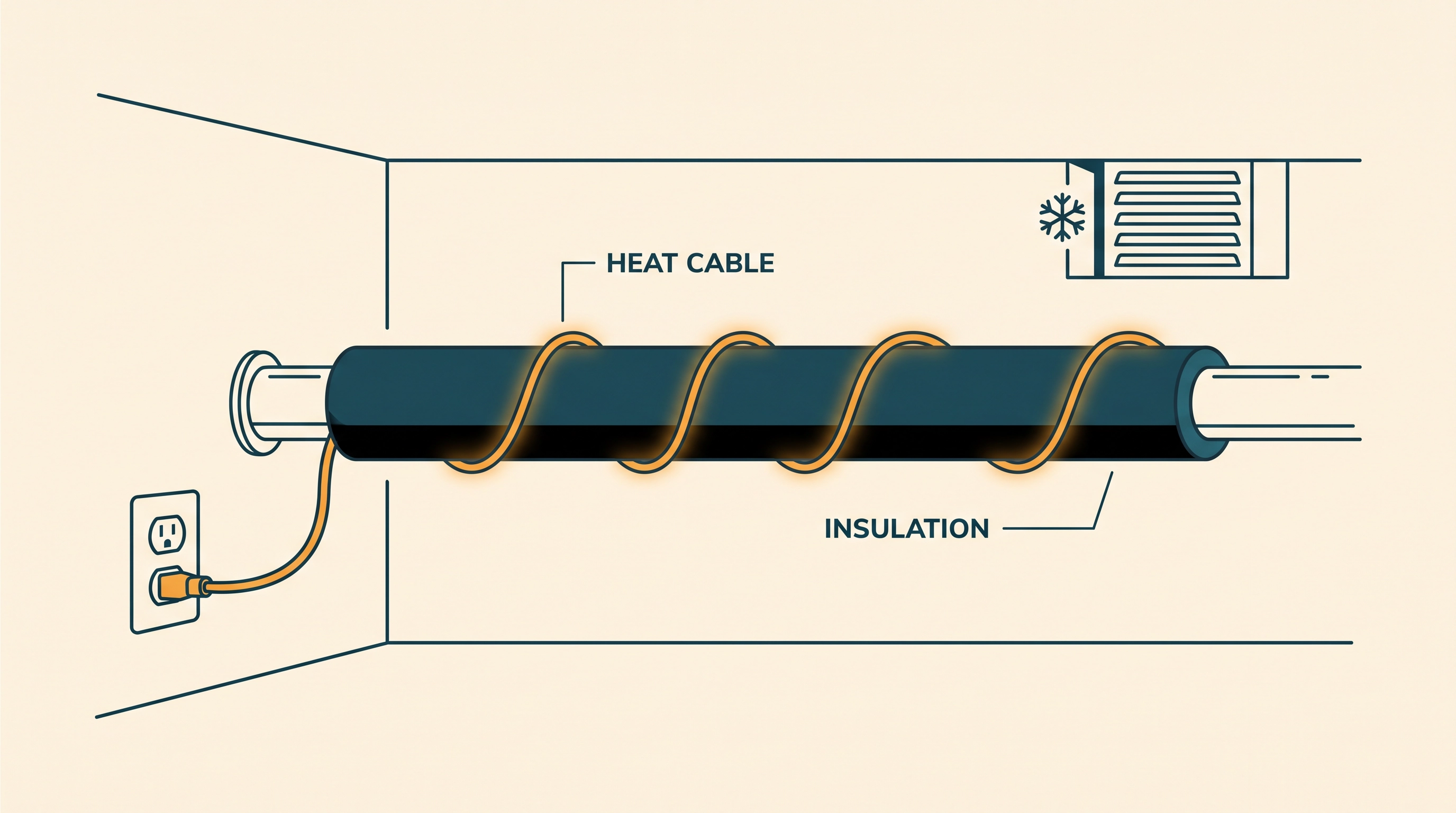
Foam pipe insulation sleeves on every accessible exposed run — crawl space, basement rim joists, garage. Pre-slit polyethylene tubes, a knife to cut, no tools to speak of. This is the highest-value $30 in home plumbing.
Self-regulating cable (3–5W per foot class) that adjusts its heat output to the pipe temperature — no thermostat to set, safe for plastic and metal pipe under insulation. For the one run that freezes every year: well lines, crawl-space feeds, mobile-home supply. Match the length to your run and follow the manufacturer's install instructions exactly.
Check price on Amazon Price & availability shown on Amazon.com — we may earn a commission.Heat tape or cable on the chronic problem pipe. Every house has one run that freezes no matter what — the well line, the crawl-space feed, the line under the addition. Self-regulating heat cable is the targeted fix: it draws power only as the pipe cools, so it’s cheap to run, and it keeps a pipe above freezing even when the space around it is well below. Run cost math: a 5W/ft cable on a 20-foot run is 100W when fully on — about 2 cents an hour at the US average rate, and self-regulating cable is rarely fully on. (For the full watts-to-dollars method, see space heater running cost — same formula.)
Insulate the crawl-space or garage wall, not just the pipe. A pipe sleeve protects inches; a bale of fiberglass or a rigid-foam windbreak protects the whole space. If the cavity is truly unheatable, the goal is to slow heat loss, not to heat it.
Rung 3 — The upgrades that end the problem ($100–$400)
A whole-home leak detection + auto-shutoff. A frozen pipe that bursts at 10 a.m. is a cleanup; one that bursts during a holiday week is a demolished kitchen. A strap-on monitor (Flume 2) watches flow at your meter and alerts your phone the moment usage looks abnormal — no plumber needed. The inline option (Moen Flo) closes the valve itself.
Straps onto your existing water meter — no plumber, no pipe cutting. Whole-home flow, usage history, and micro-leak alerts to your phone. Catches both the silent leak and the catastrophic burst-minute-one. Verify your meter model is compatible before ordering.
Straps onto your existing water meter — no plumber, no pipe cutting. Whole-home flow, usage history, and micro-leak alerts to your phone. Catches both the silent leak and the catastrophic burst-minute-one. Verify your meter model is compatible before ordering.
Check price on Amazon As an Amazon Associate we earn from qualifying purchases. Price & availability shown on Amazon.com.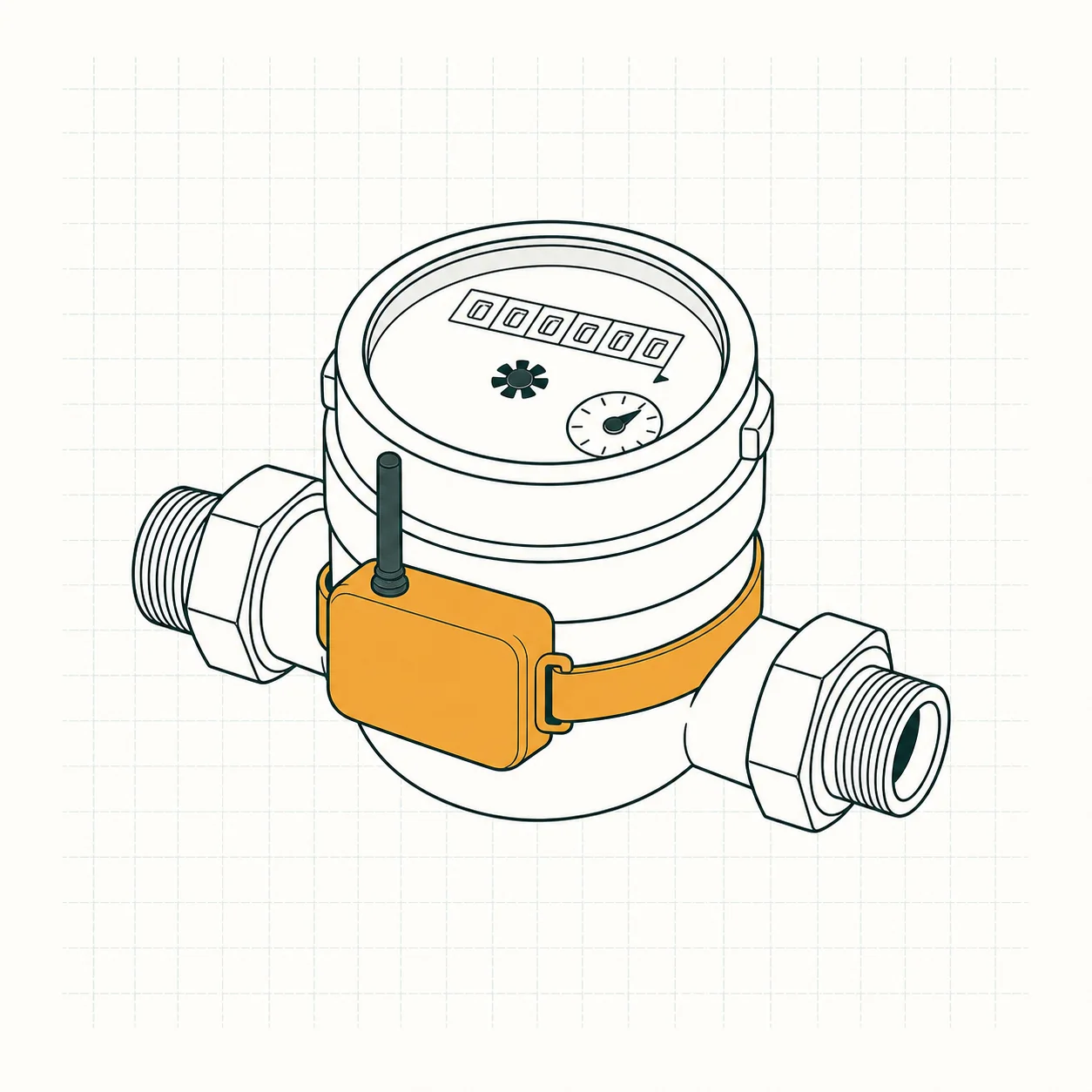
Inline monitor and automatic shutoff on the main line — plumber install. Watches flow, pressure, and pipe temperature and closes the valve itself when it sees an anomaly. Ask your insurance carrier about a smart-shutoff discount.
Check price on Amazon Price & availability shown on Amazon.com — we may earn a commission.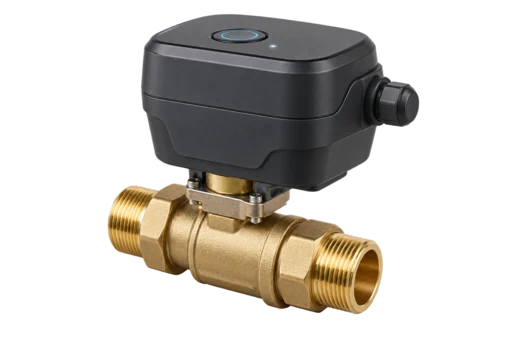
Pipe heating with a thermostat and indicator light on runs that freeze every single year despite insulation. Installed once, it runs for a decade. Have an electrician verify the circuit if the run is long.
Point sensors where a burst would be worst — under the water heater, behind the washing machine, under the kitchen sink on the outside wall.
Battery-powered sensors that sound a 100dB alarm the moment they touch water. Place under sinks, behind the washer, and beside the water heater — the five places a burst does the most damage fastest. Pairs with the [placement guide](/blog/where-to-place-water-leak-sensors/).
Check price on Amazon Price & availability shown on Amazon.com — we may earn a commission.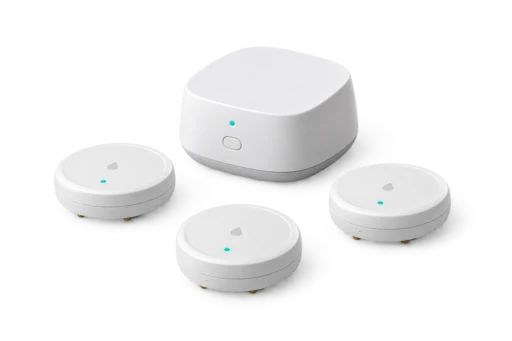
If the pipe is already frozen (do this, not that)
- Find the freeze, don’t guess. Open the tap. No flow at all says the freeze is upstream of that faucet’s branch; slow trickle says it’s partially open. Work from the faucet back toward the meter, checking accessible runs.
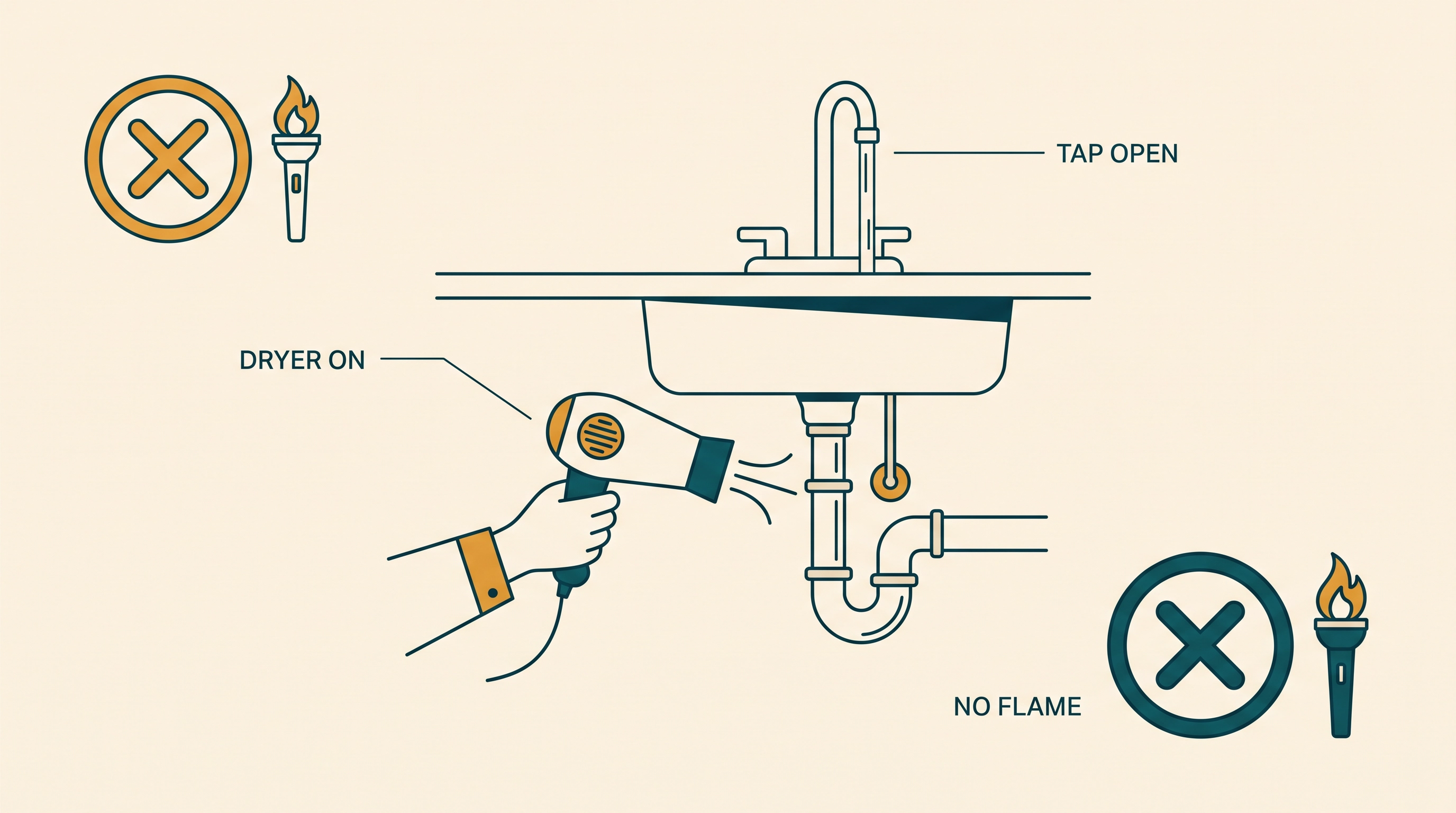
- Keep the tap open while you work. Melting water needs somewhere to go; the open faucet is the pressure release that keeps a thawing pipe from becoming a burst pipe.
- Heat the pipe, gently, from the faucet side toward the freeze. Hair dryer on high, heat gun on low, heating pad wrapped around the run, hot towels. You’re moving a plug, not blasting ice.
- Never an open flame — torch, propane, cigarette lighter. This is how frozen-pipe season produces house fires. Also never use a space heater pointed at a wall cavity unattended (see space heater running cost for what that costs to run, and keep any heater 3 feet from combustibles).
- Cannot find it, cannot reach it, or the pipe has already split? Shut the main valve — usually where the line enters the house (the shutoff test in who’s responsible for a water leak shows how to isolate your side) — and call a plumber. Water damage compounds hourly.
If it burst: shut the main first, then document everything for the insurer — most homeowner policies cover sudden accidental discharge from a burst pipe but not the pipe repair itself (the “hidden damage” nuance; verify with your carrier). And when the bill arrives, a burst pipe’s wasted water is disputable — the water bill leak-adjustment walkthrough covers the credit request.
Inline monitor and automatic shutoff on the main line — plumber install. Watches flow, pressure, and pipe temperature and closes the valve itself when it sees an anomaly. Ask your insurance carrier about a smart-shutoff discount.
Check price on Amazon As an Amazon Associate we earn from qualifying purchases. Price & availability shown on Amazon.com.Who pays: you, the utility, or the insurer?
The dividing line is the same one used for leak responsibility before and after the water meter: you own everything past the meter (in most US arrangements, the customer-side service line and all house plumbing). A freeze in your crawl space is your pipe, your repair, your insurance claim. The utility’s side of the meter is theirs — but a frozen meter pit is rarer, because meters sit below frost depth. The insurer pays for sudden water damage, subject to your deductible and the maintenance exclusion — a pipe you knew was vulnerable and ignored is arguable; a cold snap you couldn’t foresee is a clean claim. Water wasted through the burst runs through your meter and onto your bill — that part is your consumption, though many utilities grant a leak credit (see the adjustment page above).