Quick Answer
Call the utility first, then put it in writing, then escalate to your state public utility commission — and never stop paying the undisputed portion of your bill unless you know your state’s rules. Here’s the escalation ladder in brief:
- Call the utility. Explain the billing error, ask for an account-specific recalculation, and get a case or ticket number.
- Submit a written complaint. Include your account number, the disputed charge, your evidence, and the resolution you want. Use the template in Step 2 below.
- File a complaint with your state public utility commission (PUC). Find yours at naruc.org. The California Public Utilities Commission states it can order utilities to take corrective action on formal complaints [3], and the Public Utility Commission of Texas enforces a 10-day disconnection-notice rule and prohibits electric disconnection for disputed charges until the REP or PUCT determines their accuracy and notifies you [4].
- Escalate further. If the PUC decision doesn’t resolve it, options include small claims court or an FTC consumer complaint via ReportFraud.ftc.gov.
Keep paying your undisputed charges while the dispute runs. In Texas, a utility cannot disconnect you for disputed charges until the dispute is resolved and you are notified of the outcome [4] — but that protection is state-specific. Ask your utility in writing what rules apply to your account.
Step 1: Call Your Utility First
Start with the exact bill line, service dates, rate plan, meter/read status, payment information, and current tariff. Do not assume a particular deadline, payment rule, disconnection protection, regulator, or outcome applies across all utilities.
DOE’s bill guidance describes the distinct charge and rate components that need to be understood before a bill can be reproduced or reviewed.[1]
Prepare a Focused Review Request
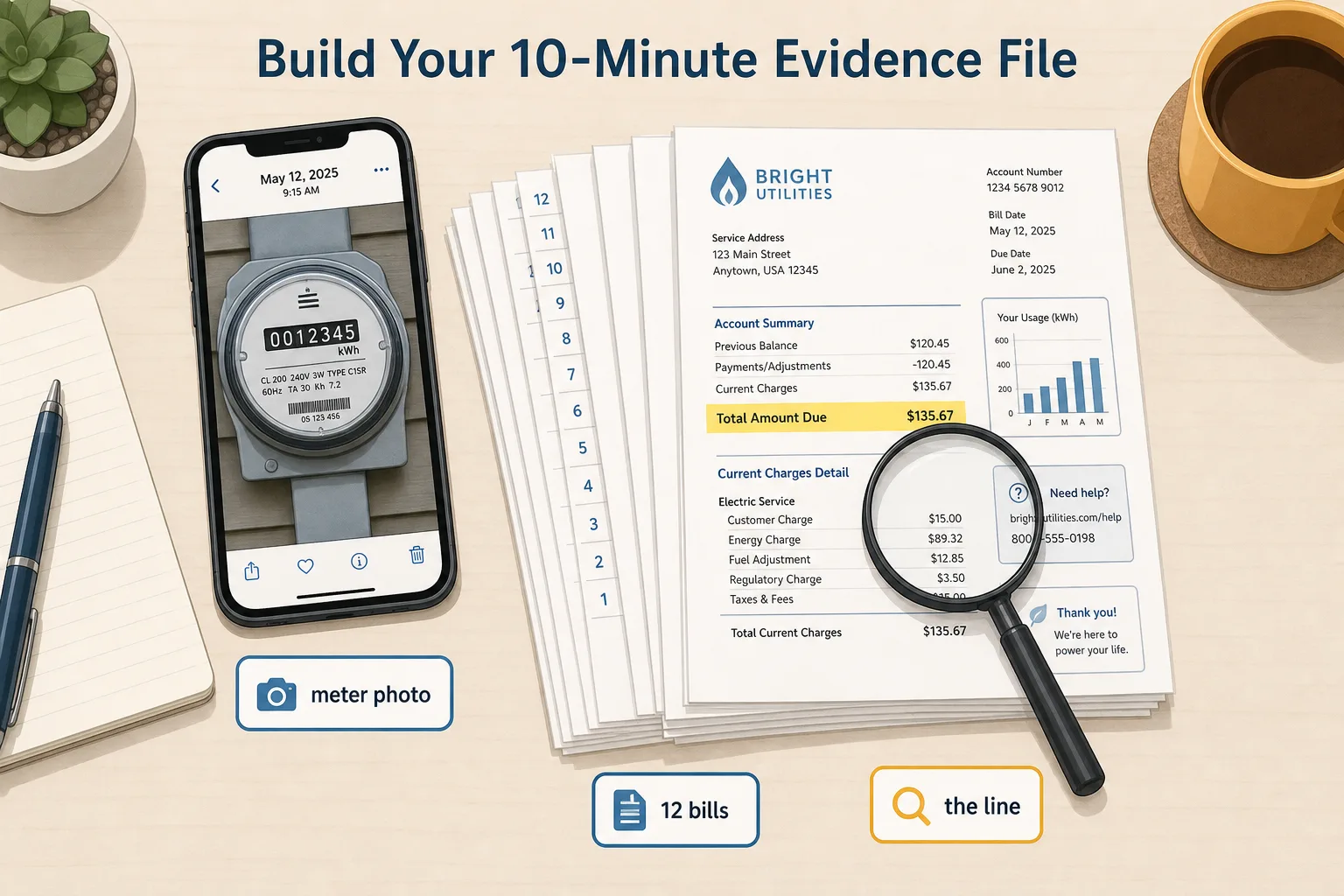
Gather copies of the current statement, a comparable earlier statement, the applicable tariff or rate schedule, payment confirmation if relevant, and any provider correspondence. Then state the precise question: a meter/read status, billed usage, rate-plan application, credit, payment posting, or named line item.
| Record | What to identify |
|---|---|
| Current bill | Account, service dates, meter/read status, rate plan, and challenged line |
| Prior comparable bill | Relevant difference in usage, rate, billing days, credit, or charge |
| Tariff/rate schedule | The account rule you believe needs explanation or review |
| Payment evidence | Date, amount, confirmation, and account reference |
| Meter evidence | Only if safely obtained and allowed by the provider |
Con Edison explains that customers can submit a meter reading in certain circumstances to avoid an estimated bill; use your own provider’s instructions because its process may differ.[2] Our guide to reading an electric meter shows how to take a defensible reading, including the load test that proves whether the register itself is accurate.
Ask for an Account-Specific Calculation
Use the provider’s official contact channel and request a written explanation of the identified line. Ask it to provide the tariff reference, rate or calculation used, meter/read status, billing period, and any credits, riders, taxes, or one-time items included.
Keep the date, communication method, representative or case reference if supplied, and the written response. Do not use another customer’s bill or a generic national example as evidence that your account is incorrect.
Protect Service and Safety
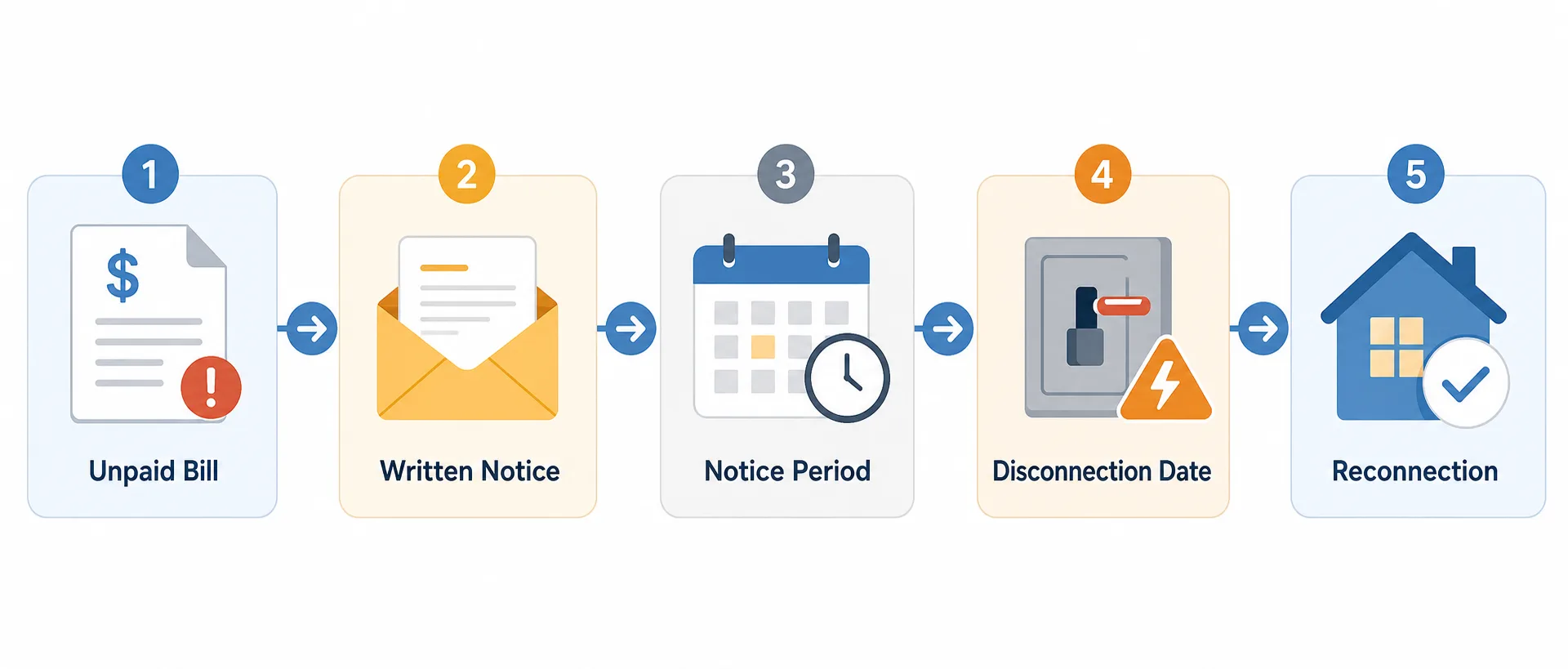
The provider’s written rules govern payment while a review is pending, notice requirements, payment arrangements, and disconnection procedures. Ask the provider directly what current account obligations and options apply; do not withhold payment or rely on a generic “undisputed portion” rule without that confirmation.
Never alter a meter, seal, utility line, or other service equipment. For a gas odor, electrical hazard, or other emergency, use the provider’s emergency instructions rather than the billing-review channel.
Step 2: Submit a Written Complaint
If the phone call doesn’t resolve the issue, put it in writing. A written complaint creates a paper trail and is often required before you can escalate to your state’s public utility commission.
What to Include
Your written complaint should include:
- Your full name and the account holder’s name (if different)
- Account number and service address
- Bill date and the specific charge you are disputing
- The exact dollar amount in question
- Your explanation of why the charge is wrong
- Your evidence — meter photos, prior bills, payment confirmations, correspondence
- The resolution you want — a corrected bill, a credit, a rebill from an actual meter read
- Your contact information — phone number, email, and mailing address
- A deadline for a response (10–15 business days is a reasonable suggestion; adjust as needed)
Sample Complaint Letter
[Your Name]
[Your Address]
[City, State, ZIP]
[Phone Number]
[Email][Date]
[Utility Company Name]
[Customer Service Department]
[Company Address]Re: Dispute of Charge on Account [Account Number] — Bill Date [Date]
Dear Customer Service Department:
I am writing to dispute a charge on my [electric/gas/water] bill dated [bill date] for account number [account number] at [service address].
The charge in question is [describe the specific charge, e.g., “$XX for usage on line item YY”]. I believe this charge is incorrect because [explain why — e.g., “my meter reading shows XX kWh, not the YY kWh billed” or “I already paid this amount on [date] per confirmation number [number]”].
I have attached [list attached evidence — e.g., “a photo of my meter dated [date], a copy of my prior bill, and my payment confirmation”].
I request that you [state the resolution you want — e.g., “correct the bill to reflect my actual meter reading and issue a credit for the overcharge”].
Please respond in writing within 15 business days. You can reach me at [phone number] or [email].
Thank you for your attention to this matter.
Sincerely,
[Your Name]
What to Do After You Send It
Send the letter by certified mail with return receipt requested, or through the utility’s secure online portal if it offers one. Keep a copy of the letter, any attachments, and the delivery confirmation. If you send it online, take a screenshot of the submission confirmation and save the case number.
Follow up if you don’t get a response within the deadline you set. Call the utility and reference your case number, or send a follow-up letter referencing the original.
Step 3: File a Complaint With Your State’s Public Utility Commission
If the utility’s written response does not resolve the issue — or if it doesn’t respond at all — your next step is your state’s public utility commission (PUC). These are the state agencies that regulate utility companies, and they have the authority to order corrections and enforce consumer protections.
Find Your State’s PUC
Every state has a public utility commission or a similar agency that handles consumer complaints against utilities. Find yours at naruc.org — the National Association of Regulatory Utility Commissioners maintains a directory of every state commission. [5]
How It Works: Two State Examples
California (CPUC). The California Public Utilities Commission handles complaints against utilities such as Pacific Gas and Electric, Southern California Edison, and others. Its website states: “If you cannot resolve the problem after talking with the utility’s customer service, you may file an informal complaint with us.” The CPUC can also order the utility to take corrective action on formal complaints. [3] To file, visit cpuc.ca.gov/complaints/.
Texas (PUCT). The Public Utility Commission of Texas regulates electric, telecommunication, and water/sewer utilities. Its published rules include a 10-day disconnection-notice requirement: “The disconnection date must be 10 days from the date the notice is issued and may not fall on a holiday or weekend” [4]. The PUCT also prohibits electric disconnection for disputed charges until the REP or PUCT determines their accuracy and notifies you and the customer is notified of the outcome [4]. To file a complaint, visit puc.texas.gov/consumer-help/complaints/.
What to Expect When You File
Most state PUCs allow you to file a complaint online, by phone, or by mail. You will need:
- Your account number and the utility’s name
- The dates of your previous attempts to resolve the issue (phone calls, written complaints)
- A description of the problem and the resolution you want
- Copies of your evidence (bills, correspondence, photos)
The PUC will typically contact the utility and ask for a response. The utility’s deadline to respond varies by state. The PUC will then review the information and issue a decision — which can include ordering the utility to correct your bill, refund overcharges, or adjust your account.
What If Your State Doesn’t Have a PUC for Your Utility?
Some utilities — particularly municipal utilities, cooperatives, and water providers — may not be regulated by the state PUC. In that case, ask your utility which agency oversees it. You may need to escalate to your city council, a local utility board, or the state attorney general’s consumer protection office.
Step 4: Further Escalation
If your state’s PUC issues a decision that doesn’t resolve the dispute, or if your utility is not regulated by a PUC, you have a few further options:
- Small claims court. For amounts within your state’s small claims limit, you can file a case without a lawyer. Check your state’s limit — it varies widely. This is a practical option for a specific overcharge that the PUC didn’t correct.
- FTC consumer complaint. File a complaint with the Federal Trade Commission at ReportFraud.ftc.gov if you believe the utility has engaged in deceptive or unfair practices. The FTC does not resolve individual disputes, but it uses complaints to identify patterns that may lead to enforcement actions.
- State attorney general. Your state attorney general’s consumer protection office may also accept utility complaints, especially if the issue affects many customers.
Scam Awareness
Be aware that scammers impersonate utility companies to steal money. The FTC warns: “If you get an unexpected call, text, email, or in-person visit from your gas, electric, or water company and they threaten to shut off your service unless you pay them, it’s a scam” [8]. Real utility companies do not demand immediate payment by wire transfer, cryptocurrency, payment app, or gift card [8]. If you have any doubt about a contact, call the utility using the number on your bill — not the number the caller gives you.
Evidence Log: What to Keep and When
A dispute is only as strong as your documentation. Keep a running log of everything related to the dispute:
| Date | Item | Details |
|---|---|---|
| [Date] | Bill copy | The disputed bill, saved as PDF or hard copy |
| [Date] | Prior bill | A comparable prior bill for comparison |
| [Date] | Meter photo | Dated photo of your meter reading (if a meter dispute) |
| [Date] | Call to utility | Date, time, representative name, ticket/case number, summary |
| [Date] | Written complaint | Copy of letter or online submission, delivery confirmation, case number |
| [Date] | Utility response | Written response, date received, summary of resolution offered |
| [Date] | PUC complaint | Filing date, case number, any correspondence |
| [Date] | Payment records | All payments made during the dispute, with confirmation numbers |
Sample Call Log
| Date | Company | Rep Name | Ticket # | Summary |
|---|---|---|---|---|
| 2026-08-01 | [Utility] | Jane Smith | CS-12345 | Explained high bill, asked for review. Jane said she’d escalate to billing dept. |
| 2026-08-08 | [Utility] | — | CS-12345 | Followed up. No response from billing. Asked for supervisor. |
| 2026-08-15 | [Utility] | Mark Davis | CS-12345 | Supervisor reviewed. Said bill is correct per tariff. Disagree. Asked for written explanation. |
Payment Assistance While You Dispute
If the disputed amount is causing financial strain, don’t wait for the resolution to seek help. The Low Income Home Energy Assistance Program (LIHEAP) can help pay your heating or cooling bills or provide emergency services during an energy crisis [6]. LIHEAP assists roughly 6.7 million households through local agencies [9] — our LIHEAP and assistance-programs guide covers eligibility, state programs, and the emergency workflow.
Eligibility is based on income, and every state and territory sets its own requirements [6]. Contact your local LIHEAP office to apply. You can also call 211 to find local assistance options.
For more on managing past-due balances while a dispute is open, see how to review a past-due balance. If a deposit is required as part of the dispute resolution, see how to review a utility deposit. For estimated bills that may be the source of the dispute, see estimated utility bills explained. For a complete walkthrough of every line on your statement, see the complete guide to understanding your utility bill. If your service is at risk, see can the utility shut off your service.
Review-Request Checklist
- What exact bill line, service date, meter/read status, payment, or rate rule is being questioned?
- What does the current tariff say for this service class and period?
- What account records support the question?
- What calculation and tariff reference did the provider give in writing?
- What current payment, safety, review, and escalation terms does the provider document?
- Have you kept a dated log of every call, letter, and response?
- Have you filed a complaint with your state’s PUC if the utility didn’t resolve the issue?
FAQ
How long does the utility have to respond to a dispute?
What evidence should I gather before disputing a utility bill?
When should I escalate to my state's public utility commission?
Does disputing a bill stop shutoff or collections?
Can I dispute an estimated bill?
Sources
- U.S. Department of Energy: Understanding Your Utility Bills—Electricity (PDF)
- Con Edison: How to Read Your Electricity Meter
- California Public Utilities Commission: File a Complaint (retrieved 2026-08-29)
- Public Utility Commission of Texas: Know Your Rights (retrieved 2026-08-29)
- National Association of Regulatory Utility Commissioners (NARUC) (retrieved 2026-08-29)
- USAGov: Get Help with Energy Bills (retrieved 2026-08-29)
- Federal Trade Commission: Getting Utility Services — Why Your Credit Matters (retrieved 2026-08-29)
- Federal Trade Commission: Scammers Pretend to Be Your Utility Company (retrieved 2026-08-29)
- LIHEAP / NEUAC: Low Income Home Energy Assistance Program (retrieved 2026-08-29)