Quick Answer
A sewer charge pays for wastewater service, but the calculation and labels vary by utility. Your statement and the applicable local rate schedule are the reliable sources for determining whether the charge is fixed, usage-based, capped, adjusted, or calculated another way.[1]
Do not assume a winter-average method, irrigation exception, or universal sewer-to-water price relationship applies to your account. Read the line-item description, billing period, units, and tariff before drawing a conclusion.

Next step: Since sewer charges are often tied to your water usage (in CCF), start with what is CCF on a water bill to understand the volume unit, then check your water service charge for the fixed portion of your bill. If your sewer charge seems high, see why water bills suddenly increase for common causes — and if your sewer line is consistently bigger than your water line, why your sewer bill is higher than your water bill explains the treatment-vs-extraction math that makes that normal.
The Three Sewer Billing Models

Utilities use three primary methods to calculate residential sewer charges. Check your bill to see which one applies.
1. Metered Water-Based Sewer Charge
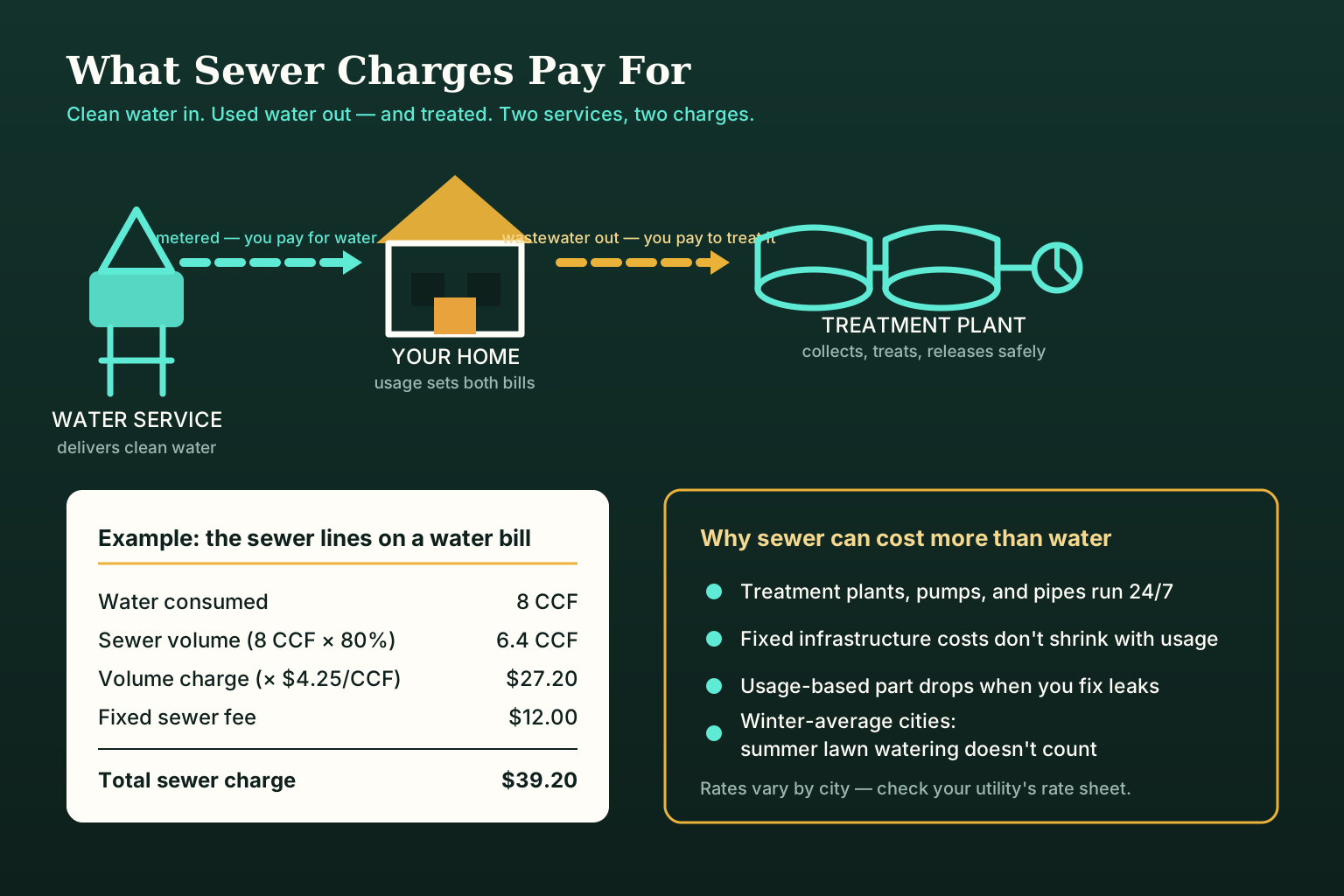
How it works: The sewer charge is calculated as a percentage of your water consumption. The utility assumes most water that enters your home (except outdoor irrigation) leaves as wastewater. The sewer rate is applied to a portion — usually 70–100% — of your metered water use.
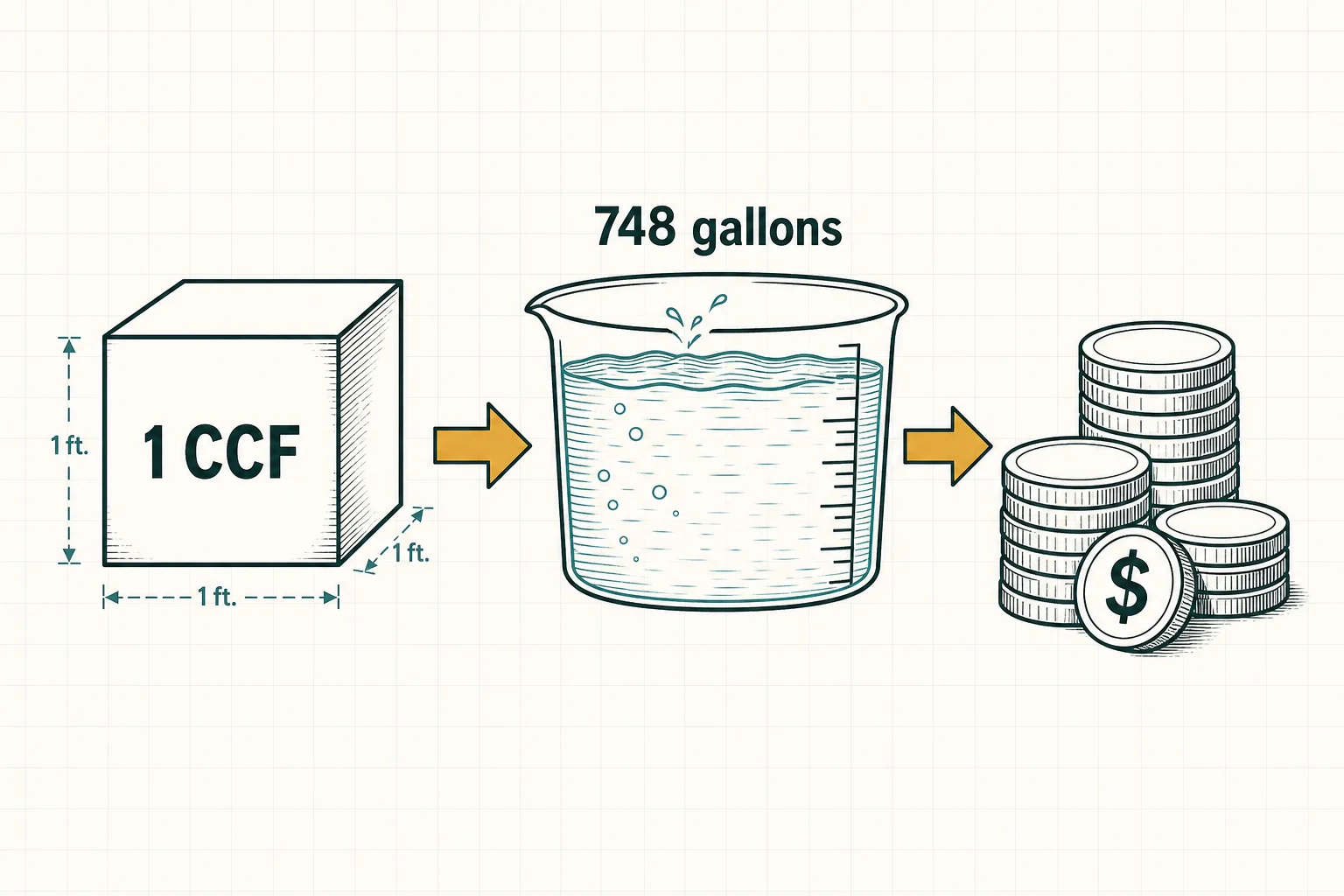
Worked example: Your water meter reads 10 CCF (748 gallons per CCF; 7,480 gallons total) for the billing period. The sewer rate is $7.50 per CCF applied to 100% of consumption.
| Component | Calculation | Amount |
|---|---|---|
| Water consumption | 10 CCF | — |
| Sewer charge multiplier | 100% | 10 CCF × 1.0 = 10 CCF |
| Sewer rate | $7.50 / CCF | 10 × $7.50 = $75.00 |
If your utility applies sewer to only 85% (winter-average ratio), the calculation would be 10 CCF × 0.85 × $7.50 = $63.75.
2. Flat Fee Sewer Charge
How it works: All residential customers pay a fixed sewer fee each billing period, regardless of how much water they use. This is common in smaller utilities or areas where almost all water use goes to the sewer system.
Worked example: Your bill lists a “Residential Sewer Service Fee” of $45.00 per month.
| Component | Calculation | Amount |
|---|---|---|
| Sewer flat fee | Fixed per billing period | $45.00 |
Usage does not affect this charge. A household using 5 CCF pays the same $45 as a household using 20 CCF.
3. ERU (Equivalent Residential Unit) Sewer Charge
How it works: The utility sets a standard sewer volume for a typical single-family home (the ERU). Each account pays a flat rate per ERU. Larger properties or multi-unit buildings may be charged multiple ERUs.
Worked example: Your utility defines 1 ERU as 6 CCF of sewer flow per month. The ERU rate is $60.00 per month.
| Component | Calculation | Amount |
|---|---|---|
| ERU allocation | 1 ERU (single-family home) | 1 ERU |
| ERU rate | $60.00 / ERU | 1 × $60.00 = $60.00 |
A duplex might be billed at 2 ERUs ($120.00), while a large home with high winter water use could be reclassified to 1.5 ERUs based on actual flow data.
Winter Averaging Explained

Winter averaging is a method utilities use to separate indoor and outdoor water use for sewer billing. Because outdoor watering (lawns, gardens, pools) is minimal in winter months, winter water consumption is assumed to represent your true indoor usage — and therefore your true wastewater flow.
How It Works
The utility averages your water consumption during winter months (typically December through March) and uses that average as your sewer billing volume for the entire year. Any extra summer water use is assumed to be irrigation that does not enter the sewer system.
Worked Example
| Month | Water Used (CCF) | |
|---|---|---|
| December | 8 | |
| January | 7 | |
| February | 8 | |
| March | 8 | |
| Winter average | (8 + 7 + 8 + 8) ÷ 4 = 7.75 CCF |
That 7.75 CCF becomes the sewer billing volume for all 12 months of the year. If you use 20 CCF in July for lawn watering, your sewer charge still uses only 7.75 CCF. The water itself is billed at the regular water rate, but sewer is based on winter indoor use.
When It Applies
Winter averaging is most common in regions with distinct summer irrigation seasons (Pacific Northwest, Mountain West, Midwest, Northeast). Check your utility’s rate schedule for “sewer winter averaging” or “seasonal sewer adjustment.” Some utilities opt out customers who have separate irrigation meters.
Real Utility Examples

Each of the following utilities uses a different sewer billing model. Compare your bill to see which pattern matches.
Seattle Public Utilities (Washington)
Model: Metered water-based, with winter averaging — summer sewer bills are based on average winter water consumption. The 2026 sewer rate is $20.18 per CCF, and the utility’s published typical monthly residential sewer bill is $86.77 (2026; $19.21/CCF in 2025). Rates as of 2026, verified against SPU’s rate page.[2]
Philadelphia Water Department (Pennsylvania)
Model: Metered water-based, applying sewer to water consumption at a flat volumetric rate — sewer is not tiered. Under the rate schedule effective September 1, 2025, the sewer quantity charge is $51.62 per Mcf — about $5.16 per CCF. A household using 8 CCF of water would pay about $41.30 for sewer (8 × $5.16). Philadelphia also charges a separately itemized stormwater fee based on impervious surface area. Rates as of the 2025–26 schedule.[3]
San Francisco Public Utilities Commission (California)
Model: Usage-based with a discount factor — single-family sewer is billed on 90% of water consumption, at a volumetric rate per unit (1 unit = 1 CCF = 748 gallons), plus a fixed service charge and a parcel-size-based stormwater charge. Effective July 1, 2026, the residential wastewater rate is $20.74 per unit (up from $18.72). A household using 4 CCF of water is billed on 3.6 units — about $74.70 for the volumetric wastewater charge before fixed charges. Rates as of the FY2026–27 schedule.[4]
Start With the Statement
EPA WaterSense notes that utilities use different units and rate structures, and that many water bills combine fixed and volume-based charges.[1] Sewer service may be shown on the same statement as water service or issued separately, depending on the provider.
For each bill, record:
- The billing period and account address.
- The water-use unit shown on the statement, if any.
- The exact sewer line-item name and amount.
- The current rate-plan or tariff name.
- Any notices, credits, adjustments, or footnotes.
Questions to Ask the Utility
Ask customer service for the current rate schedule and these account-specific answers:
- Is this sewer charge fixed, usage-based, or a combination?
- If it uses water consumption, which billing period and unit are used?
- Does the utility use winter averaging? If so, which winter months are averaged?
- Is there a minimum charge, maximum billable use, seasonal rule, or separate irrigation-meter policy?
- Does the account have a credit, adjustment, or past-due item?
- Where can I read the tariff section that defines this charge?
Keep the reply and the version date of the rate schedule with your bill records.
Compare Like With Like
Compare the same line items with a similar earlier billing period. Check the number of billed days and whether the water-use unit, rate plan, or meter-read status changed. A higher total alone does not identify the cause.
If the statement reports water use and the change is unexplained, use a no-use meter check and inspect for leaks. EPA WaterSense offers household maintenance guidance, while the utility can explain the billing rule that applies after a leak is found.[1]
When a Charge Looks Wrong
Document the bill, current meter reading if relevant, and the date you contacted the provider. Ask whether the statement used an estimated read and whether the provider can explain or review the specific line item. Do not withhold payment or assume an adjustment is available without confirming the provider’s dispute and payment policies.
This explanation is part of the Water Explained hub.
Sources
- U.S. Environmental Protection Agency WaterSense: Understanding Your Water Bill — explains bill units, fixed and variable rate structures, and finding charge information through a local utility.
- Seattle Public Utilities: Sewer Rates — 2026 rate per CCF, typical monthly residential bill, and winter-averaging method (retrieved 2026-08-29).
- Philadelphia Water Department: Rates and Charges (effective September 1, 2025) — official rate schedule; flat sewer quantity charge of $51.62 per Mcf (retrieved 2026-08-29).
- SFPUC: Water and Sewer Rates and FY2026–27 Rate Schedule (PDF) — single-family sewer billed on 90% of water consumption at $20.74 per unit effective July 1, 2026 (retrieved 2026-08-29).