Quick Answer
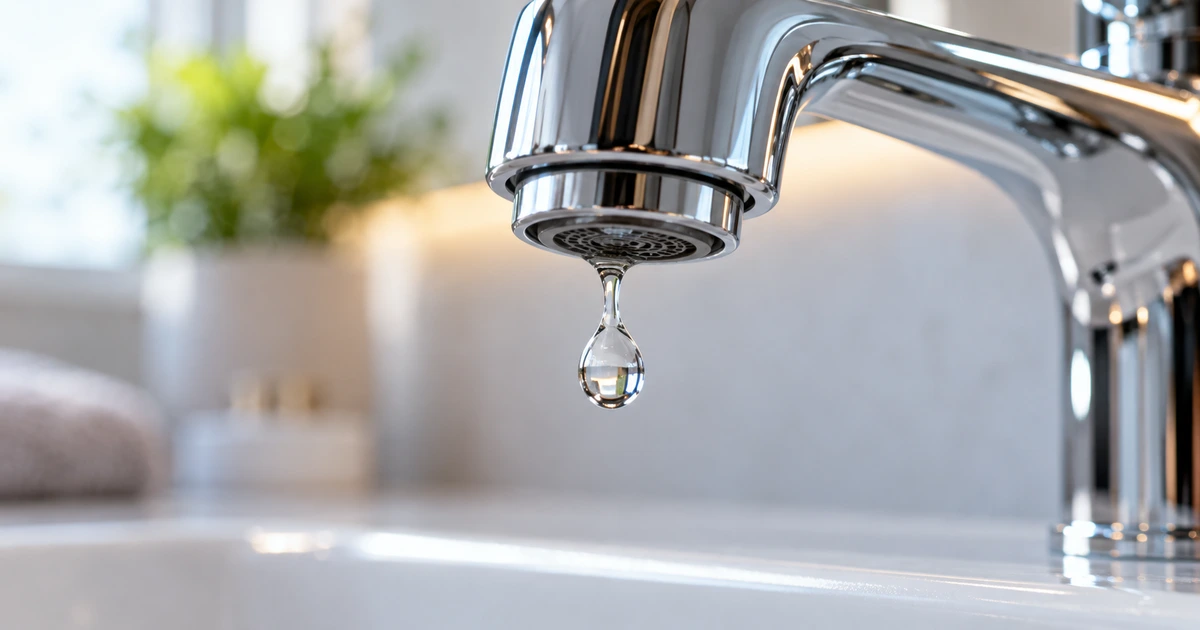
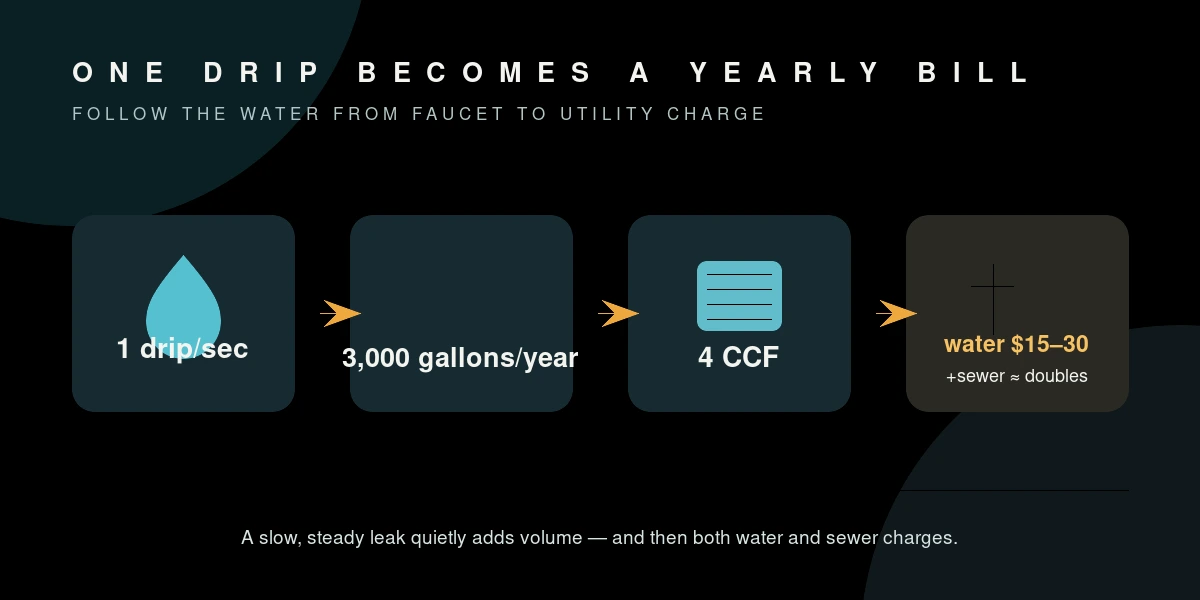
A faucet dripping at a rate of one drip per second wastes more than 3,000 gallons of water per year, which typically adds $15–$30 to your annual water bill based on standard utility rates. However, because most municipal utilities bill sewer charges as a multiplier of water usage, the total impact often doubles to $30–$60 per year for a single leak. Fixing a drip usually requires a $1–$5 washer, meaning the repair often pays for itself in just a few months.
The Math of a Drip: From Drops to Dollars
It is easy to ignore a rhythmic “plink” in the sink, but the cumulative volume of a leak is higher than most homeowners realize. To understand the cost, you have to follow the water from the spout to the meter, and finally to the dollar amount on your statement.
1. The Volume (Gallons)
According to the EPA, a faucet that drips at a steady rate of one drip per second wastes over 3,000 gallons per year [1]. To put that in perspective, 3,000 gallons is roughly 150–200 showers, depending on your showerhead’s flow rate. If you have multiple leaks or a faster “stream” leak, the volume scales quickly.
2. The Utility Unit (CCF)
Most water utilities do not bill you by the gallon. Instead, they use a unit called CCF (Centum Cubic Feet).
- 1 CCF = 748 gallons [2]
To find out how many billing units a 3,000-gallon leak consumes: 3,000 gallons ÷ 748 gallons/CCF ≈ 4.01 CCF per year
If you are looking at your bill and see “HCF” or “CCF,” you are looking at roughly 750 gallons per unit. You can use our CCF calculator to convert your own meter readings, or read more about what is CCF on a water bill to understand the terminology.
3. The Dollar Cost
Water rates vary wildly by geography and usage tiers. In our house-wide planning data, we use a band of $15–$30 per year for the water-only cost of a 3,000-gallon leak. This assumes a combined water rate of roughly $3.75 to $7.50 per CCF.
However, if your utility uses tiered water rates explained, that leak isn’t billed at the “cheap” base rate. It sits on top of your existing usage, meaning it is often billed at the highest, most expensive tier your household reaches.
The Sewer Multiplier: The Hidden Cost
The biggest mistake people make when estimating leak costs is looking only at the “Water” line of their bill. In most American cities, you are charged for sewer service based on how much fresh water you use. The logic is simple: the utility assumes that every gallon that comes into the house eventually goes down a drain.
This is where a “cheap” leak becomes expensive. Sewer rates are frequently higher than water rates. For example, in Seattle, the 2026 sewer rate is $20.18 per CCF [3].
If you have a 4 CCF leak (3,000 gallons) in a high-cost area:
- Water Cost: 4 CCF × $6.00 (est) = $24.00
- Sewer Cost: 4 CCF × $20.18 = $80.72
- Total Cost: $104.72 per year
While Seattle is an outlier, the “sewer multiplier” generally doubles the cost of any indoor leak. You can learn more about this calculation in our guide on how sewer charges work on your water bill. If your bill seems high even when you aren’t using water, you may be dealing with sewer averaging, where your winter usage sets your sewer bill for the whole year.
How to Measure Your Own Drip Rate
You don’t have to guess how much your leak is costing. You can measure it in about five minutes using the “Stopwatch Method.”
- The Setup: Place a measuring cup (with milliliter or ounce markings) under the drip.
- The Timer: Start a stopwatch and let the water collect for exactly one minute.
- The Math:
- Take the number of milliliters collected in one minute.
- Multiply by 0.38 to get gallons per day (1,440 minutes/day ÷ 3,785 milliliters/gallon ≈ 0.38).
- Multiply that by 365 for gallons per year.
Example: If you collect 20 ml in one minute — a drip roughly every second:
- 20 ml/min × 0.38 = 7.6 gallons per day
- 7.6 × 365 = ~2,770 gallons per year
That lands almost exactly on the EPA’s 3,000-gallon figure for a one-drip-per-second faucet, which is a good sanity check on your measurement: a drip per second deposits about a third of a milliliter, so one full milliliter collected per minute means a leak about three times worse than the EPA baseline — and a bill to match.
If your meter is spinning but you can’t find a drip, you may have a “silent” leak. Check our guide on what to do when the water meter is running when no water is used or perform an is your toilet running leak test.
Fix vs. Cost: The ROI of Repair
Fixing a dripping faucet is one of the highest-return home maintenance tasks you can perform. Most drips are caused by a worn-out rubber washer or an O-ring.
| Component | Typical Cost | Annual Savings (1 drip/sec) | Payback Period |
|---|---|---|---|
| Faucet Washer | $1 – $5 | $15 – $60 | < 1 Month |
| Faucet Cartridge | $15 – $40 | $15 – $60 | 6 – 12 Months |
| Plumber Labor | $100 – $250 | $15 – $60 | 2 – 4 Years |
If you are a DIYer, a $5 kit from the hardware store can stop the waste immediately. If you are looking for other ways to optimize your fixtures, consider installing the best faucet aerators to reduce flow without sacrificing pressure.
Preventing Future Leaks
A drip often starts so slowly that you don’t notice it until it has been running for weeks. This is why why did my water bill suddenly increase is such a common question. To catch these issues early, many homeowners are moving toward smart monitoring.
If you want to be alerted the moment a leak starts under a sink or near a water heater, we recommend the Govee Water Leak Detectors. They are inexpensive, battery-operated, and loud enough to hear through cabinet doors.
A 5-pack of wireless leak sensors that sound a 100dB alarm when they detect water. Perfect for placing under kitchen sinks, behind toilets, and near water heaters to catch drips before they hit your bill.
Check price on Amazon Price & availability shown on Amazon.com — we may earn a commission.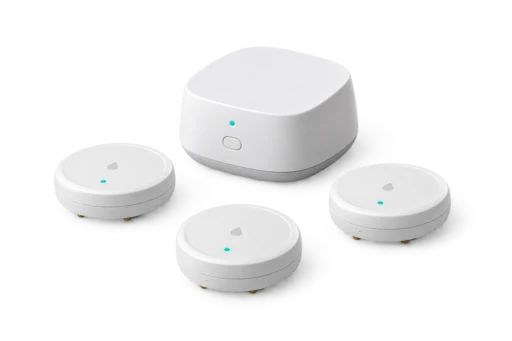
Knowing where to place water leak sensors is key to protecting your home from both the “slow bleed” of a dripping faucet and the catastrophe of a burst pipe.
When the Leak Costs More Than the Average: Tiered Rates and Winter Averaging
Two billing structures decide whether your drip is billed at the cheap end or the expensive end of these ranges:
Tiered rates. Under tiered pricing, each block of usage costs more than the last. A leak does not get its own cheap tier — every wasted gallon rides on top of your household’s normal usage, so it is billed at the highest tier you reach. A household brushing against its tier boundary can see a 3,000-gallon drip priced at double the base rate, turning a $20 leak into a $40 one on the water line alone.
Winter averaging. In cities that set your sewer charge from your winter water usage, a dripping faucet in January is the most expensive drip of the year — those wasted gallons raise the baseline your sewer bill is computed from, in some cases for a full twelve months. The sewer averaging explainer shows which months your utility watches. If a faucet starts dripping in late fall, fixing it before the averaging window opens is worth real money, not comfort.
The seasonal exception. One outdoor leak is actually less costly than it looks: irrigation-line drips never reach the sewer, so they escape the multiplier entirely — but at 6,300 gallons a month for a dime-sized leak, they hardly need it. The table below shows where each leak class lands.
Summary Table: The Cost of Wasted Water
| Leak Type | Gallons Wasted (Year) | Estimated Cost (Water Only) | Estimated Cost (Water + Sewer) |
|---|---|---|---|
| 10 drips/min (Shower) | 500+ gal | $3 – $5 | $6 – $10 |
| 1 drip/sec (Faucet) | 3,000+ gal | $15 – $30 | $30 – $60 |
| 1/32" leak (Irrigation) | 75,000+ gal | $375 – $750 | $750 – $1,500 |
Note: Irrigation leaks often do not incur sewer charges if they are on a separate “deduct” meter, but indoor leaks almost always do.
For more ways to cut your monthly expenses, see our comprehensive guide on 44 ways to lower your water bill or our 06-water-bill-too-high troubleshooting checklist.
How many gallons does a dripping faucet waste per day?
Can a dripping faucet cause a high water bill?
Is it cheaper to fix a faucet or let it drip?
Does a dripping faucet affect the sewer bill?
Water Explained Hub: /water-explained/
Sources
- EPA WaterSense — Fix a Leak Week — Data on 1 drip/sec wasting 3,000 gallons per year and easy leak repair savings.
- EPA WaterSense — Statistics and Facts — Household water usage context, CCF conversion (748 gallons), and average leak volumes.
- Seattle Public Utilities — Sewer Rates — Verified 2026 sewer rate of $20.18 per CCF for residential customers.