Quick Answer
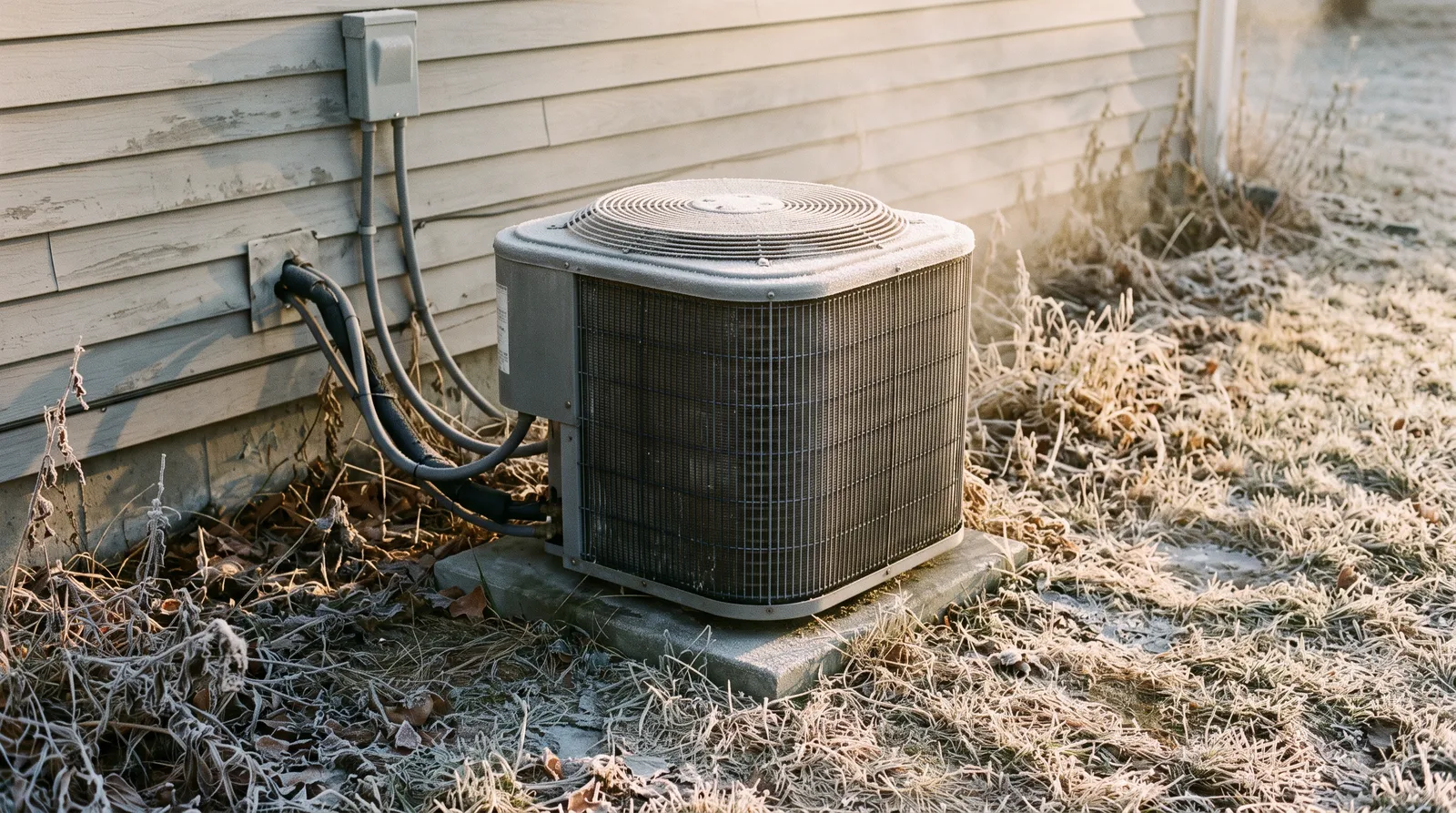
Light frost on an outdoor heat pump in cold, humid weather is normal — the unit is an air conditioner running in reverse, and its outdoor coil runs below freezing while it harvests heat. The system knows this and runs a periodic defrost cycle (typically 5-15 minutes, steam pouring off the unit, sometimes the fan stops). The line between normal and problem: frost that clears during defrost cycles is the system working; ice that thickens over days, forms a solid glaze on the case and fan guard, or comes with the unit running nonstop without warming the house means the defrost system (timer, sensor, reversing valve, or board) has failed — and that failure quietly triggers the expensive electric backup heat covered in aux heat vs. emergency heat.
One rule above all others: never chip, scrape, or pour hot water on a frozen heat pump — the coil fins bend at a touch and refrigerant leaks end the season.
Why a Heat Pump Frosts at All (The 60-Second Physics)
In heating mode, the outdoor coil is colder than the outside air — that’s how it absorbs heat from it. Whenever that coil is below 32°F while the air is humid (which is most of the cooling-fog weather between 20°F and 40°F, plus any precipitation), moisture from the air freezes directly onto the coil surface. Frost is the expected byproduct of the machine doing its job; a thin, even, white coat during those conditions is normal operation.
The problem with frost is what it does next: it insulates the coil from the air, cutting the heat the pump can harvest. So every heat pump carries a defrost system. On a timer/sensor schedule (commonly a check every 30-90 minutes of runtime, defrost when the coil sensor says frost is present), the system reverses to cooling mode for 5-15 minutes — the outdoor coil runs hot, the frost melts off as visible steam, and the electric backup heat inside keeps the house from cooling during the reversal. Then it snaps back to heating. If you’ve ever seen your outdoor unit steaming like a kettle on a January morning with the fan stopped: that was a healthy defrost.
ENERGY STAR certified with energy reports and smart recovery — the two features that catch a failing defrost system early: you see auxiliary-heat hours climbing before you'd ever notice the ice outside, and staged recovery keeps setbacks from triggering aux blasts on its own.
Check price on Amazon As an Amazon Associate we earn from qualifying purchases. Price & availability shown on Amazon.com.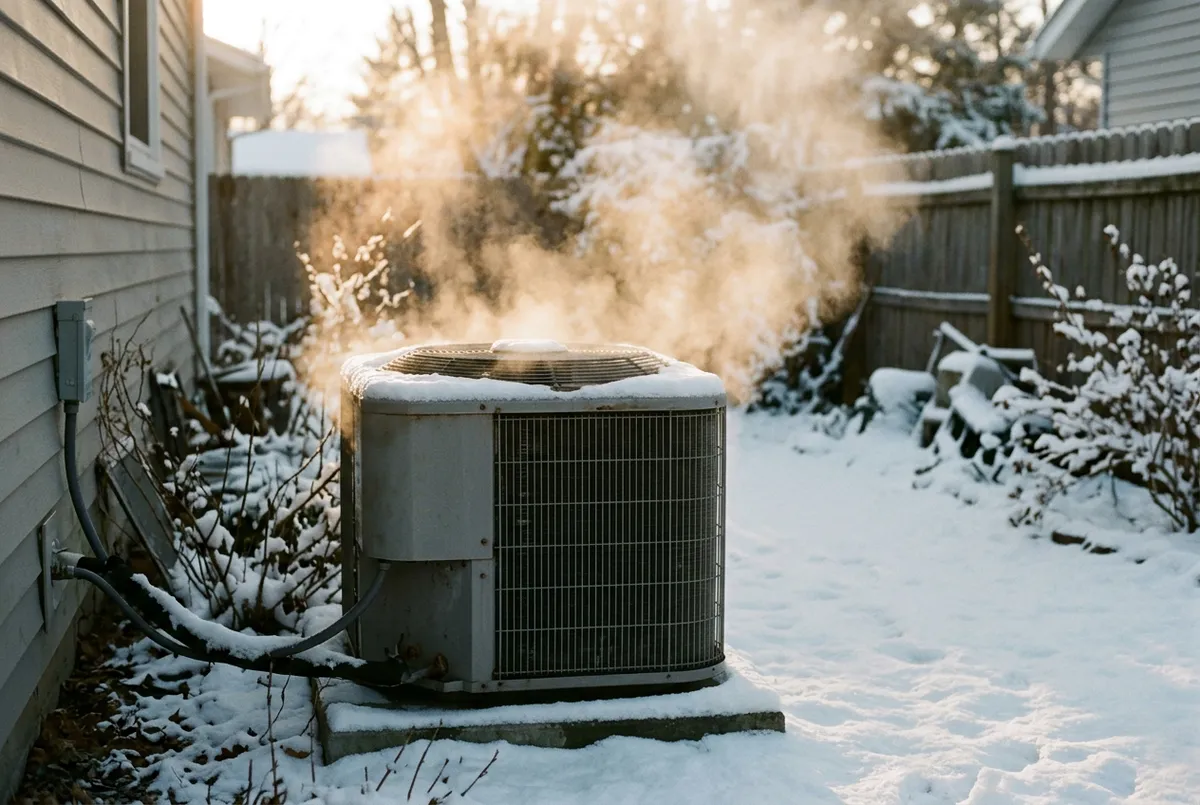
The Checklist: Normal Frost vs. Failed Defrost
| Sign | Normal (defrost working) | Problem (defrost failing) |
|---|---|---|
| Coverage | Light, even frost on coil faces; clear or slightly frosted grille | Solid glaze encasing the case, fan guard, and refrigerant lines |
| Pattern over days | Frost appears and clears; unit never stays iced after cycles | Ice thickens day over day; never fully clears |
| Fan behavior | Fan may pause during defrost, runs otherwise | Fan blocked by ice, or blade scraping ice — shut it down at the breaker |
| Steam events | Regular steam-offs in humid cold weather | Never steams; frost just accumulates |
| Indoor symptoms | House holds temperature | House losing ground, “AUX” showing on the thermostat constantly, bills climbing |
| Timing | Frost worst in 25-40°F humid weather, sleet, freezing rain | Ice persists even in dry cold, or forms a uniform block |
The indoor symptom row is the expensive one. When the outdoor coil is insulated by ice, the compressor can’t supply the house’s heat, and the thermostat calls the electric resistance backup — heat at roughly triple the compressor’s cost per BTU. A failed defrost system can add hundreds of dollars to a cold-month bill before anyone looks outside. That cost mechanics is laid out in why is my heating bill so high — and it’s also why heat-pump homes benefit from a thermostat that stages recovery instead of slamming aux: the tiers that do it are in the smart thermostat comparison.
What Actually Breaks (and What Each Costs to Fix)
- Defrost sensor or thermostat (the coil-temperature probe that says “frost present”): the most common failure, a $15-50 part plus service labor. If the unit NEVER defrosts, this is the first suspect.
- Defrost control board / timer: the schedule-keeper. A board failure shows as no defrost initiation, or defrosts that never terminate (unit stuck blowing cold air outside for an hour+).
- Reversing valve: the four-way valve that flips between heat and cool modes — the mechanism defrost depends on. If the valve sticks, you’ll also notice heating performance collapse, not just ice.
- Low refrigerant: frost behavior changes with charge — often a frost pattern concentrated on part of the coil only, or ice where it never formed before. Refrigerant work is strictly a licensed technician’s job (EPA rules), and leaks found early are cheaper than leaks found by a dead compressor.
- Snow burial and airflow block: not a defrost fault — drifts against the coil, leaves in the fall, a deck rail built too close. Keep 18-24 inches of clear space around the unit and clear snow below the coil (many units are mounted on risers for exactly this).
Winter Rules for Heat Pump Owners
- Don’t chip, scrape, or hose it. Bending fins or cracking a line ends the season. If ice must go manually, a gentle room-temperature water rinse from a hose at midday is the ceiling of DIY — never hot water (thermal shock) and never force.
- Watch the AUX indicator during cold snaps. AUX heat during a defrost cycle is normal and brief. AUX running for hours on end in ordinary cold means either a failed defrost, or a thermostat recovery pattern that needs the heat-pump setback strategy.
- Keep the coil area clear. Snow below the unit, leaves around it in fall, and that “temporary” tarp over the top for two winters — all of them choke the airflow that both heating and defrost need.
- Let it run. Heat pumps are designed to run long, steady cycles in cold weather; that’s efficiency, not a malfunction — the full explainer is heat pump running all day in winter. Short rapid cycling is the pattern that indicates trouble (the furnace-side version of that logic: short cycling).
- Track it with data. A thermostat with runtime/energy reports makes a failing defrost visible from the couch — aux hours spiking while outdoor temps are ordinary. The budget-friendly pick:
ENERGY STAR certified with energy reports and smart recovery — the two features that catch a failing defrost system early: you see auxiliary-heat hours climbing before you'd ever notice the ice outside, and staged recovery keeps setbacks from triggering aux blasts on its own.
Check price on Amazon Price & availability shown on Amazon.com — we may earn a commission.Sources
- Building America Solution Center — Thermostats and Heat Pumps — heat-pump defrost and auxiliary-heat interaction.
- ENERGY STAR — Smart Thermostats — staged-recovery and thermostat certification context.
- U.S. DOE Energy Saver — Small Space Heaters (archived) — supplemental-heating cost context.
- Amazon — ecobee Smart Thermostat Essential listing — energy-report features (verified Oct 2026).
The Defrost Cycle, Step by Step (So You Can Watch It Honestly)
Knowing the sequence turns a weird-looking winter event into a checkable process:
- Frost builds on the outdoor coil during heating in humid cold (normal).
- The control checks in on its timer/sensor schedule — typically every 30-90 minutes of compressor runtime.
- The reversal: the reversing valve flips the system to cooling mode. The outdoor coil becomes the hot condenser; the indoor coil briefly becomes the evaporator.
- The backup engages: because the house is now being “cooled,” the electric resistance backup fires to hold indoor temperature — this is the aux-heat blip on your energy reports, and it’s the expensive 5-15 minutes a failing defrost multiplies.
- The melt: frost and thin ice slide off the coil as liquid and steam; the fan stays off so the coil can heat thoroughly (a running fan would throw cold air and slow the melt).
- The snap-back: the valve returns to heating, the outdoor fan restarts, and the system resumes — usually with a soft whoosh and a puff of vapor.
Any step that doesn’t happen — no reversal (valve), no heat at the coil (refrigerant), no termination back to heat (board/sensor) — produces one of the failure signatures in the checklist table above.
Cold-Climate Units vs. Older Heat Pumps
Older and standard heat pumps defrost on fairly crude timers and lose meaningful capacity below roughly 25-35°F, which is where ice problems and aux-heavy bills concentrate. Modern cold-climate heat pumps carry variable-speed compressors, better defrost controls driven by actual coil sensors, and maintain capacity at much lower temperatures — part of why the DOE comparison our space heater guide cites shows modern heat pumps cutting heating electricity use roughly 65% versus resistance heat. If your unit is 12+ years old and this page reads like a diary of your winters, the replacement math (not just the defrost repair) belongs in the conversation — the heat pump vs. gas furnace savings analysis frames it.
Service Now vs. Emergency Later (The Scheduling Honesty)
A defrost repair in November is a scheduled appointment at weekday rates. The same repair discovered during a January ice storm — aux heat running flat-out, house losing temperature, every HVAC company in the county on emergency queue — is a premium-priced visit with a wait, plus the interim aux-heat cost on your bill. This asymmetry is why the “ice thickening over days” row in the checklist deserves a phone call the day you notice it, not the day the house gets cold.
Frequently Asked Questions
Is it normal for a heat pump to have ice on it in winter?
How often should a heat pump defrost in winter?
Why is my heat pump steaming in winter?
Can I pour hot water on my frozen heat pump?
Does a frozen heat pump use more electricity?
How do I know if my heat pump is a cold-climate model?
How much does a defrost repair cost?
Related: aux heat vs. emergency heat, heat pump running all day in winter, and what temperature to set your thermostat in winter.