Quick Answer
Home EV charging adds electricity use to the account, but the dollar impact depends on the vehicle’s measured energy use, miles driven, charging losses, and the rate plan on the utility bill. Do not rely on a national monthly-cost estimate or a generic public-charging comparison.
The Department of Energy’s Alternative Fuels Data Center notes that some utilities offer residential time-of-use rates or other charging incentives. Eligibility, hours, equipment requirements, and prices are utility-specific.[1]
Level 1 vs Level 2 Charging: Comparison
| Feature | Level 1 (120V) | Level 2 (240V) |
|---|---|---|
| Typical charging speed | 3–5 miles of range per hour | 25–46 miles of range per hour |
| Typical circuit requirement | Standard 120V outlet (15A or 20A) | Dedicated 240V circuit (20–60A breaker) |
| Equipment needed | Cable included with most EVs | Separate charger unit (like the Emporia model below) |
| Installation cost | $0 (use existing outlet) | $200–$2,000 depending on panel capacity, wiring run, permits |
| Efficiency (energy to battery) | ~80–85% (charging losses higher) | ~90–95% (less heat loss at higher voltage) |
| Full recharge time (60 kWh battery, empty) | 40–50 hours | 4–8 hours |
| Best for | Plug-in hybrids (PHEVs) with small batteries; occasional top-offs | BEVs with large batteries; daily charging needs |
| Utility TOU compatibility | Limited — may not finish charging within a 4–6 hour off-peak window | Excellent — can fill most batteries within a standard off-peak period |
Level 2 charging is generally the practical minimum for battery-electric vehicles if you drive more than 20–30 miles/day and want to take advantage of time-of-use rates. The speed difference means a Level 1 charger may need 12+ hours to replace daily driving miles, making it hard to charge only during a short off-peak window.
Real Cost-Per-Mile Math
To calculate what each mile costs on your electricity rate, use this formula:
Cost per mile = (Vehicle energy consumption in kWh/mile) × (Your electricity rate in $/kWh)
Example calculations at two rates — the national average (18.4¢/kWh) and a real time-of-use off-peak rate. For the TOU rate, we use the EIA Electric Power Monthly Table 5a (retrieved 2026-08-28) which shows a typical residential off-peak rate of 11.3¢/kWh in Georgia Power’s standard residential TOU plan (summer super-off-peak, midnight–6 AM, from Georgia Power Schedule R-TOU-8, EIA Form 861 data). This is representative of southern utilities with overnight EV rates.
| Vehicle class | Typical efficiency[1] | Cost/mile @ 18.4¢/kWh | Cost/mile @ 11.3¢/kWh (TOU off-peak) |
|---|---|---|---|
| Small EV (Nissan Leaf, Mini SE) | 3.5–4.0 mi/kWh (0.25–0.29 kWh/mi) | 4.6–5.3¢/mile | 2.8–3.3¢/mile |
| Midsize EV (Tesla Model 3/Y, Hyundai Ioniq 5, Ford Mustang Mach-E) | 3.0–3.5 mi/kWh (0.29–0.33 kWh/mi) | 5.3–6.1¢/mile | 3.3–3.7¢/mile |
| Large EV / Truck (Ford F-150 Lightning, Rivian R1T, GMC Hummer EV) | 2.0–2.5 mi/kWh (0.40–0.50 kWh/mi) | 7.4–9.2¢/mile | 4.5–5.7¢/mile |
At the off-peak TOU rate of 11.3¢/kWh, a midsize EV costs about 3.5¢/mile compared to a gasoline car at 25 MPG and $3.50/gallon = 14.0¢/mile. The EV saves roughly 75% per mile on fuel.
At the national average rate of 18.4¢/kWh without TOU, a midsize EV costs about 5.7¢/mile — still a 60% savings versus a 25 MPG gas car at $3.50/gallon.
The Same Car, Three Different Rate Realities
Residential rates vary roughly from the low teens to over 30¢/kWh across the U.S.[3] — and the same midsize EV, driving the same 1,000 miles a month (~300 kWh delivered, ~336 kWh from the wall with 12% charging loss), lands in very different places:
| Rate reality | Representative rate | Monthly charging cost (midsize EV, 1,000 mi) | vs. gas at 14¢/mile |
|---|---|---|---|
| Cheap-rate states / off-peak TOU | ~11¢/kWh | ~$37 | ~74% less ($140 gas) |
| National average flat rate | ~18.4¢/kWh | ~$62 | ~56% less |
| High-rate states on flat rates | ~30¢/kWh | ~$101 | ~28% less |
The table’s lesson is the whole article in miniature: the rate you charge at matters as much as the car you drive. A high-rate-state driver on a flat plan spends nearly 3× what a TOU driver in the same state can spend — which is why the plan-check list below comes before any equipment purchase. Your state’s average rate and bill context is in our average utility bills by state guide, and the exact tariff beats every average.
Battery-Size-to-Bill Examples
Three common EV battery sizes and what a full empty-to-full charge costs at the two rates above, plus the DOE-estimated charging loss of about 10–15% for Level 2 (included in the numbers below).
| Vehicle example | Usable battery size | kWh from wall (x 1.12 for charging loss) | Full charge cost @ 18.4¢/kWh | Full charge cost @ 11.3¢/kWh TOU | Monthly cost for 1,000 miles |
|---|---|---|---|---|---|
| Nissan Leaf (40 kWh) | 36 kWh | 40 kWh | $7.36 | $4.52 | $40–$55 @ 18.4¢ ($25–$34 @ TOU) |
| Tesla Model Y Long Range (80 kWh) | 75 kWh | 84 kWh | $15.46 | $9.49 | $52–$63 @ 18.4¢ ($32–$39 @ TOU) |
| Ford F-150 Lightning Extended Range (131 kWh) | 120 kWh | 134 kWh | $24.66 | $15.14 | $72–$92 @ 18.4¢ ($44–$57 @ TOU) |
Monthly cost range reflects the difference between large-SUV (2.0 mi/kWh) and compact-car (3.5 mi/kWh) efficiency within each battery-size class. Charging loss of 12% added. Actual monthly cost depends on your driving mix, temperature, and driving style.
The Plan-Check List
Before buying an EV or installing a charger, check these items with your utility:
| Check | Why it matters | Where to find it |
|---|---|---|
| Is a residential TOU or EV rate plan available at your address? | Without a time-varying rate, you pay the same per kWh regardless of when you charge — eliminating the primary financial benefit of overnight charging. | Utility website → Residential Rates or EV Programs page. Call customer service for address-specific tariff availability. |
| What are the exact off-peak hours and seasonal rules? | Some rates have different windows for summer and winter. Charging that starts before off-peak begins can be billed at the peak rate for the entire session. | The rate tariff document (often a PDF on the utility’s website). Look for “Schedule” or “Rate Rider” specific to your plan. |
| Does enrollment require a separate meter or specific charger? | Some utilities require a second meter (adds a monthly meter fee) or a charger that reports usage to the utility. The Emporia charger below includes WiFi for app-based usage tracking but is not load-management certified for all utility programs. | Utility EV program page → “Equipment Requirements” section. |
| Are there demand charges, minimum bills, or grid-access fees? | In some territories, a TOU rate includes a per-month fixed charge that can offset savings from off-peak charging. Calculate net savings using your total estimated monthly kWh. | Same tariff document. Look for “Customer Charge,” “Minimum Bill,” or “Facility Charge” line items. |
| Does the utility offer a bill-comparison tool or calculator specific to EV rates? | Some utilities let you upload your past 12 months of usage and see what you would have paid on the EV rate. This is the most reliable way to compare. | Utility website → EV or TOU plan page → Rate Comparison Tool. |
Estimate Your Own Charging Use
Use the vehicle’s energy-use information and your own driving record. Keep the calculation separate from the bill until you have confirmed the applicable rate and any charging-equipment losses.
- Record miles driven during a billing period.
- Find the vehicle’s rated or measured energy-use information in its manual, display, or manufacturer materials.
- Review your charging history if the vehicle or charger provides it.
- Compare the added kWh with the kWh and billing days shown on the electric statement.
- Apply the rate for the specific period and time window listed in your tariff.
If the charger reports delivered energy, keep those reports with the monthly bill. They are more useful than a generic efficiency assumption when tracking an individual account.
Check the Rate Plan Before Changing Habits
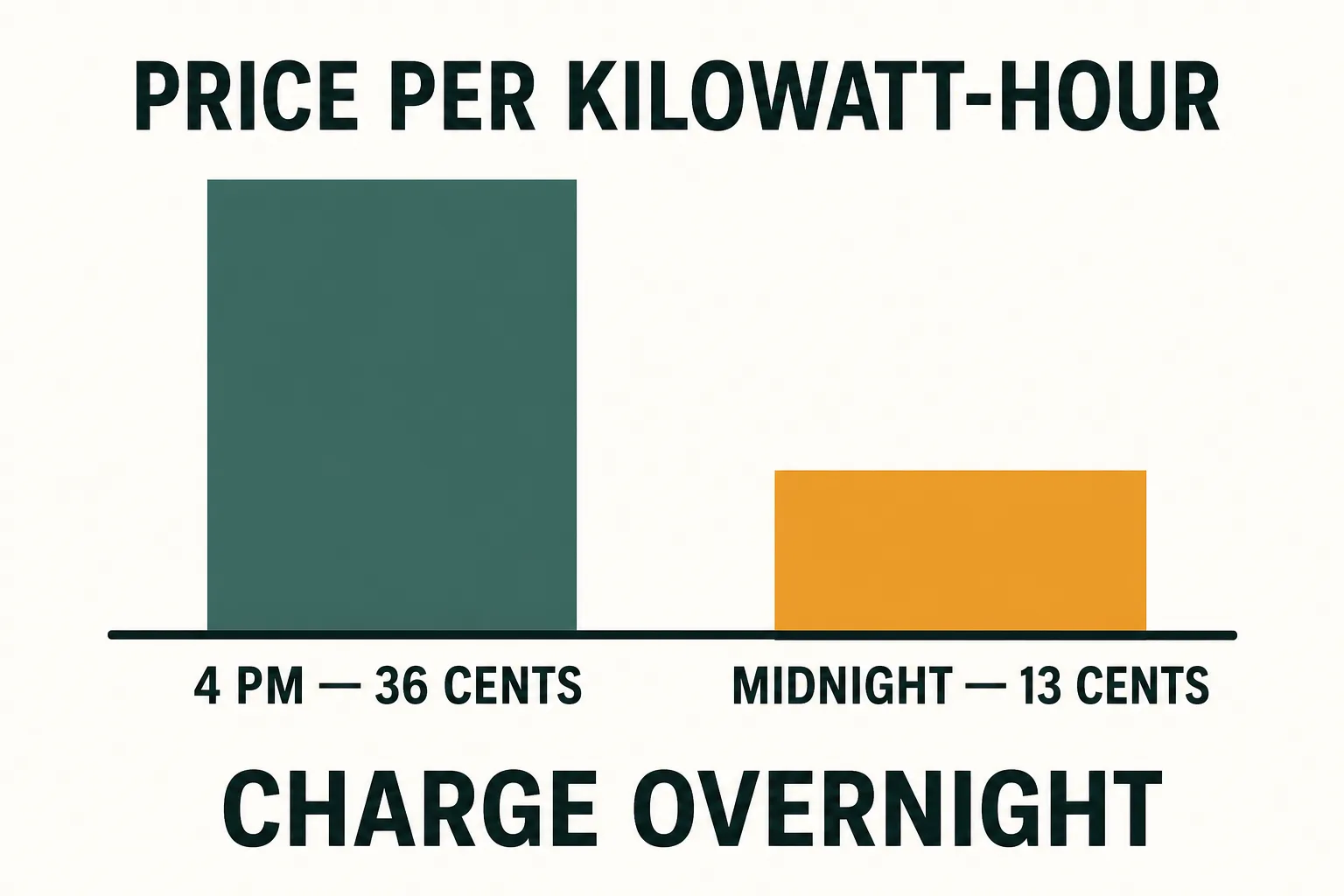
Time-of-use pricing is not the same everywhere. Some accounts have a flat rate, while others have different prices by time, season, tier, or demand rule. Before scheduling overnight charging, ask the utility:
- Is a residential EV or time-of-use plan available at my address?
- What are the current time windows, seasonal rules, and price components?
- Does enrollment require a specific charger, meter, or account setup?
- Are there demand charges, minimum bills, or other conditions that apply?
- How can I compare my current plan with the proposed plan using my actual usage?
Home Equipment and Safety
Have charging equipment installed and evaluated according to the equipment instructions, local requirements, and the electrical professional’s assessment. Panel capacity, circuit loading, wiring, and permits are site-specific; do not decide that an existing panel can support charging from a generic ampacity table.
Does a Level 2 Charger Pay For Itself?
The honest payback case for Level 2 is not speed — it is access to the off-peak window. Level 1’s 3–5 miles of range per hour cannot reliably fit a day’s driving into a 4–6 hour overnight off-peak period; Level 2 can. The arithmetic, using the same numbers as above:
- Equipment + install: typically $400–$700 for the charger plus $200–$2,000 for the 240V circuit (site-specific).
- What it can unlock: charging ~336 kWh/month at an 11.3¢ off-peak rate instead of an 18.4¢ flat rate saves about $24/month at the national-average gap.
- At that gap, a $600–$2,700 installed cost pays back in roughly two to ten years — faster only where the peak/off-peak spread is far wider than average (some summer tariffs double or triple the peak rate), and effectively never where no time-varying rate exists. If your utility has no TOU plan, Level 2 buys convenience, not savings — a perfectly fine reason, but call it that.
The same rule as every page on this site: the hardware shifts when you buy kWh; the rate plan is what makes the shift worth money. If a TOU plan is available at your address, also read smart thermostats on time-of-use plans — the house’s biggest load and the car’s charging schedule are the two halves of the same off-peak strategy.
If the math says home charging is your plan, the equipment decision is simple: a Level 2 charger turns a 12-hour trickle into a 3–4 hour fill, and a WiFi-enabled one lets you schedule charging into the off-peak window your rate plan rewards.
48A/240V hardwired charger, up to 46 miles of range per hour, WiFi scheduling from the app — set it to start at your off-peak rate and the cheap hours do the work (Emporia spec sheet). Works with every J1772 EV; Tesla via adapter.
Check price on Amazon Price & availability shown on Amazon.com — we may earn a commission.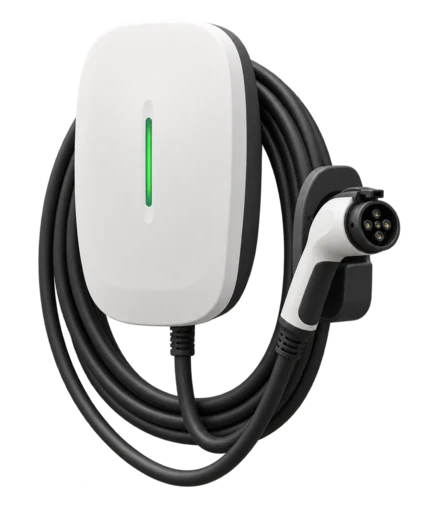
Want the charging cost separated from the rest of the house on your bill? The same brand makes the circuit-level monitor we use elsewhere on this site: Emporia Vue 3 energy monitor — see EV charging as its own line.
Compare Bills, Not Marketing Claims
After charging begins, compare similar billing periods and record driving, charging location, billing days, rate-plan changes, and major household loads. If the total rises unexpectedly, separate vehicle kWh from weather, heating or cooling, and other changes before assigning a cause.
Sources
- U.S. Department of Energy Alternative Fuels Data Center: Charging Electric Vehicles at Home — home-charging overview and utility time-of-use/incentive context.
- U.S. Department of Energy: Home Upgrades
- U.S. Energy Information Administration: Electric Sales, Revenue, and Average Price Table 5a — residential average rates by state and utility (retrieved 2026-08-28)
- ENERGY STAR: EV Chargers — certified charging equipment efficiency standards