Quick Answer
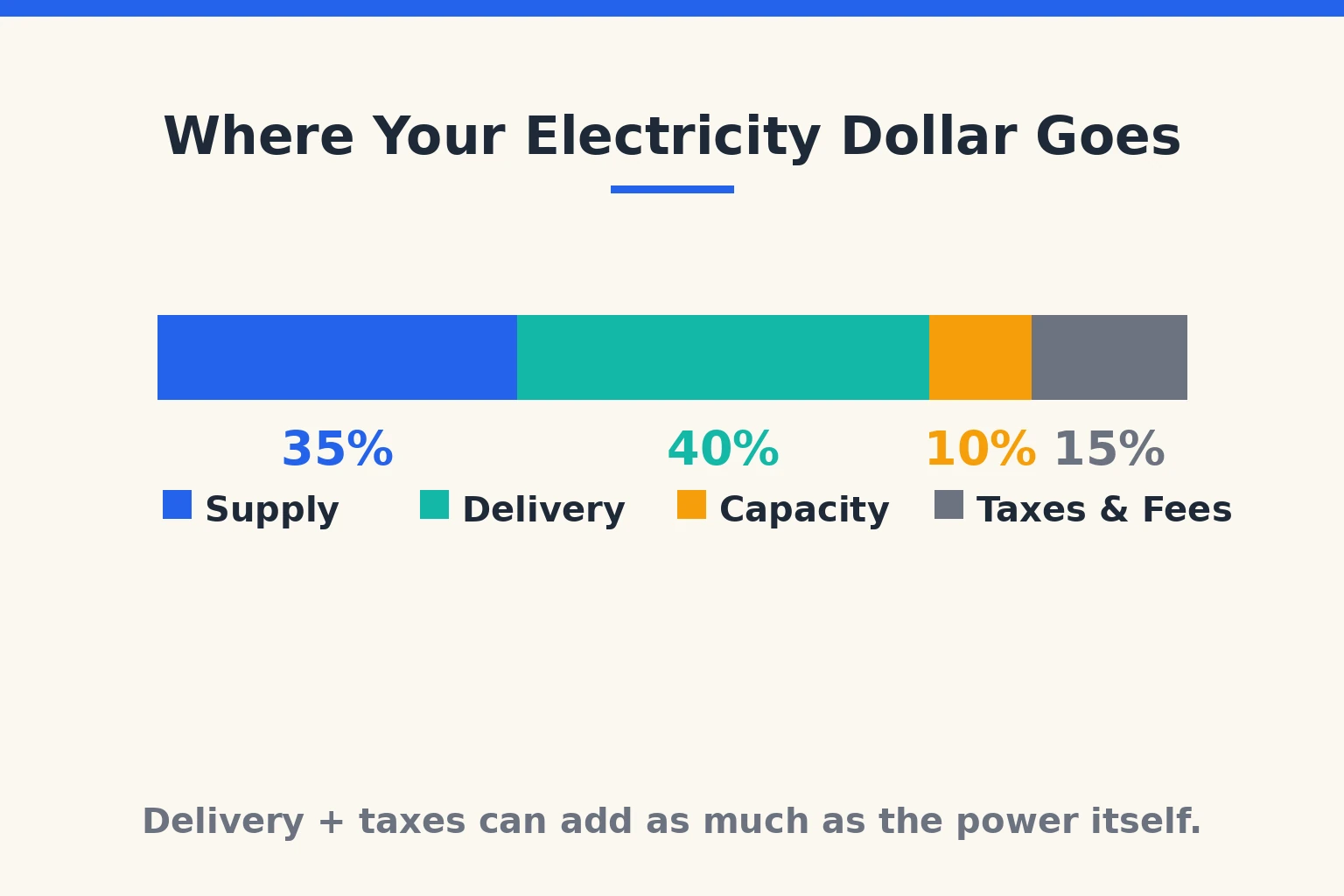
Your electric bill is four charge types stacked: supply (the kWh you used × your rate), delivery (moving it to you — also mostly usage-based), fixed customer charges, and taxes. Supply plus delivery is typically about 85–90% of the bill; only the usage-based parts move when you change habits. Most residential electric bills in the United States are built from a usage-based supply (energy) charge, usage-based delivery charges, any fixed charges your utility’s rate schedule includes, and taxes. For national context, the U.S. Energy Information Administration (EIA) reported residential customers paying an annual average of about 17.30¢ per kilowatthour (kWh) for 2025, and the June 2026 residential average was higher at 18.34¢ — but the only numbers that govern your bill are the rates in your own utility’s current rate plan or tariff.[1]
Tip: Compare your energy charge month over month against the kWh used. That tells you whether a change came from usage or from the rate itself.
Source note for the figures above: the residential averages (17.30¢ for 2025, 18.34¢ for June 2026) come from EIA Electric Power Monthly data; verify the current release at eia.gov. For the same 2025 data, EIA also reported an average U.S. retail price of electricity of about 13.63¢ per kilowatthour (kWh).
Next step: If your bill jumped, start troubleshooting with why is my electric bill so high or learn how to read your electric bill line by line.
One line look wrong? Here's where to dig in:
- Whole bill too high? — start with the diagnostic on what actually drives the total.
- Delivery vs. supply charge — the two big pieces, and why delivery can cost as much as the power itself.
- Demand charge — a line that can surprise business and time-of-use customers.
- Charges to review — how to question any line item you do not recognize.
Start here: the four things that explain most bills

Electric bills look complicated because they combine usage-based charges with infrastructure charges. But most of the story is usually explained by four things:
- Total kWh used
- Price per kWh (your energy rate)
- Billing period length (days) — how two months with the same usage can bill differently
- Fixed charges and delivery charges in your rate plan
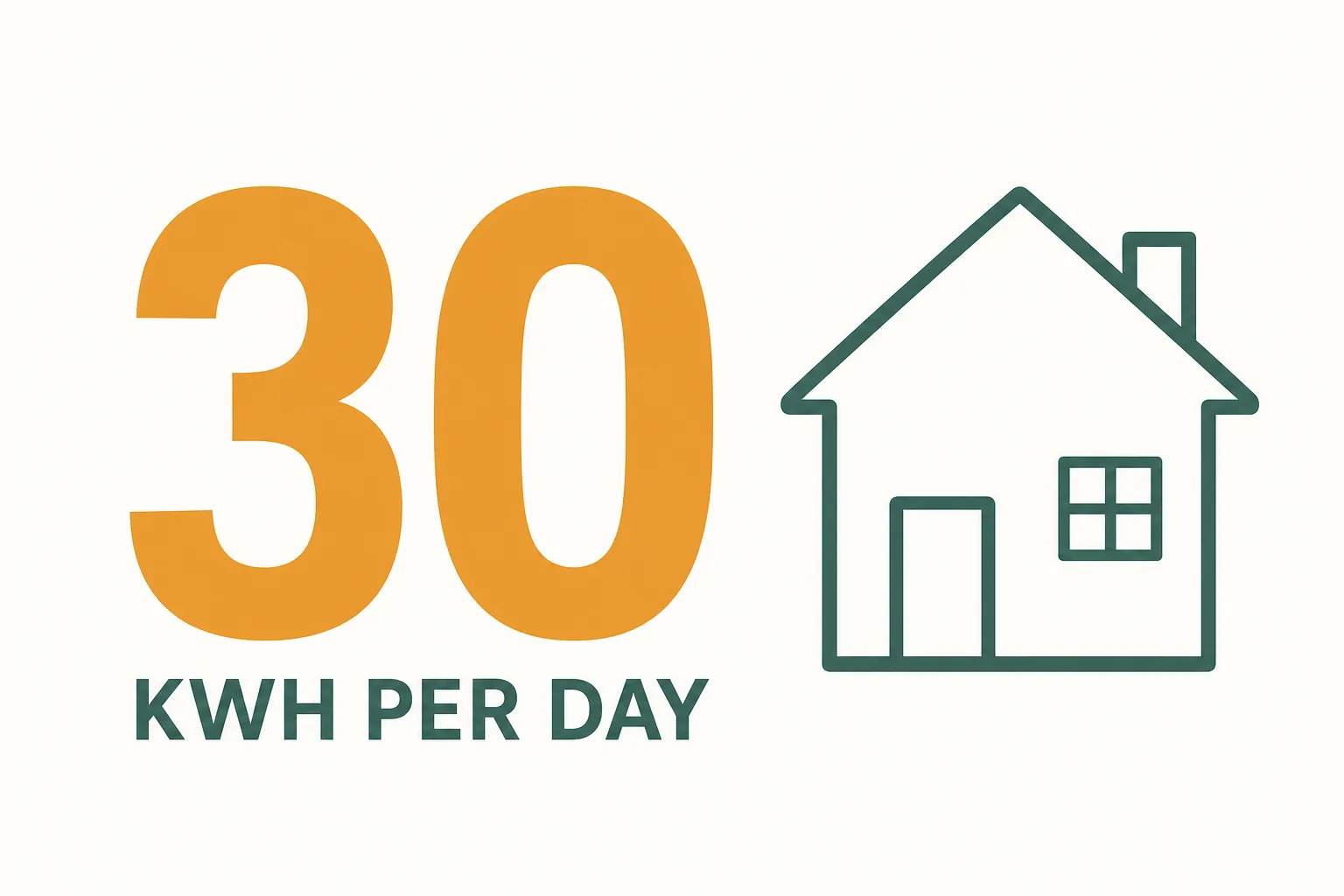
For context on typical usage, EIA reports that in 2022 the average annual electricity purchased by a U.S. residential electric-utility customer was 10,791 kWh, or about 899 kWh/month. Average purchases varied widely by state that year, from 6,178 kWh in Hawaii to 14,774 kWh in Louisiana.[2] Your own prior bills are more useful than any national average.
If you want the unit basics first, read what a kWh is.
Energy (supply) charges: what you actually used
The supply (or energy) charge is the part most people recognize: it is the electricity itself. EIA explains that electricity prices reflect the cost to build, finance, maintain, and operate power plants and the grid, and that the cost of generating electricity is the largest component of the price of electricity.[1] The supply portion is normally calculated as:
kWh used × your supply rate
How the rate itself is set depends on where you live. EIA notes that in some states public service commissions fully regulate prices, while other states use a combination of unregulated prices for generators and regulated prices for transmission and distribution.[1] Some regions also let you choose a separate energy supplier for this part of the bill; Con Edison, for example, tells its customers that whether supply is bought from the utility or from an energy service company, it appears on the bill as a supply charge, and that supply costs can vary with weather, demand, and market prices.[3]
To see the arithmetic, you can apply EIA’s reported figures: at the 2025 residential annual average of 17.30¢ per kWh,[1] a month of usage at the 2022 national average of 899 kWh/month[2] would come to roughly $155 for the supply portion alone. Your actual rate comes from your bill and rate plan, not from a national average.
If your bill uses time-of-use rates, your kWh may be split into peak and off-peak buckets with different prices.
Delivery (distribution) charges: the grid that brings it to you
Delivery charges pay for the poles, wires, transformers, substations, meter maintenance, and local system operations that bring power to your home. Con Edison describes delivery as the cost to build, maintain, and operate that infrastructure, plus the people who maintain the system and respond to service issues, and explains that delivery costs are based on the amount of energy used — customers who use more pay more of these shared costs.[3]
EIA identifies the transmission and distribution system as one of the key factors influencing electricity prices, alongside fuel costs, power plant costs, weather, and regulation. It also notes that retail prices are usually highest for residential and commercial consumers precisely because it costs more to distribute electricity to them.[1]
Even if you can choose an energy supplier, delivery is typically billed by the local utility that operates the distribution system where you live.[3] Whether your delivery charges include a fixed component in addition to the usage-based component is defined by your utility’s rate schedule.
Fixed customer charges: why you get a bill even with low usage
Many rate plans include a monthly customer charge (sometimes called a basic service charge). This is a flat amount that does not depend on kWh, and it helps cover account, billing, and service-availability costs.
The amount, if any, is set by your utility’s tariff or rate schedule — not by a universal rule. That is also why reducing usage lowers the usage-based parts of your bill but cannot take the total to zero on a plan with a fixed charge: the fixed portion is owed regardless of consumption.
To find yours, look for a flat monthly line on your bill, or ask your utility which tariff provision sets it. And if you have ever wondered why you pay a fixed fee even in an empty house, that guide walks through the economics.
Taxes and other charges: small lines that add up
Bills commonly include lines for taxes and, depending on your location and rate plan, items such as local franchise fees or charges funding public programs. Con Edison describes bills as made up of three kinds of charges — supply, delivery, and taxes — with local, state, and federal taxes listed on the bill; it also notes that some taxes on energy infrastructure are embedded within the delivery charge rather than broken out separately.[3]
If you are budgeting, it helps to think of these lines as part of the total you actually pay, even when they are not priced per kWh. Which ones appear on your bill depends on your state and locality.
Time-of-use and tiered rates: when you use power can matter

Under time-of-use (TOU) pricing, a kWh costs more during peak hours and less during off-peak hours. EIA explains that demand for electricity is usually highest in the afternoon and early evening, that costs to provide electricity are usually higher at those times, and that some utilities offer time-of-day pricing to encourage conservation and reduce peak demand — while most consumers pay prices based on the seasonal average cost instead.[1]
If you are not sure what plan you are on, the bill usually names it. Our guide on how to compare fixed and variable rate offers can help you spot the tradeoffs.
Estimated readings and true-ups: a common source of surprises
A surprising bill can happen when one bill was based on an estimated read and a later bill corrects it after an actual meter reading. The California Public Utilities Commission explains that when a utility cannot read a meter — for reasons such as severe weather, a locked gate, or a blocked access — it may estimate usage based on consumption for the same period the previous year, with adjustments, and that the estimated bill is corrected when the utility is able to read the meter. If bills are estimated for more than three months in a row, the utility will let you know it needs access.[4]
If you want to verify readings yourself, see how to read your meter.
Why bills jump: the most common explanations
Most spikes are not mysterious. They are usually one of these:
- More kWh (weather-driven heating and cooling is a common driver)[1]
- More days in the billing cycle
- A change in the rate per kWh or in your rate plan
- An estimate correction after an actual read[4]
EIA also notes that weather extremes can increase demand for heating and cooling, which can push fuel and electricity prices up.[1] For a troubleshooting checklist, read why your bill jumped this month. And when the statement itself can’t tell you which appliance drove the extra kWh, a plug-in watt meter like the P3 Kill A Watt (~$30) names the culprit in about a day of monitoring — the measurement-first step the troubleshooting guide builds on.
Related Reading
- Why is my electric bill so high? — the troubleshooting checklist, ranked by likelihood.
- Delivery charge vs supply charge — the two big halves of your bill, side by side.
- Hidden fees on your utility bill — the lines most worth questioning, and how to dispute them.
- Demand charges on electric bills, explained — the surprise line for time-of-use customers.
- Which rate plan is right for me? — flat, time-of-use, or tiered: matching the plan to how you use power.
- How to read the billing period on a statement — why a longer period means a bigger total with the same daily usage.
What is the difference between supply and delivery charges?
Why do I pay delivery charges if I chose a different supplier?
Can I remove the fixed customer charge?
Why is my bill higher even when my kWh is similar?
What should I check first if my bill seems wrong?
What line items are most worth questioning?
Why does my neighbor pay a different delivery rate than I do?
How do I get a line item formally reviewed?
Charge Categories You May See
Charge names are not standardized nationwide, so treat this as a category map rather than a prediction of your bill. Which items appear, and how they are priced, is set by your utility’s rate schedule or tariff.

| Charge category | What it generally covers | How it is priced |
|---|---|---|
| Energy or supply charge | The electricity you used | Per kWh |
| Delivery or distribution charge | Local wires, substations, system operations | Commonly usage-based; plan-dependent |
| Transmission charge | The high-voltage bulk system | Set by your rate plan |
| Customer or basic service charge | Account, billing, and service availability | Flat monthly amount, if your plan has one |
| Fuel or purchased-power adjustment | Pass-through of changing generation costs | Defined in the tariff |
| Renewable or public-program charges | State or utility programs | Defined in the tariff |
| Franchise fee or taxes | Local, state, and federal amounts | Where applicable |
Five of these lines — plus the demand charge that surprises time-of-use customers — have their own deep-dive:
- Delivery vs supply, compared line by line
- What the fixed monthly fee covers
- The pass-through line that moves with fuel costs
- Riders, surcharges, and program lines
- When a demand charge appears on a residential bill
Questions to Ask About a Line Item
When a line looks unfamiliar, these questions usually get you a real answer:
- Is this charge based on usage, a flat amount, or both?
- Which tariff or rate-schedule provision produced it?
- Is it new this billing period, and was it on last period’s bill?
- Was this bill based on an actual or an estimated meter read?
If a line still looks wrong after those four questions, the next move is how to formally question a charge — the dispute guide walks through the review request step by step.
This breakdown is part of the Utility Bills Explained hub and the Electricity Explained hub.
Sources
- U.S. Energy Information Administration: Factors affecting electricity prices — price components and 2025 average retail prices by customer class.
- U.S. Energy Information Administration: How much electricity does an American home use? — 2022 average residential purchases, national and by state.
- Con Edison: How to Read Your Bill — utility’s description of supply, delivery, and tax charges.
- California Public Utilities Commission: Consumer Assistance Booklet FAQs — when and how utilities estimate bills and correct them.