Quick Answer
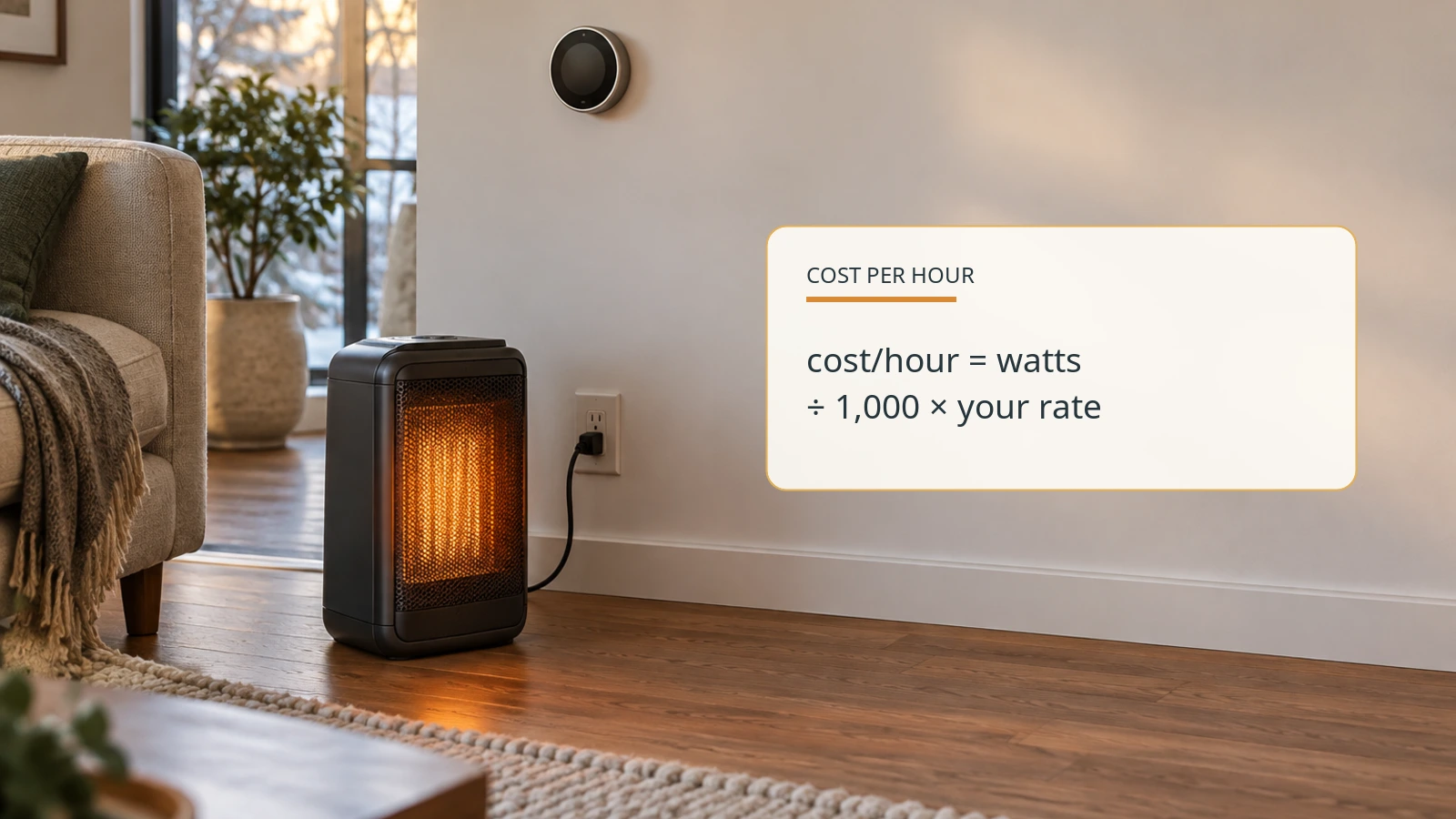
A 1,000-watt baseboard heater costs $0.18 per hour to run at the September 2026 US average residential rate of 18.34¢/kWh — and one unit heating a room 8 hours a day costs about $44 for the month. The math is three numbers you already have: 1,000 W ÷ 1,000 = 1 kW; 1 kW × $0.1834 = $0.1834 per hour; $0.1834 × 8 hours × 30 days = $44.02. Every other baseboard size prices out the same way, which is why most of this page is tables.
Two honest adjustments before you budget. First, $44 assumes the element runs at full power every hour it’s “on.” A baseboard’s built-in thermostat cycles the element off once the room reaches setpoint, and real months commonly land 30–50% below the full-power figure. Second, scale matters: one unit in one bedroom is a $44 question, but a house heated entirely by baseboard is four to eight of these running through a cold month — which is how all-electric-heating homes produce $200–300 winter bills. If your bill spiked and you’re not sure why, start with why is my electric bill so high; the per-kWh method behind every table here is in understanding kWh usage.
Why 100% efficient baseboard is usually the most expensive heat you can buy
Baseboard is electric resistance heat: a heating element inside a finned metal enclosure, hardwired into a 240-volt circuit, warming the room by convection as air passes across the fins. DOE states the efficiency case plainly: “electric resistance heating is 100% energy efficient in the sense that all the incoming electric energy is converted to heat."[3] Nothing is wasted — and yet baseboard is, for most homes, the most expensive way to buy warmth. The resolution of that paradox is the difference between efficiency and cost per unit of heat.
Efficiency measures how much of what you buy becomes heat. Cost per BTU measures how much you pay for each unit of heat. Baseboard wins the first contest and loses the second, because the fuel it converts perfectly is the most expensive fuel per BTU on most US bills:
- Electricity: 1 kWh contains 3,412 BTU, so one therm’s worth of heat (100,000 BTU) takes 29.3 kWh. At 18.34¢/kWh that’s 29.3 × $0.1834 = $5.37 delivered — and since resistance heating is 100% efficient, there’s nothing to recover on top of that.[1][3]
- Natural gas: the EIA residential series averaged $19.73 per Mcf in May 2026 — about $1.90 per therm (1 Mcf ≈ 10.37 therms).[4] A 96%-efficient furnace delivers that therm for $1.90 ÷ 0.96 = $1.98; an older 80% furnace delivers it for $2.38.
Same 100,000 BTU: $1.98–2.38 through gas versus $5.37 through baseboard. That’s the whole story — baseboard wastes nothing, but it wastes nothing of the priciest heat source per BTU in most of the country. It’s also why the fixes below are about running less of it, not running it better: there is no efficiency upgrade to buy for a resistance element.
Cost per hour by wattage (US average 18.34¢/kWh)
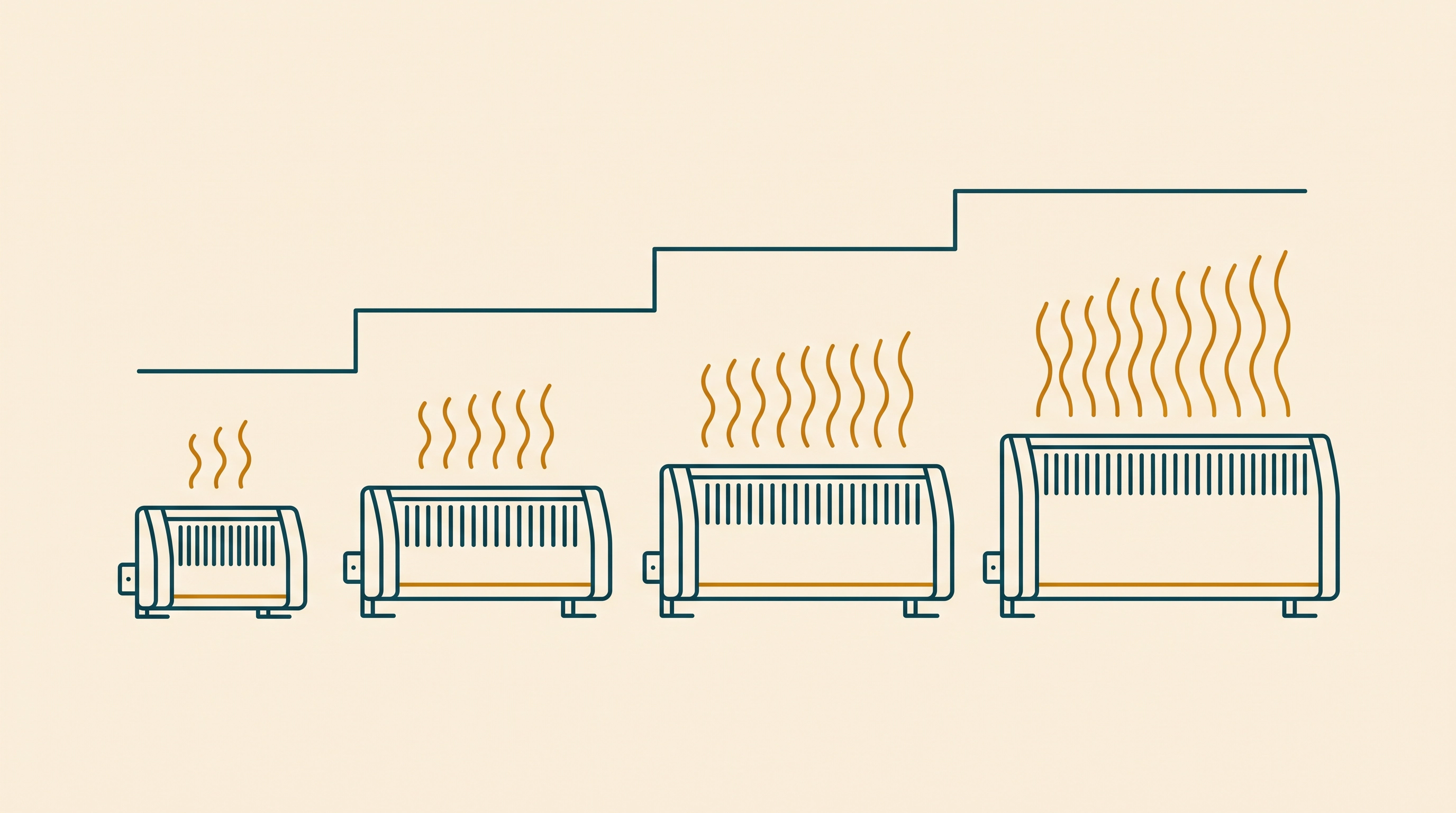
Residential baseboard clusters around 250 watts per linear foot, so a 4-foot unit is about 1,000 W and an 8-foot unit about 2,000 W. Your unit’s nameplate wattage is the number that counts; the length column is just how you’ll recognize it.
| Baseboard unit | Typical length | Cost per hour | 8-hour day | 30-day month (8h/day) |
|---|---|---|---|---|
| 500 W | ~2 ft | $0.09 | $0.73 | $22 |
| 750 W | ~3 ft | $0.14 | $1.10 | $33 |
| 1,000 W | ~4 ft | $0.18 | $1.47 | $44 |
| 1,500 W | ~6 ft | $0.28 | $2.20 | $66 |
| 2,000 W | ~8 ft | $0.37 | $2.93 | $88 |
| 2,500 W | ~10 ft | $0.46 | $3.67 | $110 |
Every row is the same formula — watts ÷ 1,000 × $0.1834 — so if your rate differs, scale linearly. At 13.11¢ (Nevada, the cheapest state average) the 1,000 W row drops to $0.13/hour and $31/month; at 52.72¢ (Hawaii, the highest) it climbs to $0.53/hour and $126/month.[6][7] The formula, not the table, is the portable part.
And the duty-cycle caveat that applies to every row: these are full-power figures. A baseboard holding a room at setpoint cycles its element off and on, and a realistic 50% duty cycle roughly halves the monthly numbers — the 1,000 W unit’s real month is often $22–35, not $44. Use the table as the ceiling and your own meter as the referee (the measurement method is in how to read an electric meter).
Per-month worked examples
Example 1 — the bedroom unit. A 1,000 W baseboard in a 12×12 bedroom (the common rule of thumb sizes electric heat at roughly 10 watts per square foot), running evenings and overnight, about 8 hours a day: 1 kW × 8 h × 30 days = 240 kWh → $44 at the US average rate, or about $22–31 once the thermostat’s cycling is counted.
Installs in your electrical panel with clamp-on sensors per circuit. Baseboard's dedicated 240V breakers make it one of the easiest loads to isolate — watch actual daily kWh per room, compare against the tables above, and find the unit that's running when it shouldn't. Professional install or experienced DIY.
Check price on Amazon As an Amazon Associate we earn from qualifying purchases. Price & availability shown on Amazon.com.Example 2 — the living room unit. A 1,500 W (6-foot) unit holding the main room 12 hours a day: 1.5 kW × 12 h × 30 = 540 kWh → $99 full-power, realistically $50–70 duty-cycled.
Example 3 — the all-baseboard apartment. A two-bedroom with 4,000 W of installed baseboard running an average 10 hours a day across a cold month: 4 kW × 10 h × 30 = 1,200 kWh → $220 at the national average rate. Same usage in Nevada: $157. In Hawaii: $633.[6][7] This is the number that explains why renters and owners in all-electric buildings dread January — and why the fixes below, applied across every room, are worth real money.
Baseboard vs space heater vs heat pump vs gas
| Heat source | Cost per 100,000 BTU delivered* | What you’re actually buying |
|---|---|---|
| Baseboard (electric resistance) | $5.37 | Perfect conversion of the most expensive fuel |
| Plug-in space heater | $5.37 | Same resistance heat, portable, capped at 1,500 W |
| Heat pump (~65% less electricity than resistance[5]) | ~$1.88 | Moves heat instead of making it |
| Gas furnace (96% AFUE, $1.90/therm) | $1.98 | Cheap fuel, small combustion loss[4] |
*At the September 2026 US average electric rate and the May 2026 EIA residential gas average; your local prices move every row.
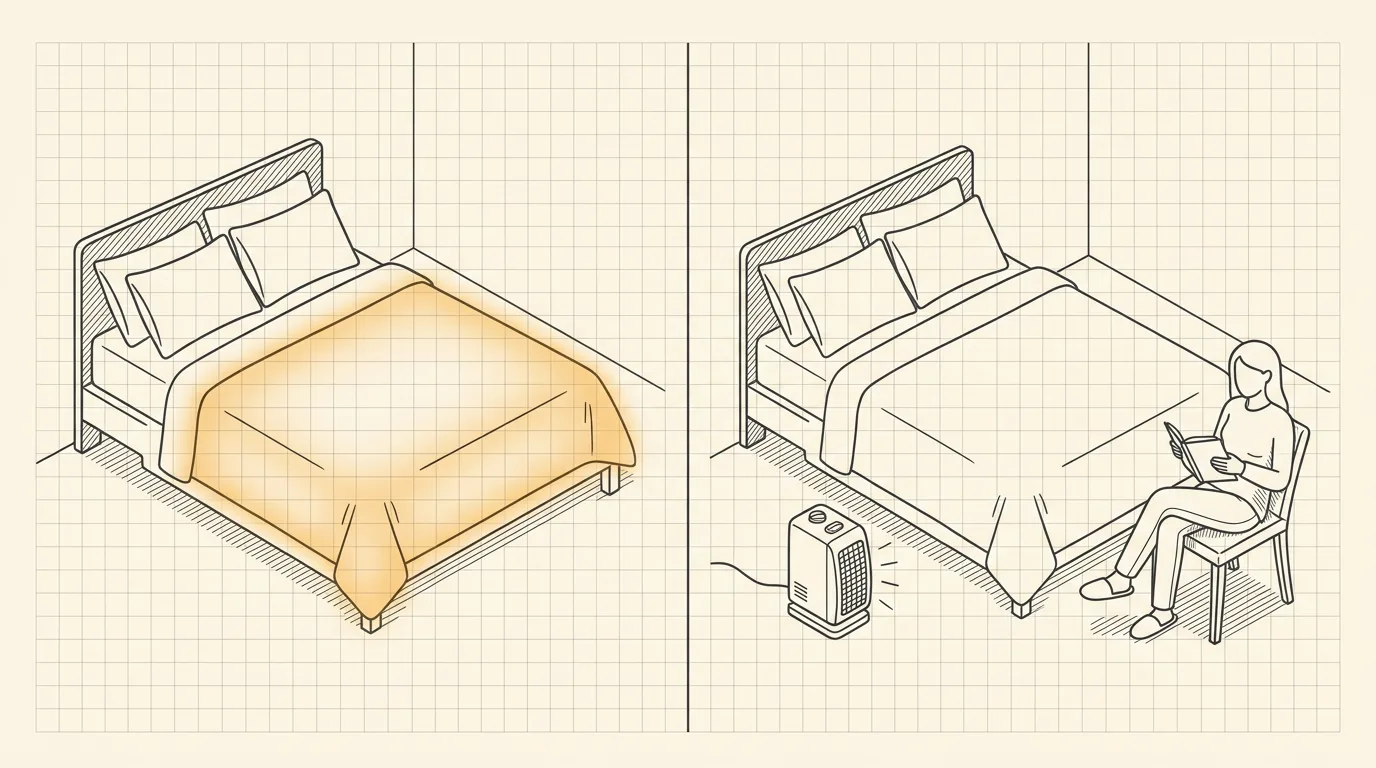
Baseboard vs space heater: per watt, they cost exactly the same to run — both are 100% resistance heat, so a 1,000 W baseboard and a 1,000 W ceramic heater produce identical heat for identical money (the full per-wattage math is in space heater running cost). The differences are structural: baseboard is hardwired 240V with no practical size cap and its own per-room thermostat; a plug-in heater is 120V, capped near 1,500 W, and portable. If you’re choosing hardware for one room, the buying decision lives in the best energy-efficient space heaters — and if the “room” is really a bed, electric blanket vs space heater shows the option that costs about a tenth as much.
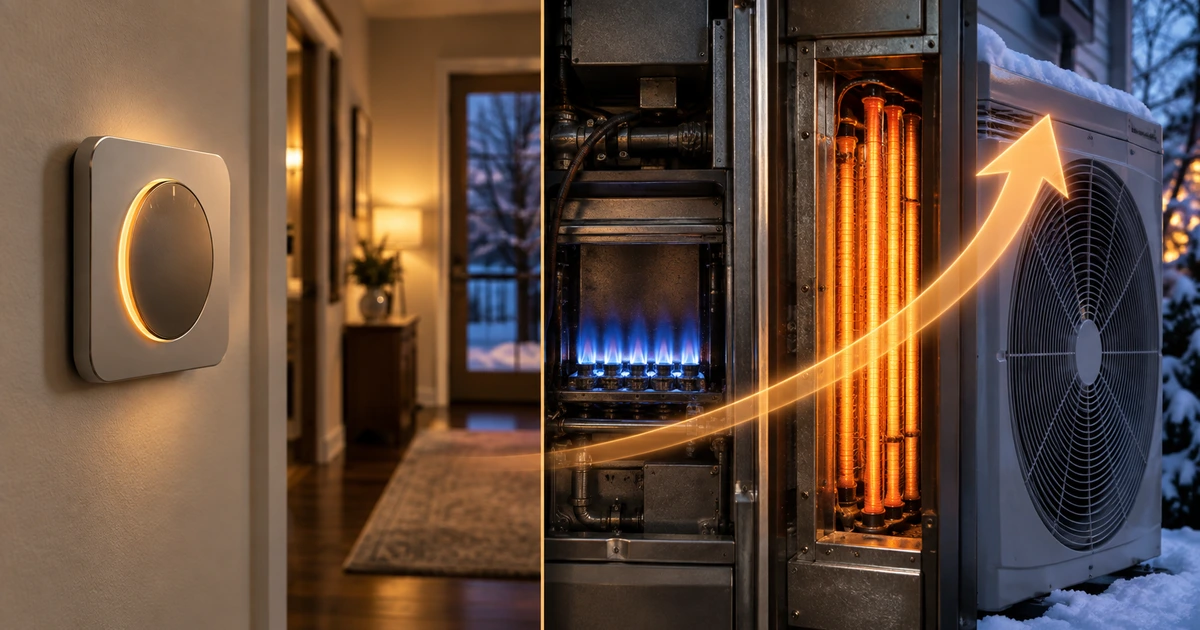
Baseboard vs heat pump: this is the lopsided one. A heat pump doesn’t create heat from electricity; it moves existing heat indoors, which is why DOE puts the electricity reduction at approximately 65% versus electric resistance heating — exactly what baseboard is.[5] That cuts the effective cost per BTU by about two-thirds: the same $5.37 of resistance heat costs roughly $1.88 delivered. The full breakeven math against a gas furnace, including where heat pumps stop winning in deep cold, is in heat pump vs gas furnace savings. One warning if you already have a heat pump somewhere in the house: its backup resistance strips are the same expensive heat as baseboard, and knowing when they run is the difference covered in aux heat vs emergency heat.
Baseboard vs gas: at national average prices, gas wins by roughly 2.3–2.7× per unit of heat, as the table shows. Baseboard’s case is installation economics: no combustion, no flue, no ducts, low install cost per room, near-zero maintenance. It persists in apartments, additions, and homes without gas service because it’s cheap to install — the operating bill is where the difference shows up.
The cheap fixes (ranked by cost)
1. Use the zoning you already have — free. Baseboard is inherently zoned: every unit (or room) has its own line-voltage thermostat, so you can hold occupied rooms at comfort temperature and let unused rooms run cooler. DOE puts the setback gain at up to 10% a year on heating for turning the thermostat back 7–10°F for 8 hours a day.[5] With baseboard, setback is the correct move — worth spelling out, because it’s the opposite of the register-closing advice for central systems. Baseboard has no ducts and no registers to close; the per-unit thermostat is the zone control, and lowering an unused room’s setpoint genuinely stops that unit’s runtime. Two cautions: don’t let any room with plumbing drift toward freezing — keep it at 55°F or above (the freeze-risk logic is in how to keep pipes from freezing) — and don’t expect a room you’ll use this evening to recover quickly; resistance heat warms slowly.
2. Replace drifting line-voltage thermostats — $50–150 per unit. Older mechanical (bimetal/coil) baseboard thermostats are imprecise: they overshoot the setpoint, then let the room swing below it before clicking back on. Electronic line-voltage thermostats hold the setpoint tightly, and many add scheduling, so the element runs only as long as needed. Manufacturer savings claims for these swaps vary and aren’t independently verified (treat any specific percentage as an ESTIMATE), but the mechanism is sound: tighter control means fewer wasted overshoot cycles in every room you fix.
3. Air-seal the rooms you heat — $20–100. The element only runs to replace heat that escapes, so every draft is paid for at resistance-heat prices — the most expensive dollars in the house. Weatherstripping, door sweeps, and outlet gaskets in baseboard-heated rooms pay back faster here than almost anywhere, because the marginal heat runs $5.37 per therm-equivalent. The walkthrough is in how to find and seal drafts in your home.
4. Don’t strangle the units. Furniture, drapes, and stored boxes sitting against baseboard trap heat, lengthen runtime, and (at the extreme) create a fire risk. Keep a clear foot of space above and in front of every unit — the free version of an efficiency upgrade.
5. Measure the circuit, then decide. Baseboard sits on dedicated 240V breakers, which makes it unusually easy to isolate: a panel-level energy monitor clamped to those circuits tells you exactly what your baseboard costs per day, per room, in your rate — no estimates.
Installs in your electrical panel with clamp-on sensors per circuit. Baseboard's dedicated 240V breakers make it one of the easiest loads to isolate — watch actual daily kWh per room, compare against the tables above, and find the unit that's running when it shouldn't. Professional install or experienced DIY.
Check price on Amazon Price & availability shown on Amazon.com — we may earn a commission.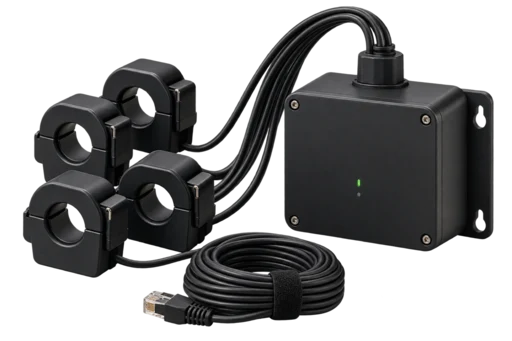
6. If you’re replacing anyway, replace with a heat pump. A ductless mini-split delivering the same heat for roughly a third of the electricity is the only fix on this list that changes the $/BTU math itself rather than the runtime.[5] It’s capital expense against operating expense — the breakeven framework is in heat pump vs gas furnace savings, and the winter-bill context is in why is my heating bill so high.
FAQs
How much does it cost to run a 1,000-watt baseboard heater per month?
Is electric baseboard heat more expensive than gas?
Why is my electric bill so high with baseboard heat?
Can I turn off baseboard heaters in unused rooms?
Is baseboard cheaper to run than a space heater?
The Number That Actually Matters
The per-hour figure — $0.18 for the common 1,000 W unit, $0.09 to $0.46 across the size range — is the ceiling, not the forecast. Your real bill is set by two things this page can’t see from here: the duty cycle your rooms’ thermostats negotiate with your insulation, and the rate your utility actually charges per kWh. Both are measurable: the rate is printed on your bill, and the runtime shows up on the baseboard circuits in your panel.
Where to go next: run the formula with your own rate tonight — watts ÷ 1,000 × your $/kWh — then check it against the panel this week. If the number is tolerable, the fixes above trim it further; if it isn’t, the structural answer is the heat pump comparison, and the whole-bill diagnosis starts with why is my electric bill so high.
Sources
- EIA Electric Power Monthly Table 5.03 — residential average 18.34¢/kWh — national average rate anchor, retrieved September 26, 2026.
- EIA Electricity Monthly Update — End-Use Consumption — residential average price 18.34¢/kWh, retrieved September 26, 2026.
- DOE Energy Saver — Electric Resistance Heating — “100% energy efficient” conversion statement, archived May 2026.
- EIA — Natural Gas Prices, US Residential Average — $19.73/Mcf May 2026 (≈$1.90/therm at 10.37 therms/Mcf), retrieved October 4, 2026.
- U.S. Department of Energy — Home Upgrades — heat pumps cut heating electricity ~65% vs electric resistance; thermostat setback of 7–10°F for 8h/day saves up to 10%/yr, retrieved October 4, 2026.
- Choose Energy — Electricity Rates by State — Nevada 13.11¢ lowest state average, retrieved October 4, 2026.
- ElectricChoice — Electricity Rates by State — 18.34¢ national average confirmation, Hawaii 52.72¢ highest, retrieved October 4, 2026.