Quick Answer
A shrink-film window kit pays for itself in one winter if you put it on the two or three draftiest windows in your home — and probably not if you put it on windows that already feel fine. The kit costs $12–20 for a five-window pack, installs with double-sided tape and a hair dryer, and works by creating a sealed pocket of still air between the film and the glass. Still air is a poor heat conductor, so the layer slows the loss that makes a cold window feel like an open refrigerator door. [1][4]
The honest framing: this is a patch for a bad window, not an upgrade to a good one. The math only works on windows that are actively leaking heat.
How the Film Actually Works
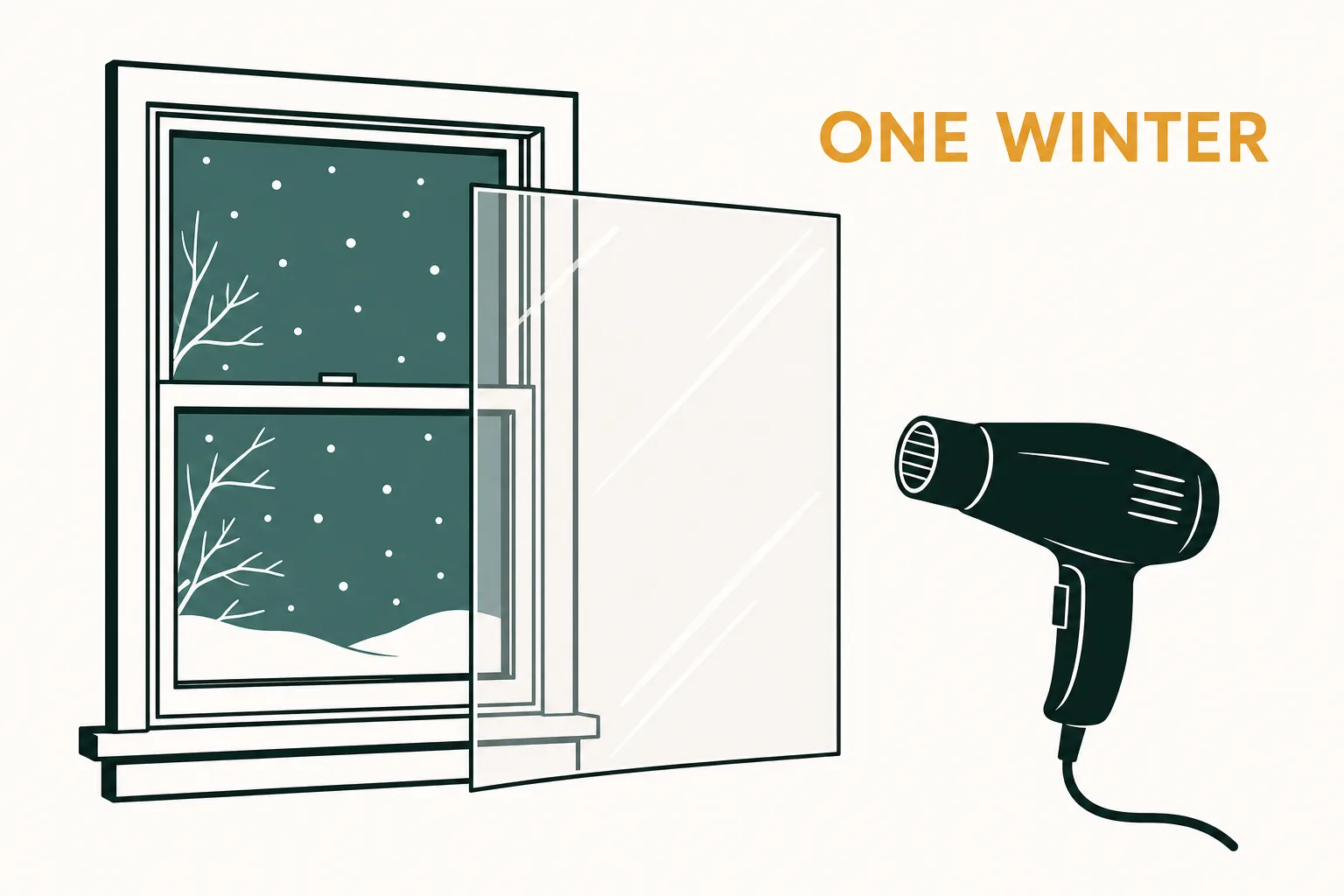
A window insulation kit is a sheet of clear plastic and a roll of tape. You tape the sheet to the wall or trim around the window, then heat it with a hair dryer until it shrinks taut and nearly invisible.
The film itself is not the insulator — the trapped air is. Heat moves through air slowly when the air cannot circulate, and a sealed film layer holds a pocket of it against the glass. The same principle is why a double-pane window insulates better than a single pane: it is not the two sheets of glass doing the work, it is the sealed gap between them. A shrink-film kit essentially turns a single-pane window into a crude double-pane, minus the permanence.
The film also stops the draft itself. A leaky sash lets cold air stream in at the frame, and the tape-and-film seal shuts that stream off completely for the season. For old windows with warped sashes — the kind where you feel moving air standing three feet away — that draft seal is usually worth more than the insulation value.
Manufacturer packaging for window film claims cuts of up to 35% of window heat loss — manufacturer-reported, so treat it as the ceiling of a lab-condition claim, not a bill forecast. No window kit comes with a promised dollar figure, and any honest payback talk has to build the logic yourself, which is the next section.
Five 3x5-foot clear film sheets with double-sided tape; shrinks taut with a hair dryer to seal drafts and add a dead-air layer for the season. Tape-on, peel-off — renter-clean, one season per kit.
Check price on Amazon As an Amazon Associate we earn from qualifying purchases. Price & availability shown on Amazon.com.The One-Winter Payback Logic
There is no universal “this will save you $30” number, and you should distrust anyone who prints one. What you can do is reason in three steps.
Step 1: which windows? A kit belongs on windows that are cold to sit near, that show condensation or frost in January, or where you can feel air movement at the frame on a windy day. A tight modern double-pane gains almost nothing from film — you would be shrink-wrapping a wall.
Step 2: what does one bad window cost you? This you cannot know exactly without measuring, and that is fine — the decision does not need precision. A single old window losing heat all winter is doing it through two channels: air leaking through the sash (which ENERGY STAR’s air-sealing guidance targets directly [1]) and heat radiating and convecting through the glass. The Department of Energy’s research on window attachments — cellular shades, the same dead-air physics as film — documents meaningful reductions in window heat loss for tight-fitting attachments.[2] A drafty window is the worst case in that family.
Step 3: compare to the $12–20 kit. The kit is a one-season item. The tape holds through a winter, then the film comes off in spring (slowly, with a hair dryer re-warm, to limit residue). So the real question is whether one winter’s reduced loss on your worst two or three windows is worth the price of a pizza. For most homes with any pre-1980 windows, the honest answer is yes. For homes with decent windows, the answer is that this product was never for you — put the same money into air sealing, which DOE’s home-upgrades guidance puts ahead of almost everything else. [1][3]
Shrink Kit vs Thermal Curtains vs Rope Caulk vs Nothing
| Option | Mechanism | Cost band | Renter fit | Reusable? |
|---|---|---|---|---|
| Shrink-film kit | Sealed dead-air layer + draft stop at the frame | $12–20 per 5-window pack | Yes — tape on trim, remove in spring | No — one season |
| Thermal curtains | Multi-layer fabric traps air; blocks radiant loss and drafts when closed | $20–50 per window | Yes — hangs on existing rod | Yes — year after year |
| Rope caulk | Press-in sealant stops sash leaks | $8–15 | Yes — presses in, peels out | Mostly — can rework a season or two |
| Doing nothing | — | $0 | — | — |
They stack. Rope caulk seals the leaky sash joints, film seals the whole opening for the season, curtains add a second air layer you can open on sunny afternoons. If you are only buying one thing for one window, the order of operations is: seal the air leak first (caulk or film both do this), add layers second. For the full room-by-room walkthrough, see how to find and seal the drafts in your home, and for the curtain side of the table, our piece on whether thermal curtains really work.
The Honest Limitations
One season, by design. The film clouds slightly over months, takes tape residue with it in spring, and cannot be reused. Buying it is renting an improvement, not owning one — which is exactly why the payback question has a one-winter clock.
Condensation can move. If a window sweats because the glass is cold and the room is humid, film makes the inner surface warmer — but if moisture is getting in behind the film through a leaky seal, it can collect where you cannot wipe it. Apply film to a dry window on a dry day, seal fully, and check under the film after the first cold snap. A window that is wet every morning has a humidity or leak problem film will hide, not fix.
It does nothing for the frame’s conduction losses into the wall cavity, and nothing for the rest of the house. A five-window kit on the five worst windows is a targeted patch; whole-house air sealing is the real project. [1][3]
Views and egress. The film is optically clear but not invisible, and it seals the window shut until spring — so skip operable windows you would need as a fire exit, and skip windows whose view you cannot stand to blur.
Where This Fits in a Winter-Proofing Budget
If you are ranking winter spends from cheapest to most effective, the list usually lands: free behavior changes first (thermostat setbacks — see how to lower your utility bills), then consumable sealing (rope caulk, outlet gaskets, film on the worst windows), then durable upgrades (thermal curtains, storm windows), and only then equipment. A gas-heated home can trace the payoff straight through the winter bills — the seasonal spike lives in why your gas bill is so high in winter.
Five 3x5-foot clear film sheets with double-sided tape; shrinks taut with a hair dryer to seal drafts and add a dead-air layer for the season. Tape-on, peel-off — renter-clean, one season per kit.
Check price on Amazon Price & availability shown on Amazon.com — we may earn a commission.Sources
- ENERGY STAR — Seal and Insulate (retrieved 2026-08-31)
- U.S. Department of Energy — Cellular Shades Factsheet (window attachment heat-loss research) (retrieved 2026-08-31)
- U.S. Department of Energy — Save on Home Upgrades (retrieved 2026-08-31)
- Amazon — 3M Indoor Window Insulator Kit, Five Pack 2141W-6 (retrieved 2026-08-31)