Quick Answer
Yes — as a fit-and-discipline product, not a fabric miracle. Window attachments are one of the few home upgrades with measured results behind them: a Department of Energy factsheet on window attachments puts the potential at roughly 15% of a household’s annual HVAC energy, and the independent rating body for the category publishes a 5–16% range for certified products [1][2].
The catch: most of the performance lives in the installation and the daily open/close habit, not in the panel. And if your home already has modern double-pane windows in a recently sealed envelope, there is little slack left to recover.
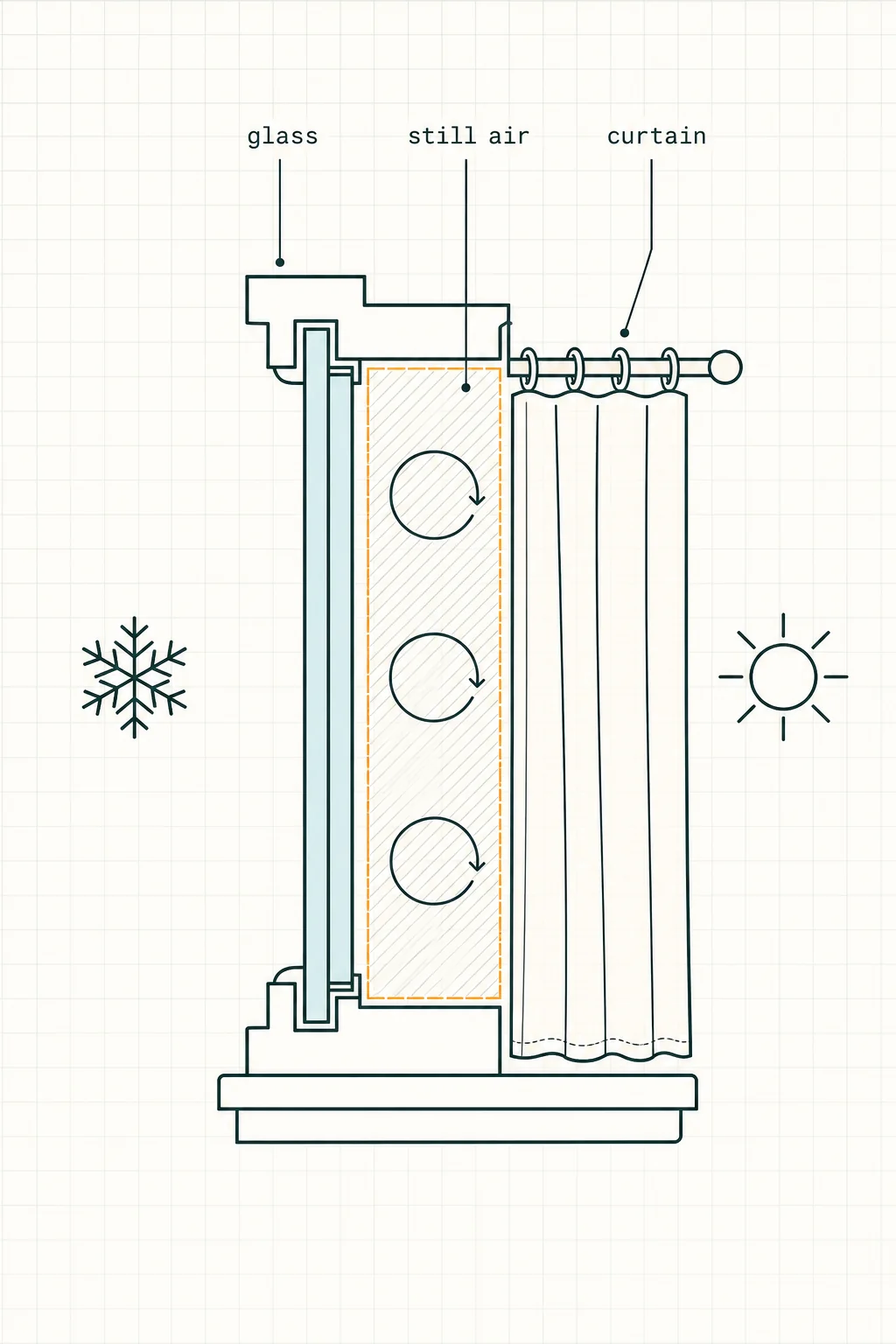
The fabric is the least important part. What does the work is the pocket of still air a curtain holds against the glass, and the convection loop it breaks there.
The Dead-Air Mechanism
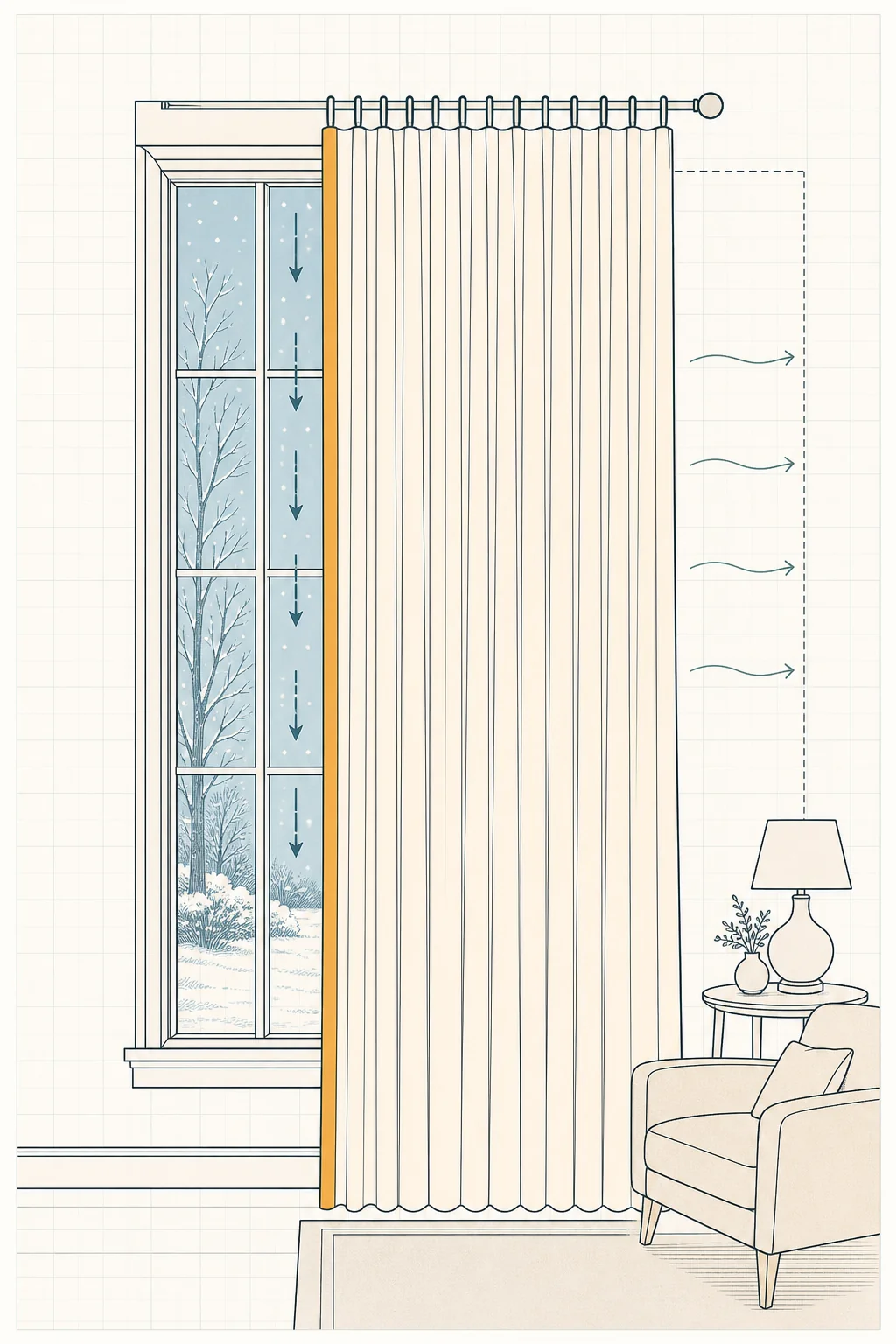
A window loses heat by conduction to whatever air touches it, and a cold pane runs that process continuously: the glass chills the room air next to it, the chilled air sinks, warmer air slides in behind it, and the cycle repeats. Stand beside a bare window on a winter night and that loop is what you feel — your heated air being fed across cold glass and dropped.
A curtain beats it with stillness. In the folds between fabric and glass sits a cushion of slow-moving air, and still air is one of the poorest heat conductors in your house. The curtain’s job is to hold that cushion in place and put the loop’s cold leg behind fabric, where the room can no longer feed it. Any tight-weave, full-coverage, floor-length panel runs the same physics; what the “thermal” label adds is layered construction that holds more still air in more pockets.
What the Savings Numbers Actually Measured
Every savings figure attached to window coverings sits on one of three rungs of evidence — and product pages rarely tell you which one you are standing on.
Tier 1: The DOE figure — about 15% of HVAC energy
The strongest number in the category comes from a Department of Energy factsheet: installing window attachments can save about 15% of a household’s annual HVAC energy [1]. The figure comes from a federal study of window attachments as a category — cellular shades measured against vinyl blinds — and it is a share of heating-and-cooling energy, not of the whole bill.
Thermal-insulated blackout panels in the twenty-to-fifty-dollar band. Order wide enough to overlap the frame on every side and hang close to the wall — fit decides the performance.
Check price on Amazon As an Amazon Associate we earn from qualifying purchases. Price & availability shown on Amazon.com.Tier 2: The certified range — 5–16%
The Attachments Energy Rating Council (AERC) independently rates window attachments the way whole windows are rated: U-factor, solar heat gain, and air leakage [2]. In AERC’s certified-product materials, cellular shades carry a savings potential of 5–16% [2]. The range is wide because the variables are yours — window condition, fit, climate, whether the covering gets operated.
Tier 3: The marketing number — “25–40% of window heat loss”
Then there is the figure circulating across retailer and brand pages: these curtains cut window heat loss by 25–40%. That tier is manufacturer-reported, with the lineage of the underlying study murky at best [3]. More important is what the percentage is of: the window’s heat loss, not your bill. A window is one loss path among several in a house, so a fraction of window loss shrinks predictably by the time it reaches your bill. Read “40%” on a tag as “up to 40% of what the glass loses, under a hang you may not have.”
The takeaway is not a demolition. The measured number is smaller than the tagline and still worthwhile — it hangs on one of the cheapest upgrades on the shelf, installed in an afternoon, by you.
Fit Beats Fabric
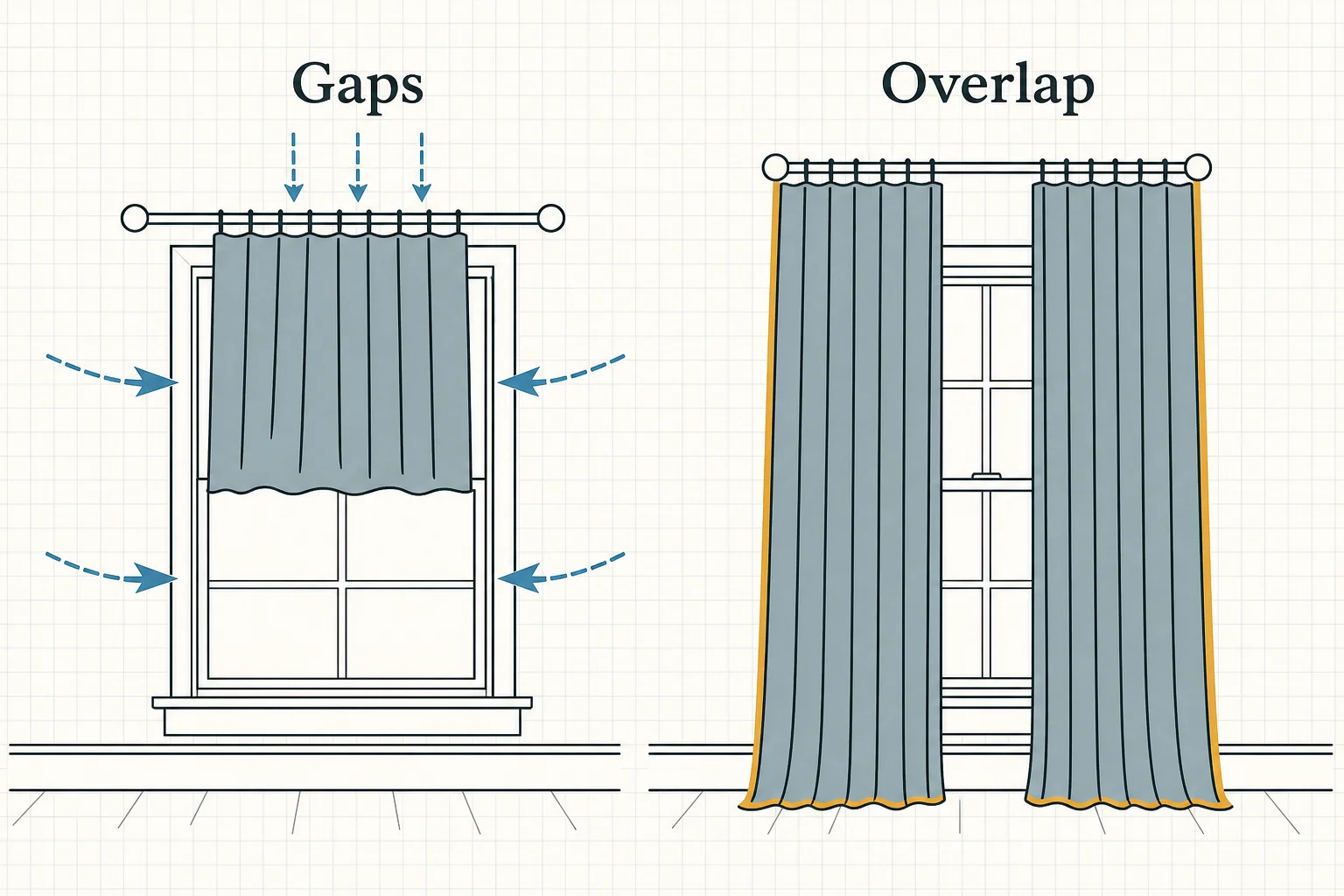
The installation decides the outcome; the fabric just shows up for it. The dead-air layer exists only where the curtain’s geometry allows, and it dies at every gap. Four rules do nearly all the work:
- Extend past the frame on each side. At least four inches beyond the frame on both sides; cloth that stops at the opening’s edge leaves the leakiest rim of the assembly uncovered.
- Hang close to the wall. Every inch between rod and wall is a feed tube where room air slips behind the panel and rejoins the loop. Mount the hardware as close as the brackets allow.
- Go all the way to the floor. Air takes the gap beneath the hem. A panel ending at the sill protects a window that mostly isn’t there.
- Close the overlap. Two panels should meet in the middle with slack, not a seam of daylight. The center of the glass is the coldest strip in the assembly; leave it open and you have hung curtains around the part that matters.
| Hang | What it does |
|---|---|
| Right: wide past the frame, snug to the wall, floor-length, panels overlapped | The still-air layer holds; the loop stops at the fabric |
| Wrong: exact window width, rod stacked forward off the wall, hem above the sill, panels merely touching | Room air feeds around every edge of the panel |
Bear repeating: a cheap curtain hung wide, snug, and floor-length beats an expensive curtain hung short and proud of the wall. Spend the money on the tape measure, not the tag.
Winter Nights, Summer Days
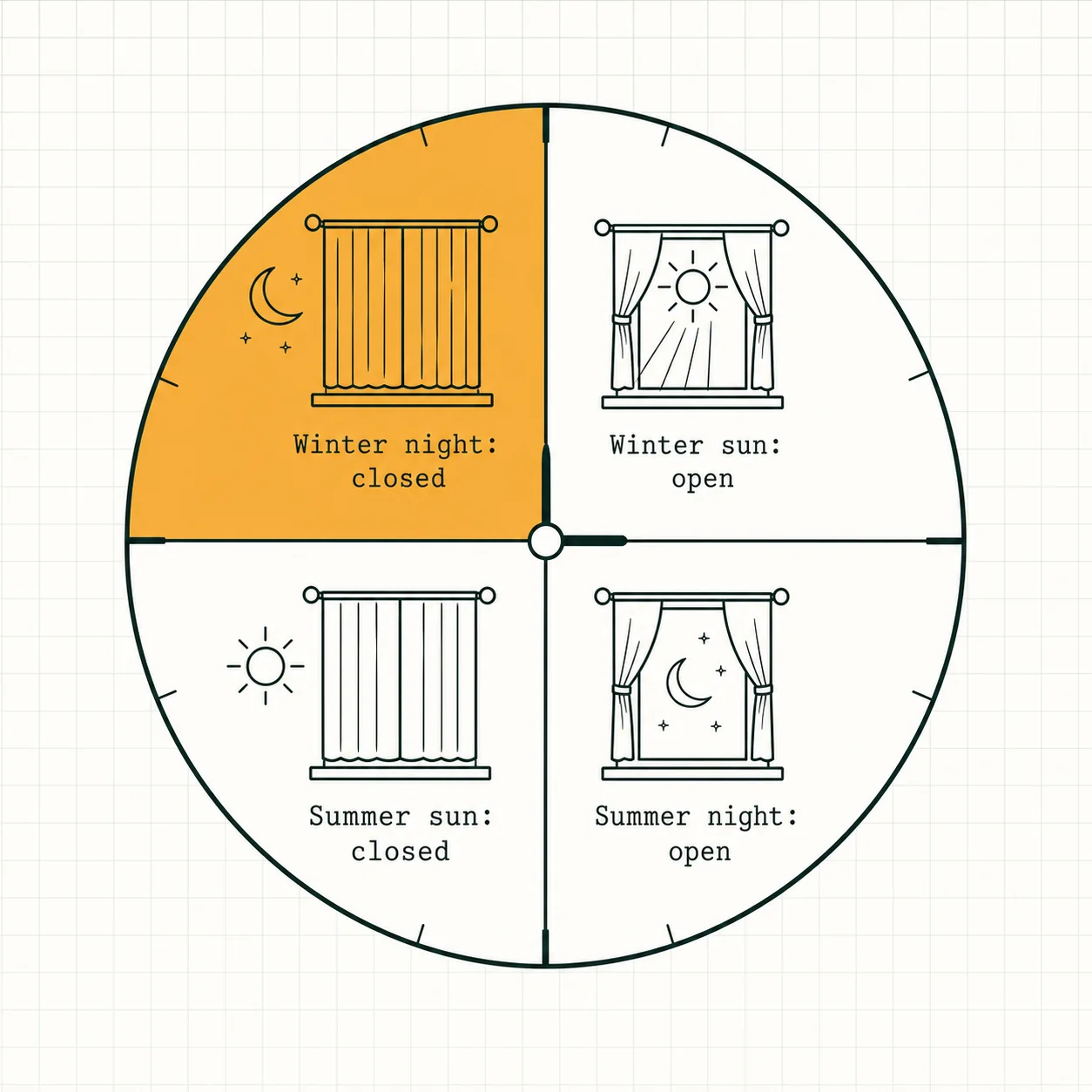
A thermal curtain has a schedule, and the schedule is free. The fabric holds still air; whether that saves energy depends on what the window is doing at the moment.
| Season | Window type | Day/night | Position | Why |
|---|---|---|---|---|
| Winter | Any | Sunny daytime | Open | Light through the glass arrives as free solar heat — invite it in |
| Winter | Any | Night, dark hours | Closed | The dead-air layer goes on duty |
| Summer | Sun-struck glass | Daytime | Closed | Block solar gain before it enters the room |
| Summer | Shaded glass | Daytime | Open | Nothing to block; let air move |
The winter discipline is two-position — closed at night, open on sunny days. Pairing closed curtains with heating only the rooms you actually use is where the winter math compounds — the best energy-efficient space heaters cover that half. The summer discipline keys on the sun: closed across beam-hit glass to block heat before it happens, open where nothing arrives. If the summer problem is the equipment rather than the glass, the real choice is ductless mini-split vs. central air.
Curtains vs. Window Film Kits vs. Cellular Shades
There is no best treatment — only the best match for the window you actually have.
| Treatment | Mechanism | Best window type | Renter-ok | Typical band | One-line verdict |
|---|---|---|---|---|---|
| Thermal curtain | Still-air layer + convection block at the glass | Older or single-pane glass; any window that runs cold | Yes — rod and panel, nothing permanent | $20–50 per panel-pair [4] | Works only while closed |
| Window film kit | Transparent film sealed over the sash | Windows you never open | Generally yes | Seasonal consumable | One-season install; reopening means redoing it |
| Cellular shade | Honeycomb pleats hold dead-air pockets inside the frame | Any; strongest independent ratings [2] | Install-dependent | Usually pricier | Best-rated, costliest, least decor-flexible |
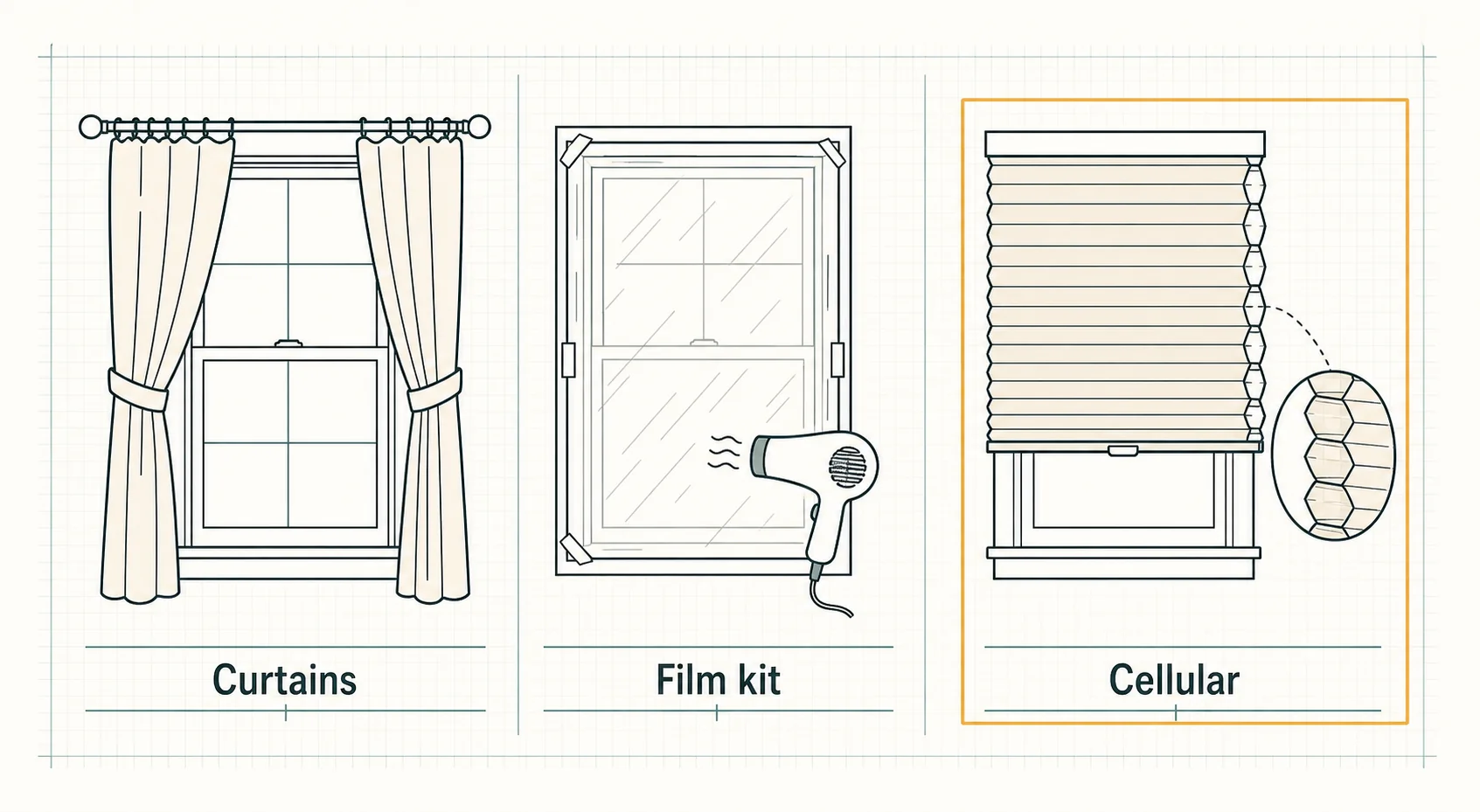
Cellular shades lead the independent ratings [2], but they price like it and commit you to a pleated look. Curtains stay the flexible middle: cheapest to try, easiest to rehang, and the only one that doubles as decor.
What to Look For (If You Buy)
Most of what matters on the tag is not the fabric — but the fabric’s construction is where the list starts.
- Tight weave or layered construction. The still-air layer lives in the build. A loose, drapey weave breathes, and breathing is the failure mode.
- Size to overlap, not to fit. If the panel’s width matches the window’s width, you bought a covering with no margin. Order past the frame on every side.
- Light-blocking is not insulating. Blackout describes visible light, not heat flow. A pitch-dark room can still shed heat all night through a gapped hang.
- The heading sets the edge seal. Grommets hang flat and slide easily; rod-pocket headings wrap the rod and bunch fabric at the top. What matters is how much slack edge sits between panel and wall when the curtain is closed.
- Go to the floor. Repeated from the install rules because it is the spec most people override: hem height is thermal before it is styling.
Nothing on this list requires a designer label. The category’s best sellers are plain, wide panels in the $20–50 band [4], and once the hang is right, the physics does not grade the brand. The best-selling panel below is the sensible default — check its size chart against your rod before the price sways you.
Thermal-insulated blackout panels in the twenty-to-fifty-dollar band. Order wide enough to overlap the frame on every side and hang close to the wall — fit decides the performance.
Check price on Amazon Price & availability shown on Amazon.com — we may earn a commission.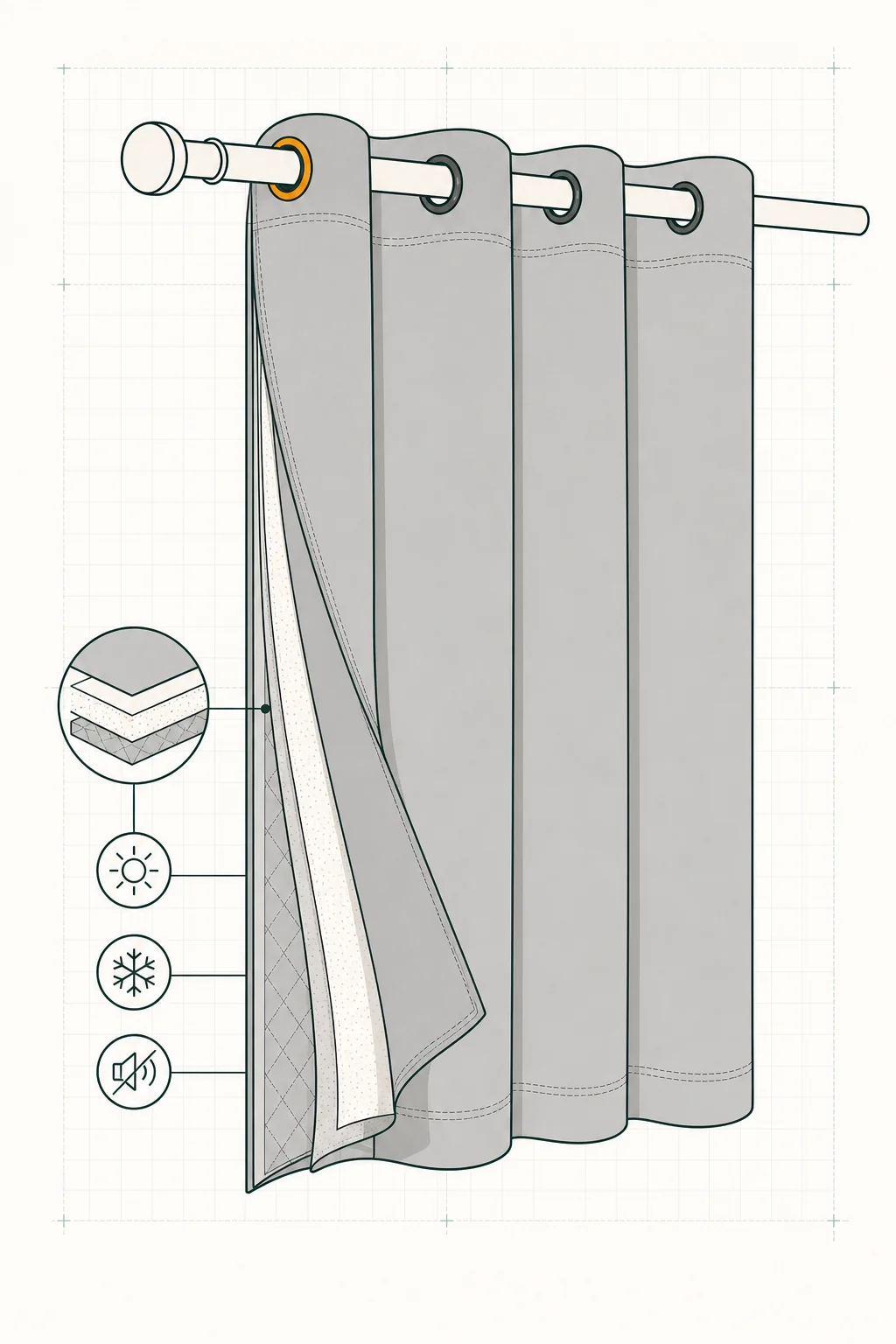
When Curtains Won’t Help
Four situations where the honest answer is that the curtain is not the tool.
- Modern double-pane windows in a recently sealed house. Sealed units already hold a dead-air layer between the panes and conduct poorly; the slack a curtain can recover is small. Buy for darkness or looks, not the heating bill.
- Deep exterior shading. Glass under a wide porch, awning, or heavy tree cover sees less sun and less wind; the curtain has less to intercept on either seasonal job.
- A radiator under the window. The curtain now sits between the heat source and the room. Hung over a hot radiator, a panel can route warm air straight up the cold glass and out — the convection loop, working for the other side. If the heat source lives under the glass, decide which one gets the job. (Air that’s lukewarm at every register is a different problem — why your furnace is blowing cold air.)
- The draft is from the frame, not the glass. Moving air you can feel at the sill is an air-leak signature — air sealing owns that fix, and a curtain will hang politely while you keep heating the outdoors. Walk a DIY home energy assessment first; seal the drafts the curtain can’t, then dress it. If the heating load itself is the problem, the story is in why your gas bill is so high.
Frequently Asked Questions
Do thermal curtains actually help in summer?
Do they work on old single-pane windows?
Are thermal curtains worth it for apartments?
Sources
- U.S. Department of Energy — Window Attachments: Cellular Shades Factsheet (PDF) — window attachments can save about 15% of annual HVAC energy (retrieved 2026-08-30)
- Attachments Energy Rating Council — Rated Products (U-factor, Solar Heat Gain, Air Leakage) — certified products carry a 5–16% savings-potential range (retrieved 2026-08-30)
- Manufacturer and retailer product pages for thermal curtains, surveyed at retrieval — the “25–40% of window heat loss” figure is manufacturer-reported, with no primary study identified (retrieved 2026-08-30)
- NICETOWN Thermal Insulated Curtains — Amazon listing — best-seller panel pairs in the $20–50 band at retrieval (retrieved 2026-08-30)