Quick Answer
Yes — but only if you are currently over-watering on a fixed schedule, and the savings come from skipping, not from the gadget itself. A smart controller replaces a dumb clock timer and skips watering when it rains, when the season cools, or when the soil is already wet; EPA’s figure is “up to 15,000 gallons” a year,[1] and that “up to” is doing a lot of work — if you already water correctly, a smart controller saves close to nothing, and a $249 box is a poor fix for a $0 habit problem. The picks: Rachio 3 (16-zone, $249) for an in-ground system with an over-watering problem; the Orbit B-hyve XD ($36) as the budget answer — a smart hose timer for one line, not a zone controller. If you just want the whole-yard option: the Rachio 3 is on Amazon — how to lower your water bill covers the rest of the levers; this page is the verdict on the controller itself.
First, What a Smart Sprinkler Controller Actually Is
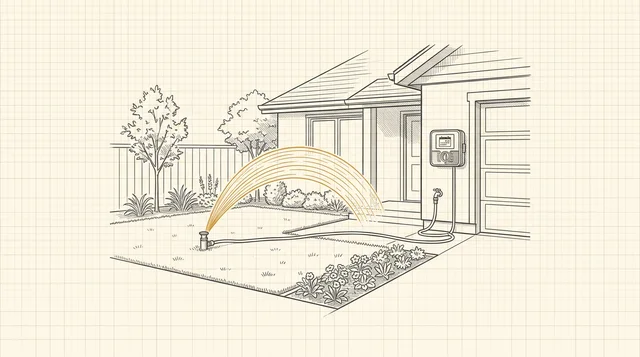
A “smart sprinkler controller” is a replacement for the little wall box that runs your in-ground sprinkler system on a clock. The dumb version you probably have is a clock-based controller: you set it to water zone 1 for 12 minutes, zone 2 for 15, three days a week, and it does exactly that forever — through rain, through a cool week, through a wet spring, through the whole year. It cannot see the sky or the soil, so it waters on schedule whether the lawn needs it or not.
A smart controller adds one or both of two sensors:
- Weather-based controllers pull local weather data (rain, temperature, evapotranspiration) and adjust the schedule automatically. Rain in the forecast → it skips. Cool, humid week → it waters less. Hot, dry stretch → it waters more.
- Soil-moisture-based controllers (soil moisture sensors, or SMS) measure actual moisture in the soil and refuse to water when the ground is already wet.
The EPA’s WaterSense program labels both types, and a controller that uses both must be certified under both specifications to carry the label.[1] That label matters: it means an independent third party verified the controller meets EPA’s efficiency and performance criteria — not that the manufacturer just claims it saves water.
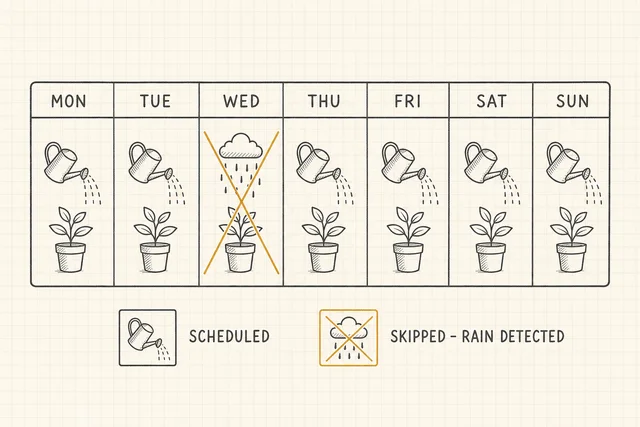
Here is the part most marketing skips: the controller does not make water cheaper, and it does not water your lawn for you. It only decides when not to water. Every gallon it saves is a gallon you were already wasting by watering on a schedule that ignored rain, season, and soil. If you are not wasting water that way, there is nothing for it to skip.
The Claim You Should Be Skeptical Of: “~32% Savings”
Before we get to products, let’s audit the number you’ll see all over thin affiliate pages: the claim that a smart sprinkler controller delivers "~32% water savings." It is repeated everywhere with no source attached — which is exactly why we checked it against the EPA.
Here is what the EPA actually publishes on its WaterSense “WaterSense Labeled Controllers” page (retrieved 2026-09-12):[1]
“Replacing a standard clock-based controller with a WaterSense labeled irrigation controller can save an average home up to 15,000 gallons of water annually.”
That is the EPA’s published figure — “up to 15,000 gallons” a year, not “32%.” The same page notes that residential outdoor water use accounts for nearly 8 billion gallons a day, mainly for landscape irrigation, and that experts estimate up to 50 percent of that water is wasted due to overwatering.[1]
So where does “32%” come from? It is not on the EPA page. It appears to be a number some affiliate sites derived or invented, then repeated without a citation. The honest reading of the EPA data is:
- The EPA’s headline savings figure is “up to 15,000 gallons” a year for an average home that swaps a clock-based controller for a WaterSense-labeled one.
- The “up to 50 percent wasted” figure describes the waste in the system, not the savings any one controller guarantees.
- Neither number is a flat “32%.” Treat any site that quotes “~32%” without a source the way you’d treat a “~32% off” claim with no fine print.
Two more EPA figures frame the scale. The average American family uses more than 300 gallons of water a day at home, with roughly 30 percent of that going outdoors — and in hot summer months or dry climates, outdoor use can climb to 70 percent of a household’s total.[2][3] That is why irrigation is such a visible driver of the summer water bill, and why why-is-my-water-bill-higher-in-summer is worth reading alongside this one. But it also means the potential savings are concentrated in households that water a lot outdoors — and waste a lot of it.
The Honest Verdict: It Depends on Your Habit, Not the Gadget
Here is the honest structure for deciding whether a smart controller saves you water:
16-zone weather-based controller that replaces your in-ground wall timer and skips watering based on local rain, temperature, and evapotranspiration. Wi-Fi connected, app-controlled, sold by Amazon. ~$249 at the time of writing.
Check price on Amazon As an Amazon Associate we earn from qualifying purchases. Price & availability shown on Amazon.com.Yes, for over-waterers on a fixed schedule. If you set your clock timer in April and never touch it until October — watering the same 12 minutes three times a week through rain, cool weeks, and wet soil — a smart controller will skip a meaningful share of those runs. That skipping is the entire savings mechanism. The EPA’s “up to 15,000 gallons” is the best case for exactly this kind of household.
Near-zero, for people who already water correctly. If you already water only in summer, only when the soil is dry, and you adjust the schedule when it rains or cools, a smart controller has almost nothing to skip. It might save you a few hundred gallons a year from a stray rain event — not enough to pay back a $249 controller in any reasonable time.
The failure mode is buying a $249 controller to fix a $0 habit problem. If your lawn is over-watered because you never adjust the timer, the cheapest fix is to adjust the timer — or just turn it off when it rains. A smart controller automates that discipline, which is genuinely useful if you won’t do it yourself. But it cannot fix a schedule you were already managing well.
So the real question is not “do smart controllers save water?” — it’s “am I the kind of person who wastes water on a fixed schedule?” If yes, the controller pays. If no, it’s a nice-to-have, not a saver.
The Two Products, Honestly Framed
The Rachio 3 — the capable whole-yard controller
Best when: you have an in-ground, multi-zone sprinkler system, you over-water on a fixed schedule, and you want weather-based skipping across the whole yard.
The Rachio 3 is a 16-zone weather-based controller[4] that replaces your wall timer and connects to your Wi-Fi. It pulls local weather data and adjusts each zone’s schedule, and it’s the kind of product that does the “skip when it rains” job across a real multi-zone system. At the time of writing it sits around ~$249, with 4.5 stars across 3,100+ reviews on Amazon, sold by Amazon directly. One honest caveat from our verification: the listing showed “Only 16 left” in stock when we checked — stock fluctuates, so the box below always shows current availability.
16-zone weather-based controller that replaces your in-ground wall timer and skips watering based on local rain, temperature, and evapotranspiration. Wi-Fi connected, app-controlled, sold by Amazon. ~$249 at the time of writing.
Check price on Amazon Price & availability shown on Amazon.com — we may earn a commission.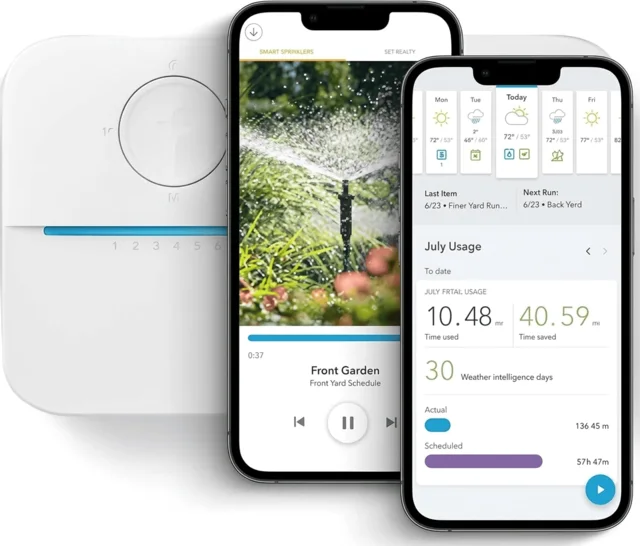
The honest framing: the Rachio 3 is worth its price only if you have a real multi-zone in-ground system and a real over-watering habit. If you have one hose and a sprinkler, it is massively overkill — you’d be paying for 16 zones you don’t have.
The Orbit B-hyve XD — the budget answer, with a big caveat
Best when: you water one line from a hose bib, you want the skip logic, and you want it for ~$36 instead of ~$249.
The Orbit B-hyve XD is a smart hose timer that screws onto a faucet and controls a single line — one sprinkler, one drip line, one soaker hose. It’s a real smart timer with the same weather-skip idea, at about ~$36 with 3.9 stars across 2,000+ reviews, sold by Amazon. But be clear-eyed about what it is: it is not a whole-yard zone controller. It manages one hose bib, not your in-ground system. If your “irrigation system” is a sprinkler on a hose, this is the honest budget pick; if you have zones, it can’t run them.
Smart hose timer that screws onto a faucet and controls one line — one sprinkler or drip line — with weather-based skip logic. ~$36 at the time of writing. A smart hose timer, not a whole-yard zone controller.
Check price on Amazon Price & availability shown on Amazon.com — we may earn a commission.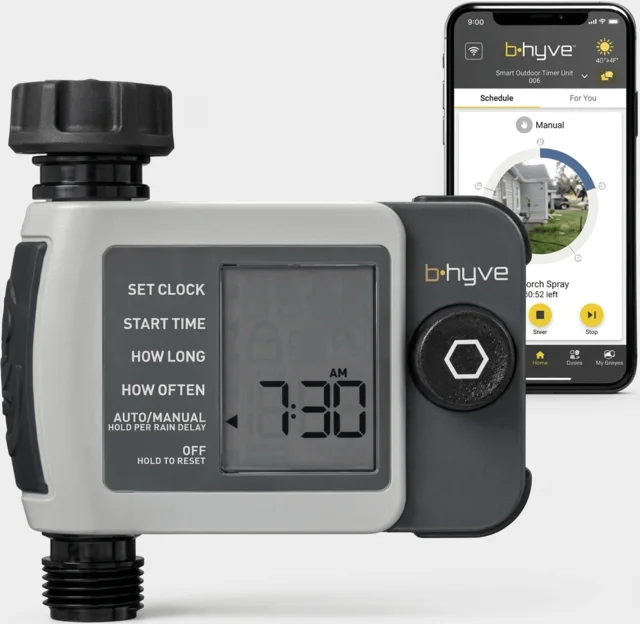
Head-to-Head
| Rachio 3 (16-zone) | Orbit B-hyve XD (hose timer) | |
|---|---|---|
| Price band | ~$249 | ~$36 |
| What it controls | Up to 16 in-ground zones | One hose bib / one line |
| Best for | Multi-zone in-ground systems | Single sprinkler or drip line |
| Weather skip | Yes, per zone | Yes, one line |
| Ratings (at writing) | 4.5★ / 3,100+ reviews | 3.9★ / 2,000+ reviews |
| Sold by | Amazon | Amazon |
| Payback (see math) | ~3 years | ~5 months |
The Math: When Does It Pay For Itself?
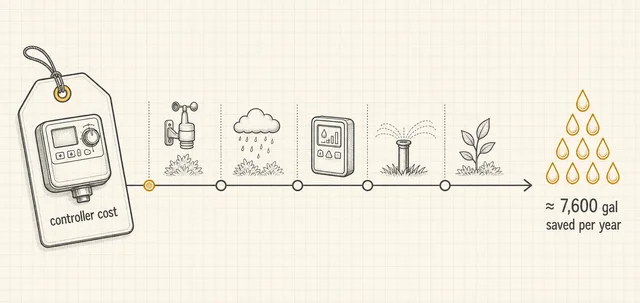
Let’s do the arithmetic with stated assumptions. We’ll use a baseline of 7,600 gallons a year of outdoor watering — a deliberately conservative assumption — and a combined water-plus-sewer rate of $10–12 per 1,000 gallons (rates vary widely by region; check your bill for your own number). For honesty: EPA’s national averages (300+ gallons per household per day, ~30% of it outdoors) imply an outdoor baseline closer to 30,000 gallons a year — if your yard is anywhere near that, every payback below is shorter than stated.
Smart hose timer that screws onto a faucet and controls one line — one sprinkler or drip line — with weather-based skip logic. ~$36 at the time of writing. A smart hose timer, not a whole-yard zone controller.
Check price on Amazon As an Amazon Associate we earn from qualifying purchases. Price & availability shown on Amazon.com.The annual outdoor watering cost:
7,600 gal ÷ 1,000 = 7.6 units
7.6 × $10 = $76 (low end)
7.6 × $12 = $91 (high end)
So the outdoor watering you’re trying to reduce costs roughly $76–91 a year.
Payback on the Rachio 3 (~$249), assuming it eliminates the full outdoor cost (best case):
$249 ÷ $76 = 3.3 years
$249 ÷ $91 = 2.7 years
So the Rachio 3 pays for itself in roughly 3 years — if it eliminates the entire outdoor watering cost. That is the best case, and it only happens for a household that was wasting nearly all of its outdoor water on a fixed schedule. For someone who already waters correctly, the savings are a fraction of that, and the payback stretches to a decade or never.
Payback on the Orbit B-hyve XD (~$36), same assumption:
$36 ÷ $76 = 0.47 years ≈ 5.6 months
$36 ÷ $91 = 0.40 years ≈ 4.8 months
The hose timer pays for itself in about 5 months under the same best-case assumption — which is why the budget pick is the rational one for a single line. Even a modest real-world saving (say, a third of the outdoor cost) pays back a $36 timer in a bit over a year, while the same modest saving barely dents a $249 controller.
Two honest caveats on this math. First, it assumes the controller eliminates the full outdoor cost, which is the ceiling, not the typical result — real savings land somewhere between “a lot” (over-waterer) and “almost nothing” (already-correct waterer). Second, the 7,600-gallon baseline is a commonly cited average, but the EPA’s own published savings figure on its controllers page is “up to 15,000 gallons” a year for swapping a clock-based controller — which, at $10–12 per 1,000 gallons, would be $150–180 a year of potential savings and a ~1.5-year payback on the Rachio in the absolute best case.[1] The honest range is wide, and it all depends on how much you’re currently wasting.
Which One Should You Actually Buy?
- You have a multi-zone in-ground system and you over-water on a fixed schedule → Rachio 3. ~$249, ~3-year payback in the best case. Worth it if the habit is real.
- You have one hose and one sprinkler, and you want the skip logic cheap → Orbit B-hyve XD. ~$36, ~5-month payback. The rational budget pick.
- You already water correctly — short runs, only when dry, adjusted for rain → Buy nothing. A smart controller has almost nothing to skip, and a $249 box won’t fix a $0 problem.
- You just never touch the timer → The cheapest fix is to touch it. Turn it off when it rains, cut it back in cool weeks. That’s the same discipline a smart controller automates, at $0.
And the standing rule for every controller on this page: the gadget only saves what you were already wasting. A smart sprinkler controller is a skip-machine for over-watering, not a water factory. If you aren’t wasting water on a fixed schedule, no controller will manufacture savings for you — and the honest first step is to read your bill, understand your tiered water rates, and fix the habit before you buy the box.
Sources
- EPA WaterSense — WaterSense Labeled Controllers — “up to 15,000 gallons” saved annually by replacing a clock-based controller; ~8 billion gallons/day outdoor use; up to 50% wasted due to overwatering; weather-based and soil-moisture controller definitions. Retrieved 2026-09-12.
- EPA WaterSense — Start Saving — ~30% of household water is outdoor use, up to 70% in summer/dry climates; average family spends ~$1,300/year in water costs. Retrieved 2026-09-12.
- EPA WaterSense — How We Use Water — average American family uses 300+ gallons/day, ~70% indoors / ~30% outdoors. Retrieved 2026-09-12.
- Rachio — Rachio 3 Smart Sprinkler Controller — 16-zone weather-based controller product page and specifications. Retrieved 2026-09-12.