Quick Answer
An ENERGY STAR certified chest freezer uses about 215 kWh a year — roughly $3.28 a month at the June 2026 US average residential rate of 18.34¢/kWh. A certified upright freezer uses about 395 kWh a year — roughly $6.04 a month, nearly double for the same certification.[1] The real-world spread is wide: EIA’s household survey puts the average existing separate freezer at 570 kWh a year (about $8.71 a month at the same rate), because most freezers in service are older, bigger, or living in hot garages.[2] The best number is the one printed on your own model’s yellow EnergyGuide label — its yearly kWh times your rate, divided by twelve. And the honest ceiling on savings: even swapping an ancient unit for a new chest saves most households under $70 a year, so measure before you shop.
The three numbers that set the answer
| Freezer | Electricity per year | Per month at 18.34¢/kWh | Per year | Implied average draw |
|---|---|---|---|---|
| ENERGY STAR chest freezer[1] | 215 kWh | $3.28 | $39.43 | ~25 W |
| ENERGY STAR upright freezer[1] | 395 kWh | $6.04 | $72.44 | ~45 W |
| Average existing separate freezer (EIA RECS 2020)[2] | 570 kWh | $8.71 | $104.54 | ~65 W |
Three sources, three truths. ENERGY STAR’s certified-model figures are what efficient new hardware does[1]. EIA’s RECS 2020 figure — 570 kWh a year for the average household that has a separate freezer — is what the installed base actually does, revisions included[2]. Your freezer is one row of this table, and the next section is how to find out which.
The rate column is the multiplier you control: the 18.34¢ national average becomes roughly half that in the cheapest states and nearly triple in the most expensive — the same arithmetic, bigger stakes, covered for every state in average utility bills by state.
The math on your own model: the EnergyGuide label
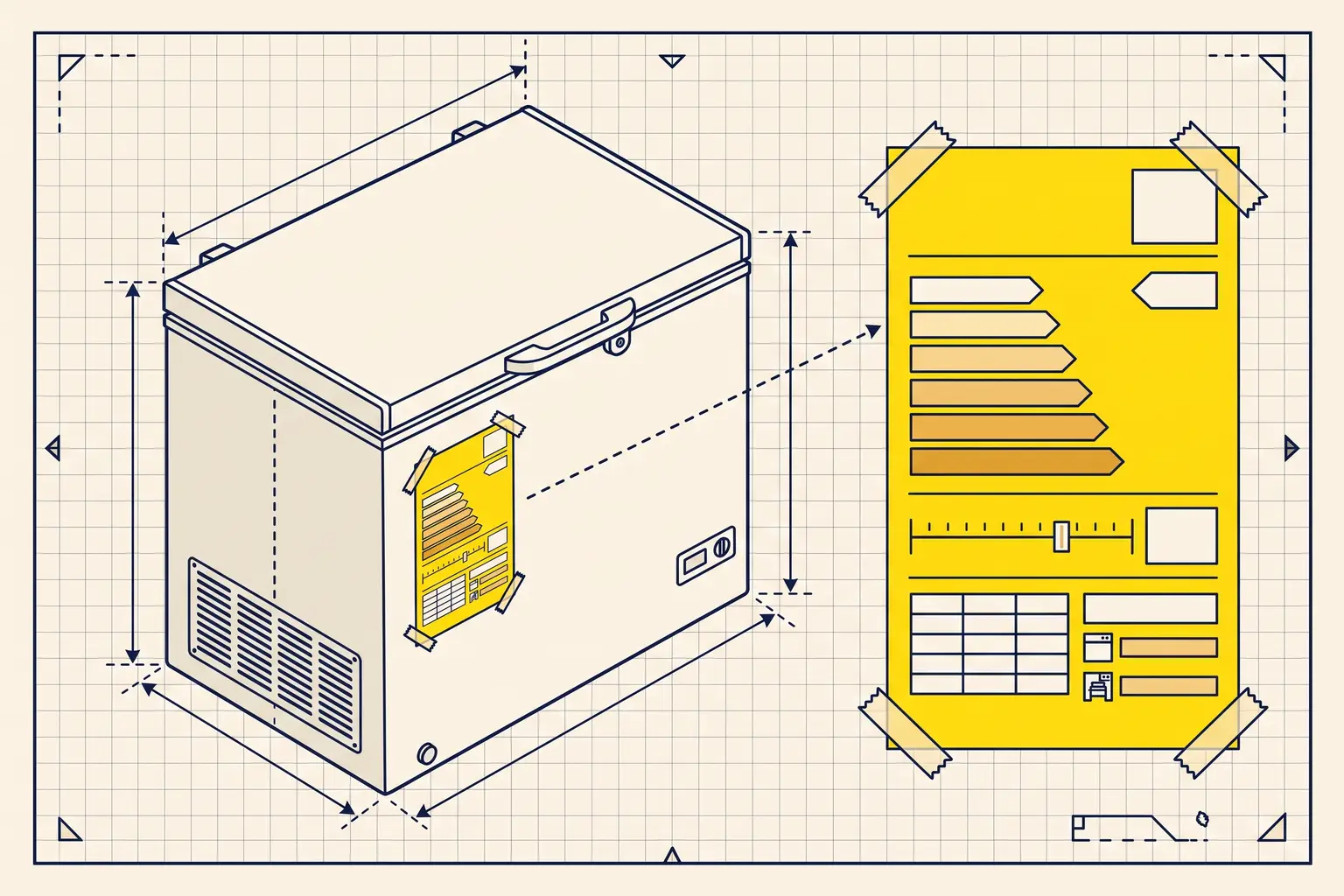
Every freezer sold in the US carries a yellow EnergyGuide label with an estimated yearly electricity use in kWh. That number turns into your cost in two steps:
yearly kWh ÷ 12 × your rate in $/kWh = monthly cost
A label that says 250 kWh and a bill that says 18.34¢: 250 ÷ 12 × $0.1834 ≈ $3.82 a month. Use the rate from your own bill (supply plus delivery, the works — how to read your electric bill shows where it hides), because state averages are for arguments, not budgets.
For a freezer already in your house, the label may be long gone. The substitute is measurement — and it is the only method that captures your garage’s temperature, your family’s door-opening habits, and the unit’s actual aging compressor in one number.
Plug-in watt meter that reads live watts and cumulative kWh over days; enter your utility rate for an on-device cost estimate. Standard 120V outlet, no installation — one meter on the freezer for a week tells you exactly which row of the table above you own.
Check price on Amazon As an Amazon Associate we earn from qualifying purchases. Price & availability shown on Amazon.com.Plug-in watt meter that reads live watts and cumulative kWh over days; enter your utility rate for an on-device cost estimate. Standard 120V outlet, no installation — one meter on the freezer for a week tells you exactly which row of the table above you own.
Check price on Amazon Price & availability shown on Amazon.com — we may earn a commission.The method: plug the freezer through the meter, wait at least 24 hours (a week is better — defrost cycles are lumpy), read the cumulative kWh, scale to a month. That measured number beats every table on this page, the same way it does for refrigerator energy use. For long-watch logging rather than a one-shot read, an energy-monitoring smart plug writes the history for you:
Wi-Fi smart plug with live wattage and cumulative kWh tracking in the app — useful for watching a garage freezer across seasons, when winter cold and summer heat move its duty cycle the most.
Typically $14–18 (our check, Oct 2026) — Amazon shows the current price.Check price on Amazon Price & availability shown on Amazon.com — we may earn a commission.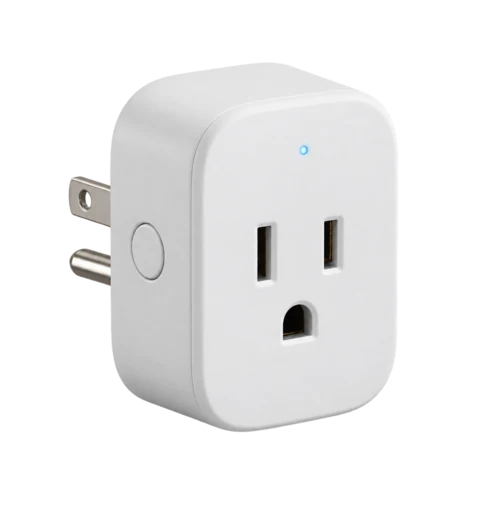
A plain-language caution that applies to both tools: a meter measures; it does not save anything by itself. The bill changes when the reading changes what you do.
Chest vs upright: physics, not branding
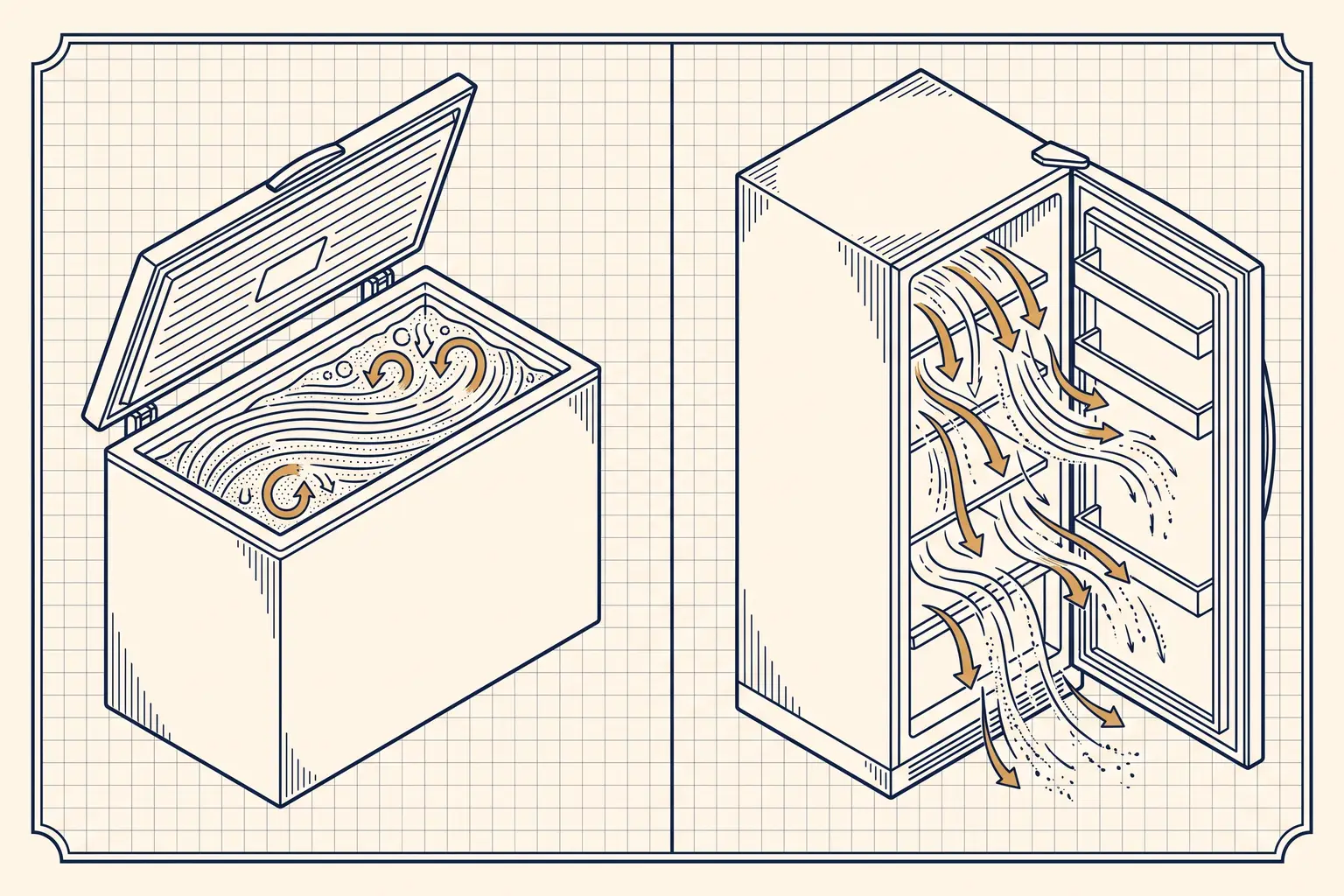
ENERGY STAR’s own numbers show certified uprights using about 84% more electricity than certified chests[1], and the reason is cold air’s habit of falling. Open a chest’s top lid and the cold air mostly stays pooled in the box; open an upright’s front door and it cascades out onto the floor, and the compressor rebuilds that loss every single opening. Add that most uprights run automatic defrost (heating elements, on a schedule) while most chests are manual defrost, and the gap widens.[1]
None of which makes uprights irrational — shelves and visibility are worth real money in weekly-cooking terms. The honest framing: you are paying roughly $33 a year (at the average rate) for organization and floor space. Whether that is cheap or expensive is your call; knowing the number exists is this page’s job.
Wi-Fi smart plug with live wattage and cumulative kWh tracking in the app — useful for watching a garage freezer across seasons, when winter cold and summer heat move its duty cycle the most.
Check price on Amazon As an Amazon Associate we earn from qualifying purchases. Price & availability shown on Amazon.com.The garage factor (and winter’s discount)
Many chest freezers live in garages, and ambient temperature moves the compressor’s workload directly: a 40°F garage in January means far shorter compressor runs than a 95°F garage in August. Freezers in cool spaces run cheaper — that is the winter discount nobody mentions, and it is why a freezer’s summer-versus-winter meter readings can differ noticeably.
Two cautions ride along. First, manufacturers rate freezers for a specific ambient range; a unit not rated for unheated spaces can struggle or cycle oddly in a hard-freeze garage — check the install manual before parking one in a Minnesota outbuilding. Second, the garage circuit question: a freezer sharing a circuit with a space heater that keeps tripping the breaker is a spoiled-food gamble; big resistive heat and the freezer’s compressor are a poor roommate pair.
Is the old one worth replacing?
The ceiling on the win: EIA’s installed-base average (570 kWh) versus an efficient new chest (215 kWh) is 355 kWh a year — about $65 a year at the national average rate. Your actual gap depends on what your meter said and your rate. Run the honest payback:
- Measured gap × your rate × years versus the new freezer’s price. At $65 a year, a new chest pays for itself in under a decade — real, not thrilling. At Hawaii-ish rates, the same gap is worth roughly triple, and the math gets serious.
- Retiring (rather than replacing) a barely-used second freezer is the instant 100% win: the whole meter reading stops.
- A freezer that runs constantly, frosts over quickly, or reads hot on the sides is suspect beyond its age — the meter catches what the eye cannot.
For context on where a freezer sits in the whole bill: even the EIA-average unit’s 570 kWh is about 5% of a typical household’s roughly 900 kWh a month[2] — real money, but the big movers live elsewhere. The appliance-size decision tree, including whether a second freezer pays for a bulk-buying habit at all, is worked through here.
FAQ
How much does it cost to run a chest freezer per month?
Does a deep freezer use a lot of electricity?
Is a chest freezer cheaper to run than an upright?
Does a freezer cost less to run in winter?
How do I find my freezer's exact energy use?
Related Reading
- How many watts does a refrigerator use? — the sibling appliance, same measurement method
- Space heater running cost — the winter appliance that actually moves the bill
- How many kWh does a house use per day? — the denominator all these percentages come from
- Average utility bills by state (2026) — your rate’s context
- How to read your electric bill — find your real rate
- Electricity explained
Sources
- ENERGY STAR: Freezers (retrieved 2026-11-18)
- EIA RECS 2020, Table CE5.3b — household site electricity end-use consumption, averages (retrieved 2026-11-18)
- EIA Electric Power Monthly, Table 5.03 (retrieved 2026-09-06)