Rate basis: U.S. EIA national averages (electricity 18.3¢/kWh July 2026; gas $1.92/therm September 2026)
Quick Answer
Heating one room is cheaper than heating the whole house only when you actually turn the central heat down for the rest of it. A space heater running on top of your normal thermostat setting always costs more — full stop. And even with an honest setback, whether you come out ahead depends on what your central system is: if you heat with electricity (baseboard, electric furnace), zone heating wins big and immediately; if you heat with a modern gas furnace, the math usually says the furnace wins; if you heat with a heat pump, the space heater almost never wins unless it’s preventing auxiliary heat strips from running.
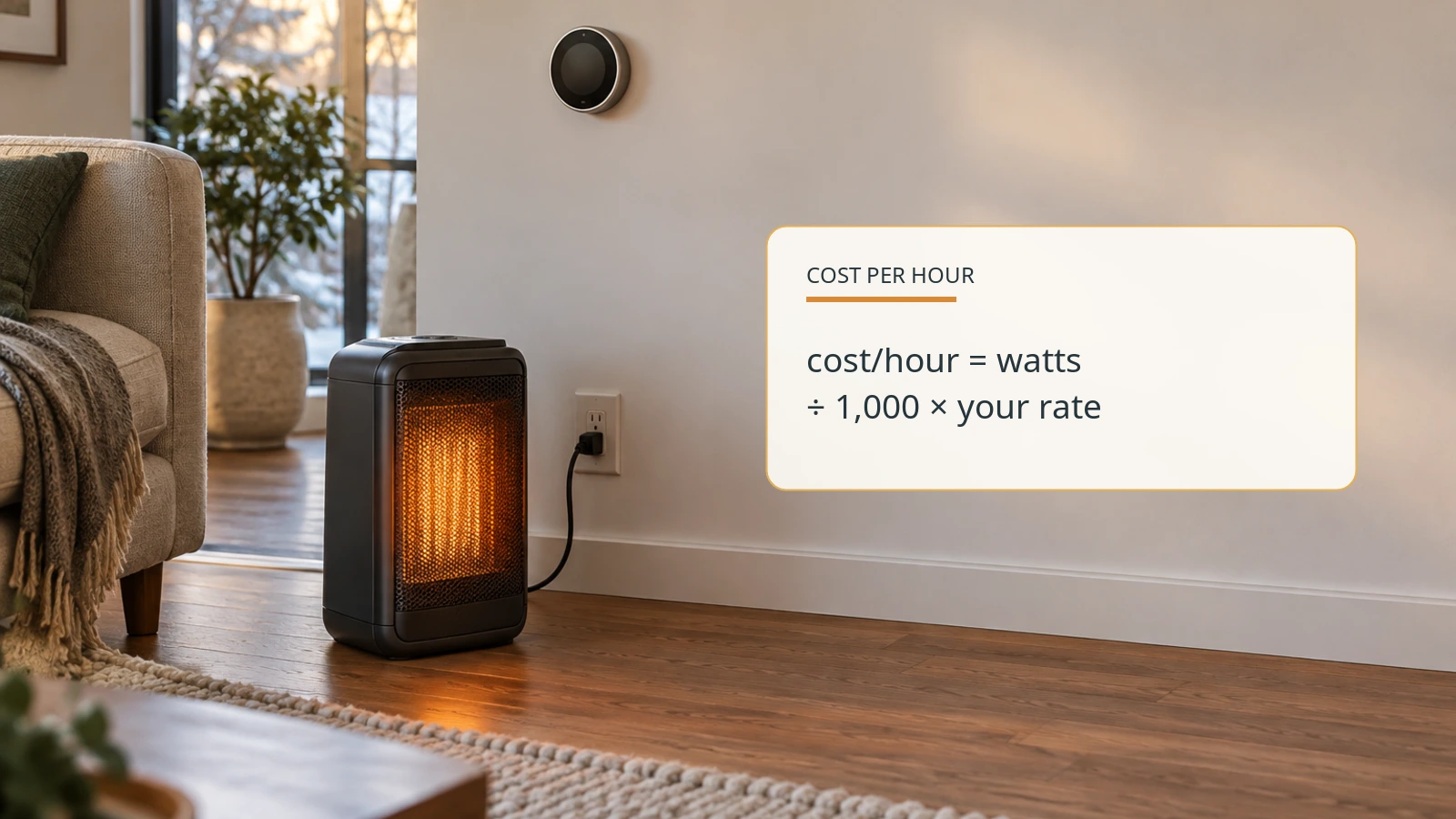
The one number to hold onto: a 1,500W space heater at the July 2026 national average rate costs about $0.27 per hour to run — roughly $66 a month at 8 hours a day. Whether that $66 is a bargain or a leak depends entirely on what it replaces.
The Per-Hour Math That Hooks People
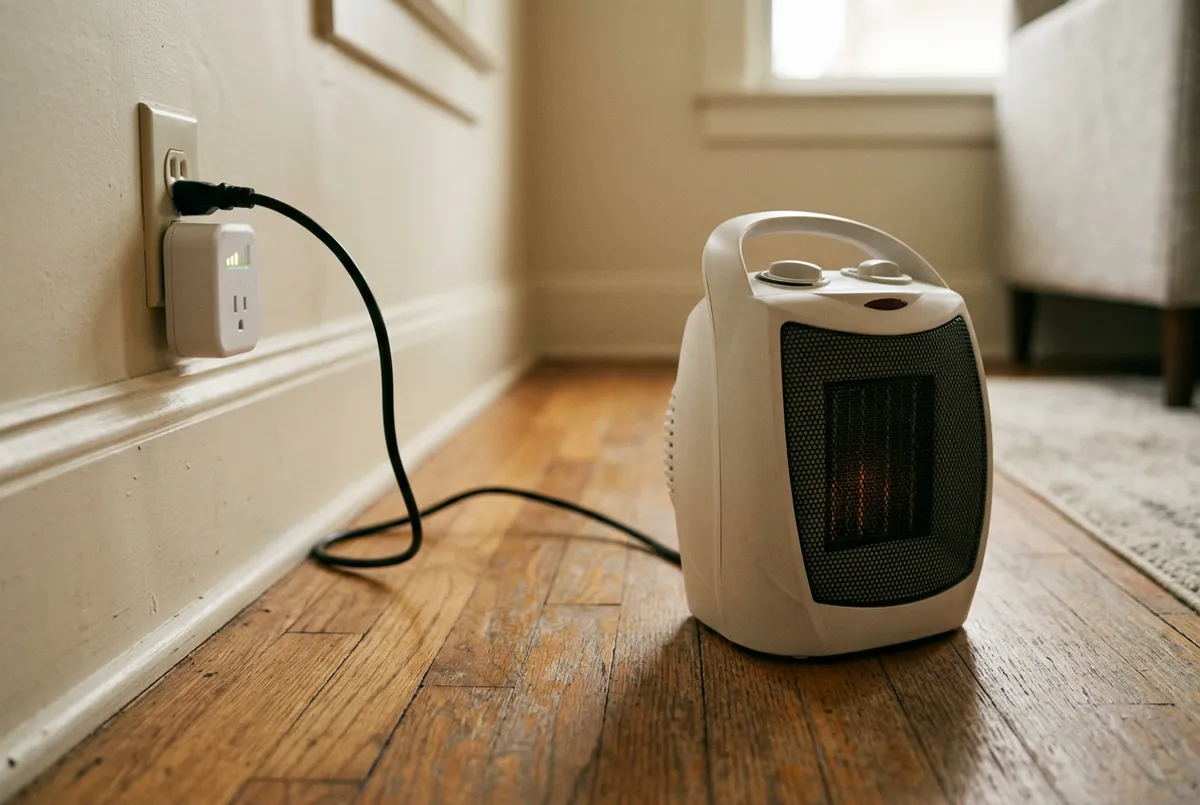
Every space heater sold in the United States tops out at 1,500 watts — it’s a UL plug-cap convention, not a coincidence. The arithmetic people do at the store:
- 1,500W × 1 hour = 1.5 kWh
- 1.5 kWh × $0.183/kWh = $0.27 per hour
- “Twenty-seven cents an hour? That’s nothing.”
Eight hours a evening, thirty days: 360 kWh, $65.92 a month. For one room. That’s the number that shows up on the bill in February as a mystery winter electric spike, and it’s why the space heater running cost breakdown deserves its own article. The per-hour framing is technically true and practically misleading — the same way “just $4 a day” is a $120-a-month habit.
The Per-BTU Truth: What a Dollar of Heat Costs
A space heater is a toaster with a fan: every watt becomes heat, no more, no less. That makes its cost per unit of heat fixed and knowable. Central systems vary — a gas furnace burns fuel, a heat pump moves heat instead of making it. Here’s what one million BTU (MMBTU) of delivered heat costs from each source, at the national-average rates in the header and typical equipment efficiencies:
| Heat source | Efficiency | $ per MMBTU delivered | vs. 1,500W space heater |
|---|---|---|---|
| Space heater (any 1,500W unit) | 100% (resistance) | $53.70 | — |
| Electric baseboard / electric furnace | 100% (resistance) | $53.70 | identical |
| Gas furnace, 80% AFUE | 80% | $24.00 | heater is 2.2× pricier |
| Gas furnace, 95% AFUE | 95% | $20.21 | heater is 2.7× pricier |
| Heat pump, COP 2.5 (cold day) | 250% | $21.48 | heater is 2.5× pricier |
| Heat pump, COP 3.5 (mild day) | 350% | $15.34 | heater is 3.5× pricier |
The conversion chain, so you can check the math: 1 kWh = 3,412 BTU, so 1 MMBTU takes 293 kWh × $0.183 = $53.70. Gas: 1 therm = 100,000 BTU at $1.92, delivered at 95% AFUE means 10.53 therms per MMBTU = $20.21. Heat pump: resistance cost divided by COP.
Two honest conclusions fall straight out of this table:
ETL-listed PTC ceramic heater with the four safety features that matter (tip-over protection, overheat shutoff, thermostat, timer) at the 1,500W standard draw every plug-in heater shares. The right tool for the room the central system can't reach — not a substitute for setting the thermostat down.
Check price on Amazon As an Amazon Associate we earn from qualifying purchases. Price & availability shown on Amazon.com.- Against gas or heat-pump central heat, the space heater is 2.2-3.5× more expensive per unit of heat. Zone heating with it only wins if you’re cancelling MORE than that multiple in central runtime.
- Against electric-resistance central heat, the space heater is exactly the same price per unit of heat. Every BTU you move from whole-house baseboards to a one-room heater is then heated at the same rate — so heating one room instead of five is a straight proportional win.

When Zone Heating Wins
Case 1 — You heat with electricity (baseboard, electric furnace, wall heaters). This is zone heating’s home turf. Your central and the plug-in heater cost the same per BTU, so the win comes purely from heating fewer cubic feet: one living room in the evening instead of the whole house is commonly a 40-60% cut in heating energy for those hours. Set the central thermostats to 58°F, close the doors on unoccupied rooms, and run the heater where you sit. If your winter electric heating runs $200/month, an honest evening zone routine can take $50-80 off that.
Case 2 — Your schedule heats an empty house. If the evening routine is one person, one room, and the alternative is whole-house comfort, the comparison isn’t “heater vs. furnace” — it’s “one room of resistance heat vs. the whole house’s worth of furnace runtime.” On an 80%-AFUE furnace in a cold climate, that can still win; on a 95% furnace it usually doesn’t (see the worked example below).
Case 3 — The heater prevents heat-pump auxiliary strips. If your heat pump’s recovery or the bedroom’s cold-morning complaint triggers the electric resistance aux strips, a strategically placed heater can prevent a $53.70/MMBTU aux blast — but note this is the same price per BTU as the space heater itself, so the honest framing is: aux heat and space heater cost the same; the win is only against the aux SYSTEM overshooting the whole house. Read aux heat vs. emergency heat — if “AUX” is showing on your thermostat all winter, that’s the bill problem, not the room temperature.
When It Backfires
Running the heater on top of the furnace. Thermostat stays at 70°F, heater adds warmth to the den: you’ve added $66/month and saved nothing. This is the default way people actually use space heaters, and it’s why heating bills spike in January.
Shallow setbacks. The furnace room wins by 2.7× per BTU; if dropping the thermostat from 68°F to 64°F only cuts central runtime 15%, the heater has to more than make up a 2.7× handicap — the arithmetic can’t get there.
Open floor plans. Zone heating works because walls and doors contain the heat. In a great-room house, “one room” is often 40% of the home’s volume — the heater is heating a zone nearly as big as the furnace would.
The drafty-room trap. A heater in the draftiest room fights the envelope leaks instead of the thermostat. Sealing the drafts is a one-time fix that pays every hour of every winter; the heater pays by the hour forever.
The Worked Example (Gas Furnace Home)
A 95%-AFUE gas furnace home, $150/month average winter heating bill, one person evenings 6pm-10pm:
- Zone attempt: thermostat 68→62°F for four evening hours (a shallow setback), space heater in the den. The setback might cut central gas use
10% for those hours — maybe $6-8/month saved. The heater: 4h × 30d × $0.27 = $32.40/month added. Net: **$25/month loss.** - Deeper version: whole house to 58°F all evening (7pm-11pm), heater where the person is. Central drops maybe 20-25% for the month: ~$30-37 saved, heater costs $32.40. Roughly a wash.
- The actual winner in this home: skip the heater entirely and run the thermostat schedule — the same setback without the resistance load saves the full $30-37.
The pattern generalizes: on gas heat, the thermostat alone beats the heater-plus-thermostat combo. On electric-resistance heat, the combo wins. On a heat pump, the thermostat (or a smart thermostat that manages recovery) beats both.
If You’re Buying a Heater Anyway
Some rooms genuinely need supplemental heat — the office above the garage, the three-season porch — and the honest buying criteria are safety features, not efficiency slogans: tip-over switch, overheat shutoff, thermostat control, and a listed (UL/ETL) product. Every 1,500W heater converts watts to heat at exactly the same 100% — “efficient” in marketing means the safety electronics and the thermostat behave, nothing more. The ceramic-vs-infrared-vs-oil-filled differences change how the heat FEELS, not what it costs — that physics breakdown is in the best energy efficient space heater guide.
ETL-listed PTC ceramic heater with the four safety features that matter (tip-over protection, overheat shutoff, thermostat, timer) at the 1,500W standard draw every plug-in heater shares. The right tool for the room the central system can't reach — not a substitute for setting the thermostat down.
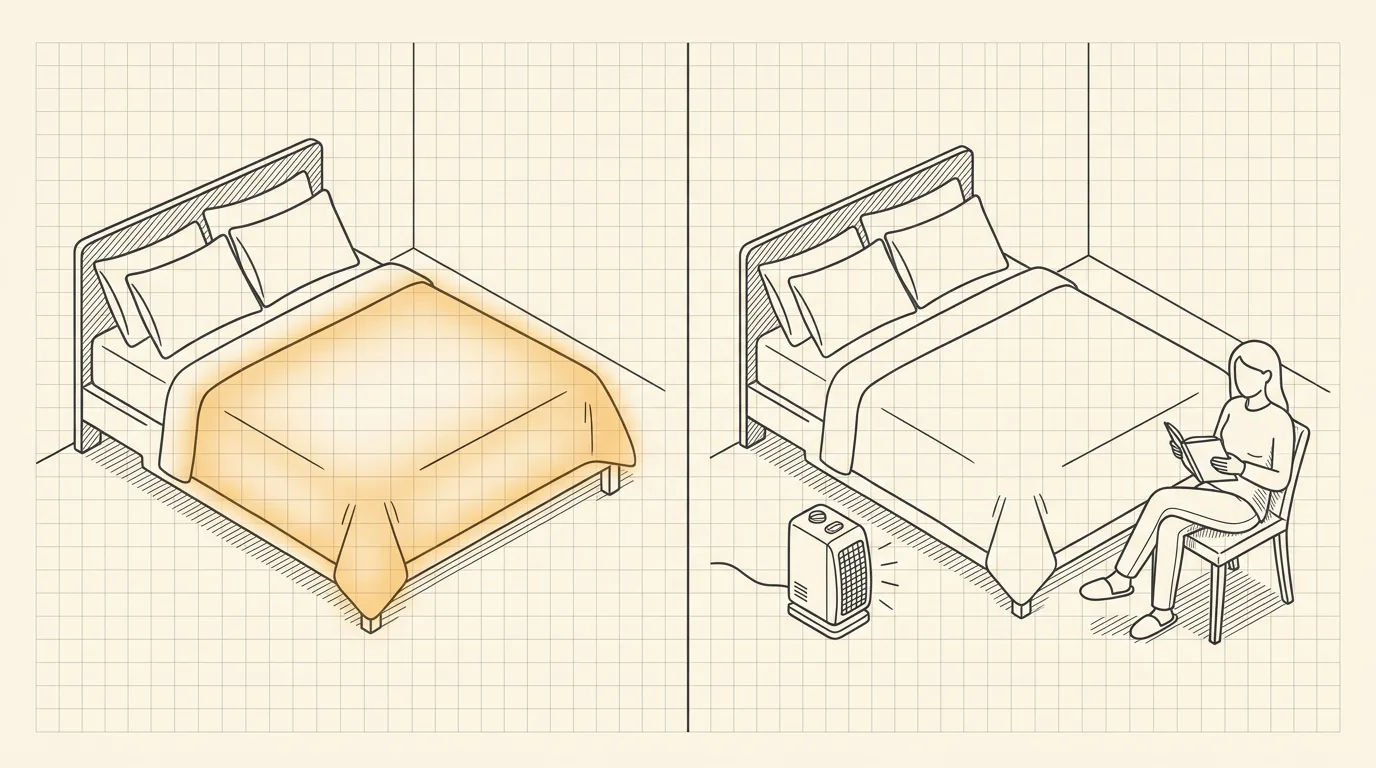
Check price on Amazon Price & availability shown on Amazon.com — we may earn a commission.And before trusting any of the math above on YOUR house: measure. A Kill A Watt P4400 on the heater for one evening tells you the real draw and duty cycle, the same way our complete guide to lowering your electric bill starts with reading the meter, not guessing. For an even cheaper personal-heating answer, check electric blanket vs. space heater cost — heating the person instead of the room is often the genuinely cheapest option in the house.
The Decision Rule, Compressed
- Electric central heat? Zone heat the occupied room, set back the rest. Clear win.
- Gas furnace? Skip the heater; run a setback schedule. The thermostat alone wins.
- Heat pump? Never supplement with resistance heat unless it prevents aux strips — and if it does, the real fix is usually a smarter thermostat recovery.
- Any system: running a heater without touching the thermostat is a $66/month subscription to warm ankles.
The Cheapest Version of This Answer: Heat the Person
Before any room-vs-house arithmetic, the cheapest heat in the building is a layer, not a load. Rough operating costs for the same evening:
| What’s warm | Typical draw | Cost for a 4-hour evening |
|---|---|---|
| Whole house (gas furnace, 95%) | — | ~$1.50-2.50 at $1.92/therm |
| One room, 1,500W heater | 1,500W | ~$1.10 |
| Heated throw or blanket | ~100-200W | ~$0.07-0.15 |
| A sweater and wool socks | 0W | $0.00 |
The full comparison — including why a heated blanket targeted at the person beats a heater targeted at the room by an order of magnitude — is its own article: electric blanket vs. space heater cost. The short version: resistance heat warming 150 pounds of human is always cheaper than resistance heat warming 1,500 cubic feet of air.
Frequently Asked Questions
How much does it cost to run a space heater for a month?
Is a space heater cheaper than gas central heating?
Do space heaters use a lot of electricity compared to other appliances?
What's the cheapest way to heat one room?
Should I close vents in unused rooms to save money?
The sibling calculations: space heater running cost, best energy efficient space heater, and what temperature to set your thermostat in winter.
Sources
- U.S. EIA — Electricity Monthly, Table 5.03 — residential rate basis (July 2026 national average, 18.3¢/kWh).
- U.S. EIA — Natural Gas Weekly — residential natural gas price basis ($1.92/therm, September 2026).
- U.S. DOE Energy Saver — Electric Resistance Heating (archived) — resistance heating is 100% efficient at point of use; fuel-cost comparison framing.
- U.S. DOE Energy Saver — Small Space Heaters (archived) — 1,500W standard draw, placement and safety guidance.
- [Utility Explained Internal Corpus] — 1 kWh = 3,412 BTU; 1 therm = 100,000 BTU; AFUE and COP conversion factors.
- Amazon — Dreo Atom One listing — safety-feature verification (verified Oct 2026).