Quick Answer
Yes — utilities can disconnect your electric, gas, or water service for nonpayment, but not instantly and not without notice. Every state sets its own rules about when a utility can and cannot disconnect service for nonpayment, based on things like weather, age, and disability [1], and many add extra protections in winter, for medical needs, and for older customers. In Minnesota, for example, regulated utilities generally cannot disconnect household heating between October 1 and April 30 for income-qualified customers who keep up a payment agreement [3]. Notice periods, moratorium dates, and medical rules vary by state — check your state’s utility commission (find yours via naruc.org [6]) or your utility’s own disconnection-policy page.
- Call your utility first — ask for a payment arrangement before the disconnection date
- Check your state’s protections — winter, medical, and age rules may pause the shutoff
- Don’t ignore the notice — the date on it is your deadline, and acting early gives you the most options
If your notice arrived yesterday, your first three steps are: call the utility, ask for a payment arrangement, and check your state’s protections below.
The Shutoff Process, Step by Step
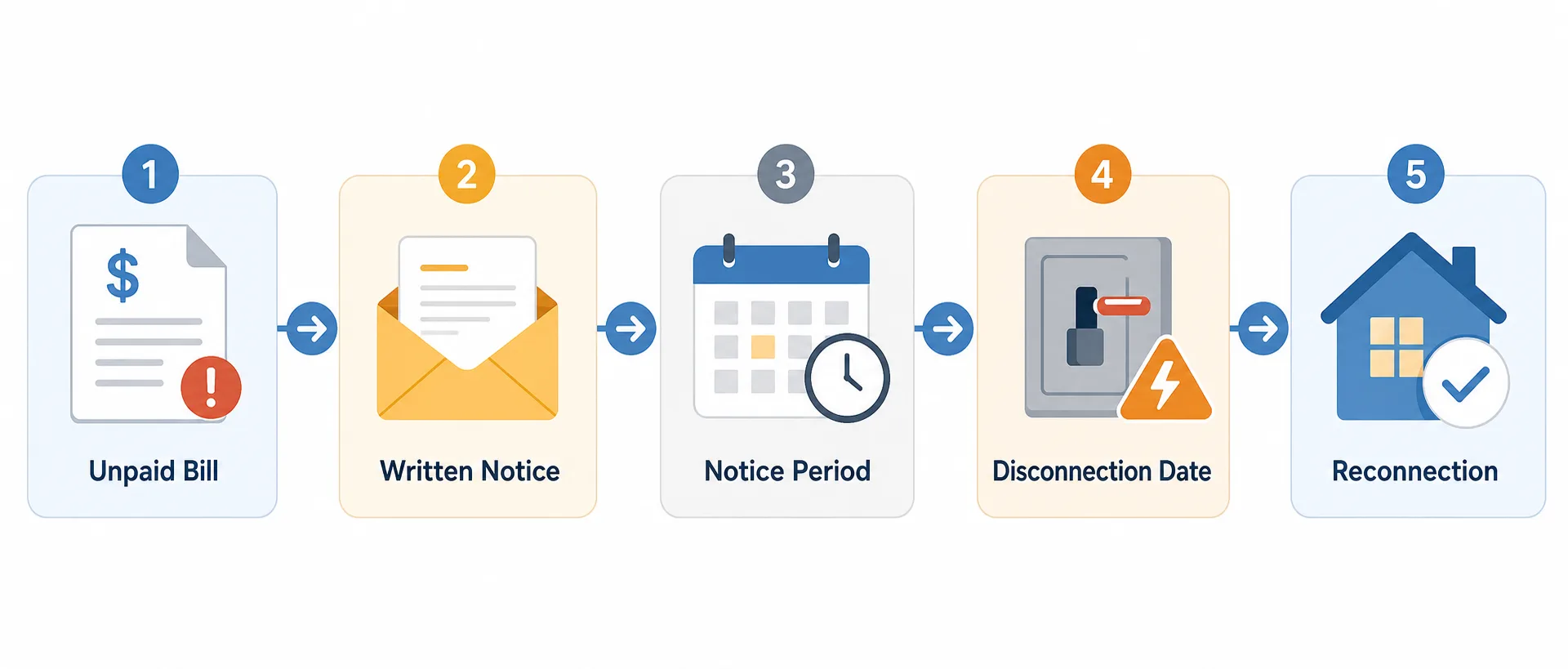
A shutoff rarely happens overnight. In most states the utility must move through a set sequence, and each step gives you a chance to act.
| Step | What happens | What you can do |
|---|---|---|
| 1. Bill goes unpaid | The due date passes and the balance becomes past due | Pay what you can, or call before the next step |
| 2. Written notice | Utility sends a disconnection notice with a date | Read it carefully — the date is your deadline |
| Varied by state — often a set number of days; check your state commission | Call and ask for a payment arrangement | |
| 4. Disconnection date | Service is shut off if nothing is resolved | Check winter/medical/age protections first |
| 5. Reconnection | Service restored after payment, with fees | Ask about same-day service and fee waivers |
Two things matter about this timeline. First, the notice period is where you have the most leverage — once the disconnection date passes, you are dealing with reconnection fees and deposits on top of the balance. Second, the rules are not the same for every service. Electric and natural gas are the most heavily regulated, because they are essential for heating and cooling, and most states have detailed rules about how and when they can be cut. Water is different: it is usually run by a city or local authority rather than a state-regulated company, and the rules vary far more sharply from one city to the next.
If you are behind on a bill, the single most useful thing you can do is read the notice and mark the date. That date is not a suggestion — it is the day the utility plans to act.
Notice Requirements
A valid disconnection notice is not just a bill with a red stamp. In most states it must tell you specific things, and if the notice is missing something your state requires, tell your state utility commission (find yours via naruc.org [6]) — a defective notice is worth challenging before the disconnection date. A proper notice typically includes:
- The amount you owe and the exact due date
- The disconnection date — how long you have before service is cut
- How to pay or set up a payment arrangement
- Your rights — including any winter, medical, or age protections you may qualify for
- How to dispute the bill if you believe it is wrong
The way the notice is delivered matters too. State rules typically require written notice by mail — in Minnesota, the annual summary of shutoff rights must be delivered personally or by first-class mail, with electronic delivery only for customers who request e-billing [4]. The date on the notice is what counts, not the date you happened to open the envelope.
There is one important exception to the clock: if your bill is based on an estimated reading rather than an actual meter read, and you dispute it, some states pause disconnection while a billing dispute is under review — ask your state utility commission (find yours via naruc.org) whether that applies to you. If you believe the amount is wrong because the utility guessed at your usage, say so in writing and ask for the shutoff to be held while they check. That single step can buy you weeks.
Winter Protections (Heating Season Moratoria)
Cold weather changes the rules. Many states restrict electric and gas shutoffs during winter months for households that apply and qualify — a protection often called a heating season moratorium [1]. During a defined winter date range, the utility cannot disconnect a qualifying household. Minnesota’s cold weather rule is a concrete example: from October 1 through April 30, a regulated utility may not disconnect household heating for a customer at or below 50 percent of the state median income who keeps a payment agreement — and that agreement can require no more than 10 percent of household income toward current and past heating bills [3] [4].
A few things to understand about how these work:
- You usually have to apply or qualify. The protection is not automatic for everyone — it often depends on income, enrollment in an assistance program, or a documented inability to pay.
- It is a pause, not a forgiveness. The balance does not disappear; the utility simply cannot cut you off during the protected period. You will still owe the money.
- It typically covers electric and gas, not water. Heating fuel is the focus, so water shutoffs are usually not covered by winter moratoria.
Some states also have summer heat protections, especially for elderly customers and people with medical conditions, that restrict shutoffs during extreme heat. The logic is the same as winter: cutting power in a heat wave can be dangerous.
If you live in a cold climate and are behind on your heating bill, call your utility and ask directly: “Does my state have a winter shutoff moratorium, and do I qualify?” That question costs nothing and can stop the process cold.
Medical and Age Protections
Health and age can also pause a shutoff. Most states have some form of medical protection. The most common is a medical certification: a doctor or other qualified provider documents that disconnection would seriously threaten someone in the household. How long that protection lasts is set by each state — there is no single number. In Minnesota, a utility must reconnect or continue service where medical equipment requiring electricity necessary to sustain life is in use, once it receives certification — which can start by phone with written certification within five business days, from a licensed doctor, physician assistant, advanced practice registered nurse, or (to verify a diagnosis) a registered nurse; the certification runs at most six months, extendable to twelve [5].
There are also specific rules for life-support equipment. If someone in your home relies on electrically powered medical equipment — a ventilator, an oxygen concentrator, a dialysis machine — many states require the utility to keep a record of that need and to provide advance notice before any disconnection, and in many cases to delay it. You usually have to register the equipment with the utility and provide documentation.
Elderly customers get additional consideration in some states, and disconnect policies can turn on age and disability [1]. Some require utilities to make extra attempts to contact an older customer before disconnecting, or to offer a longer payment arrangement. The protections are not uniform, so the honest answer is: it depends on your state.
The practical takeaway: if anyone in your home is elderly, has a medical condition, or uses life-support equipment, tell the utility before the disconnection date. Ask what documentation they need and whether it pauses the shutoff. Do not wait until after the service is cut.
How to Stop a Shutoff Today
If the notice is in your hand, you still have options. The most effective single move is to call the utility before the disconnection date and ask for a payment arrangement.
What to ask for:
- A payment plan — spreading the past-due balance over several months on top of your regular bill
- A deferred payment — pushing the due date back by a week or two if you are close to having the money
- A deposit in exchange for keeping service — some utilities will keep service on if you pay a deposit, especially if you have a history of late payments
- A waiver of late fees — many utilities will remove fees if you commit to a plan
Getting it in writing. A verbal promise is not enough. Ask the utility to send a confirmation — an email, a letter, or a note in your online account — that states the arrangement, the new due dates, and that disconnection is on hold. If they will not put it in writing, ask for a reference number for the call and note the date, time, and the name of the person you spoke with. That record is your protection if the utility later says the arrangement never happened.
If you cannot pay at all. Payment arrangements only help if you can make some payment. If you genuinely cannot, the next step is assistance. LIHEAP — the federal Low Income Home Energy Assistance Program — can help pay heating or cooling bills and provides emergency services during an energy crisis. Eligibility is based on income, and every state and territory sets its own requirements through its LIHEAP office [1] [2]. Start with your state’s LIHEAP office, and ask about the local providers and community organizations it works with — they can often connect you with food, rent, and utility help too.
A script for the call. When you call, keep it calm and specific:
“I received a disconnection notice dated [date] for my [electric/gas/water] account. I cannot pay the full balance today, but I want to keep my service on. Can you set up a payment arrangement? I would like to pay [amount] on [date] and the rest over the next [number] months. Can you confirm that in writing and put the disconnection on hold while we set this up?”
If the first person cannot help, ask to speak to a supervisor or the customer assistance department. Persistence is not rudeness — it is how you get to the person who can actually approve a plan.
After Disconnection: Reconnection
If the service is already off, the goal shifts to getting it back on as quickly and cheaply as possible. Reconnection usually requires paying the past-due balance (or a portion of it), plus a reconnection fee. The fee is typically a flat amount set by the utility — the amount varies by utility and state, so check your utility’s own disconnection and reconnection policy for the current figure.
A few things to know about reconnection:
- Same-day vs. next-day. Some utilities restore service the same day if you pay early in the day; others schedule it for the next business day. Ask what the cutoff time is for same-day service.
- Deposits may be required. If you have a history of late payments or disconnections, the utility may require a deposit before restoring service. This is separate from the balance and the reconnection fee.
- You can negotiate the deposit. If the deposit is more than you can pay, ask to pay it in installments or to have it reduced. Some utilities will lower a deposit if you agree to automatic payments or provide a letter of good credit from a previous utility.
- Ask for fee waivers. If you are on a low income or receiving assistance, some utilities will waive or reduce the reconnection fee. It never hurts to ask.
Reconnection is more expensive and more stressful than preventing the shutoff in the first place. If you are already disconnected, the fastest path is usually: call, pay what you can, ask for a plan for the rest, and ask for same-day service.
Water Shutoffs: The Harsher Rules
Water deserves its own section because the rules are often less forgiving. Electric and gas are regulated by state public utility commissions with detailed consumer protections [6]. Water is frequently run by a city or a local water authority, and those local rules can be much harsher — some cities can shut off water faster, with shorter notice, and with fewer of the protections that apply to electric and gas.
There is one reliable bright spot. Many states and cities restrict shutoffs where disconnection would create a public health risk — for example, if cutting water would leave a household without any way to flush a toilet or maintain basic hygiene.
If your water is at risk of shutoff, the advice is the same as for electric and gas, but the urgency is higher: call early, ask for a payment arrangement, and ask specifically whether your city has any protections for households with children, elderly members, or medical needs. Because the rules are local, the only way to know your actual protections is to ask your water provider directly.
Slammed with a Huge Bill You Don’t Owe?
Sometimes the past-due notice is not about a bill you actually owe. If the amount looks wrong — far higher than your normal usage, or based on an estimate that does not match your meter — do not just pay it. A disputed bill can often pause the shutoff while it is investigated.
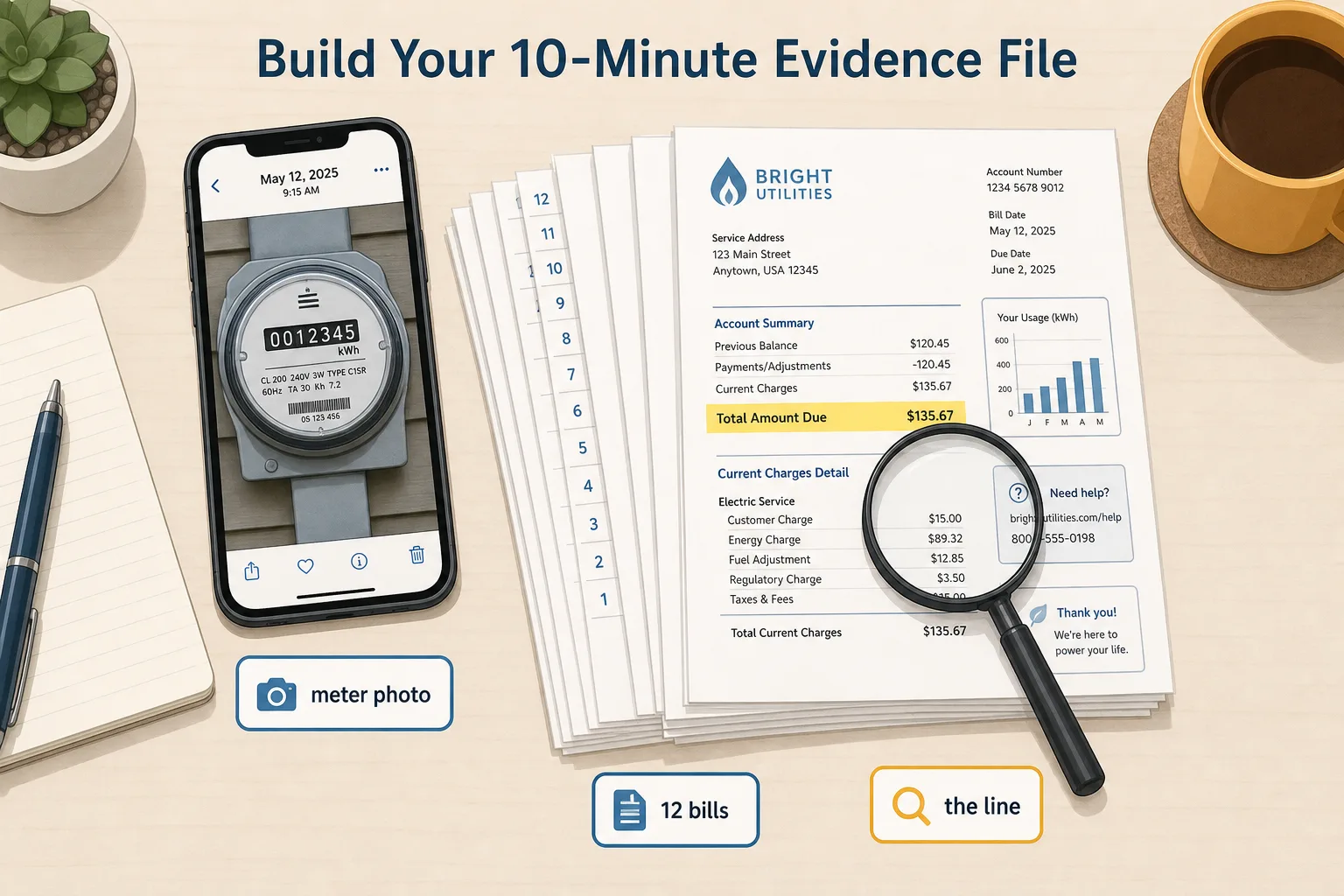
Start by checking your meter yourself. If your bill is based on an estimated reading, compare the number on the bill to the actual reading on your meter. Take a photo with the date visible. If they do not match, submit your own reading and ask for a bill review. Many utilities will adjust the bill if you can show the estimate was wrong. For the full step-by-step dispute process, see our how to dispute a utility bill guide.
If the utility will not correct it, file a complaint with your state’s public utility commission. These agencies regulate utilities and have the authority to order bill corrections and to hold a disconnection while a dispute is pending. Complaints are usually free to file online; the utility’s response deadline is set by each state, so ask when you file.
A disputed bill is not the same as an unpaid bill. If you are disputing in good faith and have documentation, say so clearly and in writing — and ask for the shutoff to be held until the dispute is resolved.
FAQ
Can the utility shut off my service in winter?
Can they shut off my service if I have kids in the home?
Can they shut off my service if I have medical equipment?
How fast is reconnection after I pay?
Does a payment plan stop the shutoff?
Sources
- USAGov — Get Help with Energy Bills (LIHEAP, WAP, disconnection policies)
- USAGov — Help with Utility Bills
- Minnesota Statutes 216B.097 — Cold Weather Rule (municipal utilities and cooperatives)
- Minnesota Statutes 216B.096 — Cold Weather Rule (utilities)
- Minnesota Statutes 216B.098 — Residential Customer Protections (medical equipment)
- NARUC — National Association of Regulatory Utility Commissioners
Image Prompts
Placement: after H2-1 (The Shutoff Process, Step by Step). Concept: a horizontal timeline strip showing the five-step shutoff process — an unpaid bill, a written notice, a notice period, a disconnection date, and a reconnection. Style: clean flat vector illustration, warm neutral palette (soft blue, amber, gray), each step as a labeled card with a simple icon connected by an arrow. Composition: wide banner, left-to-right flow, generous white space, no text-heavy clutter — the labels should be short and legible at thumbnail size.
Placement: after H2-3 or H2-4 (Winter Protections / Medical and Age Protections). Concept: a shield icon set representing the four key protections — a snowflake for winter moratoria, a medical cross for medical certification, a heart or person icon for elderly protections, and a document for the written notice. Style: flat vector iconography, consistent line weight, muted blue and teal with warm amber accents, each icon inside a soft shield outline. Composition: a 2x2 grid of four shields, balanced and symmetrical, with a calm, reassuring tone.
Placement: after H2-5 (How to Stop a Shutoff Today). Concept: a three-step “call card” showing the immediate actions — call the utility, ask for a payment arrangement, and get it in writing. Style: flat vector illustration of a phone and a hand holding a written confirmation, warm and approachable, soft green and blue palette to signal action and hope. Composition: three numbered steps arranged vertically or in a row, each with a simple icon and a short caption, clean and uncluttered for easy scanning.