Quick Answer
The WAYNE ESP25n is the battery backup to buy on Amazon right now: a 12-volt backup pump plus battery box and alarm for ~$350, 4.4 stars from 337 ratings, sold and shipped by Amazon — and Wayne’s own performance table says it removes up to 10,000 gallons on a single battery charge. The honest runner-up situation: the popular Basement Watchdog Big Dog CONNECT currently ships third-party without a Prime offer, so we don’t recommend it here (details below), and a Basement Watchdog Special variant is worth a stock check if you prefer that brand. The real decision isn’t brand, though — it’s whether battery runtime covers your outage risk, and that’s arithmetic you can do in one line: battery amp-hours × 12 V ÷ pump draw in watts ≈ hours. Pair the pump with placement rules from where to place water leak sensors and monitoring from our water monitor comparison: the WAYNE ESP25n on Amazon.
First, What a Battery Backup Sump System Actually Is
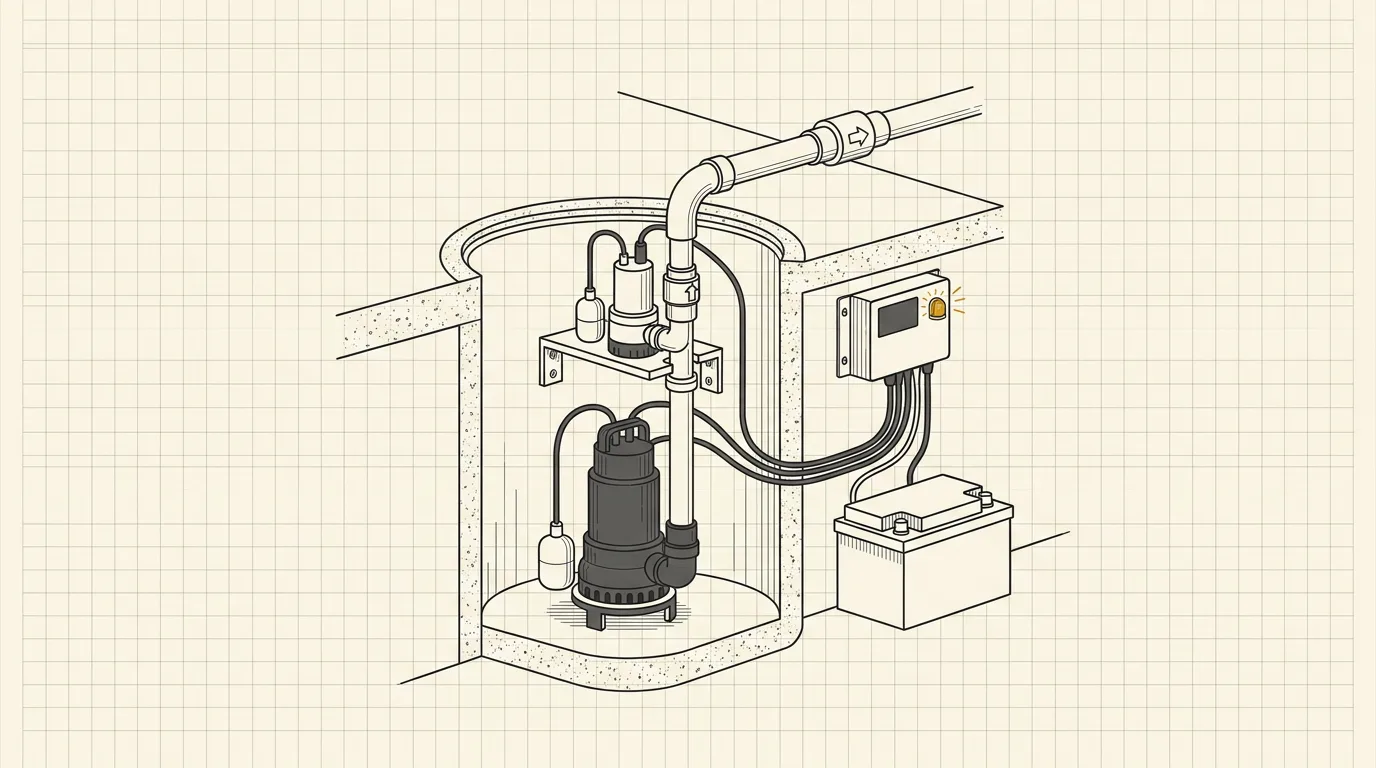
Your primary sump pump is a 120-volt appliance. Every storm that knocks out power also knocks out the pump — precisely when groundwater is rising fastest. A battery backup system is a second, smaller pump (usually 12-volt DC) mounted in the same pit a few inches above the primary, wired to a deep-cycle battery through a charger/controller. In normal operation the charger floats the battery and does nothing else. When the power fails or the primary fails, the controller senses the higher water level, starts the backup pump, and an alarm tells you something is wrong.
The parts, so the anatomy is clear when you’re looking at your pit:
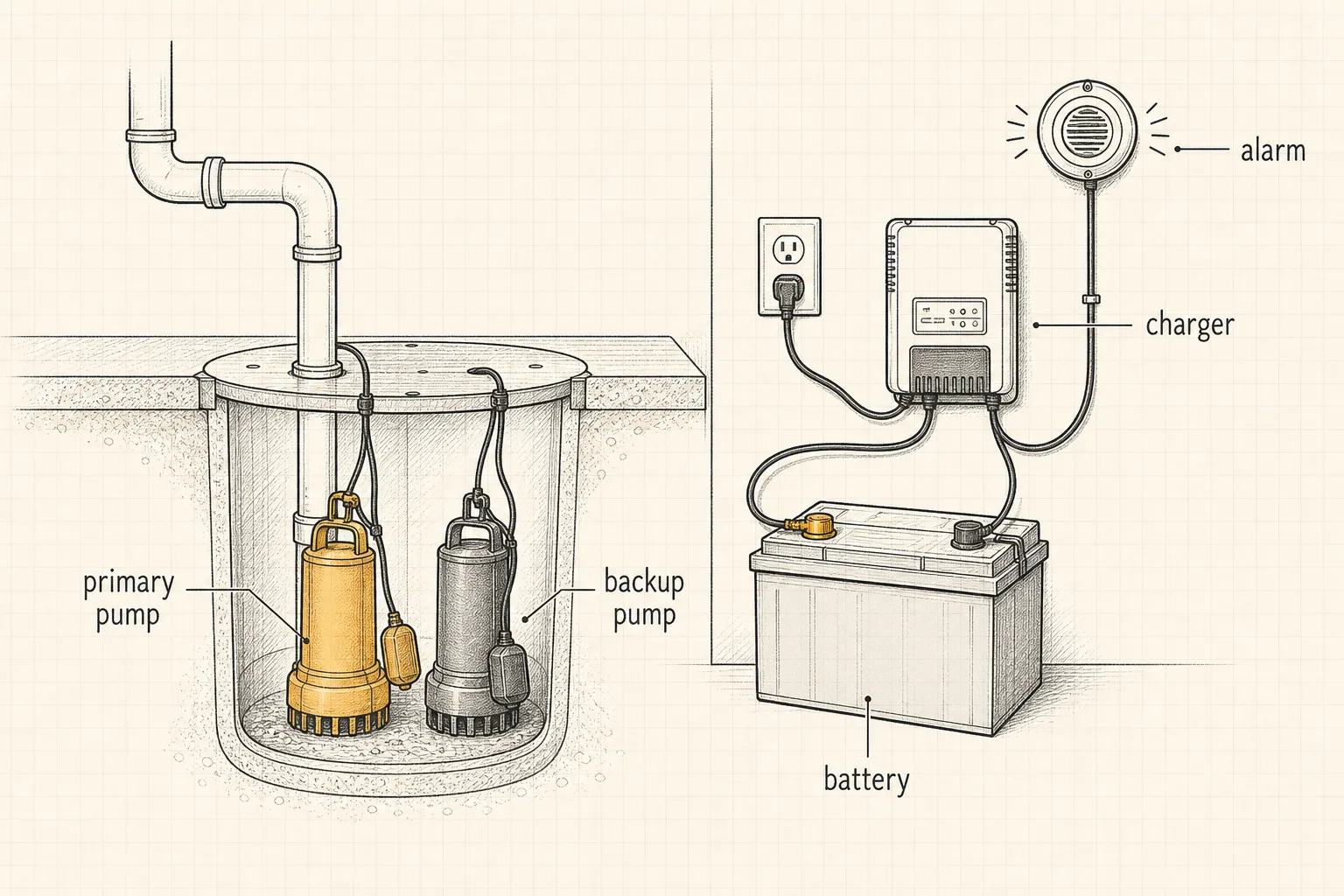
- Primary pump — the 120V workhorse that handles 99% of pumping.
- Backup pump — the 12V unit that only runs during outages or primary failure.
- Battery — a deep-cycle marine/RV-style battery (usually sold separately) that stores the runtime.
- Charger/controller — keeps the battery topped up and switches the backup on.
- Alarm — the small, loud thing that tells you the backup is running, the battery is low, or the charger has failed.
The Flood Math That Justifies the $350
Here is the number that reframes the purchase. The Insurance Information Institute’s compilation of ISO data puts the average paid water damage and freezing claim at $13,954 (2018–2022 average severity), with about 1.6 in 100 insured homes filing such a claim in a given year.[2] Set a typical insurance deductible of $1,000–$2,500 against that: even the deductible alone is 3–7× the cost of the ESP25n system — and that’s before the items insurance never covers well (finished-basement carpet, framing, the weekend of your life). A finished basement makes the stakes higher, not the math different.
The honest framing: you’re not buying a pump, you’re buying a $350 insurance rider that pays out in the exact hour you need it. And unlike your insurer, it works even when the outage is caused by the same storm that’s filling your pit.
The Runtime Math — the Honest Core of This Decision
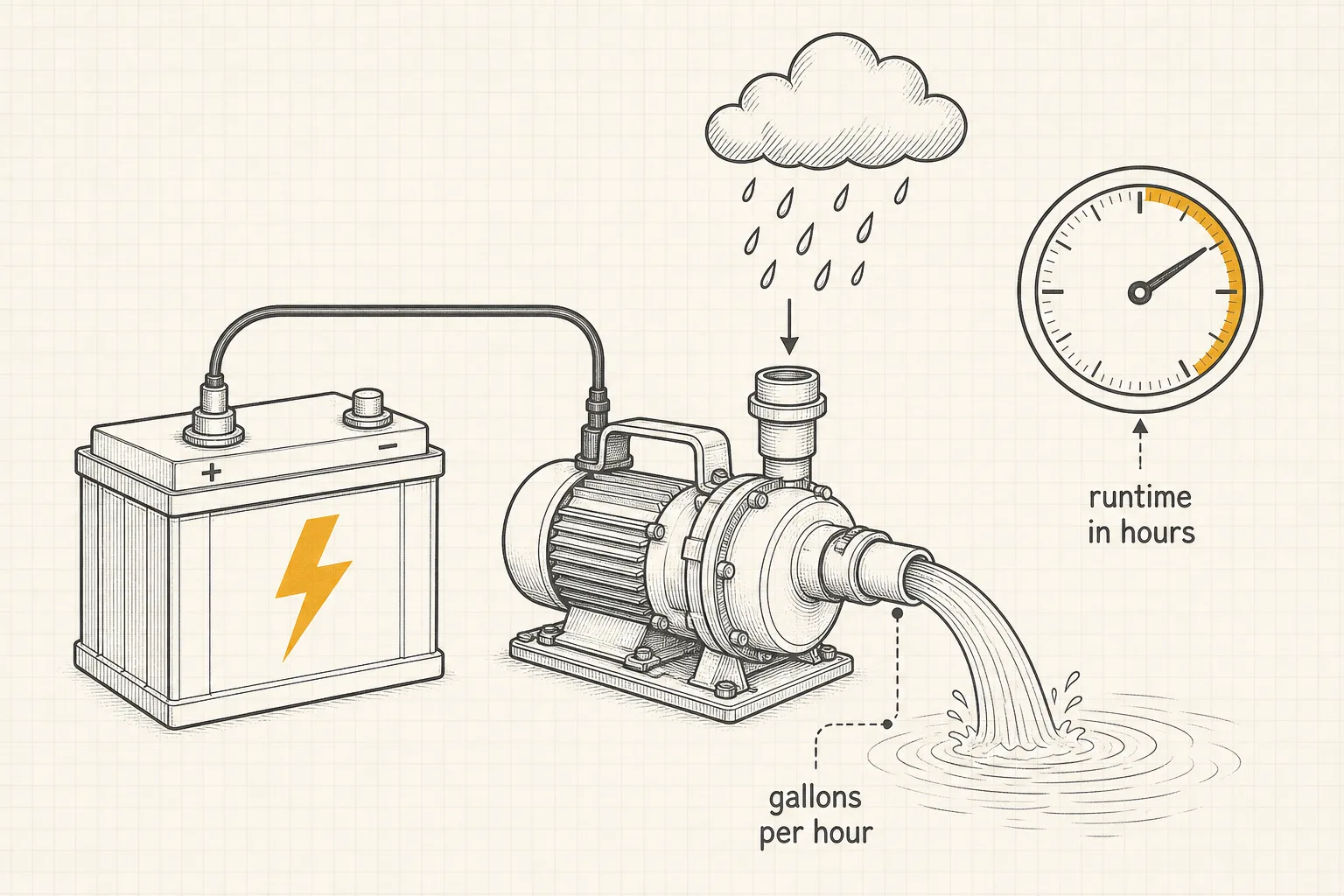
Battery backup marketing sells “hours of protection.” What you actually need is gallons, and the conversion is one line of arithmetic:
Fully submersible 12V backup pump with epoxy-coated steel housing, 1-1/2 in. NPT discharge, battery case with LED display and audible alarm. Up to 10,000 gallons per charge per Wayne's specs; battery sold separately. 4.4 stars, 337 ratings at the time of writing, sold by Amazon.
Check price on Amazon As an Amazon Associate we earn from qualifying purchases. Price & availability shown on Amazon.com.Runtime (hours) ≈ battery amp-hours (Ah) × 12 V ÷ pump draw (W)
And gallons moved: runtime × pump GPH at your discharge head ≈ gallons handled.
Worked example with the ESP25n and a common 75 Ah deep-cycle battery, assuming the pump draws roughly 12 A at 12 V (~144 W) at moderate head:
- Runtime: 75 Ah × 12 V = 900 Wh ÷ 144 W ≈ 6.25 hours of continuous running.
- Gallons: Wayne’s performance table shows 2,700 GPH at 0 ft of head, 2,100 GPH at 5 ft, 1,500 GPH at 10 ft, 660 GPH at 15 ft.[1] At a typical 8–10 ft of discharge head, call it ~1,500 GPH: 6.25 h × 1,500 GPH ≈ 9,375 gallons — consistent with Wayne’s “up to 10,000 gallons on a single charge” claim, which assumes ideal conditions.[1]
- Reality check: pumps don’t run continuously; they cycle. If your pit cycles the backup pump 25% of the time during a storm, that 6.25 hours of runtime stretches to ~25 hours of wall-clock protection. If groundwater is pouring in and it runs near-continuously, you get the 6 hours. The same battery is either a weekend of protection or an afternoon — duty cycle decides.
- Smaller battery, same math: a 40 Ah battery gives 40 × 12 = 480 Wh ÷ 144 W ≈ 3.3 hours ≈ 5,000 gallons at 1,500 GPH. Enough for a short outage; not enough for a multi-day one.
The Pick: WAYNE ESP25n
Best when: you want a complete, Prime-shippable backup system — pump, battery case, controller, alarm — and you’ll supply the deep-cycle battery.
The ESP25n is a fully submersible 12V backup pump with an epoxy-coated steel housing and cast-iron bottom, a corrosion-resistant thermoplastic impeller, a 1-1/2 in. NPT discharge, and a protective battery case with LED display and audible alarm. Wayne specifies it for 16-inch-diameter or larger sump basins, and the performance table runs from 2,700 GPH at 0 ft of head down to 660 GPH at 15 ft.[1] At the time of writing it shows 4.4 stars from 337 ratings, sold and shipped by Amazon at ~$350. Note what’s not in the box: the battery itself — budget another ~$100–200 for a deep-cycle 12V battery, which is standard across this product category, not a Wayne quirk.
Fully submersible 12V backup pump with epoxy-coated steel housing, 1-1/2 in. NPT discharge, battery case with LED display and audible alarm. Up to 10,000 gallons per charge per Wayne's specs; battery sold separately. 4.4 stars, 337 ratings at the time of writing, sold by Amazon.
Check price on Amazon Price & availability shown on Amazon.com — we may earn a commission.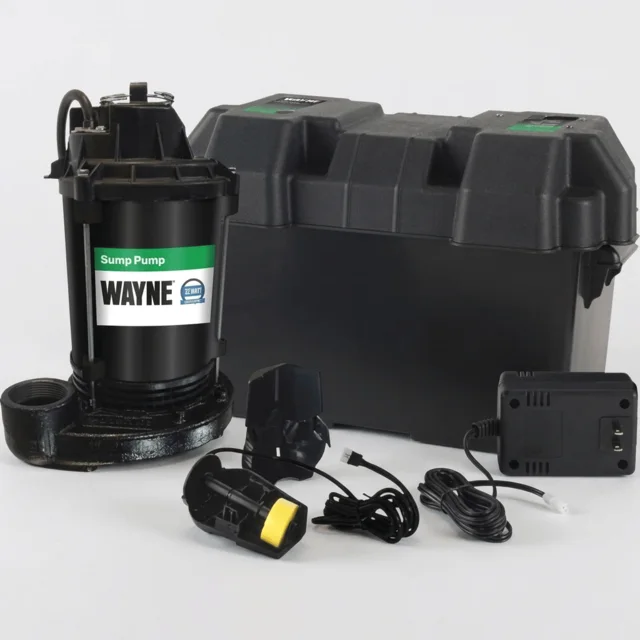
The honest alternative note: Basement Watchdog
No link, no box — here’s why. The Basement Watchdog Big Dog CONNECT is arguably the category’s most-mentioned name in homeowner threads, but at the time of writing its Amazon listing is shipping through third-party sellers without a Prime offer, which fails our buying bar for a $300+ emergency device: slower fulfillment, murkier warranty handling, and no easy return path. We won’t recommend a flood-protection device you can’t reliably get in two days. If you prefer the Basement Watchdog ecosystem (their controllers add dual-float switches and monitoring), the Basement Watchdog Special + battery variant is worth a stock check — if it shows a Prime offer when you’re buying, it’s a legitimate choice; if not, the ESP25n is the one that’s actually in stock and Prime-eligible.
Head-to-Head: Battery vs. the Alternatives
| Battery backup (ESP25n type) | Water-powered backup | Generator + primary pump | |
|---|---|---|---|
| Upfront cost | ~$350 + ~$100–200 battery | ~$150–300 + plumber install | Generator cost varies hugely |
| Runtime limit | Battery Ah (hours, finite) | Unlimited while city water flows | Fuel tank + fuel on hand |
| Needs | Charging, quarterly tests | City water connection (adds to water bill) | Transfer switch, fuel storage |
| Works during power outage | Yes | Yes | Yes (if started) |
| Best for | Most homes; finished basements | Homes on city water with long outages | Homes that already own a generator |
The Math: Total Cost of Ownership Over 5 Years
Assumptions: ESP25n at ~$350, one deep-cycle 75 Ah battery at ~$150 replaced every 4 years (midpoint of the 3–5 year rule), no major repairs.
- Year 0: $350 (system) + $150 (battery) = $500.
- Year 4: battery replacement ≈ $150.
- 5-year total: $500 + $150 = $650, or $650 ÷ 5 = $130/year.
- Against the risk: one avoided water-damage claim averages ~$13,954 in insurer payouts,[2] and your deductible portion is typically $1,000–2,500 of that. The 5-year system cost is roughly 4–8% of a single average claim — or, put another way, $130/year is about 0.9% of one average claim per year ($130 ÷ $13,954 ≈ 0.93%).
Installation Reality
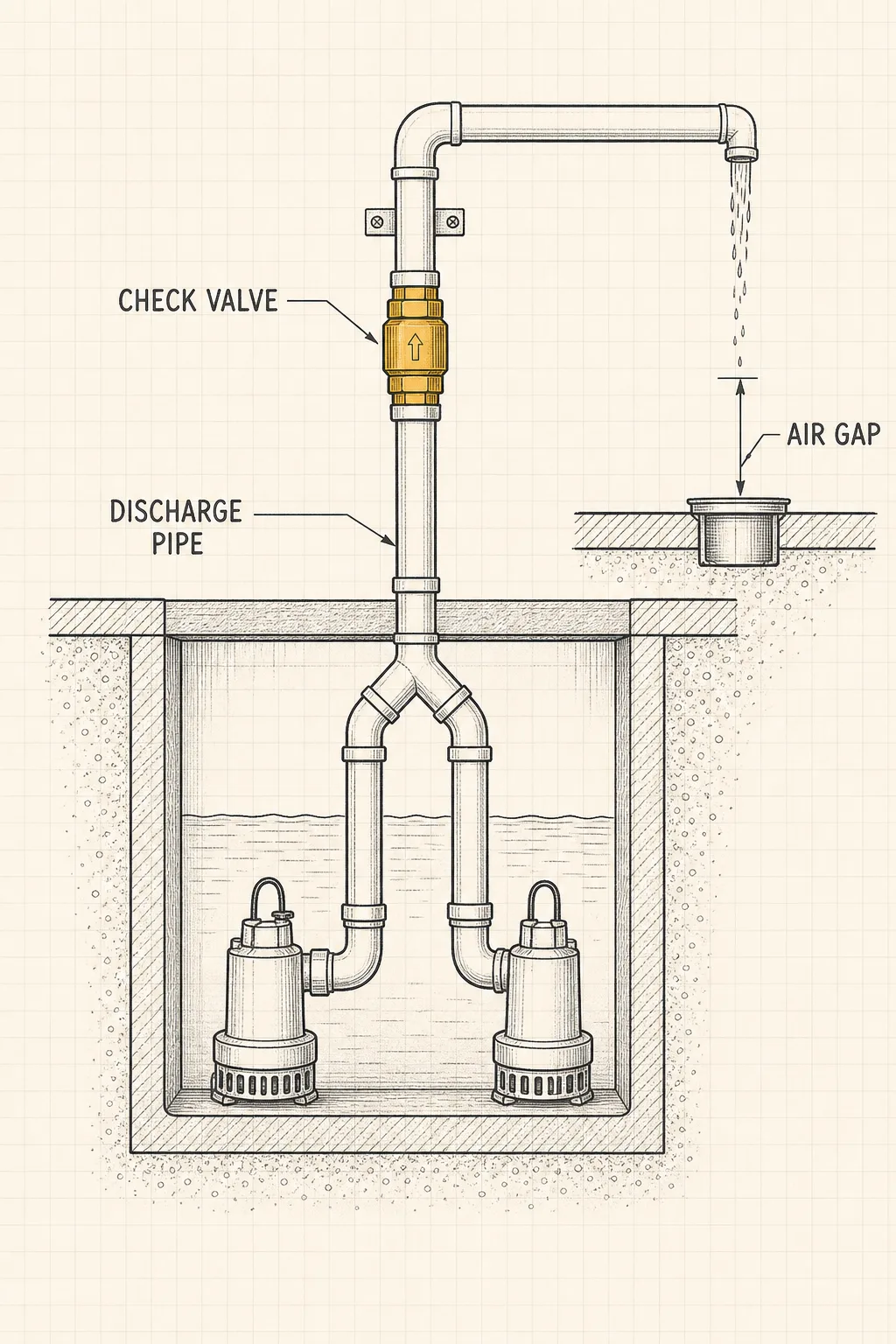
The ESP25n ties into your existing discharge line above the primary pump’s check valve, with its own check valve on the backup’s riser so water doesn’t recirculate through the idle pump. The mechanical work is an afternoon for a comfortable DIYer: PVC cutting and cementing, hose clamps, mounting the backup pump above the primary on the same pipe. The electrical side is genuinely simple — charger plugs into a wall outlet, battery terminals connect with the provided leads. Two non-negotiables: a check valve on the backup pump’s discharge (so it isn’t pumping the same water in circles), and an air gap or proper discharge termination so the line can’t siphon or backflow. If your pit is smaller than 16 inches in diameter, Wayne says this unit isn’t for it — measure before ordering.[1]
Maintenance Reality (the Part Everyone Skips)
- Water the battery if it’s flooded lead-acid. Most backup systems run flooded deep-cycle batteries, and they need distilled water periodically — check the plates monthly in the first year, quarterly after. A dry battery dies silently, which defeats the entire device.
- Test quarterly. Pour a 5-gallon bucket of water into the pit and unplug the primary — confirm the backup starts, pumps, and the alarm sounds. Twice a year isn’t enough for a device that sits idle for months.
- Replace the battery every 3–5 years. Lead-acid batteries degrade sitting on a charger; a 6-year-old battery is a decoration, not a backup. Put the replacement date on a label on the battery box.
- Keep the charger plugged into a working outlet — and not the one on the circuit that trips every storm.
Which Should You Actually Buy?
- Finished basement, city power, any history of outages → the ESP25n + a fresh deep-cycle battery. ~$500 all-in, ~$130/year over 5 years.
- Long multi-day outages and you’re on city water → a water-powered backup beats battery runtime (unlimited runtime while water pressure exists), at the cost of using metered water while it runs.
- You already own a portable generator → a generator may cover the primary pump, but it requires you to be home, awake, and willing to run cords in a storm — a battery backup covers the 3 a.m. case the generator doesn’t.
- You don’t know if your primary pump even works → test that first; a backup can’t save you from a dead primary that’s been dead since spring. And for early warning of any water where it shouldn’t be, see where to place water leak sensors, when to upgrade from point sensors to whole-home monitoring, and our Flume vs. Moen Flo vs. Phyn comparison.
And the standing rule for this entire category: runtime is bought, not assumed. The formula — battery Ah × 12 V ÷ pump watts — plus your pit’s actual cycle rate tells you what any backup will really do in your basement, and a battery you haven’t tested this quarter is a rumor, not a backup.
Sources
- WAYNE Pumps — ESP25n product page — 12V battery backup system specs: 2,700/2,100/1,500/660 GPH at 0/5/10/15 ft of head, up to 10,000 gallons per charge, 1-1/2 in. NPT discharge, 16 in. minimum basin, battery case with LED display and alarm. Retrieved 2026-09-11.
- Insurance Information Institute (Triple-I) — Facts + Statistics: Homeowners and Renters Insurance — ISO data: water damage and freezing claim severity averaged $13,954 (2018–2022), frequency 1.61 claims per 100 house-years. Retrieved 2026-09-11.
- Amazon — WAYNE ESP25n (B07GJXRZ1V) — ~$350, 4.4 stars / 337 ratings, sold and shipped by Amazon at retrieval. Retrieved 2026-09-11.