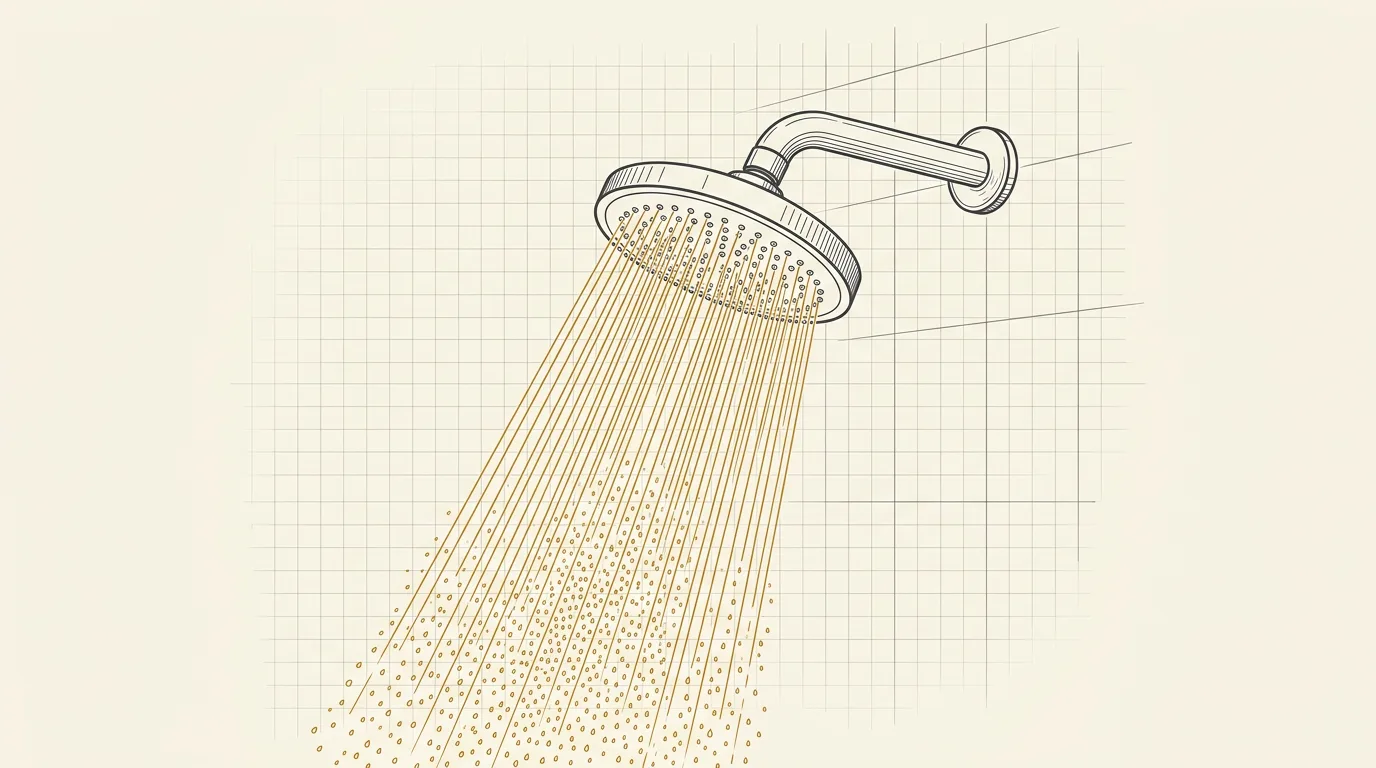
Quick Answer
The Niagara Earth Spa 1.5 GPM showerhead is the best low-flow pick that still feels high-pressure, because pressure-compensating nozzles keep the spray strong at a flow the old low-flow heads never managed. It sells for about $21, carries roughly 4.0 stars from 79 reviews at the time of writing, is Amazon’s Choice, and includes a Soap-and-Soak pause valve — a button that drops the flow to a trickle while you lather, then returns to your exact temperature. The honest runner-up is the brushed nickel finish version (about $22, ~4.5 stars from 450 reviews) for anyone who wants the same head in a finish that hides water spots. The reason this category deserves a second look: the big review sites publicly stepped back from low-flow heads — Wirecutter’s own showerhead guide says it “stopped prioritizing specifically low-flow or water-saving showerheads” because most deliver about 1.5 GPM anyway — which leaves the genuinely efficient 1.5 GPM heads under-covered and under-bought.[3] If your bill is creeping up, start with how to lower your water bill and why your water bill is higher in summer. The direct buy is the Niagara Earth Spa 1.5 GPM showerhead on Amazon.
First, What “Low-Flow” Actually Means Now
The federal maximum for a showerhead is 2.5 gallons per minute — that is the legal ceiling, and it is also what most older heads run at.[1] A “low-flow” head is anything meaningfully under that, and the WaterSense label draws the line at 2.0 GPM or less.[1] The 1.5 GPM heads we are recommending here sit a full gallon per minute under the federal ceiling — a 40% cut from a 2.5 GPM head.
The reason “low-flow” has a bad reputation is history, and it is fair history. The first generation of water-saving heads, from the 1990s, simply choked the flow and handed you a dribble. EPA itself acknowledges that early low-flow models had poor user perceptions, and that the agency spent years developing performance criteria — spray force, spray coverage, pressure compensation — specifically so a labeled head would not feel like a punishment.[1] That is the whole story of this category in one sentence: the technology that makes 1.5 GPM feel good is pressure compensation, and it is the difference between a modern efficient head and a 1990s dribble.
Why Pressure Compensation Is the Whole Trick
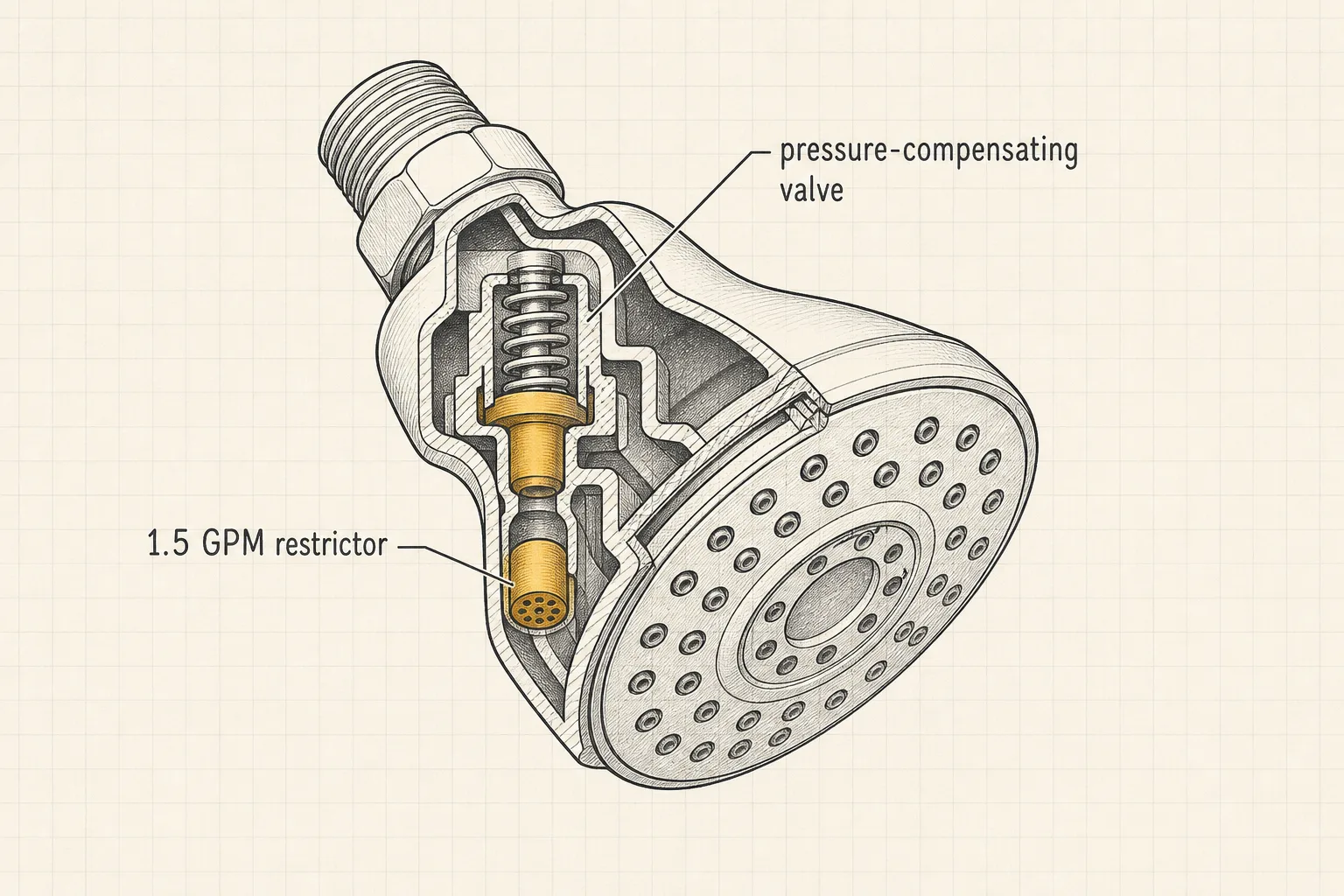
A showerhead is a nozzle: it converts the water pressure in your pipes into a spray. A cheap head at low flow simply narrows the opening, which weakens the spray and makes the stream feel thin. A pressure-compensating head does something smarter — it uses a flexible internal disc or diaphragm that automatically adjusts the opening as your home’s water pressure changes, so the spray keeps its force and coverage across a wide range of pressures.[1] High pressure in the pipes does not blow past the flow limit; low pressure does not collapse into a trickle.
That is why the WaterSense performance spec explicitly tests pressure compensation — “ensures the showerhead will provide for a minimum flow across a range of household water pressures” — alongside spray force and spray coverage.[1] When a 1.5 GPM head feels strong, it is because the manufacturer engineered the spray pattern and the compensation together, not because it is secretly flowing more than the label says. The label is the guarantee: WaterSense-labeled heads are independently certified to meet both the flow cap and the performance bar.[1]
The Niagara Earth Spa 1.5 GPM — the Pick
Best when: you want the full 1.5 GPM efficiency with a pause valve, in a head that does not feel like a compromise.
The Niagara Earth Spa is a fixed 1.5 GPM head with a Soap-and-Soak pause valve — a button on the head that drops the flow to a trickle while you shampoo or shave, then returns to the same temperature when you press it again. That pause valve is a second, hidden layer of savings: the head already flows 40% less than a 2.5 GPM head, and the pause button removes the water you used to waste while lathering. At the time of writing it is about $21, roughly 4.0 stars from 79 reviews, Prime-eligible, and carries Amazon’s Choice — a modest review count, which we are flagging honestly: this is a smaller-data pick than the runner-up, and the runner-up’s larger review base is part of why we list it.
Fixed 1.5 GPM showerhead with pressure-compensating nozzles and a Soap-and-Soak pause button that drops flow to a trickle while you lather, then returns to your temperature. About $21, Amazon's Choice at the time of writing.
Check price on Amazon As an Amazon Associate we earn from qualifying purchases. Price & availability shown on Amazon.com.Fixed 1.5 GPM showerhead with pressure-compensating nozzles and a Soap-and-Soak pause button that drops flow to a trickle while you lather, then returns to your temperature. About $21, Amazon's Choice at the time of writing.
Check price on Amazon Price & availability shown on Amazon.com — we may earn a commission.
The Brushed Nickel Version — the Runner-Up
Best when: you want the same efficiency in a finish that hides water spots and fingerprints.
The brushed nickel finish of the same head sells for about $22 and carries a stronger signal at the time of writing: roughly 4.5 stars from 450 reviews, Prime-eligible. Same 1.5 GPM flow, same pressure-compensating internals, same pause valve — the difference is cosmetic, and for a bathroom with hard water, brushed nickel is the finish that does not show every dried droplet the way chrome does. If the review count matters to you (it should), this is the version with the larger data set; if the exact finish of your trim matters more, match the head to your existing fixtures.
Same 1.5 GPM pressure-compensating head and pause valve in a brushed nickel finish, about $22 with a larger review base (~4.5 stars from 450 reviews at the time of writing).
Check price on Amazon Price & availability shown on Amazon.com — we may earn a commission.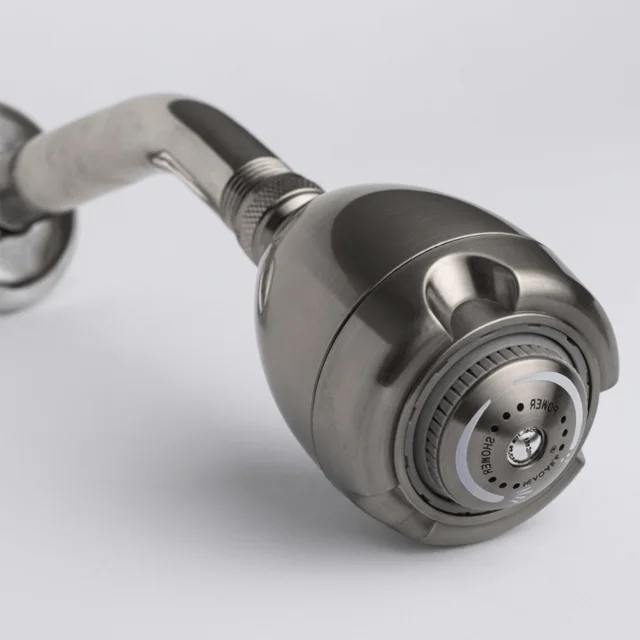
The Bucket-and-Stopwatch Test: Verify Your Own Head
Before you buy anything, spend five minutes finding out what your current showerhead actually flows. This is the test, and it requires exactly a 5-gallon bucket, a stopwatch (your phone has one), and a shower you can run into the bucket:
- Set the shower to your normal temperature and full open.
- Put the bucket under the spray and start the stopwatch.
- Time how long it takes to fill the bucket to the 1-gallon mark (or any marked level — a gallon is easiest to divide).
- Divide 60 by the seconds. If it takes 24 seconds to fill one gallon, that is 60 ÷ 24 = 2.5 GPM — a full federal-max head. If it takes 40 seconds, that is 60 ÷ 40 = 1.5 GPM — you already have a low-flow head and a swap will not save you much.
The math is the same arithmetic you will see in the savings section below, just run backward. This test matters because the single most common mistake in this category is replacing a head that was already efficient — and the second most common is assuming a “low-flow” label on an old head means it actually flows low. Measure first, then buy. If your head measures 2.5 GPM, the swap below is worth real money; if it measures 1.5 already, spend the $21 on something else.
Same 1.5 GPM pressure-compensating head and pause valve in a brushed nickel finish, about $22 with a larger review base (~4.5 stars from 450 reviews at the time of writing).
Check price on Amazon As an Amazon Associate we earn from qualifying purchases. Price & availability shown on Amazon.com.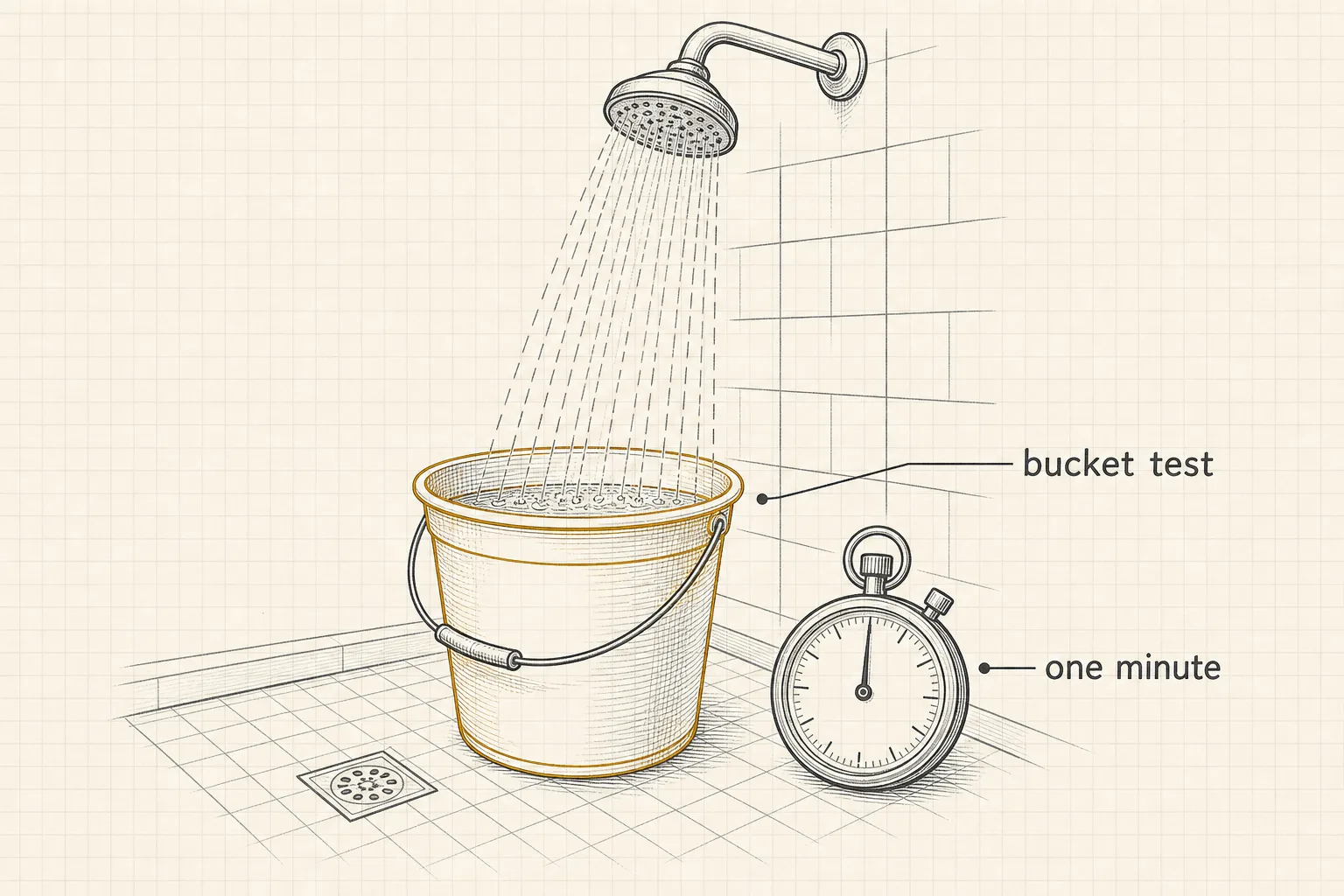
Head-to-Head
| Niagara Earth Spa (chrome) | Niagara Earth Spa (brushed nickel) | Typical 2.5 GPM head | |
|---|---|---|---|
| Typical price | ~$21 | ~$22 | $10–30 |
| Flow | 1.5 GPM | 1.5 GPM | 2.5 GPM |
| Pause valve | Yes (Soap-and-Soak) | Yes (Soap-and-Soak) | Usually no |
| Ratings (time of writing) | ~4.0★ / 79 | ~4.5★ / 450 | Varies |
| The honest trade-off | Smaller review base | Same head, better finish | Wastes ~1 GPM every minute |
The Math: 2.5 GPM Down to 1.5 GPM, Per Year
Here is the arithmetic, with assumptions stated so you can redo it for your own household. We will use a combined water-plus-sewer rate of about $0.01 per gallon (roughly $10 per 1,000 gallons, the ballpark that EPA’s ~$1,000/year family-of-four water-and-sewer spend implies) and an 8-minute shower — EPA’s own showerhead page notes showering is nearly 17% of residential indoor water use, about 40 gallons per day for the average family.[1]
One person, one shower a day:
- Old head: 2.5 GPM × 8 min = 20 gallons/day
- New head: 1.5 GPM × 8 min = 12 gallons/day
- Saved: 20 − 12 = 8 gallons/day
- Per year: 8 × 365 = 2,920 gallons/year
- In dollars: 2,920 × $0.01 = ~$29/year for one person
Now a household of four, everyone showering daily:
- 4 people × 2,920 gallons = 11,680 gallons/year
- At $0.01/gal: ~$117/year
That is the headline number: about $117 a year for a $21 head — payback in roughly two months. EPA’s own average-family figure is more conservative at 2,700 gallons/year saved by installing a WaterSense-labeled showerhead,[1] which is the right anchor for a typical household that does not run four daily 8-minute showers; the per-person math above is what you get when you actually do. And because the water you save in the shower is mostly hot water, the savings are double: every gallon not run through the showerhead is also a gallon not heated. EPA estimates the average family saves more than 330 kilowatt-hours of electricity a year from the water-heating side alone.[1] For the full picture of where your gallons go, average water use per person has the breakdown, and why is my water bill higher in summer explains the seasonal spike that makes this swap pay fastest.
Which Showerhead Should You Actually Buy?
- Want the full 1.5 GPM efficiency with a pause valve → Niagara Earth Spa (chrome), ~$21. The pause button is the hidden second saving.
- Same head, larger review base, spot-hiding finish → the brushed nickel version, ~$22.
- Your bucket test says your head is already 1.5 GPM → do not buy anything; the swap will not pay. Spend the $21 on a faucet aerator instead.
- Your bucket test says 2.5 GPM → this is the swap. Two-month payback on the math above.
- Bill is spiking and you are not sure why → read why is my water bill higher in summer and water bill too high before you buy, so you are fixing the actual cause.
And the standing rule for every showerhead on this page: measure before you replace. The bucket-and-stopwatch test takes five minutes and tells you whether a swap is worth $21 or worth nothing. A 1.5 GPM head is a genuine upgrade over a 2.5 GPM head — but only if your head actually flows 2.5 GPM. The cheapest water-saving device in your bathroom is the one you already own, running at the flow you actually need; the second cheapest is the one that tells you the truth about what you have.
Sources
- EPA WaterSense — Showerheads — standard 2.5 GPM, WaterSense ≤2.0 GPM, ~2,700 gal/yr average-family savings, ~330 kWh/yr energy savings, pressure-compensation performance criteria, showering ~17% of indoor water use. Retrieved 2026-09-11.
- EPA WaterSense — Bathroom Faucets — faucet flow standards and aerator savings context. Retrieved 2026-09-11.
- Wirecutter — The Best Showerhead — “we stopped prioritizing specifically low-flow or water-saving showerheads… Most of these deliver about 1.5 gpm”; industry shift to 1.75 gpm heads. Retrieved 2026-09-11.
- EPA WaterSense — Residential Toilets — context on household indoor water use. Retrieved 2026-09-11.