Quick Answer
The Danco HydroRight HYR460 is the best dual-flush conversion kit, because it turns an old 3.5-gallon toilet into a 1.6-gallon full flush / ~0.8-gallon half flush for about $33 — if your toilet fits it. And fit is the entire game: this kit works with 2-piece toilets with a 2-inch flush valve and a tank tall enough for the overflow tube; it will not fit 1-piece toilets or 3-inch flush valves. That compatibility guidance is the differentiator, because most of the frustration in this category is people buying a kit their toilet was never going to accept. The honest variant note: Danco also sells the HYR451T lever-style sibling, but its listing currently shows no featured offer, so we only recommend the HYR460 push-button version. Toilets are the single biggest indoor water user — nearly 30% of an average home’s indoor consumption — so this is one of the highest-leverage swaps you can make.[1] Start with is your toilet running? the leak test to rule out the silent leak that wastes more than any flush, then how to lower your water bill for the full plan. The direct buy is the Danco HydroRight HYR460 on Amazon.
First, What a Dual-Flush Conversion Kit Actually Is
A dual-flush toilet gives you two flush volumes: a full flush for solid waste and a reduced flush for liquid. The reduced flush is the whole point — most flushes in a home are liquid, and they do not need anywhere near the water a full flush uses. EPA notes that a WaterSense-labeled dual-flush toilet saves even more than a single-flush efficient toilet because you can choose the “reduced flush” mode for liquid waste.[1]
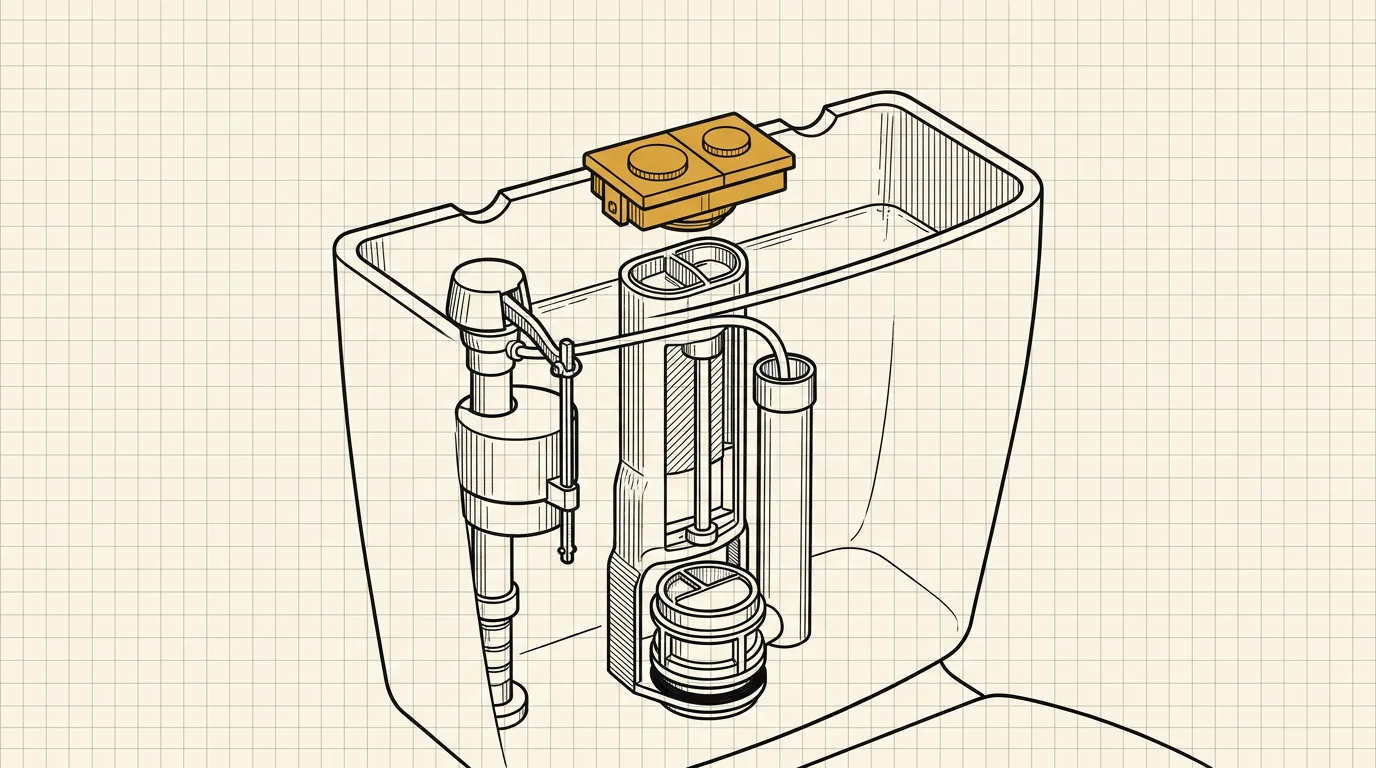
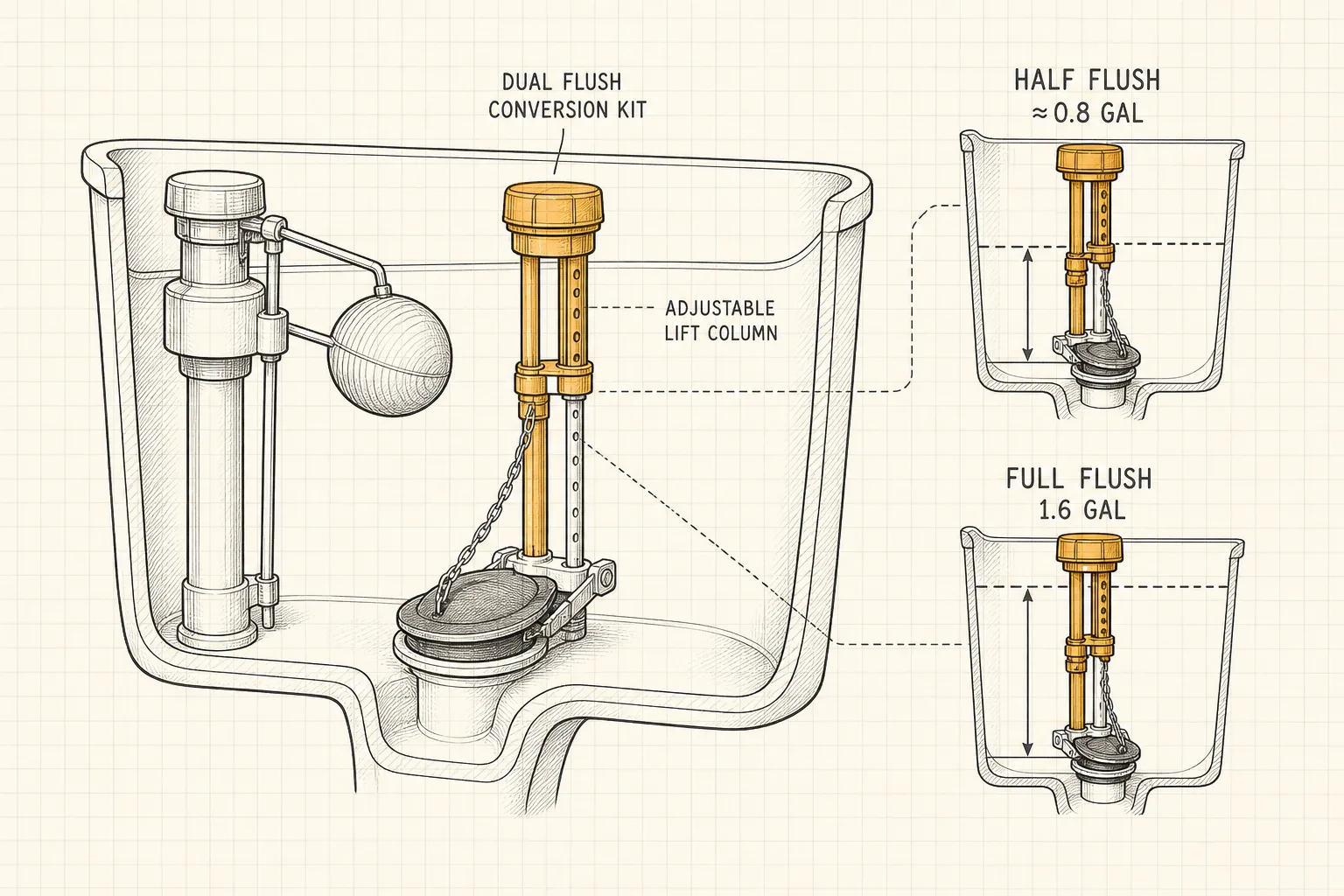
A conversion kit is the retrofit version of that idea: instead of replacing the whole toilet, you replace the guts of the tank — the flush valve, the flapper, and the handle or button — with a dual-volume mechanism. The Danco HydroRight HYR460 is the best-known version: a push-button mechanism that replaces your tank’s flush valve and flapper, giving you a 1.6-gallon full flush and a ~0.8-gallon half flush out of a toilet that used to flush 3.5 gallons every time.
The honest framing matters here: a conversion kit is not a new toilet, and it will not make an old toilet flush like a modern one. What it does is cut the water per flush dramatically — and for a toilet that is already flushing fine, that is the entire job. If your toilet double-flushes or runs, fix that first; converting a broken toilet is converting a broken toilet.
The Compatibility Checklist: Will It Fit Your Toilet?
This is the section that separates a useful guide from a frustrating one, because the HYR460 fits a specific, common-but-not-universal configuration. Check these three things before you buy:
1. Two-piece, not one-piece. The kit is designed for a standard 2-piece toilet — the familiar setup with a separate tank bolted onto the bowl. 1-piece toilets (tank and bowl molded as one unit) have a different internal geometry and the kit will not fit. If you have a 1-piece, skip the conversion and consider a full replacement.
2. A 2-inch flush valve, not 3-inch. The most common flush valve in American toilets is 2 inches — that is what the HYR460 is built for. 3-inch flush valves (common in newer, higher-performance toilets) are physically larger and the kit will not fit them. If your toilet already has a 3-inch valve, it is probably already efficient — a 3-inch valve is usually paired with a 1.28 or 1.6 gpf toilet — and a conversion would be pointless anyway.
Converts a standard 2-piece toilet with a 2-inch flush valve to dual flush: 1.6-gallon full flush and ~0.8-gallon half flush via a push-button top. About $33, sold by Amazon, 4.1 stars from 4,500+ reviews at the time of writing.
Check price on Amazon As an Amazon Associate we earn from qualifying purchases. Price & availability shown on Amazon.com.3. Tank height and overflow-tube clearance. The kit’s mechanism includes an overflow tube that must fit inside your tank. If your tank is unusually shallow, or the existing overflow tube is very short, the kit may not seat properly. Measure the tank’s interior height and compare it to the kit’s stated dimensions before buying — this is the fit check most people skip, and it is the one that produces “it doesn’t fit” reviews.
Plumber forums treat this the same way. The recurring advice on dual-flush conversion kits across plumbing communities is consistent: they are a reasonable retrofit only for a standard 2-piece, 2-inch-valve toilet, and the first question to ask is always what is inside the tank — not which kit is cheapest. The forum consensus is that a conversion kit is a legitimate water-saving move for an older 3.5-gallon toilet, and a waste of money on a toilet that is already 1.6 gpf or newer. That matches the manufacturer’s own fit guidance and the review pattern: the complaints cluster around fit, not around the mechanism failing.
The Danco HydroRight HYR460 — the Pick
Best when: you have a standard 2-piece toilet with a 2-inch flush valve, and you want the push-button dual-flush retrofit.
The HYR460 is the push-button version of Danco’s HydroRight system: about $33, roughly 4.1 stars from 4,500+ reviews at the time of writing, and sold by Amazon. The review volume is the signal here — 4,500+ reviews is a large data set for a plumbing retrofit, and the pattern is consistent: it works well on the toilets it fits, and the negative reviews are overwhelmingly fit-related (the checklist above). The push-button top replaces your handle, which is a small thing that changes the daily feel of the toilet — and the two-button layout makes the half-flush choice explicit every time you use it.
The honest variant note: Danco also sells the HYR451T, a lever-style sibling of the same mechanism. We are not recommending it because its listing currently shows no featured offer — you cannot reliably buy it right now, and we only recommend what you can actually order. The HYR460 is the buyable version.
Converts a standard 2-piece toilet with a 2-inch flush valve to dual flush: 1.6-gallon full flush and ~0.8-gallon half flush via a push-button top. About $33, sold by Amazon, 4.1 stars from 4,500+ reviews at the time of writing.
Check price on Amazon Price & availability shown on Amazon.com — we may earn a commission.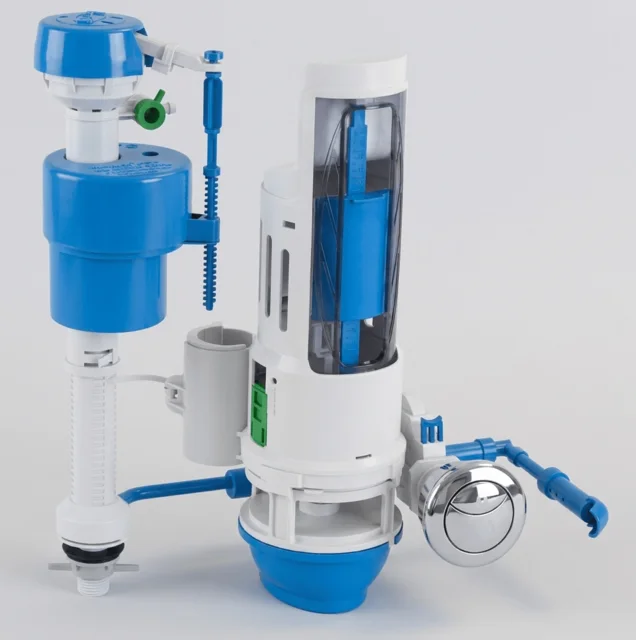
Head-to-Head: Conversion vs. the Alternatives
| HydroRight HYR460 conversion | New 1.28 gpf toilet | New dual-flush toilet | |
|---|---|---|---|
| Typical cost | ~$33 + your labor | $150–400 + install | $200–500 + install |
| Full flush | 1.6 gallons | 1.28 gallons | 1.28 gallons |
| Half flush | ~0.8 gallons | — | ~0.8–1.0 gallons |
| Fits | 2-piece, 2-inch valve only | Any standard rough-in | Any standard rough-in |
| The honest trade-off | Fit limits; not a new toilet | No half-flush option | Most expensive; best performance |
The Math: 3.5 GPF Down to 1.6 / 0.8, Per Year
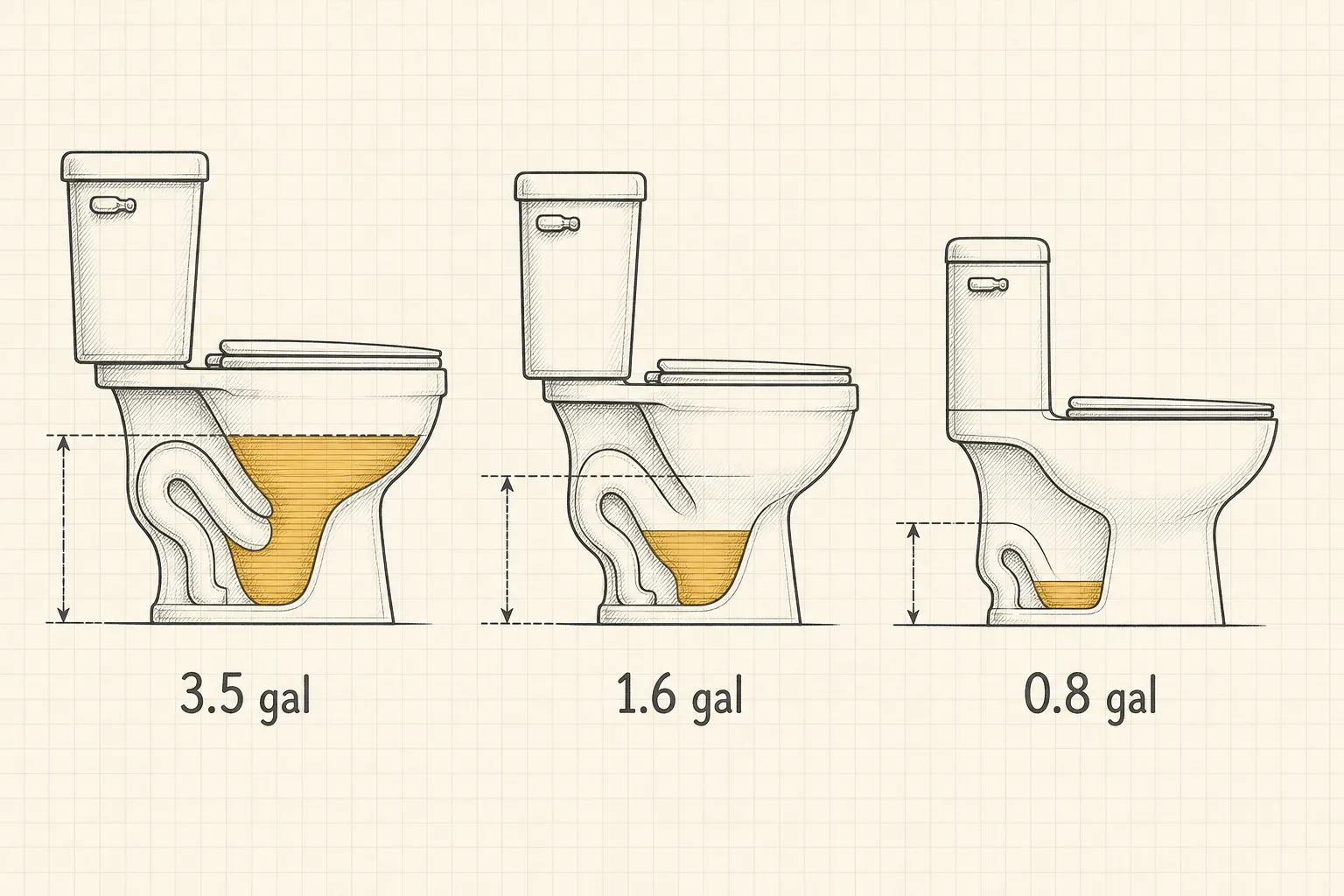
Now the arithmetic, with assumptions stated. We will use a common planning assumption of about 5 flushes per person per day for residential toilet use (a standard engineering figure for fixture sizing; EPA’s WaterSense toilet pages document the usage shares, not this exact per-person count) and a combined water-plus-sewer rate of about $0.01 per gallon (roughly $10 per 1,000 gallons, the ballpark implied by EPA’s ~$1,000/year family-of-four water-and-sewer spend). We will also assume a realistic split: about 70% of flushes are liquid and use the half flush, 30% are full.
Start with one person, one day, on an old 3.5-gallon-per-flush (gpf) toilet:
- Old: 5 flushes × 3.5 gallons = 17.5 gallons/day
- Converted: 3.5 full flushes × 1.6 + 1.5 half flushes × 0.8 = 5.6 + 1.2 = 6.8 gallons/day
- Saved per person: 17.5 − 6.8 = 10.7 gallons/day
Now a household of four:
- 4 people × 10.7 gallons = 42.8 gallons/day
- Per year: 42.8 × 365 = 15,622 gallons/year
- In dollars: 15,622 × $0.01 = ~$156/year
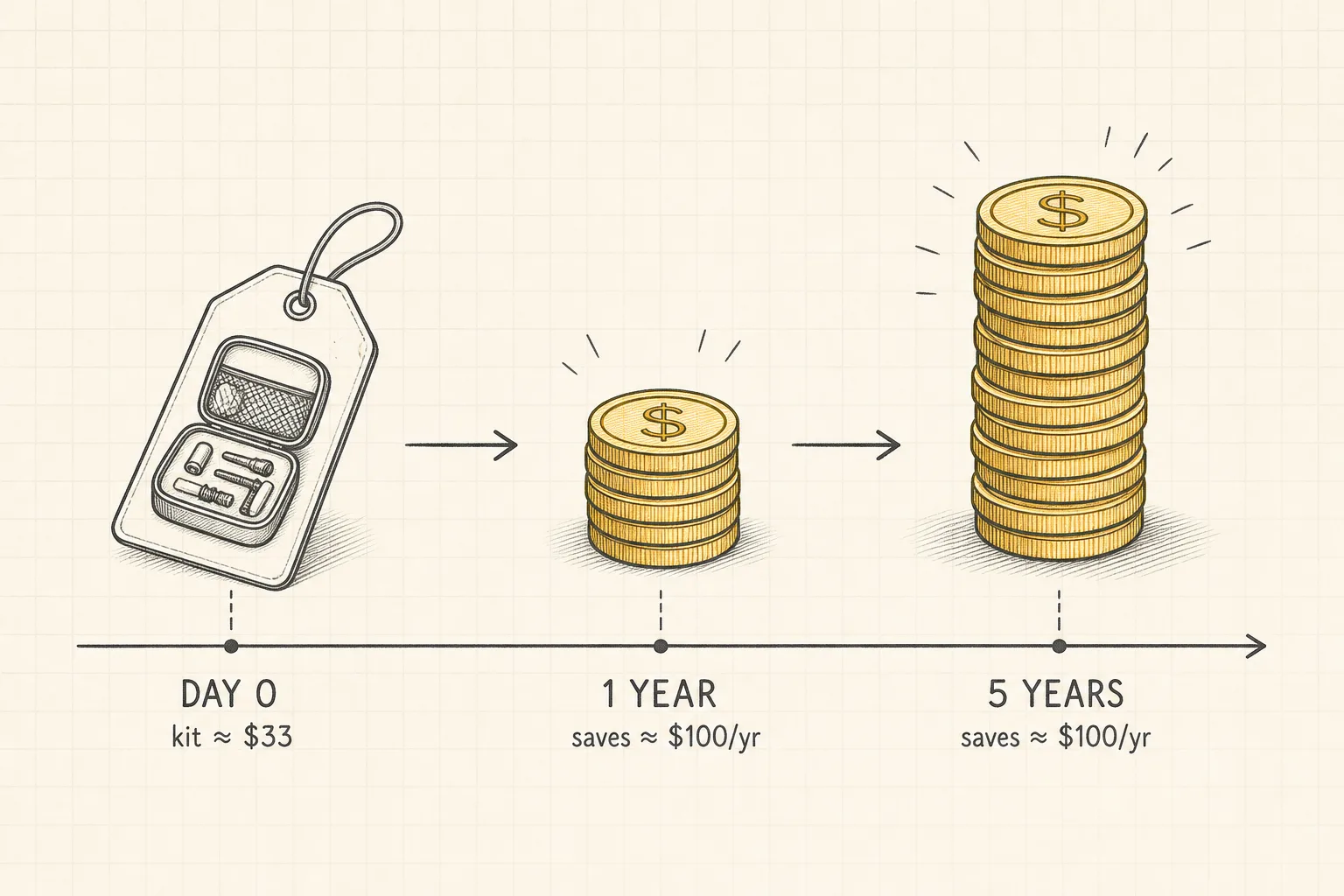
Payback on the $33 kit: $33 ÷ $156 ≈ 2.6 months — call it under three months for a family of four.
Which Option Should You Actually Buy?
- 2-piece toilet, 2-inch flush valve, tank tall enough → the HydroRight HYR460, ~$33. Under three-month payback for a family of four on the math above.
- 1-piece toilet or 3-inch flush valve → the kit will not fit. Do not buy it; a full replacement is the honest path.
- Toilet already 1.6 gpf or newer → skip the conversion entirely. You are chasing the last few gallons; the kit will not pay.
- Toilet runs or double-flushes → fix the leak first. The toilet leak test is the free starting point, and a running toilet can waste 180 gallons a week on its own.[1]
- Not sure what is in your tank → lift the lid and look before you buy. The flush valve size and the tank height are the two numbers that decide everything.
And the standing rule for every conversion kit on this page: a dual-flush kit saves water only on the flushes you actually make. The half-flush button only helps if people press it — and the honest reality is that a two-button toilet asks every user to make a choice every time, which is exactly why some households prefer a single-flush efficient toilet that saves without asking. If your household will not reliably use the half flush, a 1.28 gpf single-flush toilet (or a new dual-flush with a well-designed button) may save more in practice than a conversion kit that sits on the full setting. Measure the tank, check the valve, fix the leaks, and only then convert — the kit is a tool, not a magic wand.
Sources
- EPA WaterSense — Residential Toilets — toilets ~30% of indoor water use, 1.6/1.28 gpf standards, ~13,000 gal/yr and ~$170/yr average-family savings, dual-flush reduced mode, leaks ~180 gal/week. Retrieved 2026-09-11.
- EPA WaterSense — Showerheads — context on household indoor water use. Retrieved 2026-09-11.
- EPA WaterSense — Bathroom Faucets — context on household indoor water use. Retrieved 2026-09-11.
- Wirecutter — The Best Showerhead — context on the industry’s efficiency shift. Retrieved 2026-09-11.