Quick Answer
A demand charge must be read from the account’s tariff and statement; it is not interchangeable with total kWh use. DOE bill guidance distinguishes actual demand observed over the billing cycle from billed demand, which can be adjusted under the utility’s rate structure.[1]
Do not assume every residential or commercial account has a demand charge, that one interval length applies, or that changing appliance schedules will produce a stated saving without an account-specific calculation.
Self-check before you go further: if your bill shows a demand line but this page hasn’t answered your question yet, jump to Questions for the Provider; if the number looks wrong, the Compare Like With Like checks are the fastest route to an answer.

The strip above fixes the unit distinction underneath every demand line: kW is the rate of use in a single interval, kWh is energy accumulated over time — a demand charge prices the first, an energy charge the second.
Find the Demand Calculation
Record the exact bill line and then ask the provider for the controlling tariff section. Confirm:
| Bill detail | What to verify |
|---|---|
| Service class | Account type and applicable rate schedule |
| Demand measure | Actual demand, billed demand, unit, and measurement interval |
| Demand window | Billing-period, seasonal, time-period, or contract conditions |
| Price | Current demand rate and associated riders or adjustments |
| Other charges | Energy use, fixed charges, taxes, credits, and one-time items |

The anatomy card above turns the table into a worksheet, read in order: confirm the service class against the rate schedule, record the demand measure exactly as billed (actual or billed, in kW), note the tariff’s window, capture the per-kW price including riders, then set the demand line beside the other charges — so a rising demand charge is not mistaken for a rising total.
The service-class row is where tiered confusion usually starts. If your rate schedule prices blocks of usage instead of a single demand figure, that is a block rate — see tiered electricity rates: how blocks work.
DOE notes that bill components can be determined differently and that changes in use can affect them differently — and every charge on the bill responds to those changes in its own way.[1]
Demand charges live mainly in commercial and industrial rate schedules; the U.S. Forest Service’s facility guide puts them at 30 to 70 percent of most commercial customers’ electric bills.[2] A few residential rates carry them too — Salt River Project in Arizona offers a residential price plan whose demand charge “is based on 60-minute intervals during on-peak hours” (weekdays, 5–10 p.m.).[3] A demand line on a bill you believe is residential is a reason to verify the service class first, not to assume a misprint.
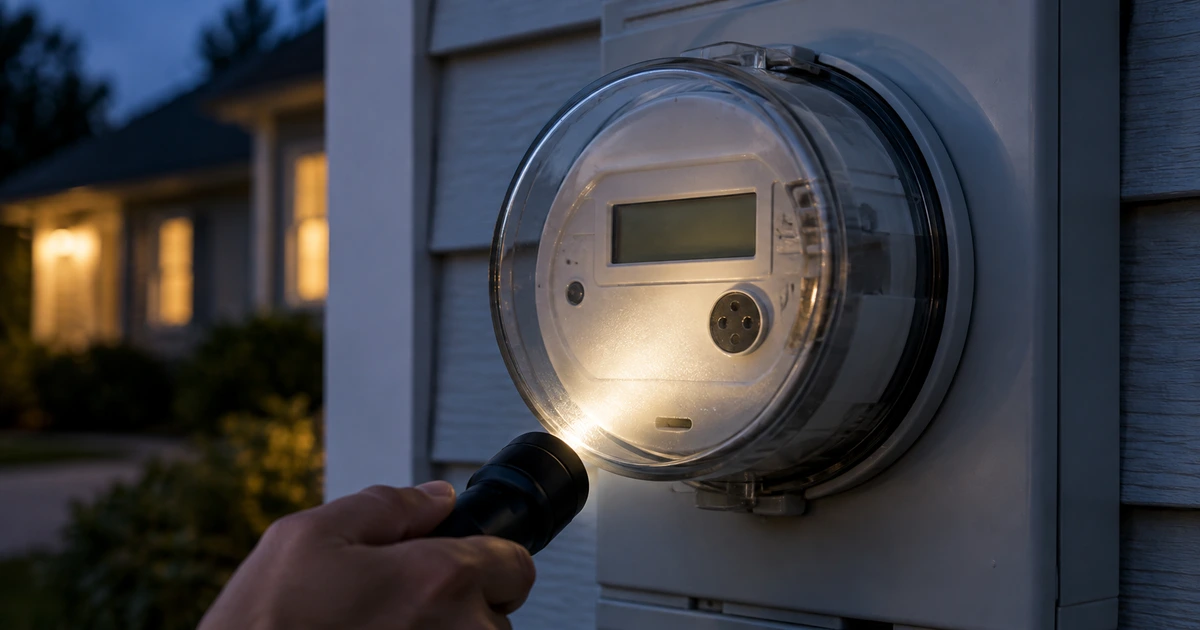
Where the charge applies, the meter records use in fixed windows — intervals “usually 15 or 30 minutes” in the Forest Service guide, and “15 consecutive minutes” in Stillwater, Oklahoma’s tariff, which bills the single highest such interval of the month.[2][4] Illustration only, not any utility’s rate: 12 kW × $8.50/kW = $102.00, before riders and taxes. Interval data starts at the meter — how to read your electric meter is the companion skill.

That one interval can follow you forward. Stillwater’s tariff sets billing demand at no less than 65% of the highest power-factor-corrected summer on-peak demand from the previous 12 months[4] — the actual-versus-billed-demand gap DOE describes, written into a tariff. When you ask for the calculation, ask specifically whether a ratchet applied.[1]
Some commercial tariffs also correct demand for power factor before billing it: Stillwater raises billed demand when average power factor falls below 80%, and Hamilton, Ohio’s industrial schedule derives billing demand from kVA rather than kW.[4][5] A demand line that resists your own interval math may simply be power-factor corrected.
Compare Like With Like
Compare the current statement with a similar earlier bill, including billing days, rate-plan version, actual versus estimated data, demand units, energy use, and all line items. If you are not yet comfortable reading the statement itself, reading your electric bill line by line is the baseline skill for this comparison. An increase in the total amount due does not by itself prove that demand caused the change.
If the provider offers interval data or an account-specific analysis, use it to understand the calculation before changing operations, buying equipment, or enrolling in a new rate plan — this is the same interval data that time-of-use rates are built on. Follow manufacturer and electrical-safety instructions for any equipment or control changes.
Questions for the Provider
- Does my current tariff include a demand charge, and where is it defined?
- What is the account’s actual and billed demand for this period?
- Which measurement interval, season, and timing rules apply?
- What rate, rider, and adjustment produced the amount on this bill?
- Can you provide interval data or an account-specific full-bill comparison?
If the provider’s answers do not match the statement in front of you, do not stop at a phone call — the next move is the formal one: see how to dispute a utility bill.
In the meantime, keep your own record: the bill in question, an earlier statement for the same season, the tariff section the provider cites, and notes from each call with dates and reference numbers. That packet is what turns a confusing demand line into a checkable calculation — and everything on this page, from the verification table to the provider questions, is built to feed it.
Related Reading
- Electric Bill Breakdown: Every Charge Explained — where the demand line sits among all the other line items.
- Time-of-Use Electricity Plans: How Demand Charges Fit In — when demand charges apply alongside time-based pricing.
- Tiered Electricity Rates: How They Differ From Demand Charges — the other common rate structure readers confuse with demand.
- Delivery vs Supply Charge: The Two Big Halves of Your Bill — the fundamental split demand sits inside.
- Which Rate Plan Is Right for You? Flat, TOU, or Demand-Based — deciding what fits once you know your options.
- Why Is My Electric Bill So High? The Full Diagnosis Checklist — if you got here because the total jumped.
Does every electric bill have a demand charge?
What is the difference between actual demand and billed demand?
How do I check the demand charge on my bill?
What should I ask my utility about a demand charge?
Sources
- U.S. Department of Energy: Evaluating Your Utility Rate Options — rate components incl. demand charges (retrieved 2026-08-29)
- U.S. Forest Service: Saving Money by Understanding Demand Charges on Your Utility Bill (retrieved 2026-08-29)
- Salt River Project: Manage Demand 5–10 p.m. and Save — residential price plan (retrieved 2026-08-29)
- Stillwater Utilities: Power and Light — Primary, Time of Day Rate (PL-P/TOD) (retrieved 2026-08-29)
- City of Hamilton, Ohio, Municipal Code: Industrial Service Rate Schedule “IS” (retrieved 2026-08-29)