Quick Answer
A do-it-yourself assessment can help you identify and prioritize energy upgrades—but it is not a substitute for safe electrical, combustion, structural, moisture, or HVAC work. DOE’s own framing: “While not as thorough as a professional home energy audit, a simple do-it-yourself walk-through can help you identify and prioritize some energy efficient upgrades."[1]
The savings are real and officially ranged, not folklore: DOE says reducing drafts “may range from 5% to 30% per year” on total energy use; ENERGY STAR says air sealing and insulation can save “up to a 10% on your annual energy bills,” and EPA’s newer estimate averages 15% on heating and cooling costs (11% on total energy) for the same work.[1][4] Your result depends on your house—which is what the walk-through documents.
The DOE Walk-Through, In Order
DOE’s DIY assessment is a six-step sequence worth following as written:[1][2]
- List the obvious air leaks — baseboards, door and window junctions, outlets and switch plates, wall- or window-mounted AC units, pipe and wire penetrations, the electrical service entrance, foundation seals, mail slots.
- Seal them with the right material — caulk stationary joints, weatherstrip movable ones (windows and doors); seal knee walls, dropped soffits over cabinets, and the furnace or water-heater closet.
- Check ventilation before you tighten — “adequate ventilation is as important as air sealing”; never cover attic soffit vents with insulation.
- Check insulation levels — heat loss is usually highest through the attic; the attic hatch or door should be insulated and weatherstripped like an exterior door; R-values are printed on batts.
- Service the HVAC side — check filters monthly in high-use seasons; DOE recommends professional inspection and cleaning at least once a year.
- Sweep lighting, appliances, and electronics — replace inefficient bulbs; test the refrigerator-door gasket (paper in the jamb should resist pulling); note appliance ages and ENERGY STAR eligibility.[1]
Find the Leaks Like an Auditor (Without the Equipment)
The pressurization trick from DOE’s air-sealing guide turns small leaks into visible ones:[2]
- Close all exterior doors, windows, and fireplace flues.
- Turn off combustion appliances (gas furnace, water heater)—and remember to relight pilots afterward.
- Turn on all kitchen and bath exhaust fans (or a large window fan blowing out).
- The house is now drawn slightly negative: pass an incense stick or smoke pencil past suspected leak points—wavering or drawn-out smoke marks the leak.
Where to check, from DOE’s list: attic-floor penetrations, dropped ceilings, soffits over cabinets, recessed light fixtures, the attic hatch, basement rim joists and sill plates, water-heater and furnace flues, the electrical service entrance, foundation-siding junctions, chimney flashing, and window/door frames.[2] On exterior walls, foam gaskets behind outlet and switch cover plates are the classic first fix. For the room-by-room companion that matches every gap to its seal — hand test, smoke pen, night flashlight — see how to find and seal drafts in your home. For doors that draft at the bottom:

See the Holikme twin door draft stopper on Amazon — adjustable 34-inch twin-sided sweep that slides over the door bottom, no adhesive.
The Duct Factor (If You Have Forced Air)
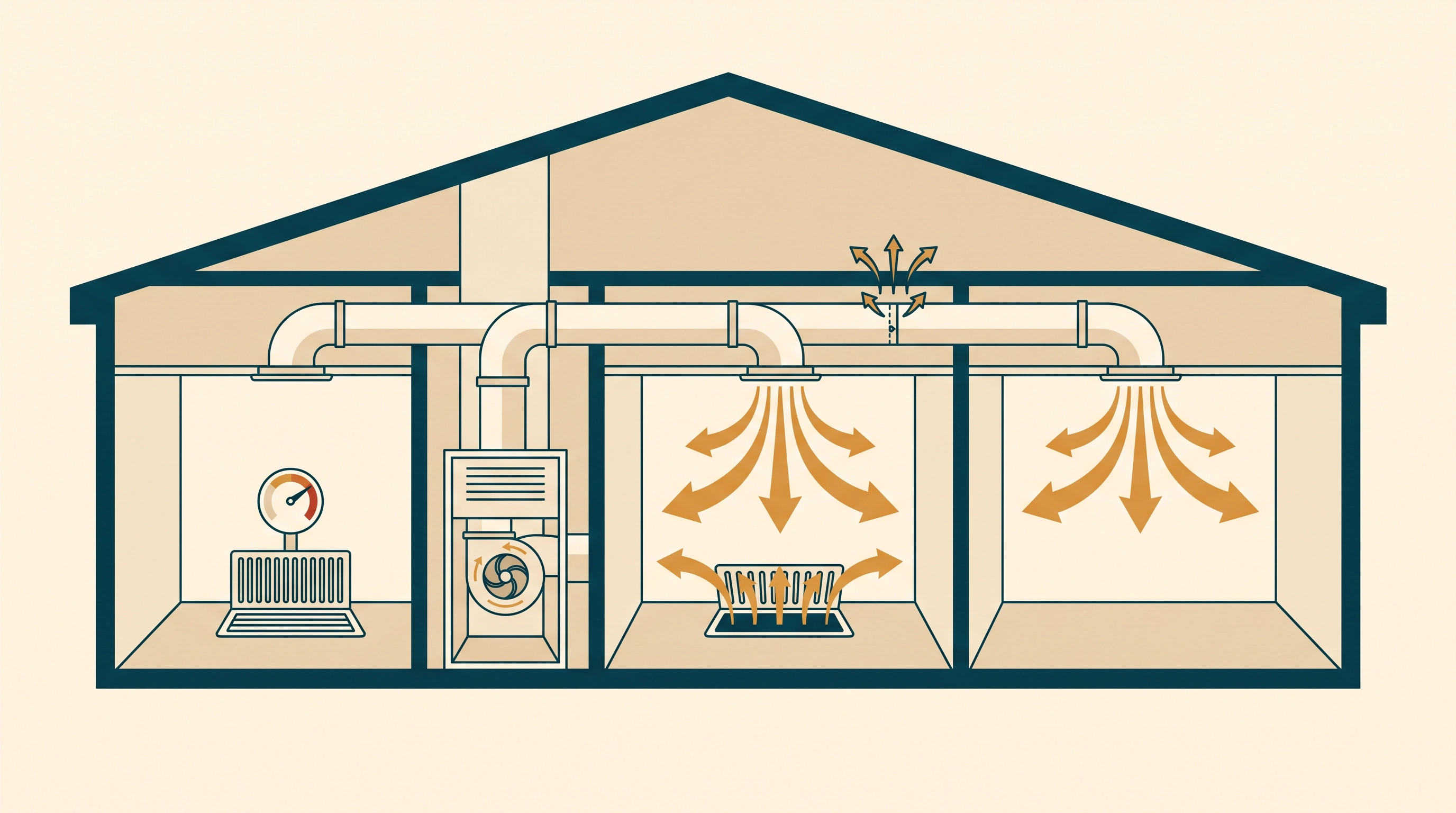
ENERGY STAR’s figure deserves its own line: “In a typical house, about 20 to 30 percent of the air that moves through the duct system is lost due to leaks, holes, and poorly connected ducts”—cutting heating and cooling efficiency by as much as 20%.[3] If your ducts run through unconditioned space, a duct-sealing scope belongs on the walk-through sheet. And ENERGY STAR’s material rule is absolute: seal with mastic sealant or metal tape—never duct tape, which does not last.[3]
160×120 thermal sensor with MSX image blending, 70 mK sensitivity, ±3°C accuracy, ~1-hour battery (FLIR spec) — run it during the fan pressurization test above and cold-air paths light up on screen. Connector note: this listing is the Lightning version for iPhone 14 and earlier; iPhone 15+/Android need the USB-C model.
Check price on Amazon As an Amazon Associate we earn from qualifying purchases. Price & availability shown on Amazon.com.Measure Instead of Assuming
Two cheap instruments replace the most common guesses:
Phantom loads. LBNL’s standby-power research puts most devices below 0.5 W in standby—but collectively standby power runs 5–10% of residential electricity use, with measured whole-home standby averages around 67 W (range 14–169 W across homes studied).[5] A plug-in meter on each suspect device for 24 hours settles what your house actually draws. (The site’s phantom power explainer covers the audit method.)
Surface temperatures. A phone-attached thermal camera makes the invisible draft visible—cold streaks at uninsulated bays, air paths at the attic hatch, a hot spot on a breaker. It pairs naturally with the pressurization test above:
160×120 thermal sensor with MSX image blending, 70 mK sensitivity, ±3°C accuracy, ~1-hour battery (FLIR spec) — run it during the fan pressurization test above and cold-air paths light up on screen. Connector note: this listing is the Lightning version for iPhone 14 and earlier; iPhone 15+/Android need the USB-C model.
Check price on Amazon Price & availability shown on Amazon.com — we may earn a commission.Honest limits, in both directions: a thermal image shows surface temperatures, not R-values—treat findings as screening that directs a professional audit, not a diagnosis. And note what the camera cannot replace: the DOE’s own walk-through list above catches many leaks a camera misses when indoor/outdoor temperatures are close.
If you are shopping the tool side, our thermal camera comparison sorts the ~$116 USB-C picks from the premium options — including one that sidesteps the Lightning caveat above.
When to Level Up to a Professional
DOE describes the professional assessment as the thorough version: a blower-door test (a variable-speed fan depressurizes the house to quantify and locate leakage), duct-leakage testing for forced-air systems, and combustion-safety checks.[6] Commonly quoted costs—marketplace figures, not official ones: $200–$500 for a standalone blower-door test, $200–$700 for a full professional audit (which usually includes a blower-door pass at its upper end), with some utilities offering them free or discounted.
The middle path many homeowners miss: DOE’s Home Energy Score—a ~1-hour assessment by a certified assessor that produces a 1–10 score and upgrade list, typically $150–$350 (and required at time of sale in some jurisdictions, such as Portland, OR).[7]
Know the Scope Limits (Do Not Cross These)
- Do not cover required ventilation, alter gas equipment, work on energized electrical components, disturb suspected hazardous materials, or perform structural repairs as a “DIY air-sealing project.”
- For rental housing, obtain the property owner or manager’s approval before altering the unit.
- Call qualified help for persistent moisture, visible building damage, electrical concerns, combustion or venting questions, or any time the correct repair method is uncertain.[6]
Keep the assessment notes, bills, repair records, and contractor findings together—that record beats any generic payback estimate when you figure out why a utility bill jumped.
Action Checklist
Today (one walk-through)
- Room-by-room sheet: gaps, damaged weatherstripping, drafts, moisture, comfort notes, photos.
- Mark every DOE checklist location: outlets, penetrations, attic hatch, rim joists, flues.[2]
- Check HVAC filter condition; note its size for stocking.
This month
- Pressurization + incense pass on a windy day; tag leaks with painter’s tape.
- Seal the wins: caulk stationary joints, weatherstrip movable ones, gasket exterior outlets, insulate the attic hatch.
- Meter the top three phantom-load suspects for 24 h each.
This season
- Decide: DIY sealing only, Home Energy Score ($150–$350 class), or full audit with blower door.[6][7]
- If forced-air: duct inspection/sealing scope with mastic or metal tape.[3]
Frequently Asked Questions
How much can air sealing actually save?
Is a thermal camera worth it for a DIY audit?
What does a professional audit add over DIY?
Sources
- U.S. Department of Energy: Do-It-Yourself Home Energy Assessments (walk-through steps; 5–30% draft-reduction range; attic hatch; filter guidance; refrigerator-gasket paper test)
- U.S. Department of Energy: Air Sealing Your Home (pressurization test steps; incense/smoke test; leak-location checklist; leak-before-insulate rule)
- ENERGY STAR: Duct Sealing (“about 20 to 30 percent of the air…is lost”; mastic or metal tape, never duct tape)
- ENERGY STAR: Seal and Insulate (“up to a 10% savings on your annual energy bills”); EPA average 15% heating/cooling, 11% total
- Lawrence Berkeley National Laboratory: Standby Power (most devices <0.5 W; 5–10% of residential electricity; measured whole-home average ≈67 W)
- U.S. Department of Energy: Professional Home Energy Assessments (blower door, duct leakage, combustion checks)
- DOE: Home Energy Scores Surpass 250,000 (1–10 scale, ~1-hour assessment; typical $150–$350 program pricing)