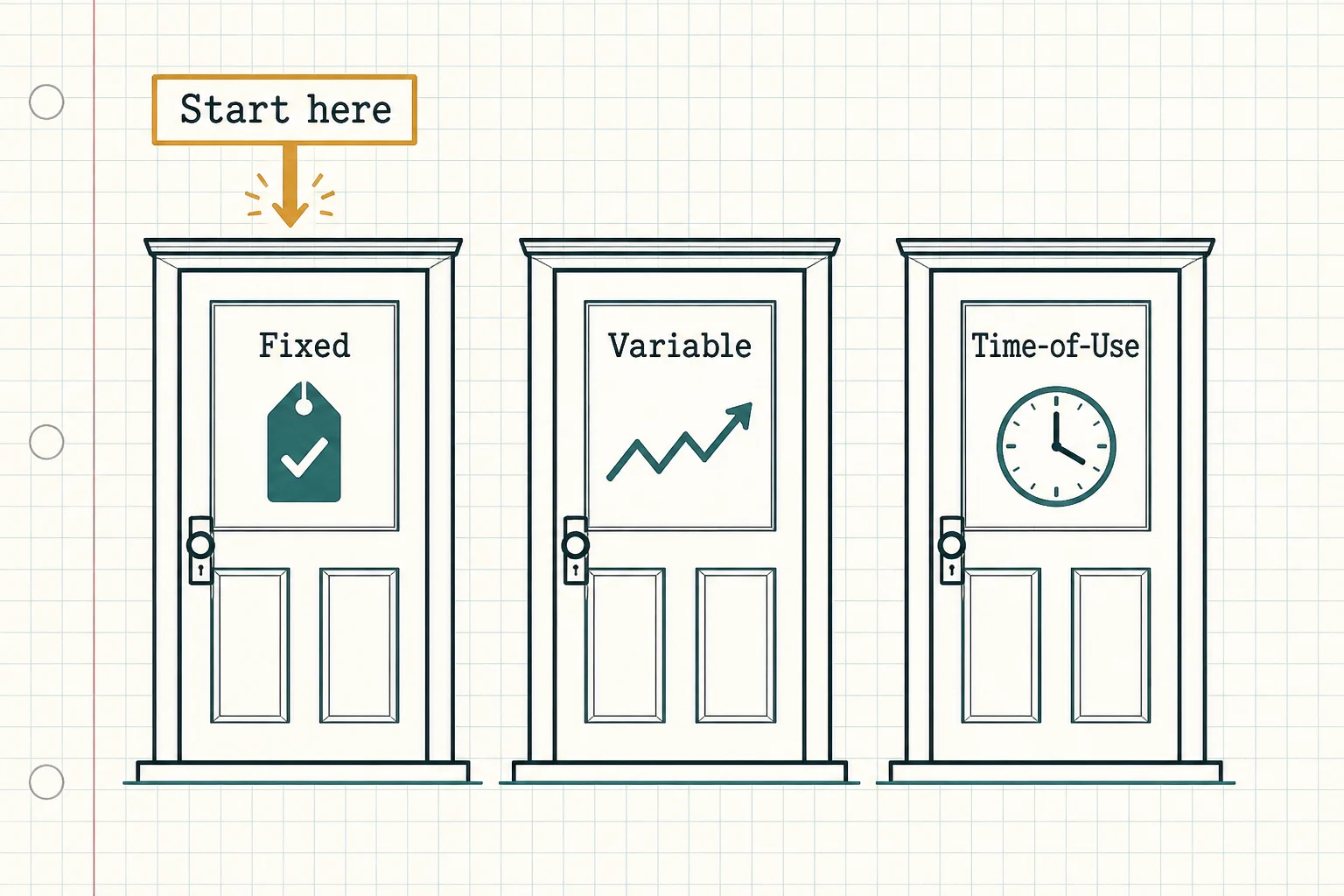
Quick Answer
For most residential time-of-use (TOU) plans, electricity is cheapest after 9:00 PM and before 4:00 PM on weekdays, plus all weekend. Exact hours depend on your utility’s specific tariff. The off-peak discount ranges from under 10% (PG&E’s winter spread) to about 81% (Con Edison’s summer spread) to entirely free overnight hours (TXU) — so confirm the gap in your utility’s tariff before shifting laundry, dishwashing, and EV charging.
This page provides the quick-reference answer. For a full explanation of how TOU plans work, how to read a tariff, and how to compare your usage to your utility’s specific schedule, see Time-of-Use Electricity Rates Explained.
Cheapest Hours by Plan Type (Real 2026 Examples)

Every utility sets its own peak and off-peak windows. The table below shows the cheapest hours for three common plan types, drawn from current tariffs. These are examples — look up your utility’s schedule using the rate-plan hub or 08’s detailed comparison table.[1][2][3]
| Utility / Plan Type | Cheapest Hours | Off-Peak Price (per kWh) | Best For |
|---|---|---|---|
| PG&E E-TOU-C (California) | All hours except 4:00–9:00 PM every day | $0.3676–$0.3994/kWh (winter); $0.3994 (summer baseline-adjusted)[1] | Homes with flexible schedules; shift big loads to mid-day or after 9 PM |
| Con Edison Residential TOU (New York) | 12:00–8:00 AM weekdays + all weekend | $0.0522/kWh (supply)[2] | Night owls and weekend laundry warriors; the 8 AM–12 AM weekday rate is still cheaper than peak (2–6 PM) |
| TXU Free Nights & Solar Days (Texas) | 9:00 PM – 9:00 AM | $0.00/kWh (up to 2,000 kWh/mo)[3] | Heavy overnight users — charge EVs, run the dryer, and cool the house after 9 PM; day rate is moderate |

For detailed hourly breakdowns, seasonal differences, and a dishwasher-cost comparison across these plans, see Time-of-Use Electricity Rates.
15A / 1800W rating, handles most major appliances. Schedule it to turn on after peak hours end, and monitor kWh from your phone. No hub required.
Check price on Amazon As an Amazon Associate we earn from qualifying purchases. Price & availability shown on Amazon.com.Off-Peak Habit Checklist
Shift these common loads to the cheapest hours on your plan:
- Dishwasher. Run it once a day after 9 PM (or before 4 PM). ENERGY STAR certifies standard-size dishwashers that cost about $50 per year to run — the off-peak share of that depends on your plan’s gap.[6] On Con Edison’s TOU plan, off-peak supply costs 5.22¢/kWh versus 27.86¢/kWh during summer peak hours (8 AM–midnight, June–September), so timing alone can cut the supply portion of dishwashing by about 81% on that plan — still about 70% in the cooler months, when peak supply is 17.11¢/kWh.[2]
- Clothes washer and dryer. Cold-water washing and overnight drying. A dryer load at off-peak rates can save $0.40–$0.70 per cycle versus peak.
- EV charging. Set your car to charge starting at 9 PM. A full 40-kWh charge at the national average peak-equivalent rate (~20¢/kWh) costs $8.00; at an off-peak rate of 5–10¢/kWh, it is $2.00–$4.00.
- Pool pump. Use a timer to run during off-peak morning or late-night hours. A typical 1.5-HP pump running 6 hours/day costs about $1.00–$1.50 at peak and $0.40–$0.75 off-peak.
- Oven and stovetop cooking. Batch-cook or use a slow cooker during off-peak. Evening meal prep (peak hours) is fine — just avoid running the dishwashers and dryers at the same time.
Automating these shifts is straightforward with a timer or smart plug. One option: the 15A / 1800W rating, handles most major appliances. Schedule it to turn on after peak hours end, and monitor kWh from your phone. No hub required.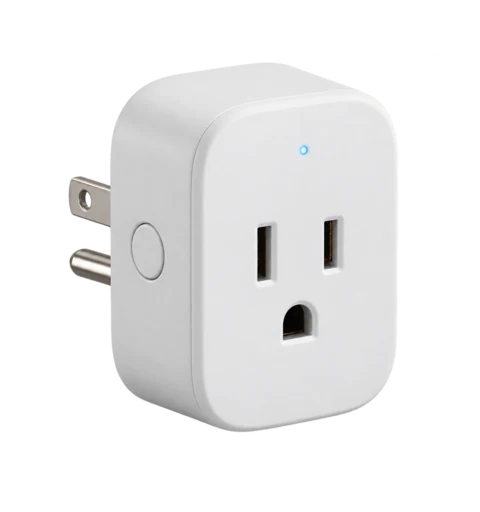
Why Shifting Pays Off
The national average residential electricity rate hit 18.34¢/kWh in June 2026 (EIA). The off-peak discount depends entirely on the plan: PG&E’s E-TOU-C winter spread is under 10%, Con Edison’s TOU discount runs about 81% versus its summer peak rate (about 70% in other months), and TXU’s Free Nights plan makes overnight energy free.[1][2][3] For an average household using 899 kWh/month, shifting just 200 kWh/month from Con Edison’s summer peak supply rate to its off-peak supply rate saves about $45/month (200 × ($0.2786 − $0.0522) ≈ $45), or roughly $540/year — about $23/month in other months, when peak supply is 17.11¢/kWh and the discount is narrowest at ~70%.[5]
The exact savings depend on your utility’s peak-to-off-peak price gap and how much you can shift. The rate-plan hub has a quick comparison tool; for a full cost-benefit check, work through the steps in Time-of-Use Electricity Rates.
A Note on Your Exact Hours
Do not assume the hours in the table above apply to you. Check your utility’s current tariff or call their customer service to confirm:
- The exact peak, off-peak, and super-peak windows (some plans have two or three tiers).
- Whether the schedule changes by season (summer vs. winter hours).
- Whether weekends and holidays are treated as off-peak or follow a special schedule.
- Whether the rate structure is flat, tiered, or includes demand charges alongside the TOU component.
Your utility’s rate-plan hub has links to each utility’s tariff. If you are shopping for a new plan, Power to Choose (Texas) or your state’s disclosure page will list the TOU windows for each offer.
Sources
- PG&E E-TOU-C Tariff Schedule, effective March 2026. Peak: 4–9 PM daily. Off-peak: all other hours. (Tariff retrieved 2026-08-28 via pge.com)
- Con Edison Residential Time-of-Use Rate Schedule, 2026. Peak supply: 8 AM–12 AM weekdays; 27.86¢/kWh June–Sept, 17.11¢/kWh other months. Off-peak supply: 5.22¢/kWh (all other hours incl. weekends). Delivery: 16.402¢/kWh 8 AM–12 AM, 18.858¢/kWh summer usage above 250 kWh/month; monthly customer charge $21.00. (Retrieved 2026-08-29 via coned.com)
- TXU Energy Free Nights & Solar Days plan, EFL retrieved via Power to Choose 2026-08-28. Rates by zip code; example shown for Dallas-area residential account.
- U.S. Department of Energy, FEMP: Evaluating Your Utility Rate Options (energy.gov/cmei/femp/evaluating-your-utility-rate-options).
- EIA Electricity Monthly Update, June 2026 — residential average revenue per kWh of 18.34¢/kWh (retrieved 2026-08-28).
- ENERGY STAR: Dishwashers — “a new ENERGY STAR certified dishwasher costs about $50 per year to run” (energystar.gov/products/dishwashers, retrieved 2026-08-29).