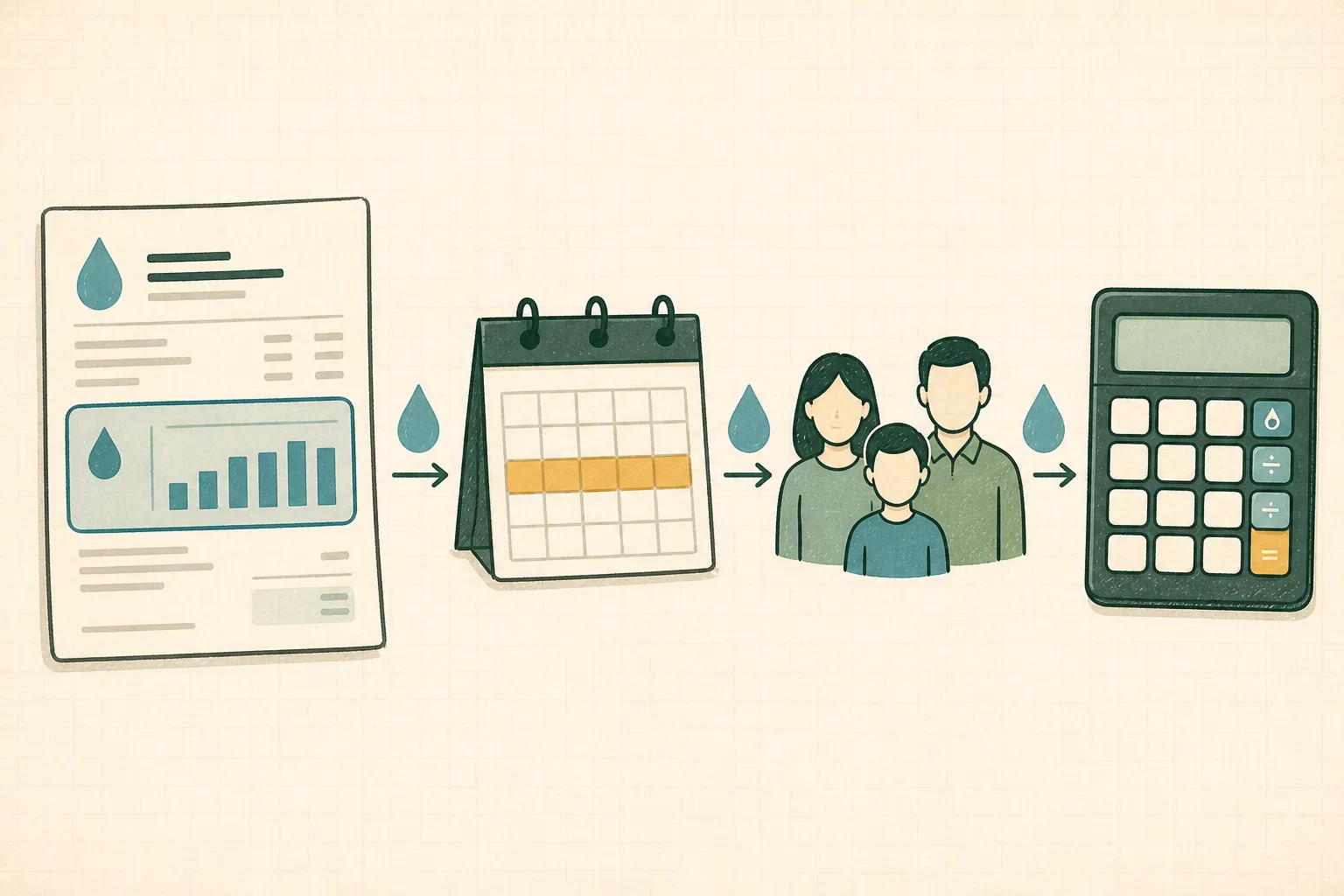
Before you shop for savings, diagnose your usage. A high water bill is either a visual problem (leak, outdoor overwatering) or a structural one (old fixtures, inefficient habits). Start with the high-water-bill investigation guide and the CCF calculator to find your baseline usage. Then come back here and work the list below from top to bottom.
Quick Answer
The fastest water-bill savings are free: find and fix leaks, run full loads, and stop outdoor waste. The average family spends about $1,300 per year on water, but EPA WaterSense estimates that upgrading to WaterSense-labeled fixtures and ENERGY STAR certified appliances can save an average of $500 per year.[1] Leak repairs alone can save a family of four up to $200 annually.
Work through the actions below in order — free behaviors first, then low-cost repairs, then upgrades with the best payback.
Ranked Actions by Cost Level
Level 1: Free Behaviors (Cost: $0)
These actions require no purchase, no tools, and no contractor. Start here.
| Action | How | Water Saved | Annual Savings* |
|---|---|---|---|
| Turn off the tap while brushing teeth | Save 8 gallons per day per person | ~2,920 gal/yr/family of 4 | $13–$30 |
| Shorter showers (under 5 min) | Save 2.5 gal/min with a standard showerhead | Up to 10,000 gal/yr for a family of 4 | $45–$100 |
| Run only full dishwasher and laundry loads | Eliminate half-full cycles; dishwasher uses ~6 gal vs. hand washing ~27 gal | ~3,000 gal/yr | $14–$40 |
| Scrape plates instead of rinsing | Skips the pre-rinse; modern dishwashers don’t need it | ~1,000 gal/yr | $5–$15 |
| Sweep the driveway instead of hosing | A garden hose uses 10 gal/min | Varies by local practice | $10–$50 |
| Use a bucket for car washing | Hose runs ~10 gal/min; bucket uses 5–10 gal total | ~500 gal/yr | $2–$10 |
Savings ranges assume household of 4, average US water rate of ~$0.0045/gal (based on $1,300/290,000 gal/yr benchmark from EPA WaterSense). Your actual savings depend on local rates and usage patterns.
Source: EPA WaterSense reports the average family spends $1,300 per year on water but can save $500 by retrofitting with WaterSense-labeled fixtures and ENERGY STAR appliances, and that we can all use at least 20 percent less water indoors by installing efficient fixtures (epa.gov/watersense/start-saving, retrieved 2026-08-29).[1]
Level 2: Low-Cost Leak Repairs ($5–$50)
Leaks are the most common driver of unexpectedly high water bills. Household leaks average about 9,400 gallons a year (EPA WaterSense) and can run far higher in leak-prone homes, costing $50–$200+ annually — the high-water-bill diagnostic shows how to find them.
The 10-Minute Leak Check
- Read your water meter. Record the reading. Don’t use any water for 2 hours. Read again. If the number changed, you have a leak.
- Check toilets. Drop a dye tablet (or food coloring) into the tank. If color appears in the bowl without flushing, the flapper is leaking. Replacing a flapper costs $5–$15 and saves up to $50/year per toilet.
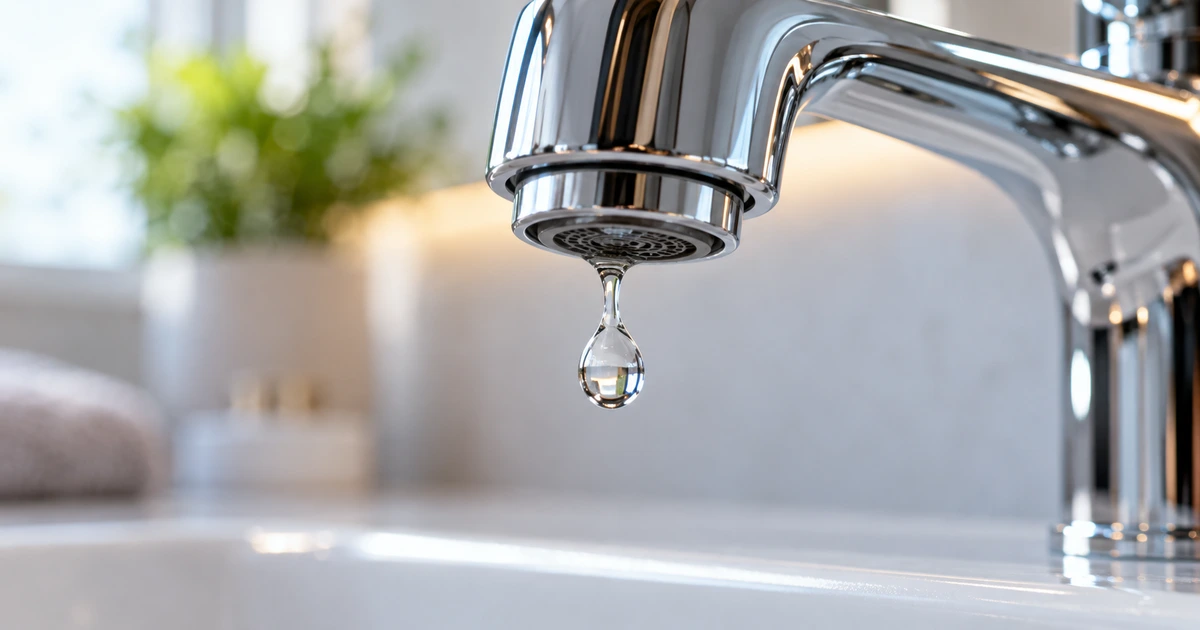
- Check faucets. A drip at 1 drop/second wastes 3,000 gallons per year. An o-ring or washer replacement costs under $5.
- Check outdoor spigots. A single outdoor leak can waste 10+ gallons/hour.
| Action | Cost | Typical Savings | Payback Period |
|---|---|---|---|
| Toilet flapper replacement | $8–$15 | $30–$50/yr | <6 months |
| Faucet washer/o-ring | $1–$5 | $10–$30/yr | Instant |
| Outdoor spigot washer | $3–$8 | $10–$100/yr | <2 months |
| Hose bib replacement | $15–$30 | $20–$80/yr | <6 months |
| — | |||
| Total low-cost fix range | $5–$50 | $30–$200/yr |
Source: EPA WaterSense “Fix a Leak Week” and “Identifying Household Leaks” (drop-test method, dye tablet guidance, and leak-cost calculator available at epa.gov/watersense/fixaleak).[1]
Monitors up to five locations with 105 dB alarms plus email and push alerts, IP67 water resistance, and a 5-year battery life (Govee spec). Placement guide above: sinks, toilet bases, water heater, washing machine box.
Check price on Amazon As an Amazon Associate we earn from qualifying purchases. Price & availability shown on Amazon.com.Level 3: Fixture Upgrades ($10–$500)
Older fixtures use far more water than modern efficient models. Replace in order of payback.
| Upgrade | Old Fixture Water Use | WaterSense Fixture | Annual Savings per Fixture | Cost | Payback |
|---|---|---|---|---|---|
| Bathroom faucet aerator | 2.2 GPM | 1.5 GPM (0.5 or 1.0 GPM optional) | $8–$20 | $2–$10 | <3 months |
| Kitchen faucet aerator | 2.2 GPM | 1.8 GPM | $5–$15 | $5–$15 | <6 months |
| Showerhead | 2.5 GPM | 2.0 GPM | $20–$50 | $15–$30 | <6 months |
| Toilet (older 3.5 GPF) | 3.5 gal/flush | 1.28 GPF (WaterSense) | $80–$140 | $80–$200 | 1–2 years |
| Clothes washer (old top-loader) | 40–45 gal/load | ENERGY STAR front-load: ~14 gal/load | $100–$200 | $400–$800 | 2–4 years |
| Dishwasher (old) | 10–12 gal/load | ENERGY STAR: ~4 gal/load | $60–$140 | $500–$1,200 | 4–6 years |
Key point: The average family can save $500/year by retrofitting with WaterSense-labeled fixtures and ENERGY STAR appliances, according to EPA WaterSense.[1] Aerators and showerheads pay for themselves in months.
Source: EPA WaterSense product specifications (2026) and ENERGY STAR water savings estimates (retrieved 2026-08-28). DOE “Home Upgrades” confirms water heating accounts for ~20% of home energy use, which efficient fixtures also reduce.[2]
Level 4: Irrigation and Outdoor Upgrades ($50–$500)
Outdoor water use accounts for nearly 30% of total household water use, rising to 70% in dry summer months.[1] Most savings here come from smarter scheduling, not bigger equipment.
| Improvement | How | Water Saved | Annual Savings | Cost |
|---|---|---|---|---|
| WaterSmart irrigation controller | Replaces manual timer; adjusts for weather and soil moisture | 20–50% reduction in outdoor use | $50–$200 | $100–$300 |
| Rain barrel for garden watering | Captures roof runoff; reduces municipal water use | hundreds to thousands of gal/yr (climate-dependent) | $10–$50 | $50–$150 |
| Drip irrigation for beds | Replaces sprinklers; delivers water to roots | significant reduction (varies) | $30–$100 | $50–$200 |
| Mulch 2–3 inches | Reduces evaporation; retains soil moisture | reduces watering frequency (varies) | $10–$30 | $5–$20 |
| Early-morning watering | Reduces evaporation loss vs. midday | 10–15% reduction | $5–$30 | $0 |
Source: EPA WaterSense “Save Outdoors” (retrieved 2026-08-28) estimates that upgrading to a WaterSense-labeled irrigation controller can cut outdoor water use by 20–50%.[1]
Level 5: Full-Load Disciplines (Cost: $0)
These are behavioral adjustments that cost nothing but require consistency.
- Dishwasher: Always run full. Modern dishwashers use 4–6 gallons per load. Hand washing the same load uses 20–27 gallons under a running tap.
- Clothes washer: Set for full loads. A top-load machine uses 40 gallons regardless of load size. A full load uses that water efficiently; a half load wastes the same amount.
- Washing machine: Use cold water. Switching from hot to cold saves energy (not water), reducing your water-heating bill up to $30–$50/year (DOE estimates water heating at ~20% of home energy bills).[2]
Payback Table — Ranked by Fastest Return
| Action | Upfront Cost | Annual Water Savings | Annual Energy/Water Cost Savings | Payback Time |
|---|---|---|---|---|
| Fix a dripping faucet washer | $1–$5 | 3,000 gal | $15–$30 | <1 month |
| Toilet flapper replacement | $8–$15 | 4,000–10,000 gal | $30–$50 | 2–6 months |
| Install aerators (bathroom + kitchen) | $5–$15 | 7,000–15,000 gal | $25–$100 | <1 year |
| Low-flow showerhead | $15–$30 | 5,000–8,000 gal | $20–$50 | <1 year |
| WaterSense toilet | $80–$200 | 10,000–16,000 gal | $80–$140 | 1–2 years |
| Smart irrigation controller | $100–$300 | 15,000–50,000 gal | $50–$200 | 2–3 years |
| ENERGY STAR clothes washer | $400–$800 | 8,000–12,000 gal | $100–$200 | 2–4 years |
Remember: The $500/year savings figure from EPA WaterSense comes from a full household retrofit. Apply these in order for fastest returns.[1]
Catch Silent Leaks with a Smart Detector
Spot sensors are the first rung of a three-rung ladder — the upgrade logic (meter monitor, automatic shutoff) is in point sensor or whole-home shutoff: when to upgrade.
Some leaks are invisible — a toilet flapper that occasionally sticks, a pipe fitting that weeps inside a wall, a slab leak under concrete. These can waste thousands of gallons and cause property damage before they’re noticed.
A smart water leak detector can catch these early. Place one under each sink, behind the toilet, near the water heater, and beside the washing machine — the gateway bridges to your Wi-Fi so you get an instant phone alert if water is detected anywhere in the house.
Monitors up to five locations with 105 dB alarms plus email and push alerts, IP67 water resistance, and a 5-year battery life (Govee spec). Placement guide above: sinks, toilet bases, water heater, washing machine box.
Check price on Amazon Price & availability shown on Amazon.com — we may earn a commission.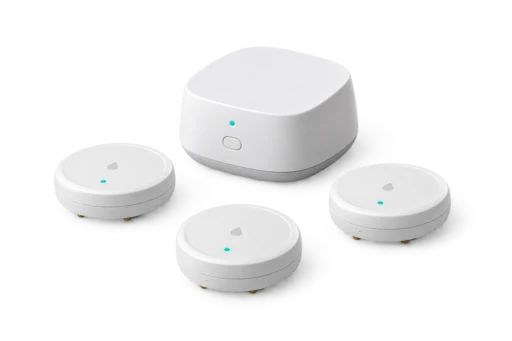
Disclosure: As an Amazon Associate, we earn from qualifying purchases. The savings from catching one hidden leak can pay for the unit many times over.
What to Do If You’ve Tried Everything and the Bill Is Still High
If you’ve worked through the actions above and your usage hasn’t dropped:
- Check the billing period length. A 33-day billing period will always show more usage than a 28-day one. Compare daily consumption (usage ÷ days). See billing cycles explained.
- Check for a meter error. Read your meter yourself and compare it to the billed reading. Report a discrepancy to your utility.
- Check rate schedule changes. Did the utility raise rates mid-cycle? Look for a notice on your bill.
- Look for a sewer charge mismatch. If your sewer is based on summer consumption without winter averaging, switching to winter-averaged billing (where available) could lower your sewer charge. See sewer charges.
- Call the utility. Ask for a bill review or a usage audit. Some utilities offer free home water audits.
This guide is part of the Lower Your Bills hub and the Water Explained hub. Leak-response gear is ranked in where to place water leak sensors.
Sources
- EPA WaterSense: Start Saving — comprehensive guide to household water savings, including behavior changes, fixture upgrades, and outdoor efficiency tips. The $500/year retrofit savings figure is from this page.
- EPA WaterSense: Understanding Your Water Bill — explains usage measurement (CCF, gallons), rate structures, and how to read your statement.
- Department of Energy: Home Upgrades — confirms water heating accounts for ~20% of home energy use; references thermostat setback savings up to 10% annually.