Utility Bill Taxes, Fees, and Franchise Charges Explained
Your utility bill includes more than just energy charges. Learn what taxes, regulatory fees, franchise fees, and surcharges appear on your bill and what they fund.
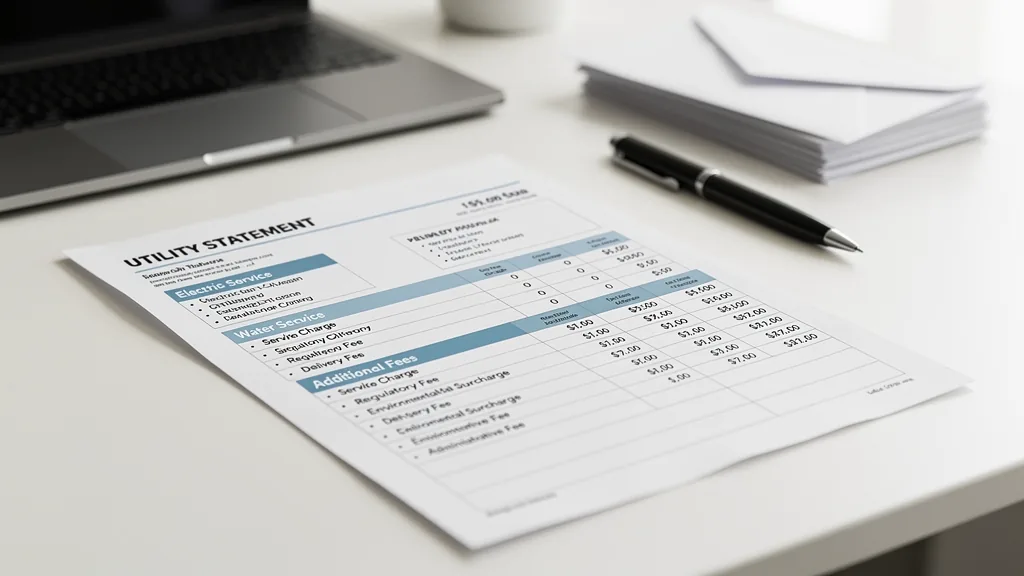
You have already decoded the delivery and supply charges on your utility bill, but scroll down further and you will find a section labeled “Taxes and Surcharges” or “Governmental Charges” that adds another 5% to 15% to your total. These line items — franchise fees, utility taxes, regulatory surcharges, and municipal assessments — are often opaque, confusing, and seemingly impossible to dispute. Here is what each one actually funds, how much they typically cost, and why they appear on your bill.
Table of Contents
- Overview of Taxes and Fees on Utility Bills
- What Is a Franchise Fee on a Utility Bill?
- State and Local Utility Taxes
- Gross Receipts Tax
- Federal and State Regulatory Surcharges
- Public Benefits Charges
- Renewable Energy Surcharges
- Nuclear Decommissioning Charges
- Universal Service and Low-Income Surcharges
- How Much Do Taxes and Fees Add to Your Bill?
- Are Any of These Charges Deductible on Your Taxes?
- Frequently Asked Questions
Overview of Taxes and Fees on Utility Bills
Utility bills across the United States include a combination of taxes, fees, and surcharges imposed by federal, state, county, and municipal governments, as well as regulatory bodies and the utilities themselves. These charges are not optional, not negotiable, and not controlled by the utility — they are mandated by law and approved through legislative or regulatory processes.
The total tax and fee burden on a typical U.S. residential utility bill ranges from 5% to 15% of the total, depending on the state and locality. Some areas, like parts of Pennsylvania and New York, can exceed 15% when multiple overlapping charges are combined.
These charges are generally calculated in one of three ways:
- Percentage of total charges: Most taxes and franchise fees are calculated as a percentage of your delivery and supply charges combined.
- Per-kWh or per-therm surcharges: Regulatory and public benefit charges are often based on consumption volume.
- Flat monthly fees: Some charges, like nuclear decommissioning fees, are fixed amounts regardless of usage.
What Is a Franchise Fee on a Utility Bill?
A franchise fee is the single most common local charge on utility bills, appearing in virtually every U.S. municipality. The fee represents the payment a utility makes to a city or county for the right to use public rights-of-way — streets, sidewalks, and alleys — to run their wires, pipes, and other infrastructure.
Franchise fees are authorized by state law and negotiated through franchise agreements between the utility and the local government. They typically range from 2% to 6% of gross utility revenues. On your bill, this translates to roughly $2 to $15 per month depending on your total usage and the local rate.
Common bill line items that represent franchise fees include:
- “City Franchise Fee” or “Municipal Franchise Charge”
- “Public Right-of-Way Fee”
- “Franchise Tax” or “Franchise Assessment”
In some states, franchise fees are explicitly labeled as taxes and appear in the tax section of your bill. In others, they are listed as surcharges or governmental charges. Regardless of the label, the function is the same: the utility collects the fee from customers and remits it to the local government.
Franchise fees fund municipal services indirectly — they are general revenue that the city can spend on any public purpose, including road maintenance, parks, police, and fire services. They are not earmarked specifically for utility infrastructure or energy programs.
State and Local Utility Taxes
Beyond franchise fees, many states and localities impose additional taxes on utility service:
State Utility Gross Receipts Tax: Some states tax the utility’s total revenue from service. The utility passes this cost through to customers as a surcharge. Examples include Pennsylvania’s Gross Receipts Tax (approximately 4.8% on electric) and Ohio’s KWH Tax.
State Sales Tax on Utility Service: Most states exempt residential electricity and natural gas from sales tax, but some do not. In Texas, residential electricity is exempt from state sales tax, but in some municipalities, local sales taxes apply. In Nebraska, electricity is subject to state sales tax.
Local Utility Users Tax (UUT): Some California cities impose a utility users tax of 1% to 11% on electric, gas, water, and telephone charges. Los Angeles, for example, charges a UUT of approximately 9.5% on electric service, which adds $10–$15 to a typical residential bill.
Municipal Occupation Tax: Some cities in Pennsylvania and Ohio impose an occupation tax on utilities operating within their borders, which is passed through as a line-item charge.
Gross Receipts Tax
A gross receipts tax (GRT) is a state-level tax on the total revenue of a utility, rather than on its profits. Unlike a corporate income tax, a GRT is charged regardless of whether the utility is profitable. Utilities pass this cost to customers through a dedicated surcharge.
Pennsylvania’s electric Gross Receipts Tax is one of the most significant in the nation at approximately 4.8%. For a customer with a $150 monthly electric bill, this adds about $7.20. West Virginia, Virginia, and Maryland also impose gross receipts taxes on utilities, though at lower rates (typically 1% to 3%).
Federal and State Regulatory Surcharges
Regulatory bodies charge utilities for their oversight activities, and utilities pass these costs to customers:
FERC Charges: The Federal Energy Regulatory Commission charges fees to fund its operations. These appear on your bill as “FERC” or “FERC-Regulated Charges” and are typically less than $0.50 per month for residential customers.
State PUC Assessments: State public utility commissions charge utilities annual assessments to fund their regulatory activities. These appear as “PUC Assessment” or “Regulatory Charge” and typically add $0.25 to $1.00 per month.
Nuclear Regulatory Commission (NRC) Fees: Customers served by nuclear power plants may see an NRC fee that funds the federal oversight of nuclear safety. This is typically a tiny per-kWh charge, under $0.001/kWh.
Public Benefits Charges
Public benefits charges fund statewide programs that serve the public interest. These are authorized by state legislation and are administered by the utility or a designated state agency. Common programs funded by public benefits charges include:
- Low-income energy assistance: Programs like LIHEAP and state-level bill payment assistance for income-qualified households.
- Weatherization programs: Free energy efficiency upgrades (insulation, air sealing, efficient appliances) for low-income homeowners.
- Energy efficiency rebates: Incentives for all customers to purchase efficient appliances, lighting, and HVAC equipment.
- Demand response programs: Compensation for customers who reduce usage during peak demand events.
Public benefits charges typically range from $0.005 to $0.03 per kWh, adding $2 to $12 per month to a typical residential bill. California’s Public Purpose Programs charge is one of the highest in the nation, contributing to the state’s elevated per-kWh rates.
Renewable Energy Surcharges
Many states with Renewable Portfolio Standards (RPS) impose surcharges to fund the development of renewable energy resources. These surcharges may be called:
- “Renewable Energy Charge” or “RPS Charge”
- “Clean Energy Fund Surcharge”
- “Renewable Energy Certificate (REC) Cost Recovery”
The cost varies significantly by state. Illinois’s renewable energy surcharge adds approximately $0.003/kWh. Pennsylvania’s Alternative Energy Portfolio Standard surcharge is about $0.0006/kWh. Some states, like Texas, do not impose a statewide renewable surcharge, though individual retail providers may include REC costs in their supply rates.
Nuclear Decommissioning Charges
Utilities that own or purchase power from nuclear plants must set aside funds for decommissioning — the process of safely shutting down and dismantling a nuclear facility when it reaches the end of its operational life. Decommissioning a single nuclear plant can cost $500 million to $1 billion or more.
These charges appear on your bill as:
- “Decommissioning Charge”
- “Nuclear Cost Recovery Surcharge”
- “Plant Decommissioning Cost”
The charge is typically small — $0.50 to $3.00 per month for residential customers — but it can be higher in states with significant nuclear generation like Illinois, Pennsylvania, New York, and South Carolina.
Universal Service and Low-Income Surcharges
Most states fund low-income utility assistance through surcharges on all customers’ bills. These are separate from the federal LIHEAP program and are administered at the state level:
- California: The California Alternate Rates for Energy (CARE) program is funded through ratepayer surcharges.
- New York: The Low-Income Home Energy Assistance Program (LIHEAP) and Energy Affordability Policy are partially funded through utility surcharges.
- Pennsylvania: The Low-Income Usage Reduction Program (LIURP) and Customer Assistance Program (CAP) are funded by customer surcharges.
- Texas: The System Benefit Fund (now largely defunded) previously provided low-income assistance through a per-kWh surcharge.
These charges typically add $0.50 to $2.00 per month for the average residential customer.
How Much Do Taxes and Fees Add to Your Bill?
Here is a breakdown of the total tax and fee burden by region, based on 2025–2026 utility rate data:
| Region | Typical Tax/Fee Range | Common Charges |
|---|---|---|
| Northeast (NY, MA, CT, PA) | 8% – 15% | Franchise fee, GRT, public benefits, RPS surcharge |
| Southeast (GA, FL, AL, SC) | 5% – 8% | Franchise fee, gross receipts tax, nuclear decommissioning |
| Midwest (IL, OH, MI, IN) | 5% – 10% | Franchise fee, utility tax, RPS surcharge, PUC assessment |
| Southwest (TX, AZ, NM) | 3% – 8% | Franchise fee (TX exempt from state tax), PUC assessment |
| West Coast (CA, OR, WA) | 6% – 12% | City utility tax, public benefits, RPS, nuclear decommissioning |
For a household paying $150 per month for electricity, taxes and fees typically add $8 to $22 to the total bill. For households with higher consumption — $250 or more — the percentage stays the same but the dollar amount rises proportionally.
Are Any of These Charges Deductible on Your Taxes?
Under current IRS rules (as of 2026), utility taxes and fees have limited deductibility:
- State and local taxes (SALT): Franchise fees and utility taxes may be deductible as part of your SALT deduction if you itemize, subject to the $10,000 SALT cap.
- Home office deduction: If you deduct home office expenses, you can include a proportional share of your utility costs (including taxes and fees) as part of your home office utility expense.
- Rental property: Landlords can deduct utility taxes and fees as part of the utility expenses for rental properties.
Consult a tax professional for guidance specific to your situation, as state and local rules vary.
Frequently Asked Questions
What is a franchise fee on my electric bill?
A franchise fee is a charge (typically 2% to 6%) that your utility pays to your local government for the right to run wires and pipes through public streets and rights-of-way. The utility collects this fee from customers and remits it to the municipality, where it becomes general revenue.
Can I dispute taxes or fees on my utility bill?
You cannot dispute legally mandated taxes, franchise fees, or regulatory surcharges on an individual basis. These charges are set by legislation or regulatory order. You can, however, participate in public comment periods when your state PUC reviews rate cases or when your city renegotiates franchise agreements.
Why does my bill show both a franchise fee and a utility tax?
These are different charges imposed by different levels of government. The franchise fee is a local (municipal or county) charge for right-of-way access. The utility tax is a state-level charge on the utility’s gross revenues. Both are common and typically both appear on the same bill.
Do solar customers pay these taxes and fees?
Yes. In most states, taxes, franchise fees, and regulatory surcharges apply to all customers regardless of whether they have solar panels. Some charges are calculated on delivered energy (meaning solar offsets reduce them), while others are calculated on total service charges or are flat monthly fees that apply regardless of usage.
Why is my total tax percentage different from my neighbor’s?
Tax rates can vary by municipality within the same utility service territory. Different cities impose different franchise fee rates, utility users taxes, or municipal assessments. If you and your neighbor live in different incorporated areas but are served by the same utility, your tax line items will differ.