Quick Answer
The billing period is the service-date range printed on your statement; it is not necessarily a calendar month. Use the exact account dates, number of billing days, meter-read status, usage unit, and rate-plan version when comparing bills. Do not assume a universal billing frequency, due-date window, route process, or adjustment rule.
Seeing a period that runs 27–35 days, or a start or end date shifted a day or three from last month, is routine — the sections below explain why, and how to check whether anything actually changed.

Con Edison’s bill FAQ notes that account holders can review an energy-bill breakdown and a monthly-usage chart through its account system; use the equivalent bill guide from your own provider.[1]
Next step: If your bill uses a longer billing period, read how to read your electric bill or gas bill to check each line item, then see the electric bill breakdown for a full charge-by-charge guide. For help with a surprise spike, troubleshoot with why is my electric bill so high.
Why Cycle Lengths Vary
Your billing cycle’s length depends on several factors that have nothing to do with the calendar month.

Meter-Read Schedules
Your utility reads meters on a route schedule, not on the first or last day of each month. Routes are organized by geography; an entire neighborhood may be read on the same weekday. The billing period runs from the previous read date to the current read date, which can be 27–35 days.
Weekend and Holiday Shifts
If your scheduled read date falls on a weekend or federal holiday, the actual read happens the preceding or following business day. This shifts the billing period start or end by 1–3 days. Two consecutive bills can have different day counts simply because one fell after a holiday.
Seasonal Scheduling
Many utilities adjust route staffing during peak summer or winter seasons, which can stretch or compress routes. Seasonal variation of 3–6 days across the year is normal.
Utility-Specific Cycle Days
Some utilities group accounts by billing cycle day (e.g., A-cycle: billed 1st–15th; B-cycle: 16th–month-end). These cycles are fixed and produce consistent billing periods that still may not align with calendar months.
The Long-vs-Short-Month Bill Math
When one billing period has more days than another, the total bill will differ even if you used the same amount of energy or water each day. Always compare average daily usage, not the raw monthly total.
Worked Example

| Bill | Service Period | Days | kWh Used | Raw Total | Avg kWh/Day |
|---|---|---|---|---|---|
| January | Jan 10 – Feb 7 | 28 | 840 | $130.20 | 30.0 |
| February | Feb 7 – Mar 12 | 33 | 990 | $153.45 | 30.0 |
Though the February bill shows $23.25 more, the daily usage is identical. The increase is entirely from the longer billing period. To see whether your usage actually changed:
- Divide billed usage by the number of days in the service period.
- Compare that daily average across two or three consecutive bills.
- If the daily average is flat, the bill difference is just a period-length artifact.
One variant of this that catches many households: the first or last bill of a lease or ownership, which often covers a partial period. See how partial periods on first or final bills are prorated.
Formula: Average daily usage = Total billed usage ÷ Number of billing days.
Plug in your own numbers when checking a pair of bills:
your kWh ÷ your billing days = your daily average
repeat for the second bill, then compare the two daily averages
Estimated-vs-Actual Read Interaction
Utilities may estimate a reading when the meter cannot be accessed (locked gate, dog, weather). An estimated read uses historical usage data to project the current reading.
| Read Status | What It Means | Effect on Bill |
|---|---|---|
| Actual | A utility worker physically read the meter on the scheduled date. | Most accurate; your bill reflects true usage. |
| Estimated | The meter was not read; the utility calculated usage based on prior periods. | May over- or under-bill; corrected when the next actual read occurs. |
| Customer-submitted | You provided the reading via phone, app, or web portal. | Useful to avoid estimates; verify the provider accepts self-reads. |
| Adjusted | A previously estimated bill was corrected after an actual meter reading. | Usually appears as a credit or additional charge on the current statement. |
How Estimated Reads Affect Your Bill
If your Jan–Feb bill was estimated at 28 days and your Feb–Mar bill is actual at 33 days, both the usage and the rate-tier placement may catch up at once. This can produce a lumpy bill that looks like a usage spike but is really a correction.

Action: Look for the words “estimated,” “actual,” or a small asterisk next to the meter reading on your statement. Con Edison explains that a customer can submit a meter reading to avoid an estimated bill when a meter reader misses a visit.[2] Your provider may use different terms and rules, so verify them from its current bill guide.
Two follow-ups worth reading: how estimated reads and true-ups work, and — if an estimate correction has just landed on your bill — why your bill changed when usage looks the same.
How to Check Your Cycle Dates
You don’t need to wait for the next statement. Most utilities publish your billing cycle schedule online or in the account portal.
| Method | How |
|---|---|
| Online account portal | Log in to your utility account. Look for “My Billing Cycle,” “Service Dates,” or “Billing Schedule.” |
| Previous bill | Your current statement lists the previous and next read dates in the meter-info section. |
| Customer service call | Ask: “What is my meter-read date each cycle? How many billing cycles per year?” |
| Provider’s website | Some utilities publish the meter-read route calendar by ZIP code or county. |
Knowing your cycle dates lets you anticipate bill arrival, spot period-length shifts, and submit a self-read before the scheduled date if you’re leaving town or want to avoid estimates.
Record the Statement Details
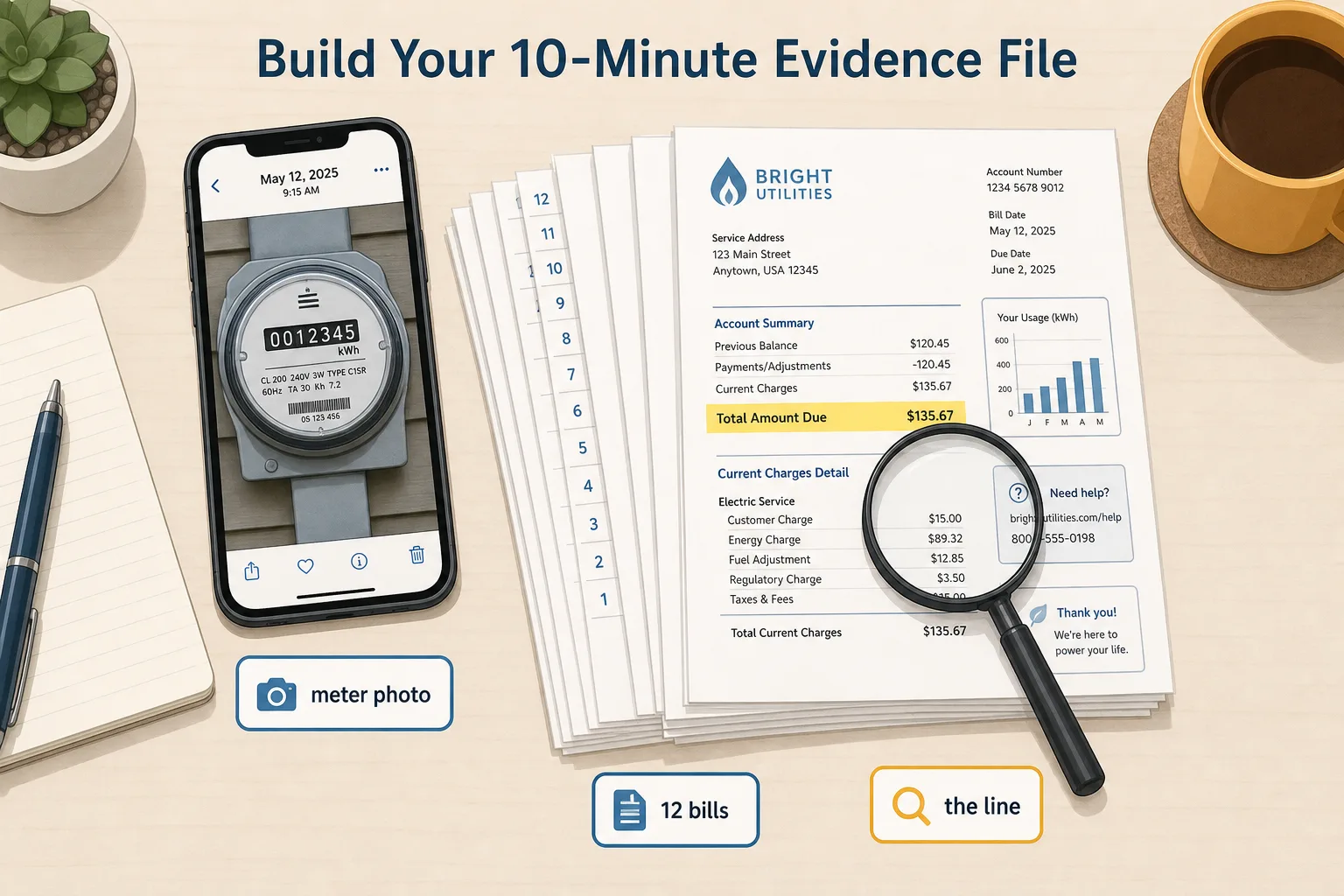
For the current bill and a comparable prior statement, record:
| Detail | What to verify |
|---|---|
| Service period | Start date, end date, and total billing days |
| Statement and due date | Dates printed by the provider |
| Meter information | Prior/current reading, unit, and actual or estimated status |
| Usage | Billed quantity and any correction or adjustment |
| Rate plan | Tariff, service class, and effective date |
| Charges | Usage, fixed, rider, tax, credit, and one-time items |
If the billing periods differ, compare the underlying service dates and all rates before deciding why the amount due changed. To map those charges once you have the dates straight, keep the electric bill breakdown charge categories handy while you record them.
Compare Bills Like With Like
Use a prior bill with a similar season only as a starting point. When you compare two statements:
- Match the billing-day counts first — a 33-day period against a 28-day period is not an apples-to-apples comparison.
- Confirm both bills use the same rate schedule, usage unit, and meter status (actual vs. estimated).
- Include credits and one-time items in the comparison, since neither shows up in the daily-average math.
- A longer or shorter period can change the total amount due without identifying the underlying reason for any change in daily use or rate.
EIA data shows the average US residential customer uses roughly 899 kWh per month, or about 29.6 kWh per day.[3] If your daily average is near that figure, a longer billing period will naturally produce a higher total. And if the daily averages match but the totals do not, check whether a minimum charge keeps your bill from dropping as low as the raw math suggests.
Is this normal, or worth a second look?
Billing periods rarely match calendar months, and most differences between two bills are routine. Use this gate before worrying:
| What you see | Verdict | Why |
|---|---|---|
| Period runs 27–35 days | Normal | Route-based meter reads set period length. |
| Start or end date shifted 1–3 days vs. last month | Normal | Weekend and holiday read-date shifts. |
| Period length drifts 3–6 days across seasons | Normal | Seasonal route scheduling. |
| One bill jumps, then the next corrects it | Normal | An estimate corrected by the next actual read. |
| Two bills differ in total while the daily average is flat | Second look | The difference is rate, fees, or read status — not usage. |
| A charge line appears twice, or a promised credit never lands | Second look | Duplication and corrections that never land are dispute territory. |
If a second-look row matches what you see, the next section gives you the questions that get a real answer.
Questions for the Provider
- What dates and reading status define this billing period?
- How was billed usage calculated from the meter information?
- Which current tariff and rate period apply?
- Does the statement include an estimate correction, credit, or one-time item?
- What is the provider’s process for a reading or billing-period review?
If the answers leave money still unexplained, the next move is how to request a billing review, which walks the formal dispute path step by step.
Can my billing date change?
Why do two consecutive bills have different day counts?
How do I know if my bill was estimated?
What if the math still looks wrong after checking everything above?
Sources
- Con Edison: Understanding Your Bill FAQ — billing period, rate plan, and account detail guide.
- Con Edison: How to Read Your Electricity Meter — actual vs. estimated read explanation and self-submission process.
- U.S. Energy Information Administration: Frequently Asked Questions — average monthly residential electricity consumption (10,791 kWh/year ≈ 899 kWh/month).