Quick Answer
An estimated bill is a bill built from predicted usage instead of an actual meter read — utilities estimate when the meter reading can’t be obtained, and in Texas estimated reads cannot be used for more than three consecutive billing cycles [3]. Check the reading-type notation on your statement, compare the estimate against your meter, and submit a reading to trigger the correction. An estimate is a placeholder, not a final number — the next actual read trues the account up.
Why Utilities Estimate Instead of Reading Your Meter
A utility bills from a meter read; when it can’t get one, it estimates. Texas’s commission states the trigger plainly: a company may estimate bills “if actual meter readings cannot be obtained or if your REP does not receive meter readings from the Transmission and Distribution Utility” — and generally, estimated readings cannot happen more than three consecutive billing cycles [3].
Con Edison lists estimated bills among the reasons a bill can run higher than expected — a high bill may reflect that “the current or previous bills were estimated” rather than a real usage jump [1]. An estimate can overshoot or undershoot the month you actually had, so an estimate arriving with a surprising total is a reason to check the math, not panic.
Utilities publish trigger lists:
| Source | Published triggers for an estimate |
|---|---|
| Pend Oreille PUD, WA [5] | Power outages, severe weather, locked gates, delayed reads |
| National Grid, MA [7] | Extreme weather, temporary connection issues, software updates |
| NJ Division of Rate Counsel [9] | Bad weather; no one home for access |
The method: Pend Oreille PUD uses “historical usage from the same time period in the previous year” [5]; NJ’s Rate Counsel says gas estimates run “based on the weather and past usage” [9]. That’s your same-season history, sometimes weather-adjusted — it misses when habits change.
The true-up should be automatic. Pend Oreille PUD: “Once we receive a valid reading, we will ’true-up’ your account” — a credit if the estimate ran high, the shortfall billed next cycle if low [5]. Illustration with round numbers: last August was 600 kWh; you used 500 kWh this August, but the estimated bill charges 600. The next actual read comes in 100 kWh lighter, so the following bill shrinks by 100 — both bills together charge exactly what you used. The estimate changes the timing, not the total; a catch-up read can even masquerade as a usage spike with no behavior change.
Actual vs. Estimated: A Side-by-Side Example
This example is illustrative — it uses round numbers to show how the same rate produces different dollar totals from different day counts and read types; it is not a prediction for any specific bill.
| Actual read month | Estimated month | |
|---|---|---|
| Billing days | 30 | 33 |
| Meter read type | Actual | Estimated |
| Billed usage | 612 kWh | 671 kWh |
| Rate | 18.34¢/kWh | 18.34¢/kWh |
| Energy charge | $112.24 | $123.06 |
The higher estimated total is mostly days, not behavior: the estimated month covers 33 days at the same 18.34¢/kWh rate, so the extra $10.82 reflects three additional billing days plus the estimate’s method. The next actual read trues the account up to the meter, not the estimate [5].
Smart meters shrink the problem without erasing it. Duke Energy: its meters “are read automatically – not manually – so there’s no need to estimate bills when meters can’t be easily accessed” [8]. National Grid still warns AMI customers about “extreme weather, temporary connection issues, or software updates” [7]. Guardrail: AMI makes estimates uncommon, not impossible.
How to Spot an Estimate on Your Statement
Work down the bill:
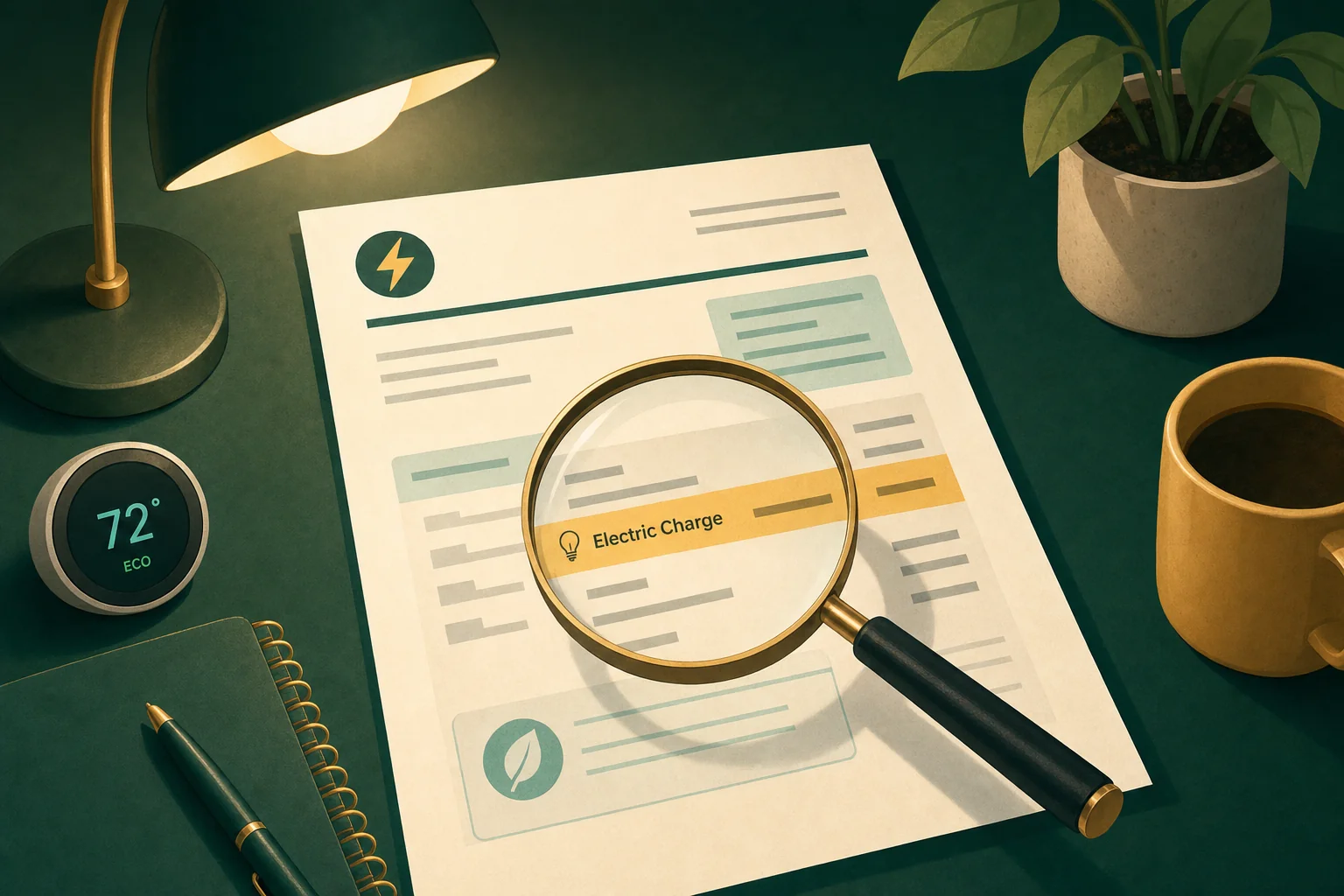
- Find the reading-type notation. Bills mark the current reading as actual, estimated (sometimes “E” or “EST”), or customer-read — see how to read your electric bill for where these codes sit. If the notation is missing, ask the utility what it was for this period.
- Check the billing period and days. Con Edison points customers to the bill’s period length — “more days in the billing period” is one of its listed reasons a bill jumps [1].
- Compare usage across months. Con Edison’s bar chart on the paper bill shows the past 13 months of usage [1]; an estimated bar that breaks the pattern deserves a question.
Force an Actual Read: The Verification Workflow
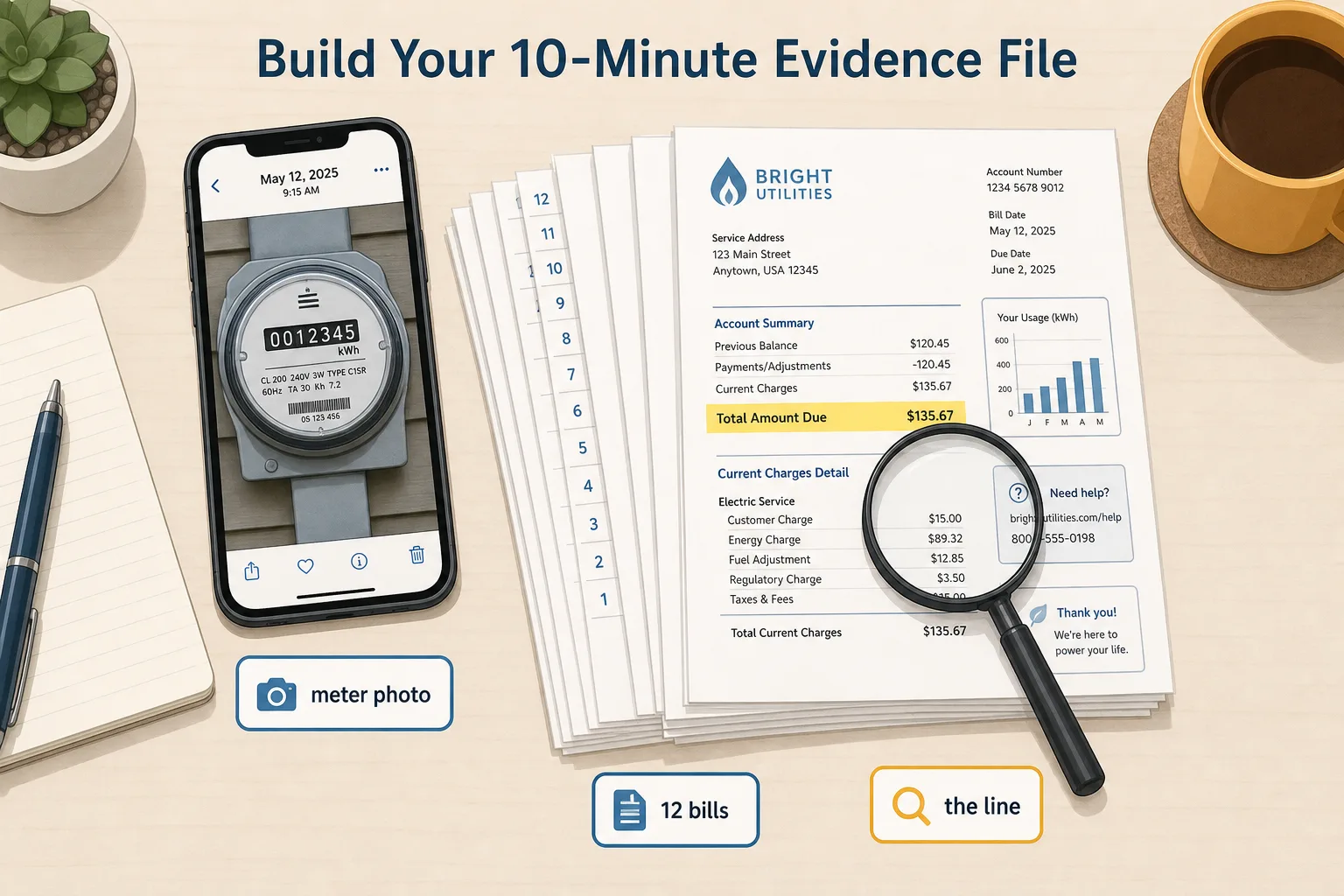
- Read your own meter. Con Edison publishes instructions for reading your electricity meter [2]. Your current read will sit a little above the bill’s figure because you’ve used more since the last read — that’s expected [1].
- Photograph the meter. Con Edison asks customers who question usage to take a photo of the meter and upload it through its site [1]. A dated photo is also your evidence if a review opens.
- Submit the reading and ask for a rebill. Submit the read through your utility’s channel and ask what correction, credit, or actual-read re-bill applies. Con Edison’s published practice: if you were billed for more energy than you used, the utility credits the account right away [1]. Channels differ: Con Edison takes readings online, by phone, or by email photo [2]; National Grid lists three “to avoid estimated reads”: email a photo, phone, or a manual-read appointment [6]. For meter-reading basics, see how to read your electric meter.
- Ask what broke the read chain. Meter access, a communication fault on a smart meter, or an internal error all have different fixes — ask which applies so the next bill is actual, not estimated again.
Texas protects this request: a REP may not disconnect service for non-payment of an estimated bill unless it’s part of a pre-approved meter-reading program or the utility couldn’t read the meter due to circumstances beyond its control [4]. So a disputed estimate is not a shutoff trigger while the reading itself is in question.
If the Estimate Is Wrong
Open a review with the utility-bill dispute process, armed with your meter photo and read. Keep the case number and the representative’s explanation in writing. Timing helps: Texas bars estimates for “more than three consecutive billing cycles” [3] — a fourth in a row is worth citing. If the corrected amount lands while you’re also carrying a past-due balance, dispute the estimate and set up a payment agreement on the undisputed part in the same conversation.
Estimates compound other bill puzzles: an estimated read followed by a catch-up actual read can look like a fuel or supply spike, and budget billing smooths the true-up over months instead of one bill. If a review ends with a service threat, the shutoff lifecycle guide covers your notice protections, and deposit demands can follow billing disputes on new accounts.
Why did my utility send an estimated bill?
How do I know if my bill is estimated or actual?
How do I get an actual meter reading instead of an estimate?
Sources
- Con Edison — Frequently Asked Questions: About Bills (retrieved 2026-08-29)
- Con Edison — How to Read Your Electricity Meter (retrieved 2026-08-29)
- Public Utility Commission of Texas — Electricity FAQs (retrieved 2026-08-29)
- Public Utility Commission of Texas — Know Your Rights (retrieved 2026-08-29)
- Pend Oreille Public Utility District (WA) — Estimated Meter Reads (retrieved 2026-08-29)
- National Grid — How to Provide a Meter Reading (Massachusetts) (retrieved 2026-08-29)
- National Grid — Smart Meters (Massachusetts) (retrieved 2026-08-29)
- Duke Energy — news release: smart meters for Kentucky customers (retrieved 2026-08-29)
- New Jersey Division of Rate Counsel — Understanding Your Natural Gas Bill (retrieved 2026-08-29)