Quick Answer
A kilowatt-hour (kWh) is a measure of electrical energy: one kilowatt used for one hour equals one kWh. The useful question for a bill is not whether a household matches a national average, but whether its kWh changed after accounting for billing days, weather, equipment, occupancy, and rate-plan changes.
EIA reports that electricity use varies widely across regions and housing types, so a national benchmark should not be treated as a personal target.[1]
The Definition, in One Table
| Term | What it measures | Plain-English meaning |
|---|---|---|
| Watt (W) | Power | How fast electricity is being used right now |
| Kilowatt (kW) | Power | 1,000 watts (a convenient larger unit) |
| Kilowatt-hour (kWh) | Energy | How much electricity was used over time |
kW is how fast; kWh is how much. Three devices, all consuming exactly 1 kWh: a 1,000-watt space heater for 1 hour, a 100-watt bulb for 10 hours, a 10-watt LED for 100 hours. A high-watt device can be cheap if it runs briefly; a small device adds up if it runs all day.
The one-line formula: (watts ÷ 1,000) × hours = kWh. A 1,500-watt heater for 3 hours is 4.5 kWh; multiply by your rate for cost. (Space heaters are the classic worked example — and they do not all cost the same to run: our space heater guide explains why “efficient” marketing rarely changes the math.)
Read kWh in Context
For each bill, record — and if you need help finding these on your statement, see how to read your electric bill:
- Total kWh and the number of billed days.
- Whether the meter reading was actual or estimated.
- The rate-plan name and each usage-related charge.
- Major changes in heating, cooling, occupancy, or equipment.
- The same information from a similar earlier period.
Compare daily kWh when billing periods differ. Then compare the price and non-usage charges separately; the dollar total alone cannot show whether usage changed.
Top Household Loads: Typical Annual kWh

The table below lists the most common electric loads in a U.S. home. The figures are drawn from the EIA’s 2020 Residential Energy Consumption Survey (RECS) and DOE’s appliance-estimating resources. Actual usage for your specific unit depends on model, age, settings, and how often it runs.[3][4]
| Appliance | Typical Annual kWh | Daily Equivalent (approx.) |
|---|---|---|
| Central air conditioner (3-ton, SEER 14–16) | 3,000–5,000 | 8–14 kWh/day in cooling season |
| Electric water heater (40–50 gal, standard) | 2,500–4,500 | 7–12 kWh/day |
| Electric clothes dryer | 600–1,000 | 1.6–2.7 kWh per load |
| Refrigerator (20–22 cu ft, top-freezer, 2010–2020 vintage) | 500–750 | 1.4–2.1 kWh/day |
| Electric oven/range (self-cleaning, moderate use) | 250–500 | 0.7–1.4 kWh/day |
| Dishwasher (standard, heated dry) | 200–350 | 0.5–1.0 kWh per cycle |
| Clothes washer (standard, warm wash) | 150–300 | 0.4–0.8 kWh per load |
| Television (55–75 LED, 4–6 hr/day) | 100–250 | 0.3–0.7 kWh/day |
| LED lighting (entire home, 12–18 bulbs, 4 hr/day average) | 100–250 | 0.3–0.7 kWh/day |
| Desktop computer + monitor (4–6 hr/day) | 80–200 | 0.2–0.5 kWh/day |
Range reflects typical household patterns. A high-efficiency model will sit at the lower end; an older or larger unit at the upper end. RECS end-use averages (CE5.3a) provide national household-level estimates; DOE’s appliance-energy guide offers unit-level estimates.[4]
The Cost Equation: What 18.34¢/kWh Means for Your Bill
At the national average residential rate of 18.34¢/kWh (EIA June 2026), the cost of running an appliance works out to:
Measures voltage, current, watts, and cumulative kWh for any 120V appliance. Plug it between the wall and your device, then read the display after a typical cycle or 24 hours. 0.2% accuracy.
Check price on Amazon As an Amazon Associate we earn from qualifying purchases. Price & availability shown on Amazon.com.| Appliance | Annual kWh (mid-range) | Annual Cost at 18.34¢/kWh |
|---|---|---|
| Central AC (3-ton) | 4,000 | $734 |
| Electric water heater | 3,500 | $642 |
| Electric dryer | 800 | $147 |
| Refrigerator | 625 | $115 |
| Oven/range | 375 | $69 |
| Dishwasher | 275 | $50 |
| Clothes washer | 225 | $41 |
| Television | 175 | $32 |
| LED lighting | 175 | $32 |
| Desktop computer | 140 | $26 |
Use the formula with your own rate:
Annual cost = appliance kWh/year × your rate ($/kWh)
If your rate is 14¢/kWh, the same 4,000-kWh AC costs $560; if it is 28¢/kWh, it costs $1,120. Rate matters.
What Moves Your Bill More: Rate or Usage?
A rate increase of 1¢/kWh adds about $108/year for the average 899-kWh/month household. A usage increase of 100 kWh/month (one additional dryer load every four days) adds about $220/year at the current national average. Both matter, but here is the practical frame:
- Rate is mostly out of your control. Supply, delivery, and regulatory charges change by utility and season. You can switch rate plans (flat, tiered, time-of-use) if your usage pattern fits a cheaper structure. See Time-of-Use Electricity Rates for details.
- Usage is where you have leverage. Adjusting thermostat settings, replacing old appliances, sealing air leaks, and shifting large loads to off-peak hours directly reduce the kWh multiplied by every rate component.
A 10% usage reduction saves the same dollar amount whether your rate is 12¢/kWh or 28¢/kWh — the percentage is constant, the absolute savings grow with your rate.
Measure Your Own Appliances
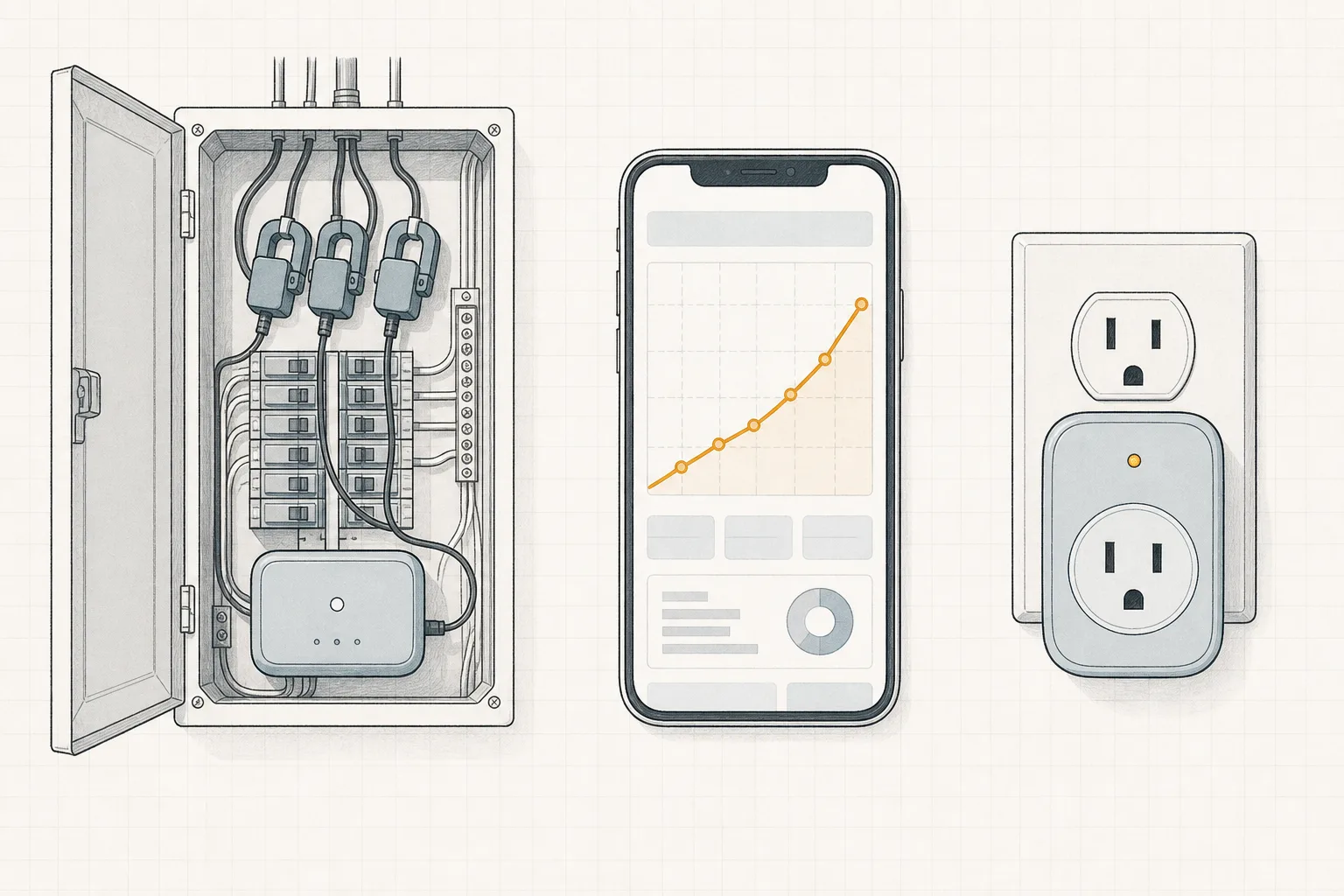
Generic tables are a starting point, but your actual appliances may differ. A plugin energy monitor like the Measures voltage, current, watts, and cumulative kWh for any 120V appliance. Plug it between the wall and your device, then read the display after a typical cycle or 24 hours. 0.2% accuracy.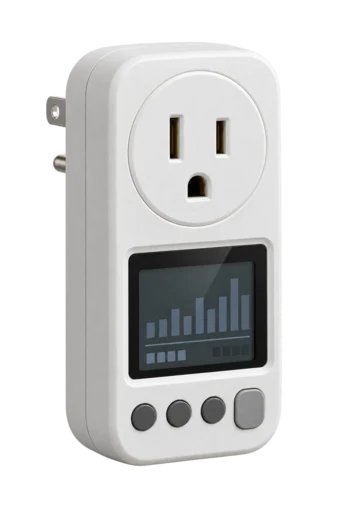
Run a load or let it log a week, then record the kWh. Divide by the number of days or cycles to estimate monthly or annual cost using the formula above.
From Meter Reading to kWh
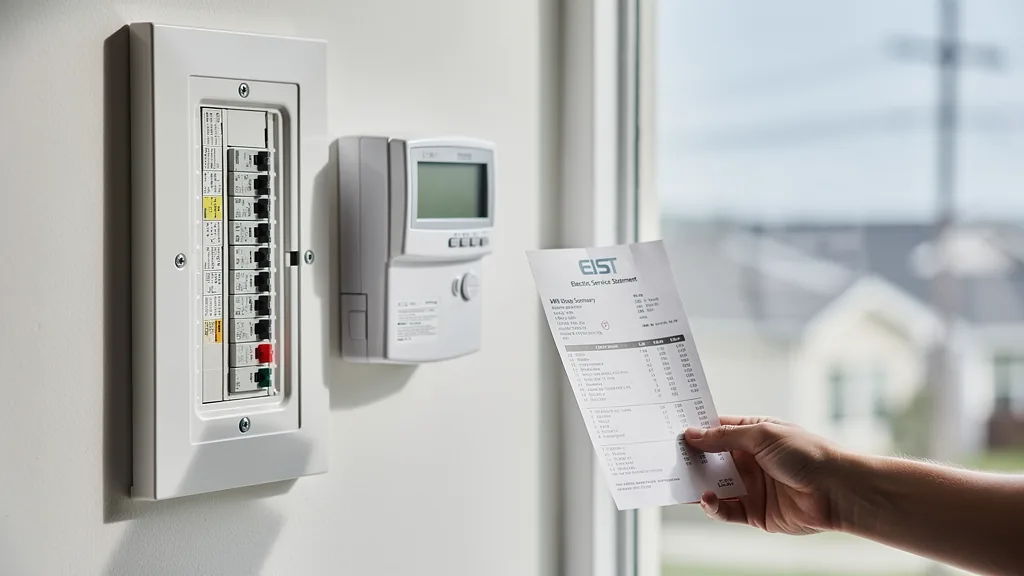
Your bill starts with the meter. If you want to verify your usage directly, take a reading at the start and end of a billing period.
For a full walkthrough of analog dial, digital, and smart-meter reading — including how to handle the tricky alternating dials — see our detailed guide: How to Read an Electric Meter (Dial & Digital Guide).
The short version:
- Record the complete number shown (digits left to right).
- Subtract the earlier reading from the later reading.
- The difference is the kWh consumed between those two readings.
- Compare that figure to the kWh line on your bill for the same period.
If the bill shows a different number, check whether the reading was estimated — it will usually say so on the statement.
National Data Is Context, Not a Bill Calculator
EIA’s published residential data can provide broad context. For example, EIA reports that the average residential electric-utility customer purchased 10,791 kWh in 2022, or about 899 kWh/month; as of 2026 that remains EIA’s latest published average.[2]
That figure does not determine whether an individual bill is correct. Your own tariff, dwelling, equipment, climate, and billing period control the account result.
When kWh Changes Suddenly
Start by checking billing days and read status. Then review changes in weather, heating or cooling, new equipment, charging, occupancy, or continuous water and HVAC operation. If the usage or bill still does not make sense, ask the utility for interval data or an explanation of the meter-read and rate-plan details.
The instruments that measure the kWh this article explains are compared in Kill A Watt alternatives.
Sources
- U.S. Energy Information Administration: Electricity Use in Homes — household-use context and regional/housing variation.
- U.S. Energy Information Administration FAQ: How Much Electricity Does an American Home Use? — 2022 residential-customer kWh context.
- EIA Residential Energy Consumption Survey (RECS) 2020 — Consumption & Expenditures Tables CE5.3a/CE5.3b — detailed end-use electricity consumption averages.
- U.S. Department of Energy: Estimating Appliance and Home Electronic Energy Use — appliance-level estimation guide.
- EIA Electricity Monthly Update, June 2026 — residential average revenue per kWh figure of 18.34¢/kWh (retrieved 2026-08-28).
- U.S. Department of Energy Better Buildings: Understanding Your Utility Bill — Electricity — meter-reading guidance.