Quick Answer
A quoted energy price is not the same as the final amount due. A utility statement can include usage-based charges, customer or service charges, delivery-related charges, taxes, riders, credits, and one-time event fees. The only reliable way to understand a charge is to read the description on your bill, the applicable tariff or rate schedule, and the state or local rule that authorizes it.
This page is the launching pad for the site’s fee-explainers: use the table below to identify a charge, then follow the linked explainer for the full review process, the questions to ask your provider, and the documents to keep.

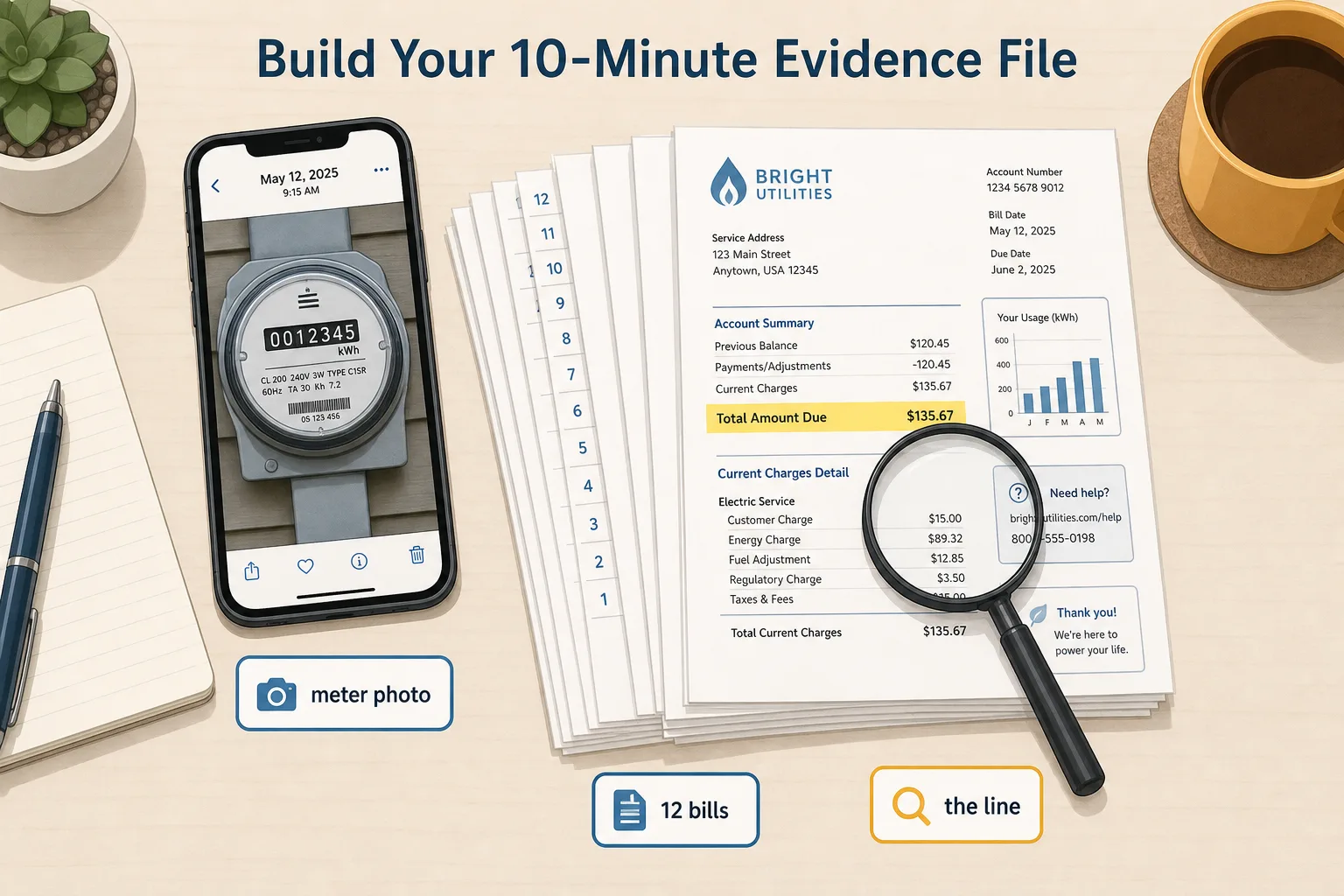
A Bill Review Process
- Identify the billing period and total usage.
- Separate usage-based charges from fixed, one-time, and policy-driven items.
- Compare the same categories with a similar prior billing period.
- Read notices, footnotes, and the rate-plan name on the statement.
- For anything unexplained, ask the utility for the tariff, rate schedule, or an itemized breakdown.
The Charges You May See

Seven categories of charges appear across U.S. residential electricity, gas, and water bills; each row links to the site’s full explainer. The rows summarize what published sources describe (DOE rate-design, Con Edison bill-guide, and CFPB consumer material) and tell you what to look for on your own statement.
| Charge | What it is | How it typically appears | How to spot it on your bill | Read more |
|---|---|---|---|---|
| Customer charge (a.k.a. basic service charge, service charge, monthly minimum) | A fixed monthly amount for being connected to the system, regardless of how much energy or water you used. DOE rate-design material describes residential rates as historically built around a fixed customer charge plus a volumetric rate.1 | Flat dollar amount billed every cycle, even on near-zero usage months. | A line that does not vary with kWh, therms, CCF, or gallons. | Customer charge explainer |
| Transmission / delivery rider (a.k.a. transmission surcharge, distribution charge, delivery service charge) | A usage-based charge that covers the wires, pipes, substations, and the people who maintain them — Con Edison describes delivery as the part of the bill that funds this shared infrastructure.2 | A cents-per-kWh (or per-therm, per-CCF) line multiplied by your usage. May be split into “transmission” and “distribution” sub-rows on restructured bills. | Look for “delivery,” “distribution,” “transmission,” “grid charge,” “wires charge,” or your utility’s equivalent; multiply the rate by your usage and confirm against the line total. | Delivery vs supply charges |
| Fuel / energy adjustment charge (a.k.a. fuel cost recovery, energy cost adjustment, purchased-gas adjustment) | A usage-based charge that passes through the provider’s wholesale fuel or energy cost for the period. DOE electricity-bill material notes that consumption charges can appear under different names and are billed at a rate determined by a contract.3 | Cents-per-kWh (or per-therm) line that changes month-to-month as the underlying fuel or wholesale energy price changes. | Look for “fuel adjustment,” “fuel cost recovery,” “energy cost adjustment,” “purchased gas adjustment,” or “wholesale supply.” Compare this month’s rate with last month’s — a jump is normal; a structural change is not. | Fuel adjustment explainer |
| Surcharges, riders, and policy riders (environmental, renewable portfolio, energy efficiency, public benefits, system benefits charge) | Account-specific add-ons whose meaning, amount, purpose, and effective dates are defined in the tariff.3 | Varies — can be a flat per-bill amount, a cents-per-kWh rate, or a percentage of another charge. | Look for “rider,” “surcharge,” “environmental,” “renewable,” “energy efficiency,” “public benefits,” or “policy adjustment” — and read the tariff section that defines each one. | Surcharges and riders explainer · Taxes, fees, and franchise charges |
| Taxes and franchise / local-government charges | Federal, state, and local taxes on utility service; franchise fees paid to a city or county for the right to operate in that jurisdiction; gross-receipts taxes. Their names, rates, and legal basis vary by jurisdiction.4 | Either a percentage of another line (subtotal, delivery, or full bill) or a flat per-bill amount, depending on the local rule. May be lumped into a single “taxes” line or split into “state tax,” “city tax,” “franchise fee,” “public utility tax.” | Identify the jurisdiction by ZIP code or service address; ask the utility which tax authority each line pays. Con Edison documents that local property taxes on energy infrastructure total more than $3.2 billion for customers in 2026, and notes that most of this is embedded in delivery rather than listed separately.2 | Taxes, fees, and franchise charges |
| Minimum bill / minimum charge | A floor below which the bill will not fall, even at zero usage.1 | When your usage × rate would compute to less than the minimum, the bill shows the minimum instead. | Look for “minimum charge,” “minimum bill,” “monthly floor,” or any line that does not move down with usage. Compare with the customer charge explainer to determine whether the two are the same item on your account. | Minimum bill explainer |
| One-time / event-driven fees (late fee, deposit, reconnection, service-start / connection) | Charges tied to a specific account event — paying past the due date, opening an account, restoring service after disconnection, or starting service at a new address. Amount, refundability, and conditions are defined in the provider’s tariff and account terms, not by a national rule.5 | Usually a single line item with a one-time dollar amount, sometimes grouped under “account activity,” “other charges,” or “adjustments.” | Look for “late fee,” “delinquent charge,” “deposit,” “connection fee,” “service start,” “reconnection,” or “restoration.” Confirm each one in writing against the provider’s tariff before paying. | Service-start / connection · Reconnection fee · Past-due balance |
Why This Page Does Not Give You a National Price Range
One caveat governs every fee page on this site: what a charge is called, how it is calculated, and what it can cost depend on the serving provider’s tariff, the service class on your account, and the state or local rules that apply.13245 Two customers on different utilities — or on different rate plans at the same utility — can see the same charge name at very different amounts: an $8 customer charge in one territory and $24 in another is normal, not an error. The table therefore describes each charge’s structure (flat dollar, per-kWh, percentage, one-time event) rather than a dollar range — confirm the amount on your bill against your utility’s current tariff, not against an article on the internet.
How to Use the Linked Explainers
Each linked explainer applies the bill review process above to a single charge: record the line with its tariff or rate-schedule reference, find the tariff or local rule that defines it, confirm the calculation type (fixed, usage-based, demand-based, percentage, credit, or one-time), compare with a similar prior billing period, and request the account-specific calculation from the provider before assuming the charge is wrong. The directory below lists every fee and bill-charge explainer on the site; pick the one that matches the line you are trying to read.
The Site’s Fee and Charge Explainer Directory
- Customer charge — the fixed monthly fee for being connected
- Fuel adjustment / fuel cost recovery — what passes through and what does not
- Surcharges and riders — how to read each one and what tariff section defines it
- Minimum bill / minimum charge — when a low-usage bill will not go low
- Delivery vs supply charges — the two halves of an electricity or gas bill
- Taxes, fees, and franchise charges — what each one funds and which authority sets it
- Service-start / connection charge — what you pay to open an account
- Reconnection fee — what it costs to restore service after a shutoff
- Past-due balance — what counts, what does not, and what the notice means
- Utility billing cycle — service dates, read dates, and proration
- Utility deposit — when one applies and how it is returned
If You Cannot Pay a Bill
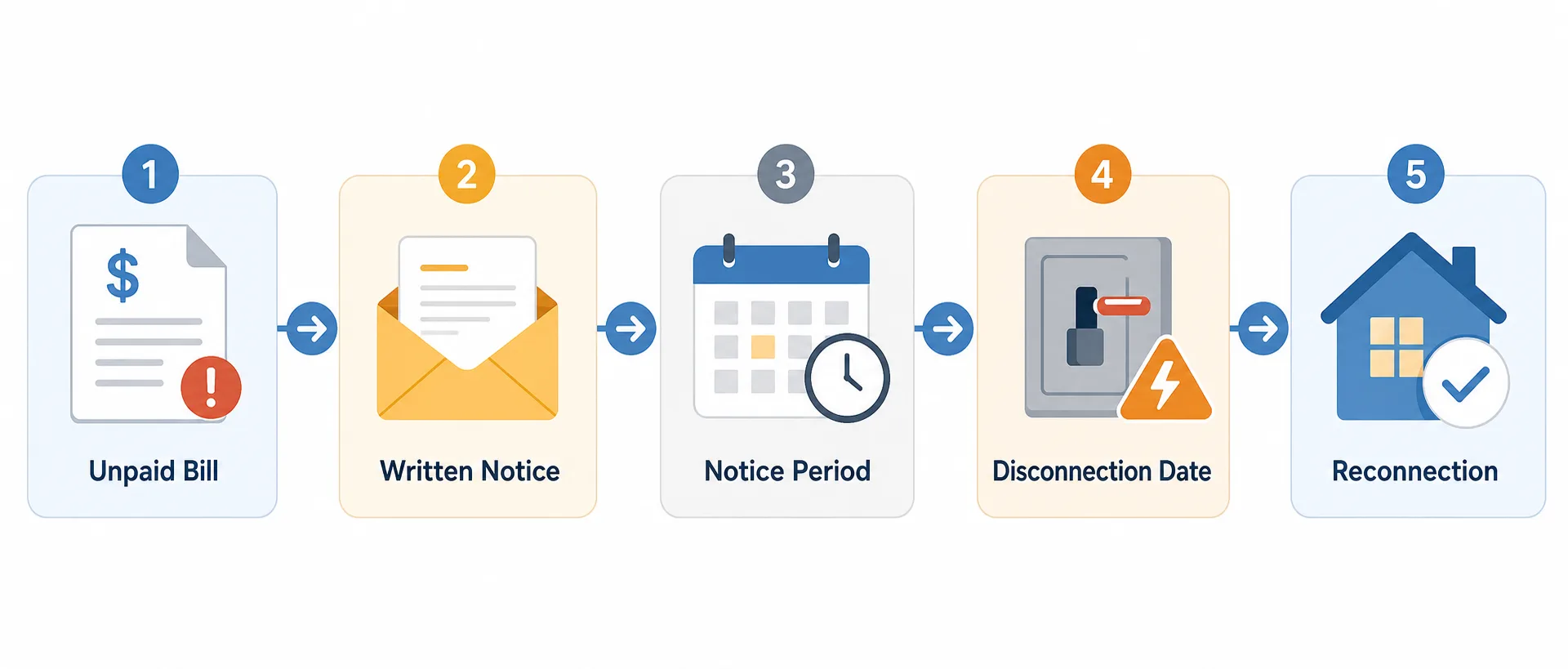
Ask the utility promptly about payment arrangements, assistance programs, and any available protections. The Consumer Financial Protection Bureau directs consumers seeking year-round utility-bill help to their local LIHEAP office or the National Energy Assistance Referral Hotline.5
Sources
- U.S. Energy Information Administration: Electricity Data
- U.S. Department of Energy: Understanding Your Electricity Bills (PDF)
- U.S. Department of Energy: Understanding Your Utility Bills — Electricity (PDF)
- Con Edison: How to Read Your Bill
- Con Edison: Market Supply Charge Calculator
- U.S. Department of Energy: Rate Design Primer (PDF)
- Consumer Financial Protection Bureau: Get help paying rent and bills
U.S. Department of Energy, Rate Design Primer (PDF). Notes that residential rates have historically included a fixed customer charge plus a volumetric component, but does not establish a national amount or rule. ↩︎ ↩︎ ↩︎
Con Edison, How to Read Your Bill. Notes that supply and delivery charges are separate categories; that “customers who use more pay more of these shared costs” of delivery; and that local property taxes on energy infrastructure make up nearly a quarter of the delivery charge. ↩︎ ↩︎ ↩︎
U.S. Department of Energy, Understanding Your Electricity Bills (PDF) and Understanding Your Utility Bills — Electricity (PDF). Notes that bills can be reproduced using the applicable rate structure and measured energy use and demand. ↩︎ ↩︎ ↩︎
Con Edison, Market Supply Charge. Documents supply charges as separate, per-kWh line items that vary by zone and service class. ↩︎ ↩︎
Consumer Financial Protection Bureau, Get help paying rent and bills. Notes that reconnection, deposit, and service-start charges are provider- and account-specific, and directs consumers with payment difficulty to local and state resources including LIHEAP. ↩︎ ↩︎ ↩︎